Are Politicians Ready to Stop Turning Back the Clock?

[Essay]

The Politics of Nostalgia 

In what time would you prefer to live? The question is such a commonly considered hypothetical that how you answer it likely provides a good deal of insight into both your character and your politics. Answers typically tend toward nostalgia for an idealized past — sometimes drawn from lived experiences, but more often inspired by television, movies, books, the media, school, political propaganda, etc. Occasionally you come across someone who would like to live in the future, accommodated by imagined technologies or afforded some exciting new opportunity like intergalactic space travel. These ideas, too, are usually inspired by various media intakes. Rarely do you meet someone who would prefer to stay in the present. This might be because to answer this way cuts against the spirit of the hypothetical. It could also be that for most of the 21st century, the idea of being content in the present has appeared untenable. 

To be fair, it is hard to argue that we are currently living in the best of times. But what are we to make of it when cultural institutions like Hollywood have preferred to spend the last decade-plus mining and regurgitating the past rather than confront the present, and our politics have been dominated by the idea that we need to return to increasingly regressive eras of former glory? That we are a society inundated and overwhelmed by nostalgia is hardly news to anyone. Writing in Harper’s about how the “nostalgic gluttony” of the 1970s bicentennial stacks up against the current semiquincentennial, Thomas Frank explains, “Nostalgia is today a structural feature of our modern world, the emptiness and vapidity at the heart of our culture, the inevitable mass-produced sentiment of a society that permanently feels that everything is constantly going wrong but is chronically unable to identify why.” Viewing nostalgia as a structural feature gives some insight into why we are unable to get out of our current rut. It also provides a basis for understanding how politicians can use it to their advantage.

The fact that time plays a central role in the push and pull of our two-party system is at once obvious and obscure. You see in the underlying ideologies that animate the parties (Republican conservatism vs Democratic liberalism/progressivism), a pitting of the desire to maintain the past against the goal of improving the future. The last presidential election was a contest between “Make American Great Again,” and “We’re not going back.” In reality, of course, this dynamic is less clear cut. The Republican Party under Donald Trump has all but abandoned any pretense of conservatism and the evocations of the past are more in line with fascistic concepts of renewal than conservative reverence for tradition. The Democrats meanwhile appear on the fence about how committed they are to a progressive platform; and while there may be consensus that we can’t go back, they have yet to articulate a compelling vision of where we are going. This has allowed Republicans room to swoop in and lay claim to being the party of both past glory and future innovation. As Frank puts it: “Crisis and renewal are strictly a matter of marketing now, a fiction that permanently assigns the Democrats the role of technocrats managing national decline while Republicans get to stand for muscular optimism and economic expansion. When the GOP holds the White House, America is great; when it doesn’t, it isn’t.”

While this strategy may have been enough to put Trump and the Republicans back in charge of the government, it appears to be cracking under the weight of actual governance. While it was never entirely clear what period of perceived American greatness Trump was referring to the first time he ran for president (likely the Reagan ‘80s but also perhaps the 1950s), his recent highlighting of the McKinley administration as peak America, along with his administration’s repeated attempts to reconstitute more than century-old laws, harken to a time it’s hard to imagine many Americans are wistful for. Worse than the resurfacing of a more menacing and antiquated America is the administration’s embrace of a future dominated by data centers which power a world of unregulated AI, prediction markets, and cryptocurrency; especially considering the AI industry is just as likely to lean into the possibility that they are harbingers of the apocalypse, or at least widescale job loss, as they are to promise future prosperity. This leaves the present mired in cultural and democratic backsliding and facing what seems like a hostile future.

In his Harper’s essay, Frank suggests that one way out of this mess is for politicians to adopt “a kind of counter-nostalgia, reclaiming a mythic past for the forces of tolerance and democratic generosity.” It’s a nice idea, but I’m not sure it’s a good reading of the room. We will always rely on certain traditions and founding principles to define ourselves. Nostalgia is simply an indulgence in the memory of who we are. It can’t be dismissed, but it might be time to give it a rest. Lost in the panic over the end of reading or sex or whatever else The Atlantic is worried about is that there are also lots of new beginnings. It’s exhausting being constantly reminded that everything around you is in decline. When something is broken, it’s good practice to fix it. However, it’s not your only option. You can also build something new. And judging from recent developments in politics, movies, media, etcetera, people are hungry for something new.

On July 14, Bastille Day in France, the House passed the Sunshine Protection Act on an overwhelmingly bipartisan bias. The bill, if it passes the Senate, would make daylight saving time (DST) permanent — answering literally the hypothetical I posed at the start of this essay. While it would be easy to file this alongside other oddball legislation like the recent bill allowing the emergency broadcast system to issue alerts for shark attacks (who says these people aren’t working for your interests), the debate over daylight’s savings time goes back more than a hundred years and has a real constituency that would like to see it made permanent. D.S.T activist Scott Yates went as far as to tell the New Yorker in 2017 that if we could get the government to solve the problem of being forced to change the clocks twice a year it “will empower people to say that this thing we thought was immovable is really fixable. We can fix this.” I agree it’s time to stop turning back the clock, but it would also be nice if our politicians could put forward a positive vision of the future that extends beyond an hour. 

[Essay]

What Should Democrats Do With This New Wave of Voters?

Listen, I will be blunt. I did not watch this Fox News interview with the Democratic Socialist of America’s New York City co-chair and come away thinking that this was someone ready to head a major movement or even adeptly fend off predictably disingenuous right-wing cable news attacks. However, I also didn’t see anything incredibly terrifying or dramatic. 

This clip aired on July 18, not long after some of the congressional candidates backed by the DSA won primary victories against more moderate Democrats. All of that came on the heels of the organization adopting a new platform that, among other things, called for a Green New Deal, universal healthcare, abolishing ICE, defunding the Department of War, and ending U.S. military aid to Israel while “prosecut[ing] U.S. and Israeli leaders responsible for the genocide in Gaza.”

Combined, these two developments spurred a wave of histrionics from Democratic operatives and apoplectic coverage from right-wing and more mainstream outlets painting the new candidates as “communists” and even part of a “parasite” project. It’s all a bit much, particularly considering how, in New York City, which has been ground zero for the wins and subsequent freakout, the DSA has recently brought more established Democrats into its ranks and backed some of former Mayor Eric Adams’ moderate agenda. 

The election was even rather widely dubbed a Democratic “Tea Party,” which is pretty obviously hyperbolic since it wasn’t fueled by a racist conspiracy theory. And some of the victorious candidates weren’t DSA members and are decidedly more moderate. But let’s stick with the DSA and its platform for a moment since the organization and its involvement this cycle inspired a majority of the hand wringing. 

We can all sit here and quibble over the specifics including the worst stuff some of the new candidates previously put on social media, the exact proper response to Israeli war crimes in Gaza, some of the more grandiose elements of the platform, including why the DSA or anyone else is still using the “defund” language when it’s such an unnecessary and proven political liability, and, of course, whether anyone on the left who isn’t an extremely gifted sparring partner should even be bothering with Fox. However, the reality is, nothing in this platform is that radical. It’s certainly not communism. And recent data — including the returns from these races — shows the progressive agenda presents a huge opportunity for the Democratic Party. 

Polling has consistently shown that the priorities of young voters mirror the progressive platform. Recent data from Yale, Tufts, and Harvard has shown that young voters’ top priority is the cost of living; they worry about the price of healthcare costs; are concerned about America’s relationship with Israel and foreign wars more broadly; they do not approve of ICE; they support climate action; and they want structural change. This is particularly important for Democrats since the youth vote has long been seen as their key to victory. And, obviously, today’s young voters are poised to become more and more influential in the future. 

But it’s not just young people who seem supportive of progressive priorities. New polling from YouGov released this week shows about half of Americans and nearly three quarters of Democrats support abolishing ICE. A poll released by the Guardian earlier this month showed a whopping 95%  of Americans believe there is an affordability crisis. And a majority of Americans — plus nearly 80% of Democrats — have an unfavorable view of Israel driven by the death and destruction in Gaza. This stuff is not radical or the provenance of the young. It is, in fact, mainstream and even cuts across party lines. 

That’s likely why there are indications in the 2026 primary returns that some of these new progressive candidates were able to bring large numbers of new voters to the polls. In two races in New York City where the DSA-backed candidates beat back fairly well-established political dynasties, the old guard didn’t actually shed support. Rather, the insurgents brought a whole new wave to the polls. 

Those wins aren’t the only indication that Democrats may have opportunities with new voters. The Harvard Institute of Politics survey of young voters found they favor Democrats by nearly 20 points. And data from Pew that we highlighted earlier this month shows that almost half of non-voters are more likely to lean Democrat compared to 37% who lean Republican. That’s a dramatic swing from 2024 when slightly more non-voters leaned to the GOP and the overall demographic was split almost evenly between the two parties. 

There are risks to outsider candidates and different approaches. Failed Maine Senate candidate Graham Platner did indeed attract new voters with a progressive message. However, his campaign infamously imploded amid a series of scandals. Of course, while Platner may have adopted the new left messaging, he didn’t exactly have a real background in progressive politics and centrist establishment Democrats were among his most influential backers

Overall, it is clear that this moment is a major opportunity for Democrats to woo new voters — and elements of the progressive platform could help them do it. Rather than fighting the new wave, they would be well served to find common ground and swim along with it. 

[Bad Posts]

The Internet Was a Mistake

[Journalism Fund]

We Need Your Help

Thank you to the many members and readers who have already contributed to the Journalism Fund. We are on pace to hit our goal, but as it goes with these things, we have to keep pushing. As Josh Marshall has repeatedly explained, it’s critical to the success of our organization. So if you haven’t yet contributed, plus you have the means and are a fan of what we do, we hope you can take a minute of your time today to help us out. It really only takes a minute and you will have our eternal gratitude.

Contribute to the Journalism Fund

[TPM Trivia]

How Much of This Week’s News Do You Remember?

  1. What is the name of Lindsey Graham’s sister who was appointed to serve out the rest of her late brother’s term, and is now running for his seat? 
  2. Which agency is moving to end demographic data collection after 60 years, and what do they do? 
  3. Which Democratic politician recently announced she would pivot to becoming a book influencer after her gubernatorial bid failed?

Answers below

[Words of Wisdom]

Home Sweet Home

“I like data centers so much, I wish I lived in one.” – CNBC host Jim Cramer
[This Effing Guy]

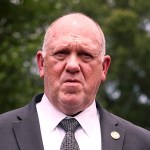
The Unfathomable Ghoulishness of Tom Homan

The Trump administration’s brutal immigration regime is responsible for deporting more than 590,000 people since he returned to office in January 2025, a majority of whom don’t have criminal convictions. At least 10 people have been fatally shot by immigration officials, and more than 50 have died in immigration detention. How does White House Border Czar Tom Homan summarize all of this? “We’re deportationmaxxing.”

[TPM in the Wild]

Sam Alito Has Gone Feral and Trump Has Wrecked the DOJ

Kate on Strict Scrutiny

We’ve all watched as Sam Alito’s brain has congealed into a mass of soft cheese, but TPM’s Kate Riga has had a front row seat. Kate joined Leah Litman of Crooked Media’s Strict Scrutiny podcast this week to break down the biggest decisions out of the recent Supreme Court term, talk about which cases have flown under the radar, and Alito going full Fox News Grandpa. 

Per Kate, “Alito is an old guy who is in this insular world of old, embittered right-wing men; he’s imbibing the same media they imbibe; he’s listening to the people they respect. And you can see it in his opinions on everything from the voter fraud conspiracies to the anti-trans stuff. His brain is pickled ‘cause that’s what he’s stewing in.”

Josh on The Beat With Ari Melber

Josh Marshall joined The Beat With Ari Melber to talk DOJ corruption and Josh Kovensky’s exclusive about the federal prosecutor who marched at January 6 now leading Trump’s task force targeting alleged left-wing political violence.

As Josh put it, “The Department of Justice basically gets whittled down to what serves the immediate whims of Donald Trump, and that is punishing and retaliating against the people he perceives as his enemies; keeping his friends out of prison; and getting in the grill of people who generate headlines that make him feel bad.”

Trivia answers: 1) Darline Graham Nordone 2) The Equal Employment Opportunity Commission, which enforces anti-discrimination laws in the workplace 3) Former congresswoman Katie Porter
Important Drive Update!

We need to get to $325,000 today to stay on track for our goal in this year’s Annual TPM Journalism Fund Drive. Can you help us get there? We don’t need that many contributors this afternoon to get us to this benchmark. Can you help us? A contribution in any amount is a big, big help. Just click here and be part of the drive, part of TPM’s resilience, growth and vitality. Click right here. And then if you have an extra moment, drop me a line and let me know why you did. I’ll keep our club updated.

Update: Now just $1,868 to go to get to today’s benchmark!

Update II: Boom! We made it to and past $325,000. Thank you! Can we get to $330,000 tonight? Now just $3,461 to go. I think we can do this. Let’s do this !!!!!

Update III: Triple boom, people! Just $794 to go to get to $330,000! This is great weekend progress and sets us up well for next week. We can totally hit this number by this evening. LFG!!!!!

Update IV: Boom! $330,001. Not kidding about that total. Awesome! Thanks, everyone!

New WSJ Article Paints Trump in ‘Downfall Video’ Type Scenes in the Oval

The Journal has an article today about the increasing unreality of the strategy, if one can call it that, the U.S. is using to approach Trump’s war with Iran. The headline tells the story: Trump is Losing Patience Over an Iran War with No Clear End in Sight. The article appears to be based on accounts from various advisors who’ve been present at planning meetings with Trump. It’s filled with quotes about how he’s out of patience, mad, fed up, has lost confidence in diplomacy, etc. One advisors says he’s moved into “revenge mode.” He’s telling advisors he thinks he can “break the Iranians’ will through an aggressive bombing campaign.”

A constant through-line in the article (and based on this account of Trump’s private White House rants) is that the Iranians can’t be trusted and that Trump keeps making deals with them that they simply break. I certainly don’t see the Iranian government as very trustworthy either. But this whole set of claims is a fantasy. Trump has never had any agreements or deals with the Iranians. What he’s had is a series of notional ceasefires in which nothing of substance or consequence is actually agreed to — you might sum them up with the famous Bill & Ted’s maxim to “be excellent to each other.” The point of these deals has been to calm international oil markets and give Trump space to moonwalk away from his totally self-inflicted debacle. But since these ceasefires are only “deals” to begin negotiations the actual war aims and demands of each side eventually seep through. Then they go back to fighting. Each deal really amounts to a temporary or contingent U.S. surrender. Trump needs them to calm oil markets and lower the U.S. price of gas. Iran wants it to consolidate its gains and get a break for aerial bombardment.

Federal Judge Rules That FDA’s Mifepristone Restrictions Are Excessive, Unscientific and Unlawful

A federal judge in Virginia ruled in favor of an abortion provider Thursday, finding that the Food and Drug Administration’s most recent set of restrictions on mifepristone isn’t justified by the data.

Continue reading “Federal Judge Rules That FDA’s Mifepristone Restrictions Are Excessive, Unscientific and Unlawful”

Trump’s New ‘Forced Labor’ Tariffs Were Set Under Sham Pretenses

President Donald Trump has made clear from very early in his second term that he intends to reorder global trade  by instilling permanent tariffs. More than a year later, his government has proven relentless in its attempt. Compounding the growing inflationary pressures from his ill-conceived war in Iran, Trump on Friday set a new round of tariffs ranging from 10% to 12.5% on products from more than 80 countries.

But like other aspects of the administration’s signature policies — from bogus Justice Department investigations to unfounded claims of widespread national voter fraud — the stated reasons behind the administration’s freshest round of tariffs smell like a sham, a former trade official and international trade policy expert told TPM.

Continue reading “Trump’s New ‘Forced Labor’ Tariffs Were Set Under Sham Pretenses”

Extremely Online: Minnesota ‘Antifa’ Cases Born of Internet Beef With Far-right Activists

In two cases this year, federal prosecutors announced that they had finally done it: charged the “antifa” cells and its members that had beguiled federal law enforcement in Minnesota. 

Continue reading “Extremely Online: Minnesota ‘Antifa’ Cases Born of Internet Beef With Far-right Activists”

A Huge Win for the NYT In Air Force One Subpoena Debacle

Blanche and Clayton Own This Mess

The responsibility for the Trump DOJ’s unlawful use of subpoenas as a tool of retribution against NYT reporters — for writing about the deficiencies of President Trump’s beloved new Air Force One — falls most heavily on two men: acting Attorney General Todd Blanche and Manhattan U.S. Attorney Jay Clayton, both of whom are awaiting Senate confirmation for promotion to higher offices.

In the alternate world of normal politics that we used to inhabit, the NYT subpoena debacle — especially what happened in court yesterday — would be the cherry on top of the myriad reasons that neither man could win Senate confirmation even with a Republican majority. Instead, we slouch onward, with Clayton expected to be confirmed as DNI and with Blanche making accommodations to a few remaining GOP holdouts who need a fig lead to camouflage his historically awful 18 months at DOJ.

The Justice Department withdrew the NYT subpoenas yesterday rather than endure the greater humiliation of U.S. District Judge Arun Subramanian ordering them quashed, which he made clear he was prepared to do. But prosecutors, most notably Clayton’s hand-picked deputy U.S. attorney Sean Buckley, still faced a public rebuke from the judge over their multiple errors and missteps in the case — although that may be too generous of a characterization.

“It seems like the inadvertent errors and ‘we should’ve done things differently’ are piling up,” Subramanian said.

To say that prosecutors merely mishandled the case is to presume a level of good faith that is not warranted. The errors and missteps flowed directly from the retributive abuse of the powers of the federal government to retaliate against unflattering news coverage. The rush to subpoena reporters at the earliest stages of the investigation was itself unlawful, but the haste also produced predictable errors, like not thoroughly researching the law, providing misinformation to the court, and mistakenly subpoenaing the phone records of reporters’ family members.

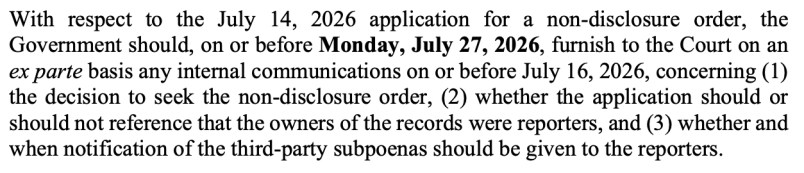
Judge Subramanian isn’t done with prosecutors yet. He asked during the hearing why he shouldn’t consider sanctions against prosecutors. In an order following the hearing, he demanded that the administration provide him with any internal communications it had about the non-disclosure order it sought regarding the subpoenas to the phone service providers of the reporters:

Subramanian seems to be zeroing in on this discrete part of the case for potential sanctions because prosecutors admittedly mislead the magistrate judge that issued the non-disclosure order, failing to tell him that the phone subpoenas involved journalists and misrepresenting that the investigation wasn’t public when prosecutors were already engaged with NYT counsel in the case.

While the NYT won a resounding victory in court in the narrow confines of this case, the Trump DOJ remains an enormous, unprecedented, and unchecked threat to civil liberties, including freedom of the press. And the people most responsible for this travesty of justice are the president’s picks to be attorney general and DNI.

Attack on Higher Ed: Penn Wins

After the University of Pennsylvania put up an extended fight, the Trump administration withdrew its subpoena for the names and personal information of Jewish people on campus as part of a purported investigation into antisemitism.

Border Patrol Agent Indicted

A Border Patrol agent was indicted in Texas last month on state charges of aggravated assault with a deadly weapon after he allegedly ran over an undocumented immigrant with his vehicle during an enforcement operation in January 2025.

Quote of the Day

“I got carried away, frankly.”—Elon Musk

Is Kagan Playing A Kind of Long Game?

The accounts of Justice Elena Kagan remarks yesterday about the Roberts Court make her sound tone deaf, naive, and perhaps not up to meeting the current moment:

  • “You just have to deal with the fact that there’s a conservative court doing things that conservative jurists have long thought it appropriate to do, and I can really dislike that. But it has nothing to do, I think, with becoming the arm of this current administration.”
  • “[I]s this court kind of a puppet for the current administration? I think definitely not.”
  • “I think that is a bad rap.”

A perhaps more generous interpretation is that Kagan is approaching the challenge of being in what is likely to be a permanent minority for the rest of her career with a very granular sense of what counts as wins and losses.

Not only does she see herself as a bridge between the three liberal justices (herself included) and the six-justice conservative majority (in particular the Chief Justice Roberts and Justice Amy Coney Barrett, who can, on occasion, either side with the liberals or moderate the conservatives), but she keeps a very fine-grained score of the game being played — collecting wins that are almost imperceptible and trying to stack those on top of each other over time in a way that starts to count for something.

Or … her approach may simply be too precious and self-regarding to meet the moment. The jury is still out for me on which it is.

The Age of Fire

 David Wallace-Wells, on the Pyrocene:

[P]erhaps it shouldn’t come as a surprise, given the years of warnings that climate change might not inspire global solidarity, but the opposite — an intensifying, zero-sum competition over a world pinched by perceived resource scarcity and pockmarked by more and more frequent extreme weather. If you insist on believing climate change isn’t real, or that its effects must be trivial, then whenever you find yourself overwhelmed by those effects, you have to place the blame somewhere.

See Ya Back Here Monday

News? Tips? Feedback? Please let me know. For sensitive information, use the encrypted methods here.

DOJ Was Never Not Gonna Use New Jersey Noncitizen Error to Bolster Trump’s Delusions

‘Working Very Hard to Protect Them’

The Trump administration has been salivating for something — anything! — that could help feed President Trump’s belief in the myth that noncitizens are illegally voting en masse for Democrats. The unfortunate situation in New Jersey this week, involving a software error at the state’s Motor Vehicle Commission during Gov. Phil Murphy’s administration, sadly gives them at least one datapoint rooted in reality to point to to justify Trump’s singular fixation with the otherwise widespread conspiracy theory. And perhaps also offers a new rationale for his attempts to try to jam a voter suppression/documentary proof of citizenship bill through Congress to throw the midterms — and hope of Dems taking back power — into chaos.

His Justice Department was never not going to seize on the moment, especially as the DOJ faces loss after loss after loss in its crusade to try to force states to give their voter rolls to the federal government, supposedly for the purpose of purging noncitizens from the rolls, something that states already do themselves and an occurrence that is vanishingly rare, even in light of the news from New Jersey this week.

Gov. Mikie Sherrill (D) announced Tuesday that her administration had found that a software glitch at the MVC had allowed 6,600 noncitizens to be added to the New Jersey voter rolls. About 400 of them have voted in at least one election since 2023. Sherrill said the people had disclosed they were noncitizens while trying to get a license or ID and were mistakenly registered to vote. The people were removed from the voter rolls, likely had no impact on overall election results in the state, and the state is cutting ties with the software company behind the error. Sherrill placed blame for the issue on her predecessor and said her administration was “working very hard to protect” the people who were placed on the rolls through no fault of their own.

Nonetheless, and of course, Assistant Attorney General for the Civil Rights Division, and Trump’s former personal lawyer, Harmeet Dhillon sent a letter to Sherrill on Tuesday demanding that she hand over the identities of the 6,600 noncitizens who were placed on the voter rolls within five business days. She requested the names, nationalities and residential addresses for each of them, Politico reported.

Dhillon reportedly said that she was interested in the information as part of a DOJ investigation into whether New Jersey was following federal law, but she has since hinted publicly that the DOJ might want to make a big show of deporting or bringing criminal charges against the noncitizens on the rolls.

“The consequences of voting when you’re not allowed to in a federal election can mean removal to your home country and worse — it’s a crime,” Dhillon said during a conversation with far-right influencer Benny Johnson Wednesday. “And you know people need to just stop cold in their tracks and not enable it. And shame on New Jersey for its sloppy and incompetent handling of this issue, or worse.”

Additionally, the DOJ is trying to use the incident to bolster its genuinely unbelievably disastrous campaign to seize voter records from states ahead of the midterms. The DOJ has lost every single case that has made its way through court thus far after suing 44 states and Washington, D.C. to try to obtain these records. In fact, in dismissing the lawsuits, every judge has shot down the DOJ’s legal theory, as TPM has reported. Per Politico:

Separately, the DOJ is also using the disclosure of noncitizen voters to bolster its case in court to obtain New Jersey’s unredacted voter registration files. The Trump administration is suing New Jersey, seeking access to the state’s full voter file which includes nonpublic information like the drivers license ID numbers and partial Social Security numbers of New Jersey voters.

Seems Like Thune’s the One Whose ‘Patience Is Running Out’

Senate Majority Leader John Thune (R-SD) got testy when presented with White House press secretary Karoline Leavitt’s recent remarks — that President Trump’s “patience is running out” with Senate Republicans, who both don’t have the votes to pass the SAVE Act or the interest in nuking the filibuster in order to jam through Trump’s voter suppression bill ahead of the midterms.

“Maybe she or somebody else ought to get on the phone and get the votes. Right? It’s 50 around here,” Thune said, when reporters asked him about Leavitt’s remarks.

“Instead of pointing the finger at Republicans, they might think about going after the people who are stopping it on the floor, which is the Democrats,” he continued. “And if there are Republicans they think are gettable, get on the phone.”

Obviously, Thune is one of the few roadblocks standing in the way of Trump having his delusions fulfilled by fall, but it’s not just Thune and Senate GOP leadership’s disinterest in changing filibuster rules for the sake of disenfranchisement. There are several other Senate Republicans who are not on board with the legislation, one of whom has been very vocal about the fact that it would be impossible to implement Trump’s documentary proof of citizenship and voter ID laws just months out from a major federal election.

Even Fox News Poll Finds Trump’s Approval Rating Won’t Stop Tanking

New stats from a new Fox News poll conducted between July 17-20:

Several findings in the latest Fox News Poll show voters are unhappy and want major change, which bodes well for Democrats in November: President Donald Trump’s job approval remains near a record low, more Democrats are motivated to vote, Republicans join Democrats and independents in rating the economy negatively, and 4 in 10 voters want “dramatic” or “revolutionary” change. Plus, more view the GOP as tied to elites than the Democratic Party.

More From TPM Today

Kate Riga covers the latest fallout from Callais: A panel of judges blocked Black Tennesseans’ attempt to challenge Republicans’ racial gerrymander in Tennessee where, after the Supreme Court ruling gutting the Voting Rights Act, state Republicans moved to carve up the state’s one Democratic district: Tennessee Gerrymandering Challenge Fails, Just as Supreme Court Intended

In this week’s edition of The Franchise, Khaya Himmelman digs in on election denier wins in Arizona’s Republican primaries this week and DHS Secretary Markwayne Mullin escalating the admin’s threats against state election officials: Election Deniers’ Grip on the Republican Party Strengthens in Arizona

“A new and ironic development in the first-of-its-kind legal challenge to President Trump’s U.S. attorney scheme gives me a chance to pull back the lens a bit to show the full scope of the corruption involved and why it matters,” David Kurtz writes in today’s Morning Memo: What’s Really Behind Trump’s Corrupt US Attorney Scheme

Yesterday’s Top Story

New Attack Launched Against Trump’s Corrupt US Attorney Scheme

What I’m Reading

Sex work or starve: Aid workers in Nepal left jobless by USAID cuts turn to sex work to survive

Government withdraws subpoenas of 3 reporters for The New York Times after admitting legal errors 

Trump Badly Screws Susan Collins as Maine ICE Death Takes Darker Turn 

From a Correspondent in Wisconsin #2

Another take on the governor’s race in Wisconsin, from TPM Reader BC

Just listened to this week’s podcast and read the reader’s commentary on the race, which I largely agree with and mostly want to add on to.  Like JB mentioned, Francesca Hong is really hustling in a way the other candidates are not.  I live in the Madison area and at first thought that was the reason why I only noticed her campaign.  Our kids even attend the same taekwondo studio, which I only learned in the last week.  So I live on her home turf.

Continue reading “From a Correspondent in Wisconsin #2”