


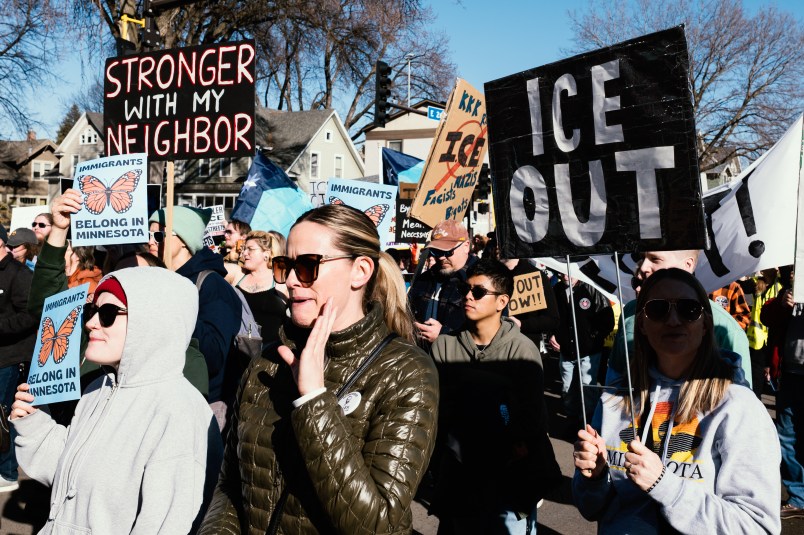
In two cases this year, federal prosecutors announced that they had finally done it: charged the “antifa” cells and its members that had beguiled federal law enforcement in Minnesota.
It was a hard feat to pull off, given the group’s notoriously chaotic, loosely defined organizational structure, and lingering questions about whether a group called antifa even exists in any coherent form. But in one case in Detroit, federal prosecutors brought charges against Kyle Wagner, who described himself in online diatribes as “Antifa Kyle.” For another case, brought in Minneapolis against 15 defendants, Wagner’s inclusion among the defendants was enough to dub the entire group “antifa.”
A look under the hood of both cases suggests that they emerged from online and real-life beefs between left-leaning opposition activists and members of the far-right. Other outlets, including the Minneapolis Star-Tribune, Zeteo, and emptywheel have reported on some of these ties.
It’s a bizarre scenario in which federal law enforcement finds itself wading into microscopic disputes between local activists. Far-right agitators, at least one of whom was charged over January 6 and two of whom face ongoing criminal cases, and nearly all of whom spout racist rhetoric, are posting online about their pursuit of Minneapolis protesters that they accuse of impeding federal immigration enforcement. The irony isn’t lost on some of the far-right figures on the periphery of these cases, one of whom marveled at the “grace” the Trump administration afforded him in an interview with TPM.
TPM has covered these cases in the context of NSPM-7, the Trump administration’s directive to federal law enforcement to treat a vague array of beliefs it dislikes as potential indicia of domestic terrorism. As TPM first reported, the DOJ is operationalizing that via material support for terrorism charges against activists around the country. It has a new task force, Joint Task Force Vanguard, to implement the program, run by a gang prosecutor and a terrorism prosecutor. The gang prosecutor, Brian W. Lynch, was at the Capitol on January 6, TPM exclusively reported last week.
Vanguard brought the case last month against what activists have come to call the Minnesota 15. It’s built partly around one figure, Wagner — a frequent target of these far-right influencers.
Wagner was initially charged in a February indictment with one count of cyberstalking and one count of making threats by interstate communications over an incident with far-right activist Jayden Scott.
A prolific and incendiary user of the internet, Wagner became involved in an escalating series of taunts with Scott in January. Scott told TPM that he had traveled to Minneapolis that month, amid the massive ICE crackdown in the city, to stage “an anti-Islam, anti-Somali takeover” demonstration. The day after Renee Good’s killing, Scott was filmed yelling, “we executed one of you” at anti-ICE protesters.
As the federal surge of immigration enforcement into Minneapolis continued, protests began to expand. Scott eventually singled out an independent journalist to target, Andrew Mercado, for posting a video Scott didn’t like. Scott told TPM that he was upset that the video appeared to expose the personal details of an immigration officer.
He told TPM that he decided on Jan. 28 to enter Mercado’s apartment building and record a livestream; he posted a video outside of Mercado’s front door. Scott told TPM that it was “to let him know that, you know, stop harassing the local federal agents, you know, stop doing this. It’s that old adage, you know, do to others what you want done to you.”
“We just had to give him a quick reality check that, you know, this is still real life,” he added.
The video prompted a wave of online fury, including from Wagner. Federal prosecutors accused Wagner of posting Scott’s address the next day. “We can all knock on strangers doors…See you soon kiddo – stay safe out here,” an indictment quoted Wagner as writing online.
Wagner was charged in February. The case was among the first that the DOJ promoted as part of its pursuit of “antifa;” in a press release, U.S. Attorney for the Eastern District of Michigan Jerome Gorgon cited scripture in justifying why federal law enforcement intervened.
“We know that a ‘worthless man plots evil, and his speech is like a scorching fire.’ And Wagner’s alleged actions were an attempt to spread fire into our peaceful community. That is not going to happen,” he said.
Scott, who appears to have faced no repercussions for entering Mercado’s building, told TPM that he hopes to see Wagner executed.
“We’re calling for the death penalty,” he said. “And really we want it to be done by public hanging of Antifa Kyle,” adding later that executing Wagner and the Minneapolis defendants would “send a message to the communists that are trying to take over our country.”
He also said that while federal law enforcement had backed off, he and other activists that he travels with have still faced pressure from state law enforcement.
“Federally, we may have some grace,” he observed. “But, still, at the local levels, we have state prosecutions in almost every state we go to.”
Another, bigger case
Scott has what you might describe as credibility issues. He was accused of lying about serving as the CEO of a healthcare company. His troubles with Michigan state courts include a contempt charge emanating from a child custody battle; Michigan prosecutors reportedly said earlier this year that Scott had eight prior convictions or adjudications relating to identity theft, retail fraud, larceny, domestic violence, assault, and attempting to flee police. He’s the defendant in a lawsuit in which a Michigan Republican state Senate candidate accused him of making deepfakes that defamed him.
Online and to TPM, Scott also suggested that he’s been helping the federal government investigate Wagner and others. After Wagner’s arrest, Scott posted a link to the case, writing “We had ABSOLUTELY nothing to do with this” and a winking emoji.
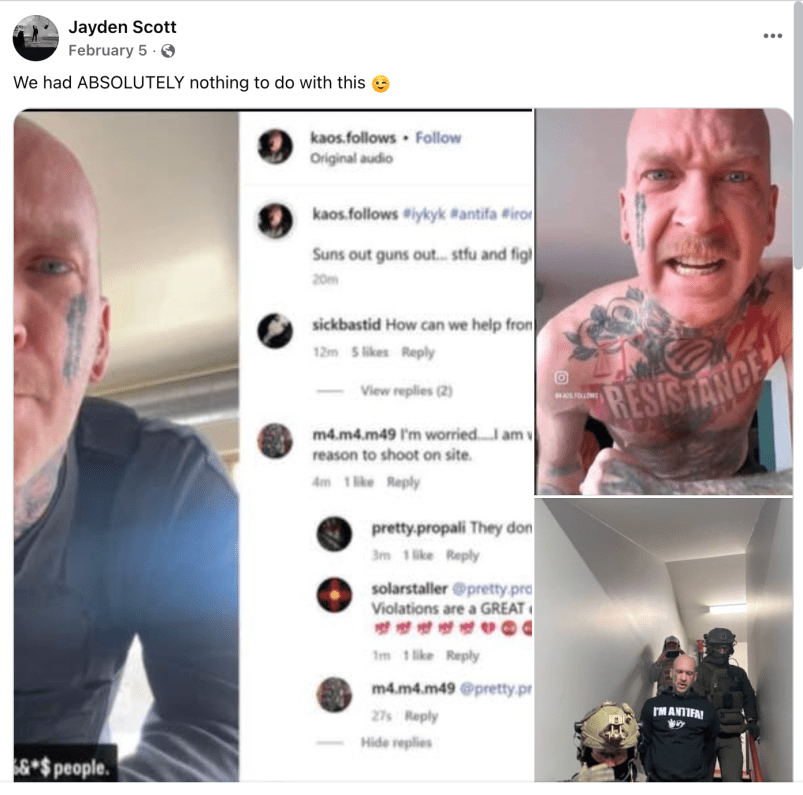
To the Minneapolis Star-Tribune, Scott said, “when my team got into their Telegram groups, when we broke into their vibe-coded websites and got their emails, we sent it to Homeland Security Investigations to go ahead and get these people arrested.”
It’s not clear whether anything that Scott claims to have provided actually made its way into the Wagner case. A spokesperson for the U.S. Attorney’s office declined to comment. Wagner’s attorney didn’t return requests for comment. ICE, the parent agency of HSI, didn’t return TPM’s requests for comment.
Wagner’s case eventually grew into the “Minnesota 15.” In that case, prosecutors are applying the kind of broad-based conspiracy charges — typically reserved for alleging a conspiracy against gang and drug distribution cases — on a group of anti-ICE protesters. Before prosecutors unveiled the case, rumors had been circulating among Minneapolis lawyers that federal prosecutors in Detroit were working on a conspiracy case involving their state.
The indictment includes long passages from Signal chats in which activists debate tactics and strategy, and cites remarks from an anarchist speaking tour, during which some of those charged described their experience in Minneapolis. It treats the removal of Customs and Border Protection Commander Greg Bovino and federal immigration agents from the city as a defeat for law enforcement, describing it at one point as “the success of efforts to impede federal immigration enforcement.”
Another figure looms over that case: Jake Lang, the January 6 defendant and far-right activist. This year alone, Lang had to post a $250,000 bond in Texas after getting arrested for threatening to kill a 17-year old. He pleaded guilty this week to a misdemeanor in D.C. Superior Court for telling a Capitol Police officer he should be “hung” during a Jan. 6 anniversary event, and received a 180-day suspended sentence, court records show. In a separate case in Minnesota, Lang pleaded not guilty to a charge over his alleged vandalism of a sculpture.
As emptywheel’s Marcy Wheeler first identified, prosecutors removed a reference to Lang that Wagner included in an Instagram post from a photo in the indictment.
Lang appears elsewhere in the document. At one point in February, a defendant purportedly sent a message asking for security “in case actual fash (fascists)” appeared — ”not soft handed Jake.” Prosecutors glossed this as a reference to Lang, writing “reference to right-wing influencer Jake Lang, who was assaulted by left-wing rioters in downtown Minneapolis on January 17, 2026.”
Scott declined to answer more questions about what information he gave to the government and when. He did have his own run-in with the feds in Minneapolis: in January, he was cited federally in Minneapolis with obstruction for blocking a roadway and inciting others to do the same.
Prosecutors agreed to drop the charge on May 21, after, Scott claimed, he spoke directly with the prosecutor assigned to the case.
“We talked about it, we communicated about it, and it went away,” he said.



In case any more evidence was needed, tRump DOJ prosecuting based on whether the perp is on their side or not.
What does NSPM-7 mean?
There used to have to be proof of a crime before there was an investigation. What crime are the Feds investigating?
Finally I used to know a lot of members of an organized Antifa group, but sadly my father and his friends who fought Hitler in WWII have all passed away. They were the greatest.
If your government is prosecuting ant-fascists it may be time to prosecute your government.
At my age, I’m just a Grantifa member, but you fascists can come and get me.