


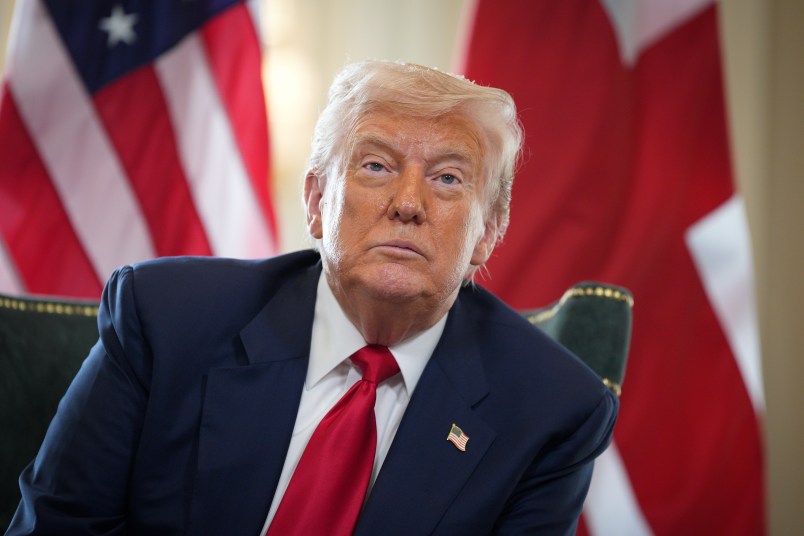
President Donald Trump on Thursday night signed an executive order applying blanket tariffs to scores of countries. In announcing tariffs ranging from 10% to 41% levied against around 70 countries, Trump began a new chapter in a volatile, months-long saga that reached a fever pitch over the last couple weeks, during which he also announced hundreds of billions of dollars worth of so-called trade deals with the United Kingdom, Japan, Indonesia, the European Union, and South Korea, among others.
The unprecedented process has restructured how the U.S. does global trade. But it’s what Trump hasn’t been able to do which reveals the cracks in his economic agenda.
Large parts of Trump’s so-called trade agreements amount to nothing, economists and foreign trade experts told TPM. The more than $1 trillion in foreign investments the White House has touted have quickly revealed themselves to be aspirational apparitions at best, and expensive vehicles for increasing the ballooning federal debt at worse. Trump’s whims and the volatility they create means companies can’t securely take the chance to bring production back to the U.S. — the stated reason for imposing such heavy tariffs in the first place. And these agreements are only frameworks with non-binding language. Much of what nations are agreeing to is merely keeping conversations open.
“The agreement quote unquote,” said William Reinsch, former president of the National Foreign Trade Council, “is a promise for a further discussion, so there’s less there than meets the eye to these things.”
The tariffs exceeded Trump’s authority, according to a May ruling from the Court of International Trade — an opinion with which several foreign trade policy experts who spoke to TPM agreed, including one who helped negotiate in the 1970s-era act Trump is currently being sued over.
Judges on the U.S. Court of Appeals for the Federal Circuit in Washington D.C., hearing an appeal of that case, on Thursday expressed doubt about the government’s justification for using a national security-related measure to enact global trade policy. The case is expected to make its way to the Supreme Court, which could declare most of Trump’s tariffs a violation of the law and void them.
In short, experts agreed: the president, and by extension the American people, is being hoodwinked by foreign governments protecting their domestic interests by appeasing Trump with empty words.
“They’re playing Trump,” said C. Fred Bergsten, a renowned economist who served on the Advisory Committee on Trade Policy and negotiations under both presidents Barack Obama and Trump. “They’re giving him a talking point that he can use to characterize his agreements as big deals with big pay offs, but there’s no ‘there’ there.”
A White House official with knowledge of the president’s trade deals told TPM the Trump administration believes governments will uphold their obligations.
“We expect our trading partners to live up to their commitments in our trade agreements,” the person said. “President Trump reserves the right to adjust tariff rates if any party reneges.”
Contrary to accounts of Trump’s “triumphant” performance in trade negotiations, “America is a loser from all of Trump’s trade deals,” said Bergsten, who also served as the founding director of the Peterson Institute for International Economics.
In recent days, Trump has trumpeted multibillion-dollar investments that foreign governments have pledged to put into the U.S. economy, including two separate $750 billion and $600 billion pledges from the EU, a $550 executive account funded by Japan, $350 billion from South Korea. These flashy numbers don’t tell the whole story.
“It’s ludicrous to think that these market economies would be able to fulfill such commitments,” said Bergsten.
In a late July release, the White House claimed the 27 member states that make up the EU “will purchase $750 billion in U.S. energy” over the next three years, along with $600 billion in additional investments. Almost immediately, the European Commission contradicted that alleged commitment. Euronews itemized a list of conflicting accounts, ranging from the tariff rate on pharmaceuticals to the pledges to purchase U.S. military equipment, a pledge Euronews reported the EU “resolutely denied.”
A commitment to spend $250 billion per year on U.S. energy products would also require Europe to triple their annual American energy imports. “Question one is if they need that much, can afford that much,” Reinsch said. “Question two is if we can even supply that much.”
The EU has no power to give the U.S. the more than $1 trillion the Trump administration announced. Such investments are wholly up to “thousands of private companies in the 27 member states,” said Jared Bernstein, the former chair of the United States Council of Economic Advisers and a fellow at the Center for American Progress.
“If you’re the other country, [you’re thinking] what can we give this guy to make him back down as much as we can, shut up and go away,” said Tad DeHaven, a policy analyst at the libertarian Cato Institute. “What do they really care if Donald Trump runs around and says they’re gonna invest $750 billion even though they’re not gonna invest $750 billion?
“Their goal is to lessen the damage to their domestic interests and if that means giving Donald Trump some BS headline figure that makes him shut up and go away, then so be it.”
The $550 billion “investment vehicle” from Japan will only amount to about $5.5 billion to $11 billion in actual cash investments, a top Japanese official told Bloomberg, while the Asian nation stands to save $68 billion in lower tariffs. The remaining portion of the Japanese investment will come in the form of loans, adding to the growing federal deficit.
“President Trump’s trade deals have unlocked unprecedented market access for American exports to economies that in total are worth over $32 trillion with 1.2 billion people,” Kush Desai, a White House spokesperson, said in an email. “As these historic trade deals and the Administration’s pro-growth domestic agenda of deregulation and The One Big Beautiful Bill’s tax cuts take effect, American businesses and families alike have the certainty that the best is yet to come.”
Experts painted a different picture.
“I think he knows that these things are not going to be fulfilled,” Bergsten said. “I think he knows that these things are not operational. He’s been told that by his own people.”
With proclivities that DeHaven likened to a child flipping a light switch, Trump’s inconsistency around his favored economic policy tool is eroding trust in the American economic system.
Confusion abounded up until the moment the full spread of levies was rolled out Thursday night, with White House Press Secretary Caroline Leavitt saying earlier that day that, ““[Y]es, tomorrow, August 1st, the reciprocal rates will be going into effect.” As of now, most of the tariffs won’t actually go into effect until Aug. 7. Goods loaded onto shipping vessels by then won’t be subject to the blanket tariff rates until Oct. 5, per a White House announcement.
As a result, nations aren’t taking the Trump administration seriously, according to statements from key foreign officials.
“[W]e cannot be relieved, because we do not know when we will face pressure from tariffs or non-tariff measures again,” South Korean Trade Minister Yeo Han-koo told reporters upon returning home from Washington, according to Reuters.
He added that the nation’s alleged $350 billion investment in the U.S. “still needs to be worked out.”
Back in January, an Indonesian official told the Jakarta Globe, “We’ve become somewhat immune to the tariffs imposed by the US.”
They also likely know the tariffs, which Trump levied under a statute called the International Emergency Economic Powers Act or IEEPA, face legal challenges that could eliminate them altogether.
“To implement policies like this under IEEPA, you have to rely on the existence of a national emergency that’s a threat to national security,” said Bergsten, who said he helped negotiate the act in the 1970s. “It’s very hard to argue that any of this trade stuff falls in that category.”
Democrats pounced on the perpetual uncertainty created by Trump’s new world order. Sen. Chuck Schumer (D-N.Y.) said Thursday, “Our businesses, our small businesses, our medium-sized businesses, our large businesses need some degree of certainty and all they’re getting is chaos and inflation… So the Trump tariff trade war is a trade war on the American people.”
Federal Reserve Chair Jerome Powell on Wednesday pointed to the trade issues as a reason not to cut interest rates during a press conference, saying, in part, “we’re still a ways away from seeing where things settle down.”
And data released by the Commerce Department Thursday showed core inflation increased by 2.8% in June, over the 2% benchmark the Federal Reserve is aiming for. Prices for home goods and durable household goods rose by 1.3%, while prices for clothing and shoes rose by 0.4%.
“I do not understand how making life more expensive for already highly stressed American consumers is any sort of a win,” said Bernstein of Trump’s constant refrain. “I know that Donald Trump defies gravity in lots of ways, but I’m pretty confident that at some point the politics of raising prices on American consumers begins to hurt his administration politically. So what some people are calling a win now, I think, is going to redound against them later.”



Well, that’s no surprise given that he’s an utter fool. But we, and much of the rest of the world, are still getting screwed by these tariffs and the shitstorm of confusion around them, every day and in every way.
The Heard and McDonald islands are not playing any games with pedo and are paying their full share of tariffs up front.
The Bureau of Labor Statistics and Federal Reserve have experienced a reduction in workforce.
The employees providing statistics should provide the statistics that are expected by elected officials, not real numbers. They are messengers who should bring the right message to the right occasion. Providing statistics is a privilege, not a right because America always deserves to have low unemployment and low inflation through the best statistics. There is no reason that statisticians should face no occupational hazards or have guaranteed job security. Their performance will be evaluated by the numbers they make up and how well they follow instructions to cook the books.
Same thing with election officials, they should count the votes that matter and disqualify those that are not quite right so that we get the desired outcome.
I think the President will appoint his favorite daughter or son to the Federal Reserve governorship. Ms. Loomer is another option but she will get Johnny Roberts’ position on SCOTUS when he resigns for not making the best choices in judging cases.
Can you get the MSM to pick up on Two Scoops’ bullshit?
They’re appeasing a toddler and everyone in the world knows it but him.
“The case is expected to make its way to the Supreme Court, which could declare most of Trump’s tariffs a violation of the law and void them.” – That’s the funniest thing I’ve read in awhile.