


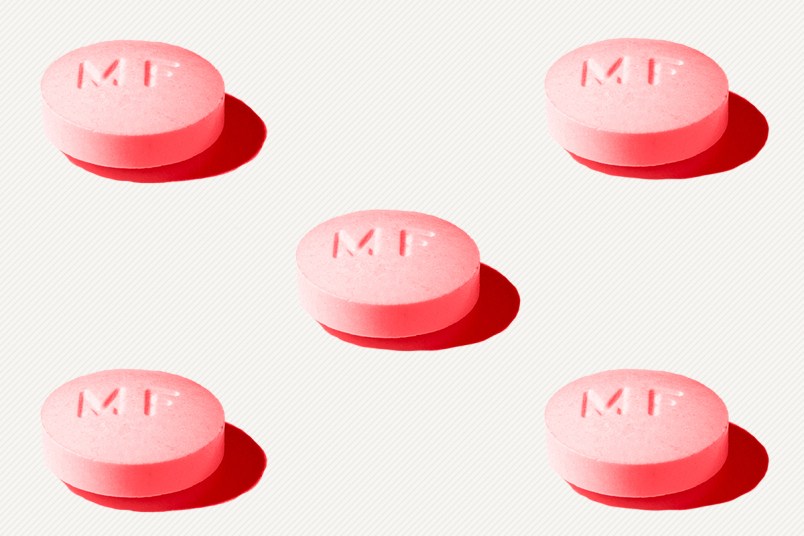
A federal judge in Virginia ruled in favor of an abortion provider Thursday, finding that the Food and Drug Administration’s most recent set of restrictions on mifepristone isn’t justified by the data.
Whole Woman’s Health, a reproductive health clinic in Alexandria, joined a rich history of medical organizations and providers challenging the Risk Evaluation and Mitigation Strategy (REMS), some form of which has been imposed on mifepristone for years. In its most current iteration, formalized under the Biden administration in 2023, the agency lifted some crucial restrictions, allowing the drug to be prescribed over telehealth, dispensed by certified pharmacies and mailed.
Still, the drug is larded up with restrictions that Judge Robert Ballou, a Biden appointee, found to be unsupported by FDA’s review of the drug’s safety. The REMS — which only 73 of over 20,000 FDA-approved drugs have — still requires pharmacies and providers to get special certification and for patients to sign a consent form without the agency having proved that the drug is unusually dangerous.
“Plaintiffs note that other commonly prescribed drugs, comparable in safety to mifepristone, have been approved without any REMS requirements,” Ballou wrote in Whole Woman’s Health Alliance v. FDA. “For example, an analysis of medication abortion risk explained that the mortality rate associated with medical abortion is 0.65 deaths per 100,000 medication abortions, while the mortality rate of Penicillin, which does not have a REMS, is 2 deaths per 100,000 patients administered the drug.”
He added: “In 2012, the FDA approved mifepristone (marketed as Korlym) for the treatment of Cushing’s syndrome at a higher dosage and for longer duration, without imposing any REMS or [Elements to Assure Safe Use].”
The FDA under Democratic and Republican administrations alike has always treated mifepristone politically, catering to an unrelenting anti-abortion crusade to falsely malign the drug as intolerably risky and often fatal. Anti-abortion activists have been laying that foundation for years — aided by the FDA — and now use it to undergird their ongoing nationwide attacks on the drug. An attempt to get mifepristone’s authorization removed, or at least to add back onerous restrictions, failed at the Supreme Court in 2024 when the justices ruled unanimously that the anti-abortion doctor plaintiffs lacked standing.
The movement has since renewed its anti-mifepristone legal fusillade. In one notable case, Louisiana v. FDA, Louisiana is challenging the 2023 restrictions as too permissive, arguing that they infringe on the state’s abortion ban and force it to spend money on Medicaid patients who are hospitalized after taking the drug (a frequent refrain in anti-abortion activists’ smear campaign). A Fifth Circuit Court of Appeals panel sided with Louisiana, but the Supreme Court blocked that ruling while the litigation plays out.
In Whole Woman’s Health, the clinic is trying to make mifepristone as accessible as possible in Virginia, one of the only southern states where abortion is still legal.
Ballou remanded the 2023 REMS to the FDA for further proceedings. The agency under President Donald Trump has begun a slow-moving review of the drug’s safety, prodded along by an impatient anti-abortion movement, which expected faster and more decisive action from the Trump administration to take mifepristone off the market nationwide. Former FDA Commissioner Marty Makary reportedly ordered that the review be slow-walked so its inevitable conclusion that the drug is dangerous comes after this year’s midterms, avoiding another Dobbs-like backlash that could hurt Republicans’ electoral prospects.
Read the ruling here:







Every Republican in federal government should be immediately required to take remedial math.
Republicans waste money.
Mifepristone is probably one of the most studied drugs in FDA history, and it still comes out relatively clean in terms of safety. All drugs have side effects and outlyers, but mifepristone has few. As another example, prophylactic aspirin (single 325 mg daily) results in an average 10 deaths per 100,000.
So this is good news, but will probably be ignored by the swim in sewage heroin addict.
You know who takes aspirin as a prophylactic? Yeah, that guy. A nickel bet pays $500. Just saying…
A periodic yet timely reminder:
So FDA leadership decided that allowing “unborn children” to continue to be murdered pending the midterms is a reasonable price to be paid to avoid political backlash. Can’t think of a better way to show your pro-life Xtian family values than that.