


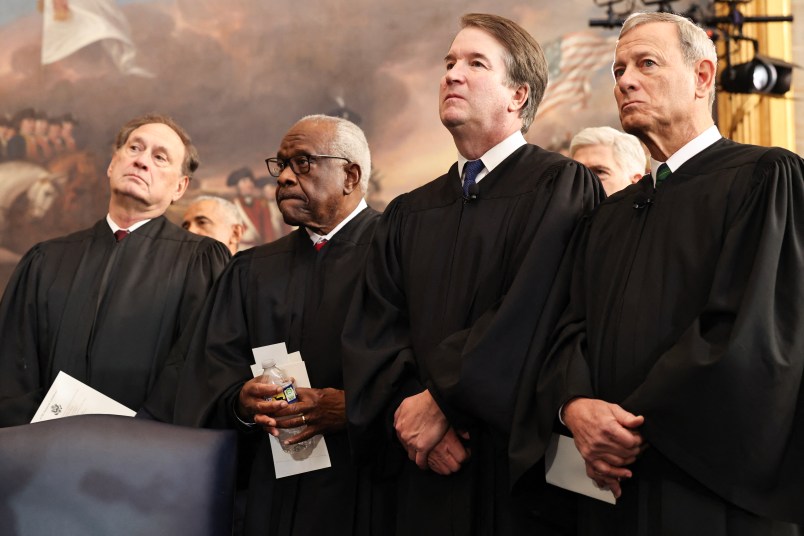
A panel of judges on Thursday unanimously rebuffed Black Tennesseans’ attempt to block the state’s new 9-0 Republican gerrymander.
The panel was composed of one Obama appointee and two Trump appointees.
Tennessee Republicans were the first to act after the Supreme Court decided Callais, the case that virtually killed the Voting Rights Act (VRA) and made racial vote dilution in redistricting impossible to prove. Legislators cracked the Memphis seat long held by Rep. Steve Cohen (D) into three parts, diluting the Black vote into heavily Republican areas.
As the 6-3 right-wing Supreme Court supermajority intended, the coalition of Black voters and associated organizations was unable to prove that the map was a result of racially motivated redistricting.
“Here, the map’s effects — breaking Black Memphians into three separate congressional districts — are readily explainable by political motivations,” wrote the panel in Sherman v. Hargett. “It’s no secret (supported by Plaintiffs’ own statements) that city voters prefer Democratic candidates and that rural voters prefer Republican candidates.”
“So it makes sense that Tennessee’s legislature would split Memphis into thirds when attempting to create a map that favors Republican candidates,” it continued. “And it’s no surprise that the resulting map would also split the Black population of Memphis into thirds.”
In the southern states that most consistently violated the pre-Callais VRA, race and partisan lean are inextricable, requiring plaintiffs to provide smoking gun evidence that the legislators were racially motivated. In this case, the judges dismissed most of plaintiffs’ proof as irrelevant, since the lawmakers who made various racist comments are no longer in the state legislature. Of the one still serving — state Rep. Paul Sherrell (R), who wondered whether he could “put an amendment on that that would include hanging by a tree, also” during a debate on death penalty legislation — the judges said it wasn’t enough.
“And although Plaintiffs cite one insensitive and regrettable remark from Rep. Paul Sherrell, who remains in the legislature, we’re ‘wary of relying on the remarks of a single legislator’ to ascertain the intent of the body,” they wrote.
And even if the plaintiffs had been able to dredge up proof of racist intent from legislators well coached to avoid making such comments while redrawing maps, the Supreme Court had added yet another stumbling block.
“The Supreme Court recently confirmed that the Purcell principle doesn’t prevent states from altering their own election rules — it discourages only federal courts from doing so,” the judges wrote.
So Tennessee is free to pass and enforce a new gerrymander on the eve of the midterm elections, but the courts can’t intervene to block it.
The next Tennessee congressional delegation will almost certainly be entirely Republican and, more likely than not, entirely white — serving a state that is about 16 percent Black and where 35 percent of voters cast a ballot for Kamala Harris in 2024.
Read the ruling here:




Sickening.
Garbage In. Garbage Out.
Next up: “It is ok to pass state legislation stating that only one political party is permitted to exist, run for office or cast votes that are permitted to be legally counted in an election.”
The residents of Memphis will have no meaningful representation in Congress at a time when their city leads the country in pedestrian fatalities, the number of deaths is still increasing year over year, and the victims are disproportionately poor and black. This is just one problem that requires federal involvement and funding to solve. Disenfranchisement kills, as intended.
If Clarence ever discovers he’s black (even when it isn’t convenient) he’ll be horrified.
It’s a decades-long overcompensation, from Clarence the ultimate House Negro, as described by Malcolm X.