


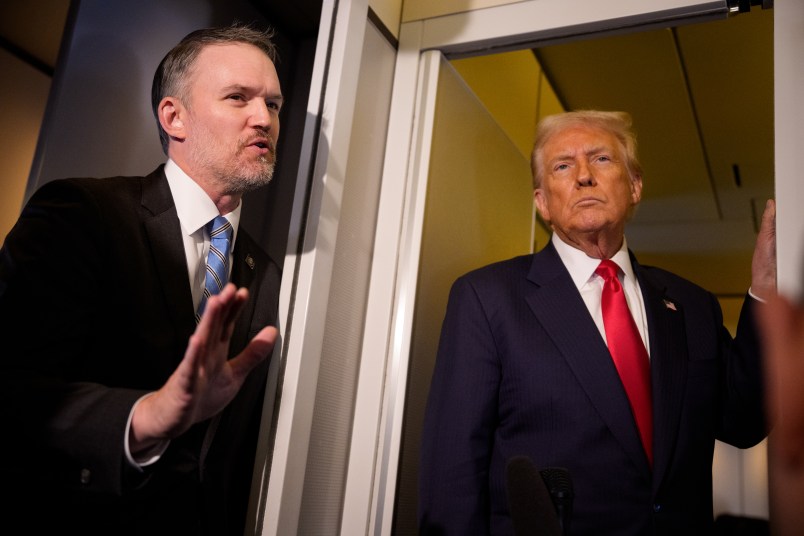
President Donald Trump has made clear from very early in his second term that he intends to reorder global trade by instilling permanent tariffs. More than a year later, his government has proven relentless in its attempt. Compounding the growing inflationary pressures from his ill-conceived war in Iran, Trump on Friday set a new round of tariffs ranging from 10% to 12.5% on products from more than 80 countries.
But like other aspects of the administration’s signature policies — from bogus Justice Department investigations to unfounded claims of widespread national voter fraud — the stated reasons behind the administration’s freshest round of tariffs smell like a sham, a former trade official and international trade policy expert told TPM.
“It’s just a subterfuge to try to have an excuse to continue their blanket tariffs on lots of countries at arbitrary levels,” C. Fred Bergsten, an international trade policy expert who served on the Advisory Committee on Trade Policy and Negotiations under former President Barack Obama and during Trump I.
Levied under a statute called Section 301, the administration has said these new tariffs are designed to target countries that have not effectively banned forced labor from their supply chains. But that veil has already worn thin.
Canada currently bans imports of goods made with forced labor, yet faces a 10% tariff under this new regime. The European Union, the New York Times reported, is also facing 10% tariffs despite a forced labor prohibition set to begin in December 2027. The Office of the U.S. Trade Representative, USTR, recently found that those and other governments didn’t effectively enforce existing prohibitions.
Trump’s new tariffs were met with a fresh lawsuit the day they began. The Liberty Justice Center, a conservative legal nonprofit that successfully sued to overturn two sets of tariffs enacted under Trump II, filed on Friday a new suit against the government’s Section 301 tariffs on behalf of two small businesses.
“The administration allowed one global tariff to expire and immediately replaced it with another under a different statute,” Sara Albrecht, chair and CEO of the Liberty Justice Center, said in a statement. “Changing the statute doesn’t change the law. Every tariff authority has limits, and every administration must respect them.”
All in all, some of America’s largest trading partners, including Mexico, countries throughout South America, swaths of North Africa and other parts of the continent, Australia, China, other Asian countries and the countries in the E.U. are now subject to the tariffs.
There are some exemptions. Oil and gas, already facing massive price hikes because of the closure of the Strait of Hormuz caused by Trump’s war in Iran, are exempt from the tariffs. So are some goods covered under the nation’s trade agreement with Mexico and Canada, and others already subject to different sets of tariffs.
These new import taxes had been a long time coming. Even before the Supreme Court struck down tariffs Trump levied under the International Economic Emergency Powers Act, or IEEPA, the administration appeared to be gearing up for these. After November oral arguments in the IEEPA case suggested the justices might rule against the government, Treasury Secretary Scott Bessent said the administration could “recreate the exact tariff structure” of the illegal IEEPA tariffs by relying on a bevy of other statutes, including the section 301 import taxes now in place.
And unlike the IEEPA ones, they came with some heavy lifting on the front end.
Launching Section 301 tariffs requires the Office of the U.S. Trade Representative to conduct an investigation and allow for public comment. USTR began its investigation into several countries and dozens of economies in March. By June 2, USTR announced every economy investigated had failed to properly impose or enforce anti-slavery measures and proposed tariffs. A public comment period yielded several exemptions, USTR said in a notice of action, including on raw materials that could impact domestic supply, things the U.S. doesn’t make or grow, and other certain products from more than a dozen countries.
The lack of in-depth policy analysis in the USTR investigation, said Bergsten, suggests it falls woefully short of past forced labor probes.
“Certainly there was no detailed look at countries’ labor practices,” said Bergsten, the founding director at the Peterson Institute for International Economics. “I always expected they would just try to use it as a subterfuge, a workaround, an end run to try to do under that heading what the Supreme Court already said they could not do under the other heading.”
“I’m not surprised they’re trying it,” Bergsten said, “but does it meet the legislative and historical requirements for forced labor investigations? No, not at all.”
Rep. Linda Sanchez (D-CA) said Trump’s new tariffs aren’t about ending forced labor practices.
“He’s trying to make an end-run around the Supreme Court and Congress to reimpose his illegal tariffs,” she wrote on X.
Sanchez went on to detail the ways the administration’s domestic and international policies have worked against ending forced labor, including by gutting “funding to combat forced labor through cuts to the Bureau of International Labor Affairs.”
And some foreign governments have already spoken out against the U.S. The northern thorn in Trump’s side, Canadian Prime Minister Mark Carney, suggested his government is prepared to retaliate if trade negotiations fall through.
Members of the Brazilian government also said it plans to retaliate while claiming the justification for the 12.5% tariffs were “completely arbitrary and unjustified.”
“In the absence of an internal legal basis to sustain its protectionist trade policy, the USTR chose to manipulate a topic dear to human rights,” the Brazilian government said in a statement.
Bergsten said he doesn’t expect these levies to hold up in court. A loss on this front would be the third such defeat suffered by the administration.
“Eventually, I think it’s pretty clear they will be overturned and the tariffs will have to be refunded and this whole mess that came out of the IEEPA fiasco will be repeated,” he said.
The Liberty Justice Center claim alleges the government failed to provide “a reasoned, record-based explanation for how the tariffs,” would address alleged forced labor practices. The blanket nature of the tariffs also means they apply to products imported by businesses with no record of forced labor, LJC said in a statement about its lawsuit.
The government was ordered to repay importers with interest after SCOTUS struck down Trump’s IEEPA tariffs in February. The administration launched new tariffs that same month, which were struck down by the Court of International Trade but allowed to remain in place until they expired while the government appealed the court’s decision.
Nothing about the Trump administration’s goals to enact and enforce permanent tariffs has been kept secret. Trump has long been obsessed with the idea of tariffs. He enacted a range of tariffs against China during his first term. Less than three months into his second term, Trump sent financial markets spinning when he announced blanket tariffs in April on what he called “Liberation Day.” Since then, markets, businesses, and consumers have had to contend with the whiplash of Trump’s boisterous tariff threats, actualized levies, and court-ordered rollbacks that have made planning for the future more difficult.
On Monday, Trump also announced 50% tariffs on goods from Canada, America’s second largest trading partner, under a Great Depression-era statute that had never been used before. Those are set to begin in mid August.
When SCOTUS blocked the IEEPA tariffs, it noted, in part, that a tariff is a tax, and that taxation powers — outside of very narrow regulatory law — belong to Congress alone. In one most recent attempt to reign in the president, Sen. Ron Wyden (D-OR) on Wednesday introduced a bill that his office said would mandate congressional approval for tariffs and establish a congressional tariff committee. But Republicans in the legislature have refused to be a check on Trump, even blocking attempts to curtail his ability to enact tariffs and, in doing so, ceding further power to the executive branch.





Old King Stole wants to combat “forced labor”?
Well, lookee here…
I’d love to see an article about the mechanics of tariffs.
A farmer in Brazil makes a deal with a distributor to sell them his grapes. The farmer harvests the grapes and sends them to the distributor, who puts them on a ship to the US bound for Whole Foods. The boat arrives and a Trumper goes through all the crates (???). The Trumper declares the red grapes are subject to a tariff, so he demands 10% of (???), which he puts in his pocket (???) until the end of his shift, when he then takes the tariffs to a federal credit union (???) where it’s deposited into a Treasury account that Mike Johnson reconciles every budget period (???).
I mean, I understand the price of green grapes at Whole Foods is unchanged, but red grapes go up in the store because… ???
Or maybe Whole Foods unpacks the crate at their store and realizes it has red grapes that are under tariff because a Trumper called the store to inform them of the 10% tariff that’s due on red grapes. So, Whole Foods tells the employee to add 10% to the cost of the red grapes, then some MAGA dude slithers into the store when few witnesses are around and collects an envelope containing the tariff payment?
I need help.
Pro Publica also has had a series of articles on forced labor and H-2A farmworkers visas
Many of these tariff affected countries are incredulous, proclaiming that they have stronger labor laws than the USA.
It’s difficult to understand how another nation could still be incredulous about anything this bag of shit does now. He is a fat hose under pressure whipping around. No rules and unbound by logic or laws. Everyone knows that at this point.
Why are so many intelligent people, even whole governments, unable to get in front of or disarm him? Because 1) he is so abnormal. The literal reason he lives is to hurt others. And 2) he offers the chance for other damaged people to join in and make $ doing it. The cult is so big and powerful now that it’s making its own weather, as they say. We are pretty much in N Korea in many ways.
Tariffs are paid by the “Importer of record.” Basically, one of the entities in that chain from Brazilian grape farmer to the red grapes at the grocery store says they will take responsibility for ensuring those grapes follow all the appropriate legal requirements for import, including paying the tariffs.
This mostly operates on an honor system, where the Importer of record self-declares the goods and their value to CBP and pays the tariff amount they self-calculate using tariff schedules. CBP does spot check some imported goods to confirm they match the submitted documentation, but they don’t have enough staff to check more than a small fraction. Compliance is based on fear of the civil and/or criminal penalities one could be subject to for misrepresenting the imported goods or failing to pay the required tariffs.
Obviously, this system is ripe for tariff evasion, primarily through “classifying” imported goods as either under non-tariffed good categories or as lower value goods. That wasn’t worth the effort when tariffs were in the single digits for most countries, but with double-digit tariffs we see those practices more frequently.