



So here we are. So much of the last 24 months has been about the Trump opposition rebuilding its energies, pacing its morale, marshaling its resources, building walls as firm against autocracy as possible with no power in Washington and preparing for the shot at reclaiming as much of that power as possible. In a week and a day we’ll get the first measure of the results. And we’ll get our first look at how the table is set for the next two years.
I wanted to return to the topic we discussed at the end of last week — the Democratic email and text fundraising colossus — but now from a different perspective. I wrote a response to Adam Bonica and Jake Grumbach’s piece in The New Republic about all the problems with the system. While I don’t agree with every point, it’s a very valuable article and points toward at least two straightforward if challenging-to-implement reforms. But we also shouldn’t lose sight of what an amazing accomplishment and how incredibly needed Democratic small donor fundraising is. It is a genuinely mass-based, non-oligarch system of funding political campaigns at a time when the Supreme Court has given billionaire oligarchs free rein to buy campaigns and offices at scale.

The New Republic has a new piece out by Adam Bonica and Jake Grumbach called How the Consulting Class is Eating the Democratic Party. It’s a very interesting piece and I recommend it to you. The following is a series of comments, responses, thoughts, not necessarily in any particular order. That’s in part because this is a big article and in a several different articles bundled into one, some parts of which I agree with more than others.
The basic gist is that you have a Democratic consulting industry based on profit maximization which is burning through Democratic Party patience, commitment, money rather than cultivating them for the long haul. That expresses itself through high-pressure, doomy fundraising asks and by SuperPACs, fundraising vendors, consultants, etc. who spend a huge amount of fundraising dollars on fundraising itself. Here’s one key passage from the piece …
Here is one of those things we can see on the horizon and it will be important to be ready for. It will become especially important if Democrats take both the House and the Senate.
It’s a given that even with only the House under Democratic control, we’re in for a period of pretty intense inter-branch conflict. Just how intense, whether Democrats will fight as much as their partisans demand … those things we can’t know. But this basic feature of the next Congress is pretty clear. What I’d like to discuss here is a wrinkle in that fabric that hasn’t gotten enough attention.

One interesting dimension of the “Wedgewood Polls” story I discussed last night is that Republican leaders are latching on to it as evidence that all the polls are fake or at least wrong. Normally you might see this as part of election denial or setting the stage for questioning results. Maybe it’s some of that. But this looks much more like trying to prevent the bottom from falling out in an already bad situation. If your core partisans think the election is already lost a chunk of them just won’t show up to vote at all. And that’s how you can take a bad election night and turn it into a disaster.
Here’s a tweet from this afternoon from House Speaker Mike Johnson (R-LA) …
I corresponded with a TPM Reader from the tech world recently who marveled at the political salience of data centers when data centers have been around since the late 90s. Many data centers today are orders of magnitude larger than their pre-AI relatives, gobbling up much more energy, making more noise and physical pollution. But he noted that the bulk of them aren’t nearly that large. These points each have some truth to them, though I think it understates the real-world impact of hyperscaler data centers. And, as I’ve noted, a lot of our collective social angst about data centers and AI is really focused on oligarchy — the way that it appears to be the tech oligarchs’ world and we’re just living in it. The ability for town and county councils to say no to data centers is irresistible precisely because it’s the one case where democratic self-government is in a position to say “NO!” and that’s so contrary to all our other experience these days. But there’s an entirely different vantage point on this question I want to focus on.
The impact of particular data centers in particular places is one issue. But the macro-story is even bigger and more jarring. Axios has a piece this morning about how the housing sector is getting hammered by the hyperscaler AI boom, both buildings and buyers. And as you may have heard the lack of affordable housing is a rather pressing issue in American society today. This applies to everything from inflation/scarcity of the physical building blocks that are used for building housing to the scarcity of capital to fund it. If that sounds overstated look at this chart from a study we discussed late last month and which got written up in various publications.
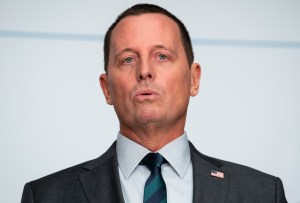
In my earlier posts on the Habba-Grenell mutual self-immolation spectacle, I’d told you that while Ric Grenell is as nasty as they come, I was skeptical that he was quite dumb or reckless enough to be involved in what Alina Habba and her new husband were alleging.
But I may heve been wrong!
There’s a new report out in Axios that adds a bunch more detail to the story. But before getting to that report, there’s some important context and caveats. I wouldn’t see this new Axios report as quite a “report” in the sense of new reporting that advances the story. It’s better to see this as three players (the White House, Grenell and Habba/Mildon) each of whom are trading a very hot potato back and forth between the three of them and hoping not to be the one left holding it when the music stops. But instead of a literal potato, that lashing out is taking place through new batches of leaks. We need to be clear that each batch of new leaks is from an interested party, with its own goals and agenda. And it may include some false details or more likely ones that are misleading. But on balance each batch of leaks is probably mostly true, helps fill out the emerging picture and sinks both adversary parties (Grenell and Habba/Mildon) deeper into the quicksand.

Democrats’ prospects across the board look about as good as they have at any point in the 2026 election cycle, and about as good as could have reasonably been imagined at any point since late November 2024. House, Senate, governorships, state legislative races, really just about everything is looking pretty rosy. The point of this post isn’t to rain on any of that. But for the last week or so I’ve been wanting to write a post about just how close many of the frontline Senate races are, despite the fact that it’s plausible that Democrats could come out of this election with a majority in the low or even mid-50s. What I’m talking about here is no more than the inherent uncertainty around all polls and all elections. But it’s still worth absorbing.

Earlier this week, we saw former Don Jr. fiancé Kimberly Guilfoyle summarily canned because she became a scandal lightning rod, in a particularly pitiful way, right when Donald Trump doesn’t need any scandal headlines — not just going into the midterms in a couple weeks but also into 2027 when it seems highly likely that at least the House will be in Democratic hands. Then yesterday, we had this new MAGA war break into the open which pits Alina Habba and her new Turkish oligarch boy-toy husband against Trump fixer Ric Grenell. Habba claims that Grenell either pocketed or misdirected a $6 million check her now-husband wrote as a contribution to the Kennedy Center. I suspect that Habba may be out over her skis on this one. Grenell is the worst. But he’s not stupid. I’m skeptical he’d try something quite that reckless.
In any case, today we have yet another new story just kind of breaking out into the open out of nowhere.
This is the weekly, free edition of The Backchannel. If you’d like to receive the free edition of The Backchannel in your inbox, you can subscribe here.
Kimberly Guilfoyle, the recently defenestrated and soon-to-be-former Ambassador to Greece, has that stench about her of third-string corruption, the type that is hated by the righteous and sneered at by the corrupt. In Trumpworld setting up your own bribery-faucet meme coin and making billions is a baller move. Begging a MAGA-adjacent huckster to settle your Amex bill on the strength of once being Don Jr’s fiancée is sad. “Steal a little and they throw ya in jail / Steal a lot and they make you king …” But we seem quite suddenly to be seeing MAGA world become quite leaky. That’s not what we’re used to — what we’re used to is mammoth kinds of Trump and MAGA corruption more or less in plain sight. But now various MAGA capos are accusing each other, or dropping dimes on each other, as the reality of a possible Blue Wave or more comes into view.
Another only-in-MAGA corruption story hit this afternoon. Or, I guess, alleged corruption story since it’s not altogether clear which player in the story is the crook or more of a crook.
Read More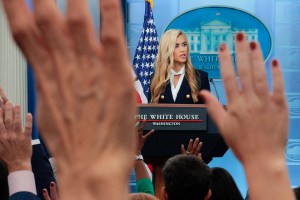
I couldn’t think what to say about this beyond simply reposting the first two grafs of this Washington Post article …
The White House on Tuesday scrambled to answer questions about the legal credentials of President Donald Trump’s new press secretary, Katie Zacharia, who made a brief and halting debut in the briefing room and later said she had passed a bar exam in China, a country where noncitizens aren’t allowed to practice in courtrooms.
Trump called Zacharia “an attorney” in his Friday announcement of her appointment, and her LinkedIn profile says she served as general counsel for Fix California, a nonprofit founded by Ric Grenell, a high-profile Trump adviser. Asked Tuesday where she had been admitted to the bar, Zacharia said China — not a U.S. state or D.C., where one would need to have been admitted to practice law in the United States.