

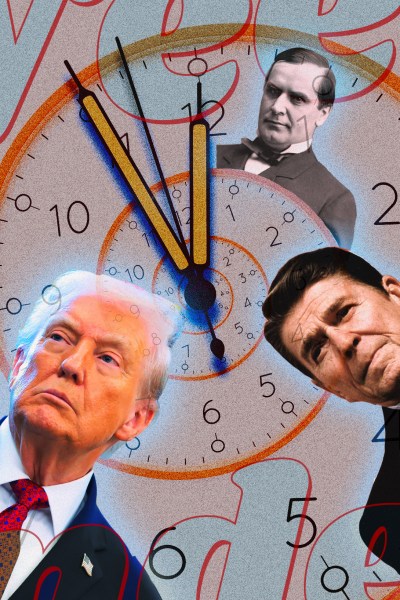



The Politics of Nostalgia
In what time would you prefer to live? The question is such a commonly considered hypothetical that how you answer it likely provides a good deal of insight into both your character and your politics. Answers typically tend toward nostalgia for an idealized past — sometimes drawn from lived experiences, but more often inspired by television, movies, books, the media, school, political propaganda, etc. Occasionally you come across someone who would like to live in the future, accommodated by imagined technologies or afforded some exciting new opportunity like intergalactic space travel. These ideas, too, are usually inspired by various media intakes. Rarely do you meet someone who would prefer to stay in the present. This might be because to answer this way cuts against the spirit of the hypothetical. It could also be that for most of the 21st century, the idea of being content in the present has appeared untenable.
To be fair, it is hard to argue that we are currently living in the best of times. But what are we to make of it when cultural institutions like Hollywood have preferred to spend the last decade-plus mining and regurgitating the past rather than confront the present, and our politics have been dominated by the idea that we need to return to increasingly regressive eras of former glory? That we are a society inundated and overwhelmed by nostalgia is hardly news to anyone. Writing in Harper’s about how the “nostalgic gluttony” of the 1970s bicentennial stacks up against the current semiquincentennial, Thomas Frank explains, “Nostalgia is today a structural feature of our modern world, the emptiness and vapidity at the heart of our culture, the inevitable mass-produced sentiment of a society that permanently feels that everything is constantly going wrong but is chronically unable to identify why.” Viewing nostalgia as a structural feature gives some insight into why we are unable to get out of our current rut. It also provides a basis for understanding how politicians can use it to their advantage.
The fact that time plays a central role in the push and pull of our two-party system is at once obvious and obscure. You see in the underlying ideologies that animate the parties (Republican conservatism vs Democratic liberalism/progressivism), a pitting of the desire to maintain the past against the goal of improving the future. The last presidential election was a contest between “Make American Great Again,” and “We’re not going back.” In reality, of course, this dynamic is less clear cut. The Republican Party under Donald Trump has all but abandoned any pretense of conservatism and the evocations of the past are more in line with fascistic concepts of renewal than conservative reverence for tradition. The Democrats meanwhile appear on the fence about how committed they are to a progressive platform; and while there may be consensus that we can’t go back, they have yet to articulate a compelling vision of where we are going. This has allowed Republicans room to swoop in and lay claim to being the party of both past glory and future innovation. As Frank puts it: “Crisis and renewal are strictly a matter of marketing now, a fiction that permanently assigns the Democrats the role of technocrats managing national decline while Republicans get to stand for muscular optimism and economic expansion. When the GOP holds the White House, America is great; when it doesn’t, it isn’t.”
While this strategy may have been enough to put Trump and the Republicans back in charge of the government, it appears to be cracking under the weight of actual governance. While it was never entirely clear what period of perceived American greatness Trump was referring to the first time he ran for president (likely the Reagan ‘80s but also perhaps the 1950s), his recent highlighting of the McKinley administration as peak America, along with his administration’s repeated attempts to reconstitute more than century-old laws, harken to a time it’s hard to imagine many Americans are wistful for. Worse than the resurfacing of a more menacing and antiquated America is the administration’s embrace of a future dominated by data centers which power a world of unregulated AI, prediction markets, and cryptocurrency; especially considering the AI industry is just as likely to lean into the possibility that they are harbingers of the apocalypse, or at least widescale job loss, as they are to promise future prosperity. This leaves the present mired in cultural and democratic backsliding and facing what seems like a hostile future.
In his Harper’s essay, Frank suggests that one way out of this mess is for politicians to adopt “a kind of counter-nostalgia, reclaiming a mythic past for the forces of tolerance and democratic generosity.” It’s a nice idea, but I’m not sure it’s a good reading of the room. We will always rely on certain traditions and founding principles to define ourselves. Nostalgia is simply an indulgence in the memory of who we are. It can’t be dismissed, but it might be time to give it a rest. Lost in the panic over the end of reading or sex or whatever else The Atlantic is worried about is that there are also lots of new beginnings. It’s exhausting being constantly reminded that everything around you is in decline. When something is broken, it’s good practice to fix it. However, it’s not your only option. You can also build something new. And judging from recent developments in politics, movies, media, etcetera, people are hungry for something new.
On July 14, Bastille Day in France, the House passed the Sunshine Protection Act on an overwhelmingly bipartisan bias. The bill, if it passes the Senate, would make daylight saving time (DST) permanent — answering literally the hypothetical I posed at the start of this essay. While it would be easy to file this alongside other oddball legislation like the recent bill allowing the emergency broadcast system to issue alerts for shark attacks (who says these people aren’t working for your interests), the debate over daylight’s savings time goes back more than a hundred years and has a real constituency that would like to see it made permanent. D.S.T activist Scott Yates went as far as to tell the New Yorker in 2017 that if we could get the government to solve the problem of being forced to change the clocks twice a year it “will empower people to say that this thing we thought was immovable is really fixable. We can fix this.” I agree it’s time to stop turning back the clock, but it would also be nice if our politicians could put forward a positive vision of the future that extends beyond an hour.

What Should Democrats Do With This New Wave of Voters?
Listen, I will be blunt. I did not watch this Fox News interview with the Democratic Socialist of America’s New York City co-chair and come away thinking that this was someone ready to head a major movement or even adeptly fend off predictably disingenuous right-wing cable news attacks. However, I also didn’t see anything incredibly terrifying or dramatic.
This clip aired on July 18, not long after some of the congressional candidates backed by the DSA won primary victories against more moderate Democrats. All of that came on the heels of the organization adopting a new platform that, among other things, called for a Green New Deal, universal healthcare, abolishing ICE, defunding the Department of War, and ending U.S. military aid to Israel while “prosecut[ing] U.S. and Israeli leaders responsible for the genocide in Gaza.”
Combined, these two developments spurred a wave of histrionics from Democratic operatives and apoplectic coverage from right-wing and more mainstream outlets painting the new candidates as “communists” and even part of a “parasite” project. It’s all a bit much, particularly considering how, in New York City, which has been ground zero for the wins and subsequent freakout, the DSA has recently brought more established Democrats into its ranks and backed some of former Mayor Eric Adams’ moderate agenda.
The election was even rather widely dubbed a Democratic “Tea Party,” which is pretty obviously hyperbolic since it wasn’t fueled by a racist conspiracy theory. And some of the victorious candidates weren’t DSA members and are decidedly more moderate. But let’s stick with the DSA and its platform for a moment since the organization and its involvement this cycle inspired a majority of the hand wringing.
We can all sit here and quibble over the specifics including the worst stuff some of the new candidates previously put on social media, the exact proper response to Israeli war crimes in Gaza, some of the more grandiose elements of the platform, including why the DSA or anyone else is still using the “defund” language when it’s such an unnecessary and proven political liability, and, of course, whether anyone on the left who isn’t an extremely gifted sparring partner should even be bothering with Fox. However, the reality is, nothing in this platform is that radical. It’s certainly not communism. And recent data — including the returns from these races — shows the progressive agenda presents a huge opportunity for the Democratic Party.
Polling has consistently shown that the priorities of young voters mirror the progressive platform. Recent data from Yale, Tufts, and Harvard has shown that young voters’ top priority is the cost of living; they worry about the price of healthcare costs; are concerned about America’s relationship with Israel and foreign wars more broadly; they do not approve of ICE; they support climate action; and they want structural change. This is particularly important for Democrats since the youth vote has long been seen as their key to victory. And, obviously, today’s young voters are poised to become more and more influential in the future.
But it’s not just young people who seem supportive of progressive priorities. New polling from YouGov released this week shows about half of Americans and nearly three quarters of Democrats support abolishing ICE. A poll released by the Guardian earlier this month showed a whopping 95% of Americans believe there is an affordability crisis. And a majority of Americans — plus nearly 80% of Democrats — have an unfavorable view of Israel driven by the death and destruction in Gaza. This stuff is not radical or the provenance of the young. It is, in fact, mainstream and even cuts across party lines.
That’s likely why there are indications in the 2026 primary returns that some of these new progressive candidates were able to bring large numbers of new voters to the polls. In two races in New York City where the DSA-backed candidates beat back fairly well-established political dynasties, the old guard didn’t actually shed support. Rather, the insurgents brought a whole new wave to the polls.
Those wins aren’t the only indication that Democrats may have opportunities with new voters. The Harvard Institute of Politics survey of young voters found they favor Democrats by nearly 20 points. And data from Pew that we highlighted earlier this month shows that almost half of non-voters are more likely to lean Democrat compared to 37% who lean Republican. That’s a dramatic swing from 2024 when slightly more non-voters leaned to the GOP and the overall demographic was split almost evenly between the two parties.
There are risks to outsider candidates and different approaches. Failed Maine Senate candidate Graham Platner did indeed attract new voters with a progressive message. However, his campaign infamously imploded amid a series of scandals. Of course, while Platner may have adopted the new left messaging, he didn’t exactly have a real background in progressive politics and centrist establishment Democrats were among his most influential backers.
Overall, it is clear that this moment is a major opportunity for Democrats to woo new voters — and elements of the progressive platform could help them do it. Rather than fighting the new wave, they would be well served to find common ground and swim along with it.
The Internet Was a Mistake
We Need Your Help
Thank you to the many members and readers who have already contributed to the Journalism Fund. We are on pace to hit our goal, but as it goes with these things, we have to keep pushing. As Josh Marshall has repeatedly explained, it’s critical to the success of our organization. So if you haven’t yet contributed, plus you have the means and are a fan of what we do, we hope you can take a minute of your time today to help us out. It really only takes a minute and you will have our eternal gratitude.

How Much of This Week’s News Do You Remember?
- What is the name of Lindsey Graham’s sister who was appointed to serve out the rest of her late brother’s term, and is now running for his seat?
- Which agency is moving to end demographic data collection after 60 years, and what do they do?
- Which Democratic politician recently announced she would pivot to becoming a book influencer after her gubernatorial bid failed?
Answers below

Home Sweet Home
“I like data centers so much, I wish I lived in one.” – CNBC host Jim Cramer

The Unfathomable Ghoulishness of Tom Homan
The Trump administration’s brutal immigration regime is responsible for deporting more than 590,000 people since he returned to office in January 2025, a majority of whom don’t have criminal convictions. At least 10 people have been fatally shot by immigration officials, and more than 50 have died in immigration detention. How does White House Border Czar Tom Homan summarize all of this? “We’re deportationmaxxing.”
Sam Alito Has Gone Feral and Trump Has Wrecked the DOJ
Kate on Strict Scrutiny
We’ve all watched as Sam Alito’s brain has congealed into a mass of soft cheese, but TPM’s Kate Riga has had a front row seat. Kate joined Leah Litman of Crooked Media’s Strict Scrutiny podcast this week to break down the biggest decisions out of the recent Supreme Court term, talk about which cases have flown under the radar, and Alito going full Fox News Grandpa.
Per Kate, “Alito is an old guy who is in this insular world of old, embittered right-wing men; he’s imbibing the same media they imbibe; he’s listening to the people they respect. And you can see it in his opinions on everything from the voter fraud conspiracies to the anti-trans stuff. His brain is pickled ‘cause that’s what he’s stewing in.”
Josh on The Beat With Ari Melber
Josh Marshall joined The Beat With Ari Melber to talk DOJ corruption and Josh Kovensky’s exclusive about the federal prosecutor who marched at January 6 now leading Trump’s task force targeting alleged left-wing political violence.
As Josh put it, “The Department of Justice basically gets whittled down to what serves the immediate whims of Donald Trump, and that is punishing and retaliating against the people he perceives as his enemies; keeping his friends out of prison; and getting in the grill of people who generate headlines that make him feel bad.”
Trivia answers: 1) Darline Graham Nordone 2) The Equal Employment Opportunity Commission, which enforces anti-discrimination laws in the workplace 3) Former congresswoman Katie Porter






Cat (wow…I’m frist!!)
Got up entirely too early to watch the Tour de France … this is how I felt prior to coffee…
Good morning USA from Belize & PG by the Sea ! This is my Saturday morning breakfast crowd,Candy dog & 5 of her cat buddies all snoozing in harmony. The news from my old home always makes me sad, reinforces my belief that it was time to leave. There is always Hope, going back to when Pandora first opened the box but it’s being hounded by the forces of Greed & Destruction. I wish the best of fortune to you all…..
Good morning darr ! You are frist because of my creaky typing speed. Always so good to hear from you !
I envy you being in Belize and in harmony with critters!
My tribe now includes 12 cats, 1 dog, 5 chickens & 6 ducks ! I’m working with a veterinarian on donating my property to have a veterinarian center opened on it. Currently Punta Gorda has zero veterinarians available as the local doctor had a stroke 2 weeks ago. And so many animals in desperate need of care