

We have a new Cafe piece from an expert on the country’s authoritarian movement.
Three Lessons From Hungary on How to Beat Competitive Authoritarianism
This article is part of TPM Cafe, TPM’s home for opinion and news analysis.
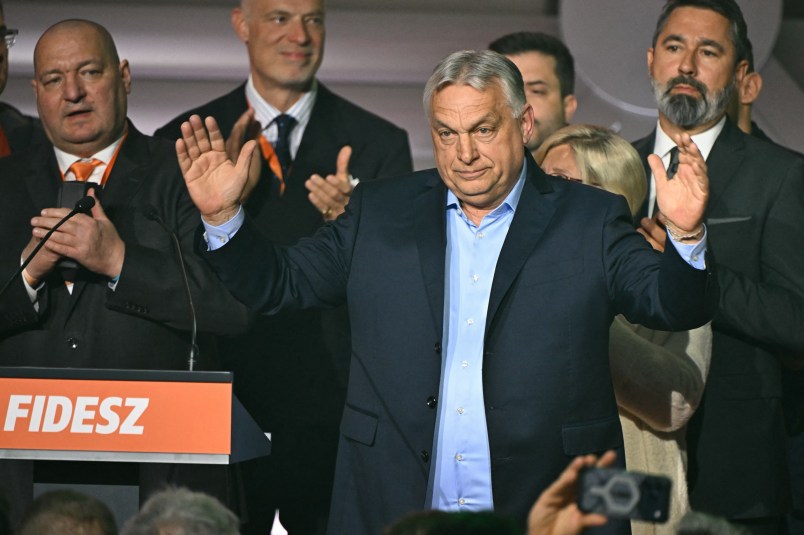
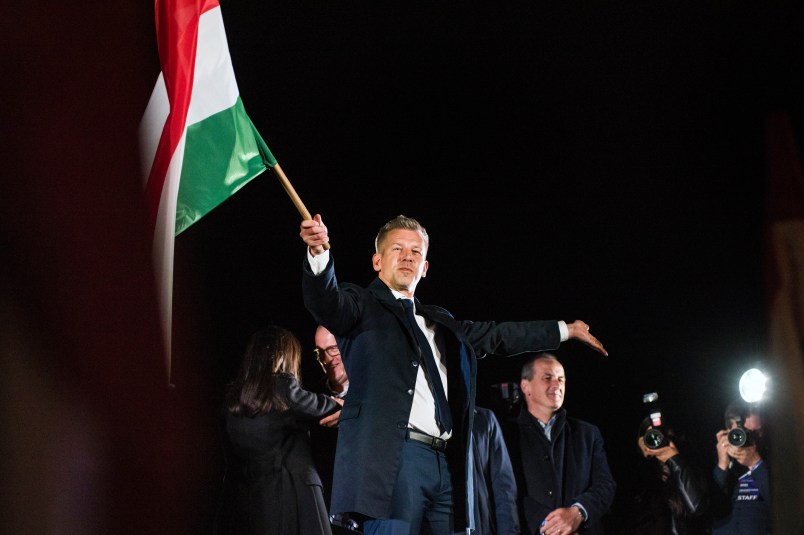
Sunday, April 12, brought long-awaited political change to Hungary. After 16 years in power, Prime Minister Orbán and his Fidesz party have been roundly defeated at the polls. Tisza, a new party led by Péter Magyar — a former Fidesz government insider who started openly opposing the Orbán regime after a clemency scandal rocked the government in 2024, leading to the president’s and the justice minister’s resignations — has won the election in a landslide.
The success came after more than a decade of Hungary’s slide towards authoritarianism, as Orbán’s government restricted media freedom, undermined the independence of the judiciary, eroded the rule of law, restricted civil liberties, and tilted the electoral playing field in its favour, among others. Right-wing leaders throughout Europe and in U.S. President Donald Trump’s MAGA movement took inspiration from his model.
Tisza won a clear majority in votes, which projections estimated would translate into a constitutional majority in parliament. Even with Magyar leading in the polls ahead of Sunday, few of those opposed to Orbán’s government felt this outcome was assured. Thanks to this super-majority, the party will now be able to implement fundamental reforms and undo parts of the authoritarian system Orbán has built over the past 16 years in power.
Contrary to most punditry, which suspected that the incumbent Fidesz party would resist, perhaps even challenge, a swift transfer of power, Prime Minister Viktor Orbán had conceded the race to Péter Magyar even before 50% of the votes were counted. Most likely, Fidesz realised that the opposing party’s winning margins were too wide across constituencies, thus undermining their ability to credibly challenge them.
Even though the Hungarian context differs fundamentally from the U.S. — and while the election in Hungary is, in the end, predominantly about Hungary — it does offer a few lessons on how far-right competitive authoritarianism can be defeated at the ballot box.
1) Campaigns are important, but it also matters where you campaign
Magyar’s victory did not come out of nowhere. In fact, it was the result of an arduous, almost two-year-long campaign across the country, involving hundreds of volunteers and individuals who sought change and supported the party.
Moreover, his landslide victory was also the result of intense campaigning in the smallest constituencies. Hungarian elections are overwhelmingly decided in smaller towns and rural areas, which have traditionally been Fidesz’s strongholds. Magyar drew on lessons from previous years and campaigned not only in big cities but also, overwhelmingly, in rural constituencies. Touring the country and visiting the smallest towns to spread his message helped him gain notoriety outside of government propaganda media that tried to misconstrue his message and portray him as a pro-Ukrainian, pro-war stooge supported by the EU establishment. Additionally, Magyar used his social media presence and the remaining independent online media to communicate with potential voters, once again enabling him to build momentum against the regime.
If there’s one lesson to draw for American democrats and Democrats, it’s to focus not just on big cities but also to establish a notable presence in rural areas and invest in personal contacts with voters.
2) A unified message behind one candidate
Although Magyar is a rather right-wing figure, coming from a politically conservative family tradition, his party’s voter base is majority left- and liberal-leaning. And yet, he managed to unite people behind him, create a big-tent organization, and mobilise voters. This was crucial in an electoral system in which Fidesz, the incumbent, can only be defeated with a strong, unified opposition party. Previous attempts at creating a coalition of parties to oppose Fidesz through Hungary’s parliamentary system notably failed. This time, however, Magyar managed to build a movement riding a wave of public discontent with the government’s performance and uniting voters of different ideological backgrounds behind a simple, unified message: No more business as usual; things must change. “Now or never” became the core slogan of the Tisza party, with “or never” cutting through, underscoring the urgency of removing the Orbán government, which had a tight grip on the country for the past 16 years and was likely to double down on its authoritarianism, while living standards for ordinary Hungarians would further deteriorate.
While Hungary shows that competitive authoritarianism can be beaten, that it will be is not a given. If anything, the Hungarian election shows that authoritarians don’t “just lose.”
“Now or never” is also a line from one of Hungary’s most well-known poems by a prominent national hero and revolutionary, Sándor Petöfi, which virtually every Hungarian knows. The message thus resonated broadly while also appealing to national pride, unifying Hungarians in their fight not just against but also for something: their homeland.
The lesson for other countries is to likewise build on what unites, rather than what divides. A fractured opposition — or, in the U.S. context, a fractured opposition party campaigning on different issues — is unlikely to effectively oppose an authoritarian.
3) Sowing hope
Notably, while Magyar’s key message was about opposing the Orbán regime and the soaring kleptocracy and corruption it allowed and encouraged, resulting in poor living standards, he also offered a strong message of hope. Repeatedly appealing to Hungarians, reminding them that their future is in their hands, that they do not have to live like this, and that they have an opportunity for change, motivated voters, keeping them engaged in an environment that seeks to make them politically disillusioned and disenchanted. As such, he campaigned not just against something but also, distinctly, for something, based on hope and trust in the country, namely: a better future and a better Hungary.
This lesson is crucial, also for other contexts facing competitive authoritarianism. Authoritarians want people to feel a sense of helplessness and despair, to demobilise them and suppress dissent. Offering messages of hope, allowing voters to dream of a better future, and reminding them that it’s in their hands helps them maintain morale, particularly in competitive authoritarian regimes with mostly free but unfair elections.
No one size fits all
Obviously, every election is context-dependent, and opposition strategies depend on local circumstances, salient issues, electoral systems and rules. As such, there is no one-size-fits-all solution to defeating authoritarianism, and Hungary’s lessons, as a distinct case, are limited.
While Hungary shows that competitive authoritarianism can be beaten, that it will be is not a given. If anything, the Hungarian election shows that authoritarians don’t “just lose.” Rather, Hungary presented the perfect storm to defeat an authoritarian: a weak economy, scandal after scandal from the governing party, and an emerging opposition figure who rose to the occasion with the skill to lead a movement, highlight the government’s numerous failings, and increase the salience of issues that are of interest to the majority of voters.
Beating a party entrenched in power requires not just a good strategy, but also the right conditions and someone able to take advantage of them. This includes building a strong, unified opposition that focuses on local mobilization and campaigns on salient issues that affect and resonate with everyday people across the board.
Orbán Falls
The defeat of Viktor Orbán is a big, big deal. He’s not only a core symbol of the global authoritarian movement. His regime was also its laboratory, its rallying point and a source of funding, a location to operate from. It’s important to note that he was defeated by what is essentially a center-right party, led by a defector from Orbán’s party. But from appearances, at least, it’s a center-right party that plans to operate within the structures of civic democracy. I wanted to note that, perhaps in spite of himself, Orbán, bad as he is, managed to again illustrate just what a weak and fraudulent man Donald Trump is. He managed to do what Trump has never been able to do: concede defeat.
This is a big and consequential defeat for global Team Strongman.
Staff At Minnesota Deportation Hub Received ‘Obscene’ Trump-Themed Challenge Coins Adorned With Skulls
Federal employees involved in the massive operation that led to a surge of deportations and detentions around Minneapolis in recent months have received a souvenir from the controversial mission. A federal worker provided TPM with images of a challenge coin that was given to employees from various government agencies at the B.H. Whipple Federal Building Minnesota, which holds a detention center and has served as a headquarters for ICE agents and others involved in the controversial Minneapolis operation, which was dubbed “Metro Surge.” The commemorative token includes portraits of President Donald Trump and a person who appears to be White House Border Czar Tom Homan glaring out from under a skull.
Continue reading “Staff At Minnesota Deportation Hub Received ‘Obscene’ Trump-Themed Challenge Coins Adorned With Skulls”JD to Pakistan
I’m no Trumper. I hate what they represent. But I can occasionally appreciate their approach to ritually humiliating their own. In this vein, it’s sort of a nice touch that they’ve made JD Vance — who’s been leaking to basically every news outlet that will listen that he was 100% against this war and it’s totally not his fault — own it outright, wrap himself in it really, in Pakistan.
Chef’s kiss, as they say.
For Eric Adams, Albania Is the New York Of the Balkans
Hello it’s the weekend. This is The Weekender ☕️
There is a long list of famous and infamous people who can trace their roots to Albania including the pop singer Dua Lipa, Mother Theresa, dictator Enver Hoxha, and the late comedian John Belushi. And now, disgraced former New York City Mayor Eric Adams has joined the ranks of famous Albanians.
Continue reading “For Eric Adams, Albania Is the New York Of the Balkans “The New Defense Budget
We need to talk about the president’s 2027 proposed defense budget. It’s not like there’s been a shortage of reporting about it. But even with all that, I don’t think people have really absorbed the extent of it, it’s significance, the scale of growth. The president wants to increase the defense budget by more than 40%. That comes on top of his request for $200 billion to fund his current war with Iran.
Continue reading “The New Defense Budget”How Do You Deprogram an Electoral Autocracy?
Hungary’s prime minister Viktor Orbán has become a kind of godfather of competitive authoritarianism, an autocratic visionary for the 21st century that right-wing parties around the world are seeking to emulate. Trump’s second term draws directly from his model, with the various thought leaders of that movement making their admiration plain. Orbán’s is a system in which elections continue, giving the country the appearance of democracy, but it is just that: an appearance.
Or so the thinking has gone. There is some irony in the fact that, according polls, Orbán is on track to lose reelection on Sunday to a former member of his Fidesz Party, Péter Magyar, who has won voters over by denouncing the regime’s corruption and incompetence. While it is no longer a question whether the country’s democratic mechanisms are fair, Sunday will test whether they are rigged enough to withstand the overwhelming backlash Orbán is now facing. JD Vance and Vladimir Putin are, in various ways, scrambling to save their ideological ally.
If Magyar’s party, Tisza, does win on Sunday, it could become the first step in a long process of de-Orbánization, which we have a great piece up on this afternoon. Political scientist Gabriela Greilinger walks through what will have to happen to unwind the prime minister’s grip on power. He and legions of his loyalists have burrowed deep into the mechanism of Hungarian government, and extracting them will not be quick or easy.
Continue reading “How Do You Deprogram an Electoral Autocracy?”Hungary’s Creep Toward Autocracy Helped Inspire Trump. In 2 Days, Voters Will Try to Reverse It
This article is part of TPM Cafe, TPM’s home for opinion and news analysis.
On Sunday, April 12, Hungarians will go to the polls in an election that will decide the future of their country and the illiberal state that Prime Minister Viktor Orbán — Europe’s longest-serving head of state and a role model for far-right authoritarians in Europe and America alike — has built over the past 16 years in power.
Continue reading “Hungary’s Creep Toward Autocracy Helped Inspire Trump. In 2 Days, Voters Will Try to Reverse It”Trump Goes International With Criminalizing Left-Wing Opposition
So THIS Is What Seb Gorka’s Been Up To?
Old TPM fave Sebastian Gorka has been pretty under-the-radar as the senior counterterrorism director on President Trump’s second term National Security Council, but now he pops up in this important New York Times story as a leader of what you might call the internationalization of the administration’s effort to criminalize left-wing opposition:
[Gorka] has pushed to designate more far-left groups abroad as terrorist organizations, to pressure foreign allies to investigate the groups and to search for connections between them and Americans. …
For months, Mr. Gorka has led a regular counterterrorism meeting with dozens of officials from U.S. security agencies. In those meetings, he has pushed for more attention on antifa, as well as other groups, like transgender activists and undocumented migrants.
Trump’s criminalization of left-wing politics, which TPM’s Josh Kovensky has covered closely in our series Creating the Enemy Within, traces back to Trump I, where it really took off during the Black Lives Matter protests in the summer of 2020. Authoritarians like Trump practically need a shadowy, cohesive, violent opposition — at least rhetorically — and if they don’t have one, they’ll set about inventing it.
The beauty, from the MAGA perspective, of the amorphous nature of antifa is that it can be a vessel into which every right-wing fear, conspiracy theory, and fever dream can be poured. What emerges from the NYT story is that Gorka is pushing the myth of an all-encompassing global antifa with purported ties back to American leftists:
Mr. Gorka has repeatedly told U.S. officials that “there are no lone wolves,” according to two officials who have witnessed the comments, in urging them to find links between left-wing extremists abroad and Americans, which could create a legal avenue to investigate U.S. citizens.
That possibility has alarmed current and former U.S. officials who worry the Trump administration is politicizing counterterrorism efforts, with the ultimate aim of punishing Mr. Trump’s opponents at home, potentially with charges of supporting terrorism. The unusually expansive way in which the administration has defined far-left extremism, they warned, could allow investigators to use slender connections to people overseas to go after Americans who have no real history of violence.
Gorka has an ally at the State Department in Thomas G. DiNanno, the undersecretary for arms control and international security. (Gorka called the NYT story “wrong.” DiNanno did not respond to the NYT.) The State Department issued a statement to the NYT confirming it is working with international partners to counter “antifa-aligned terrorism.” It’s offering a $10 million reward for information that disrupts the finances of violent leftist groups.
The whole thing is well worth a read.
Pentagon Denies Pope Threat
After initially issuing a non-denial denial, the Pentagon broadly denied as “grossly false” reports that a top Trump official had dressed down the Vatican ambassador in January for the Pope not being on the administration’s side, including making an ominous reference to the Avignon papacy.
Still, the Pentagon did not address the specifics of the reports. Instead, the U.S. embassy in the Vatican posted a rather odd rebuttal in which the U.S. ambassador to the Holy See purports to quote strained denials of a sort from the Vatican ambassador who was in the January meeting with Undersecretary of Defense for Policy Elbridge Colby:
The Cardinal emphatically denied the media’s portrayal of his meeting with Colby. He described the meeting as “frank, but very cordial” and a “normal encounter.” He confirmed that the reporting “does not reflect what happened” and was “just invented to make a story.”
Here’s the full thread:
Ambassador Burch spoke today with His Eminence Cardinal Pierre, the outgoing papal nuncio to the United States, regarding his January meeting with Under Secretary Elbridge Colby. 1/4 https://t.co/FYwa2T7uln
— U.S. in Holy See (@USinHolySee) April 9, 2026
Judge: Pentagon Defied My Order
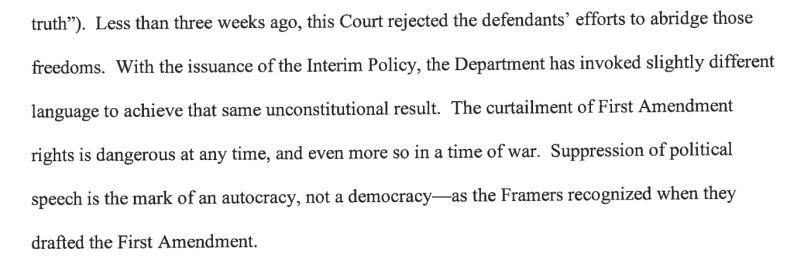
Unlike the slow-motion confrontations in many of the other case where the Trump administration has defied court orders, U.S. District Judge Paul Friedman quickly called out the misconduct and moved to put a stop it.
It took Friedman less than three weeks to rule that the Defense Department had violated his March 20 order to restore press access to the Pentagon. In the case brought by the NYT, Friedman issued a scathing rebuke of the administration’s conduct in the case:
Latest From the Middle East …
- How It’s Going: Trump Demands Reopening of Hormuz Ahead of US-Iran Peace Talks
- Israel: There’s growing evidence that Israel’s operation in Lebanon was understood by the parties to covered by the ceasefire with Iran, but instead Israel ramped up attacks against Hezbollah, complicating diplomatic efforts to such an extent that President Trump gave Prime Minister Benjamin Netanyahu a “stern message” in a brief phone call to “scale back attacks,” according to the WSJ.
- ‘Squirter’: Army survivors of the deadly attack in Kuwait dispute Pentagon’s account, saying the unit “was unprepared” to defend itself, CBS News reports.
The Corruption: In All Its Glory Edition
- DoD: A Pentagon official who oversees the Defense Department’s artificial intelligence efforts made a cool profit of as much as $24 million earlier this year when he sold a private investment in Elon Musk’s AI company, The Guardian reports.
- White House: “The day after President Trump announced a sudden pause of strikes against Iran last month, the White House warned staff against improperly leveraging their positions to place well-timed bets in futures markets,” the WSJ reports.
Trump DOJ Watch
- Bloomberg: Under Trump, DOJ Has Been Making Errors in Court, Testing Judges’ Patience
- The Trump DOJ is putting the finishing touches on a politicized report that will accuse the Biden Justice Department of being anti-Christian in how it enforced Covid regulations and laws protecting abortion clinics.
Thread of the Day
Mass Deportation Watch
- Lawyers for man shot multiple times by ICE during a traffic stop this week in California say their client has already been shot before he tried to flee the scene.
- San Francisco Chronicle: Medical delays and misdiagnoses drive rising death toll in ICE custody
- A California philosophy professor was acquitted by a federal jury after some two hours of deliberation on charges of assaulting federal agents by throwing back a tear gas canister they had deployed against protesters.
Nothing to be Concerned About …
The Trump administration is quietly seeking unprecedented access to personally identifiable medical information in the insurance records of millions of federal workers and retirees, and their families, KFF Health News reports.
Enjoy Your Spring Weekend
See ya back here Monday.
Hot tips? Juicy scuttlebutt? Keen insights? Let me know. For sensitive information, use the encrypted methods here.