I agree with a lot of your post on disorganized retreat. But I want to come at this from another angle.
For the most benefit practically and politically over the next few months, the concession that is most important imo is giving MN AG full, real time access to all evidence. Not to be crass about it but the public loves a murder trial. Talking about legislative constraints on ICE will put the public to sleep. But the public will have an endless appetite when it comes to pursuing justice for Alex Pretti and putting the man who shot him in the back of the head in jail.
In Ward 10, the Minneapolis neighborhood where ICU nurse Alex Pretti was gunned down by federal agents, neighbors are turning to each other for everything from groceries to school dropoffs.
“We have people who are, every single day, taking their vulnerable neighbors’ kids to school for them; taking them to work; taking them to do their laundry; bringing groceries to folks so they can be safe in their homes,” Aisha Chughtai, the Minneapolis council member representing Ward 10, told Talking Points Memo.
“This is the most Minnesotan thing I know. This is the most compassion-for-neighbors thing I know.”
Federal agents have occupied Minneapolis and St. Paul, Minnesota since December as part of “Operation Metro Surge,” a deportation campaign aimed at the Twin Cities. That surge has resulted in the deaths of both Pretti and 37-year-old mother and activist Renée Good. As ICE increased its presence in the city this month, Minnesotans also stepped up, with tens of thousands braving harsh winter weather to protest, act as legal observers, and participate in mutual aid. These acts, Twin Cities residents say, constitute basic care for their communities. But the GOP wants to cast these support networks as something more sinister: a conspiracy, possibly even a criminal one.
It’s a familiar tactic by a Trump administration that has often alleged dark motives for acts of decency. In Minnesota, though, that tactic is backfiring on a historic scale.
This article is part of TPM Cafe, TPM’s home for opinion and news analysis. It was originally published by The Conversation under a Creative Commons license.
As the operations of Immigration and Customs Enforcement have intensified over the past year, politicians and journalists alike have begun referring to ICE as a “paramilitary force.”
Rep. John Mannion, a New York Democrat, called ICE “a personal paramilitary unit of the president.” Journalist Radley Balko, who wrote a book about how American police forces have been militarized, has argued that President Donald Trump was using the force “the way an authoritarian uses a paramilitary force, to carry out his own personal grudges, to inflict pain and violence, and discomfort on people that he sees as his political enemies.” And New York Times columnist Jamelle Bouie characterized ICE as a “virtual secret police” and “paramilitary enforcer of despotic rule.”
All this raises a couple of questions: What are paramilitaries? And is ICE one?
Defining paramilitaries
As a government professor who studies policing and state security forces, I believe it’s clear that ICE meets many but not all of the most salient definitions. It’s worth exploring what those are and how the administration’s use of ICE compares with the ways paramilitaries have been deployed in other countries.
The term paramilitary is commonly used in two ways. The first refers to highly militarized police forces, which are an official part of a nation’s security forces. They typically have access to military-grade weaponry and equipment, are highly centralized with a hierarchical command structure, and deploy in large formed units to carry out domestic policing.
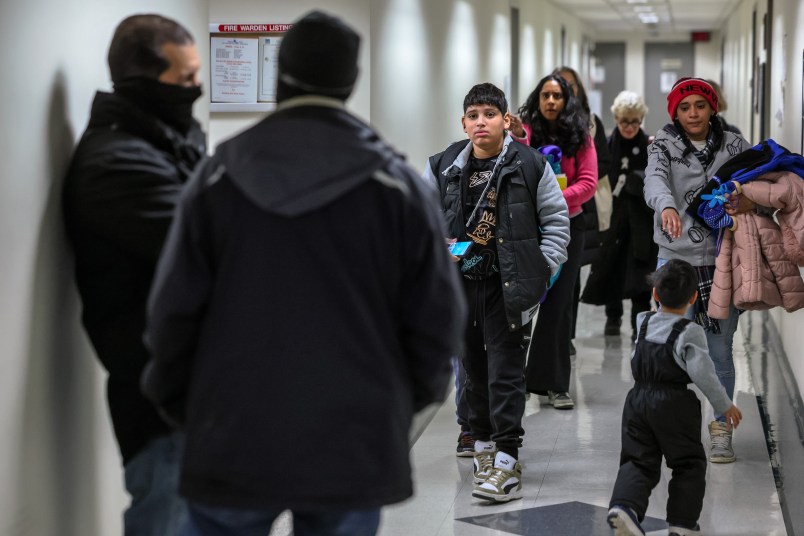
NEW YORK, NEW YORK – JANUARY 28: A family is escorted after their hearing in immigration court as masked federal agents patrol the halls at the Jacob K. Javits Federal Building on January 28, 2026 in New York City. Immigration and Customs Enforcement (ICE) agents and other federal agencies continue to make detainments in immigration courts as immigrants attend court hearings, a day after dozens of demonstrators were arrested in Manhattan on after occupying the lobby of a TriBeCa hotel where federal immigration agents were reportedly staying while carrying out the Trump administration’s immigration crackdown. (Photo by Michael M. Santiago/Getty Images)
The second definition denotes less formal and often more partisan armed groups that operate outside of the state’s regular security sector. Sometimes these groups, as with the United Self-Defense Forces of Colombia, emerge out of community self-defense efforts; in other cases, they are established by the government or receive government support, even though they lack official status. Political scientists also call these groups “pro-government militias” in order to convey both their political orientation in support of the government and less formal status as an irregular force.
They typically receive less training than regular state forces, if any. How well equipped they are can vary a great deal. Leaders may turn to these informal or unofficial paramilitaries because they are less expensive than regular forces, or because they can help them evade accountability for violent repression.
Many informal paramilitaries are engaged in regime maintenance, meaning they preserve the power of current rulers through repression of political opponents and the broader public. They may share partisan affiliations or ethnic ties with prominent political leaders or the incumbent political party and work in tandem to carry out political goals.
In Haiti, President François “Papa Doc” Duvalier’s Tonton Macouts provided a prime example of this second type of paramilitary. After Duvalier survived a coup attempt in 1970, he established the Tonton Macouts as a paramilitary counterweight to the regular military. Initially a ragtag, undisciplined but highly loyal force, it became the central instrument through which the Duvalier regime carried out political repression, surveilling, harassing, detaining, torturing and killing ordinary Haitians.
Is ICE a paramilitary?
The recent references to ICE in the U.S. as a “paramilitary force” are using the term in both senses, viewing the agency as both a militarized police force and tool for repression.
There is no question that ICE fits the definition of a paramilitary police force. It is a police force under the control of the federal government, through the Department of Homeland Security, and it is heavily militarized, having adopted the weaponry, organization, operational patterns and cultural markers of the regular military. Some other federal forces, such as Customs and Border Patrol, or CBP, also fit this definition.
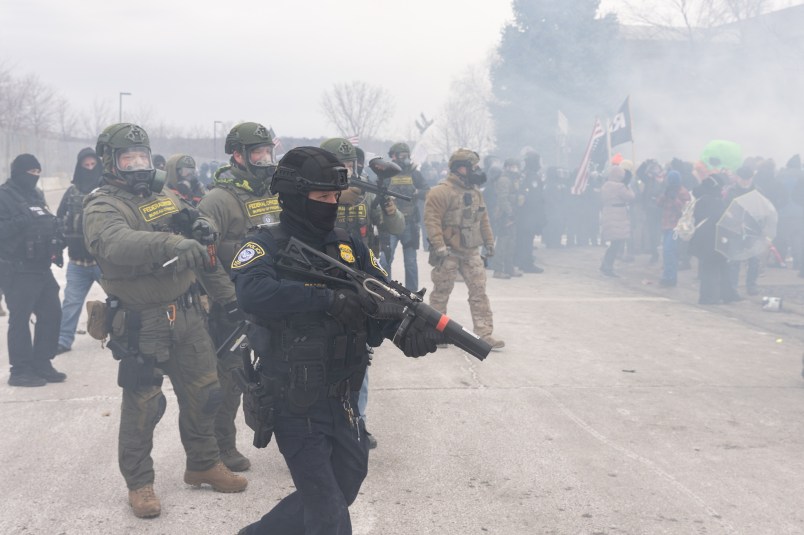
MINNEAPOLIS, UNITED STATES â” JANUARY 15: Federal agents clash with protestors outside an Immigration and Customs Enforcement (ICE) facility in Minneapolis, Minnesota, during a demonstration over the fatal shooting of Renee Nicole Good, a 37-year-old woman who was killed by a U.S. ICE agent, on January 15, 2026. (Photo by Mostafa Bassim/Anadolu via Getty Images)
The United States is nearly alone among established democracies in creating a new paramilitary police force in recent decades. Indeed, the creation of ICE in the U.S. following the terrorist attacks of Sept. 11, 2001, is one of just four instances I’ve found since 1960 where a democratic country created a new paramilitary police force, the others being Honduras, Brazil and Nigeria.
ICE and CBP also have some, though not all, of the characteristics of a paramilitary in the second sense of the term, referring to forces as repressive political agents. These forces are not informal; they are official agents of the state. However, their officers are less professional, receive less oversight and are operating in more overtly political ways than is typical of both regular military forces and local police in the United States.
The lack of professionalism predates the current administration. In 2014, for instance, CBP’s head of internal affairs described the lowering of standards for post-9/11 expansion as leading to the recruitment of thousands of officers “potentially unfit to carry a badge and gun.”
This problem has only been exacerbated by the rapid expansion undertaken by the Trump administration. ICE has added approximately 12,000 new recruits — more than doubling its size in less than a year — while substantially cutting the length of the training they receive.
ICE and CBP are not subject to the same constitutional restrictions that apply to other law enforcement agencies, such as the Fourth Amendment’s prohibition on unreasonable search and seizure; both have gained exemptions from oversight intended to hold officers accountable for excessive force. CBP regulations, for instance, allow it to search and seize people’s property without a warrant or the “probable cause” requirement imposed on other forces within 100 miles, or about 161 kilometers, of the border.
Both ICE and CBP have been deployed against political opponents in nonimmigration contexts, including Black Lives Matter protests in Washington, D.C., and Portland, Oregon, in 2020. They have also gathered data, according to political scientist Elizabeth F. Cohen, to “surveil citizens’ political beliefs and activities — including protest actions they have taken on issues as far afield as gun control — in addition to immigrants’ rights.”
In these ways, ICE and CBP do bear some resemblance to the informal paramilitaries used in many countries to carry out political repression along partisan and ethnic lines, even though they are official agents of the state.
Why this matters
An extensive body of research shows that more militarized forms of policing are associated with higher rates of police violence and rights violations, without reducing crime or improving officer safety.
Studies have also found that more militarized police forces are harder to reform than less-militarized law enforcement agencies. The use of such forces can also create tensions with both the regular military and civilian police, as currently appears to be happening with ICE in Minneapolis.
The ways in which federal immigration forces in the United States resemble informal paramilitaries in other countries — operating with less effective oversight, less competent recruits and increasingly entrenched partisan identity — make all these issues more intractable. Which is why, I believe, many commentators have surfaced the term paramilitary and are using it as a warning.
The FBI executed a search warrant on Wednesday at an election office near Atlanta in Fulton County, Georgia, a locale infamous among MAGA conspiracy theorists who fulminated about the 2020 election and beyond. The search was, indeed, related to the 2020 election, according to a sweeping search warrant that surfaced hours after the raid.
Big public and political fights often have the dynamics of military confrontations. The ongoing backlash and outcry over the ICE murder of Alex Pretti is one such example. Over the first days of this week, the Trump White House lost its footing on the whole issue of ICE wilding sprees in Blue cities. As we discussed yesterday, they’re trying to manage what amounts to a live-action rebranding, telling the public they’re getting things back into line without, if possible, changing anything. But the White House’s public line on ICE and its Blue state wilding sprees has been so categorical and over-the-top it’s a really tough pivot. It’s hard to get your footing when you’re rapidly going from “ICE is our warrior force against immigrant-befouled hellholes run by domestic terrorists” to “we need a real investigation and ICE probably shouldn’t be murdering this many people.”
A small number of tickets are still available for tomorrow night’s event in D.C.I’ll be talking about DOJ weaponization with a stellar panel:
Stacey Young, a DOJ veteran who is the founder and executive director at Justice Connection;
Kyle R. Freeny, a former DOJer who was a member of Special Counsel Robert Mueller’s team and is now senior counsel at the Washington Litigation Group; and
Anna Bower, senior editor at Lawfare
Ticket information here(TPM members should look out for a special discount code in your inboxes to get 2-for-1 tickets. Reach out to allegra@talkingpointsmemo.com if you didn’t receive or can’t find it.) Hope to see you there!
Authoritarian Trickery
Since the Trump administration abandoned its initial false claims about Alex Pretti — reportedly authored by Stephen Miller — it has repeatedly fallen back on the position that it cannot comment on the fatal shooting by two Customs and Border Protection agents because there is an ongoing investigation.
As I pieced together in yesterday’s Morning Memo by reviewing a cluster of newly filed declarations from federal law enforcement officials, their investigation is limited to an administrative review of the use of force by the officers who shot Pretti, not a DOJ criminal probe under civil rights laws. That is to say, the inquiry is focused on whether officers broke CBP’s internal rules, not the law.
As MSNow has since confirmed, the Trump DOJ has decided not to open a civil rights investigation into the Pretti shooting, the same decision it made in the fatal ICE shooting of Renee Good:
A Justice Department official confirmed that there is no current DOJ investigation but said, “We are not going to prejudge the facts. At some later point, if the evidence presents itself, we may investigate.”
As in the Good shooting, the focus of at least one federal investigation is not on the use of deadly force but on the victim:
A Customs and Border Protection office will investigate whether its own officers followed agency policy in the shooting, according to the people. Another DHS unit, Homeland Security Investigations, will investigate whether Pretti broke any laws, according to two people familiar with the decision.
Re-read that last sentence: “whether Pretti broke any laws.”
MSNow also reports that federal agencies are still not sharing information about the fatal shootings with Minnesota law enforcement or giving them access to evidence.
You wouldn’t think the clumsy rhetorical trick of hiding behind a pending investigation to avoid immediate accountability would work, but the number of news stories citing the federal investigation as if it’s a real thing over the past 48 hours suggests the trickery is more effective than it should be.
It’s not a new trick:
Okay, so this is an authoritarian playbook trick, once the evidence is overwhelming say everyone needs to wait for the official investigation then either fix it or attack it when its completed. Same shit Russian pulled with MH17 and chemical attacks in Syria, very predictable.
In all 16 incidents since July in which DHS officers have fired shots, the Trump administration has publicly declared their actions justified before waiting for investigations to be completed, the WaPo reports.
As Aaron Blake notes: “This kind of maximalist, factually challenged approach isn’t just commensurate with who Trump is; it’s who the top Department of Homeland Security officials involved have shown themselves to be. This was very much par for the course. And to the extent the name of the game was sobriety, steadiness and credibility, these might not have been the people for the job.”
It Wasn’t Alex Pretti’s First Rodeo Either
About a week before his death, Alex Pretti suffered a broken rib at the hands of federal officers, who tackled him when while he was protesting a detention operation, CNN reports:
The earlier incident started when he stopped his car after observing ICE agents chasing what he described as a family on foot, and began shouting and blowing his whistle, according to a source who asked not to be named out of fear of retribution.
Pretti later told the source that five agents tackled him and one leaned on his back – an encounter that left him with a broken rib. The agents quickly released him at the scene.
“That day, he thought he was going to die,” the source told CNN.
The Public Meaning of Masculinity
Brian Beutler contrasts the thuggish masculinity extolled by MAGA with the bravery of Alex Pretti:
Pretti was unafraid. His last act was to help a woman who had been tackled to the ground by a masked invader—to place himself between her and him. He died in a heroic way, but if he’d survived, he’d have been welcomed home by a grateful community. Strangers, who would have wanted to get to know him, learn from him, and see him safely through the rest of his life. He would have lived the life of fulfillment that MAGA wants you to believe is only possible if you behave like a thug.
‘Demented Shit’
"This is moral injury that we're living through. They still have an active federal investigation into the wife of Renee Good. And that is demented shit right there." – @governorwalz.mn.gov Watch his full conversation with @timmiller.bsky.social on today's Bulwark Podcast.
After threat from the chief federal judge in Minnesota that he would haul the acting ICE director into court for contempt of court proceedings unless it complied with his previous order to release an ICE detainee, the Trump administration released the man, his lawyer said.
The government of Ecuador filed a protest with the U.S. embassy after an ICE agent attempted to enter the Ecuadorian consulate in Minneapolis without permission but was rebuffed by consular staff. “One ICE officer can be heard responding by threatening to ‘grab’ the staffer if he touched the agent before agreeing to leave,” the AP reports.
A very informative NYT analysis uses one AP photo of federal agents conducting a warrantless raid in Minneapolis to illustrate the militarization of U.S. law enforcement
Fuck Around and Find Out
Nine state prosecutors from big blue cities have launched a coalition to assist in prosecuting federal law enforcement officers who violate state laws. The pungent name of the organization — Project for the Fight Against Federal Overreach — left the NYT struggling to to convey the word play: “Its acronym, F.A.F.O., references a slang term for negative consequences”
Quote of the Day
“It’s not like the SS are coming.”—Italian Foreign Minister Antonio Tajani trying to tamp down domestic concerns that ICE’s Homeland Security Investigations will be helping with security at next month’s Winter Olympics in Italy
Man Arrested in Assault on Rep. Omar
Anthony James Kazmierczak, 55, was arrested for the assault on Rep. Ilhan Omar (D-MN) during a town hall in Minneapolis last evening after he disrupted the meeting by spraying an unknown foul-smelling substance on her:
Omar declined to end her appearance after the assault. “We will continue,” she said. “These fucking assholes are not going to get away with this.”
For the Record …
We know exactly who Trump is at this point, but yesterday offered a couple of especially pointed examples of the curdled soul of the man:
On the assault on Rep. Omar …
Just spoke to Pres. Trump. I asked him if he had seen the video of Rep. Omar being attacked and sprayed by a substance.
“No. I don't think about her. I think she's a fraud. I really don't think about that. She probably had herself sprayed, knowing her,” the president said.
In related news, Trump — in a move that would have been a standalone scandal in any other administration — revealed on social media before the Omar assault that she is the subject of Justice Department criminal investigation that apparently dates back to the Biden administration.
On the two fatal shootings in Minneapolis …
While talking about Alex Pretti, Trump suggests he feels even worse about Renee Good because her parents were Trump fans.
The U.S. Park Service has undertaken a new wave of removals of exhibits, signs, and interpretative aids that whitewash U.S. history to conform to a sanitized MAGA revisionism embodied in President Trump’s March executive order.
The changes have hit 17 additional parks mostly in the West, including Grand Canyon, Glacier, Big Bend, and Zion, the WaPo reports: “The removal orders include descriptions of how climate change is driving the disappearance of the glaciers at Glacier National Park and a wayside display at the Grand Canyon referring to the forced removal of Native Americans.”
When White Supremacy Is Official Gov’t Policy
The NYT catalogues dozens of social media posts by government agencies over the past month that include iconography associated with far-right extremist groups.
Hot tips? Juicy scuttlebutt? Keen insights? Let me know. For sensitive information, use the encrypted methods here.
The mother and sister of two Trinidadian citizens who the Trump administration killed in a mid-October boat strike have sued the government in federal court, seeking “pecuniary, compensatory, and punitive damages.”
Yesterday I discussed how in a flash, over roughly 24 hours, the Trump administration began to lose control of the public narrative about ICE and its wilding missions in Minneapolis. The public has been turning against ICE for months. This isn’t new. What we see now is the fragmentation of the pro-ICE wilding chorus. These propaganda choruses are like schools of fish. They are marvelously united and function in a way that no fish has any interest in straying from the school. They flit this way and that but always in unison. When they begin to fragment, that coherence breaks apart very rapidly as the incentive for each fish to stay in line diminishes.
I want to recommend a new article in The Atlantic, one by Adam Serwer, the kind of article only Adam can write. The gist is that ICE and MAGA are losing in Minneapolis in large part because the citizens of the city are performing — really embodying — a resistance of mutual protection. MAGA (and its paramilitary wing, ICE) presents itself as a movement of social solidarity, camaraderie and valor based on ethnic and ideological purity. But it’s the citizens of Minneapolis who are embodying those values. Good and Pretti lost their lives acting as observers, spotters, place-your-body-in-the-breach defenders of people they didn’t know. They showed bravery and selflessness and concern for their neighbors, the kind of intense communalism MAGA posits as commonplace in a lost golden age that can be regained with a purifying violence.
This article is part of TPM Cafe, TPM’s home for opinion and news analysis.
On a frigid day in late January, more than a dozen masked federal agents surrounded a white ranch house in St. Paul, Minnesota. They entered the home with guns drawn after one busted open the front door with a battering ram; when they re-emerged, they led a man wearing nothing but sandals, blue underwear, and a red plaid blanket thrown over his shoulders, head bowed, into the street. ChongLy “Scott” Thao, a U.S. citizen, told the Associated Press that the agents handcuffed him in front of his 4-year-old grandson and refused to let him retrieve his ID. In Thao’s telling, the agents drove him to the “middle of nowhere,” photographed him outside in the subfreezing temperatures, and asked to see the ID they had not let him collect before they returned him to his rental home a few hours later.
The Department of Homeland Security said its agents detained Thao because they believed he was living with two convicted sex offenders they were seeking to arrest, which he has denied. The AP reported that the nearest sex offender listed as living in Thao’s zip code is more than two blocks away, raising the question of why the department thought its targets were living at his address. And under what authority, exactly, did these immigration enforcement officers break into Thao’s rental? According to the Washington Post, ICE agents now have been empowered to enter homes in order to arrest immigrants, a directive that advocates say flagrantly violates the Constitution. “The highest levels of ICE are, in effect, saying agents should break down your door, ransack your home, terrify your children, arrest or detain you without a judicial warrant,” Sen. Richard Blumenthal (D-CT) told MSNOW. “It simply means the law means nothing to these agents.”
A flex of power like this should confirm the deeply-held suspicions of many on the right that federal agents are, as former National Rifle Association president Wayne LaPierre infamously worded it 30 years ago, “jack-booted thugs armed to the teeth who break down doors, open fire with automatic weapons and kill law-abiding citizens.” From Waco and Ruby Ridge in the ‘90s to armed standoffs at the Bundy ranch and the Malheur National Wildlife refuge in the mid-2010s, conservatives have long viewed use of force by federal agents as tyrannical — even when that threat of force was entirely made up, like when conservative officials and commentators stoked conspiracy theories that former President Obama would use military training exercises as cover to implement martial law and seize law-abiding citizens’ guns.
Two M1 Abrams tanks sit in the underbrush about 200 yards from the Branch Davidian cult compound in Waco, Texas 10, March 1993.
Secretaries of State across the country are denouncing Attorney General Pam Bondi’s recent demand for access to Minnesota voter rolls — an attempt to tie the Trump administration’s months-long crusade to obtain personal voter information from various states with the recent killing of 37-year-old U.S. citizen Alex Pretti by Immigrations and Customs Enforcement.
In a letter to Democratic Minnesota Gov. Tim Walz following Pretti’s killing by federal immigration officers, Bondi described the ways in which Walz could end the “chaos” in Minnesota and “restore the rule of law.” One of those things being, as outlined by Bondi, allowing “the Civil Rights Division of the Department of Justice to access voter rolls to confirm that Minnesota’s voter registration practices comply with federal law as authorized by the Civil Rights Act of 1960.”
During a press briefing this week, Walz rejected Bondi’s order and slammed the attorney general for her request.
“I would just give a pro tip to the attorney general — there’s 2 million documents in the Epstein files we’re still waiting on. Go ahead and work on those,” he said.
“The way to fix this is get these [ICE] folks out of here,” he added.
A handful of Democratic secretaries of state who have also been targeted by the DOJ’s voter roll demands have rebuked Bondi’s letter to Minnesota, with one describing the maneuver as “blackmail.”
Maine Secretary of State Shenna Bellows argued that the ongoing ICE raids, specifically in parts of the country that did not vote for President Trump, are all part of a broader effort to “create chaos and control our states and elections.” Maine is one of a handful of states that the Trump administration is targeting with its ongoing immigration enforcement occupation.
“Attorney General Bondi’s letter to Minnesota made explicit what has long been clear: ICE is invading our states and inflicting violence in order to create chaos and control our states and elections. These sinister actions are Donald Trump’s attempt to assume absolute power,” Bellows said in a statement.
“Let me say this clearly for President Trump: Maine will never turn over our voter rolls as a ransom payment to get ICE to end its unconstitutional assault on our state,” she added.
Colorado Secretary of State Jena Griswold, similarly spoke against the letter.
“I am horrified that this administration would inflict violence and chaos on American communities and continue to pressure the state into handing over its voter data. This is wrong, morally bankrupt, and a disgrace,” she said.
Arizona Secretary of State Adrian Fontes described Bondi’s demand as “blackmail.”
“The Department of Justice has now told Minnesota officials that they will remove ICE if they hand over their voter rolls — this is not how the law works,” he said.
In rejecting Bondi’s letter, Minnesota’s own Secretary of State Steve Simon described Bondi’s attempt to connect the DOJ’s voter data order with an end to the “chaos” in Minnesota as “an apparent ransom to pay for our state’s peace and security.”
Bondi’s demand for voter files is part of the Trump administration’s months-long crusade to obtain sensitive voter data from 44 states across the country. The DOJ is currently suing 24 states — including Minnesota — who have not complied with this request, which experts have described as an overreach of the DOJ’s authority, at best.
Against the backdrop of this ongoing DOJ pursuit in Minnesota, a federal judge recently dismissed a related lawsuit in Oregon. The lawsuit was brought by the DOJ against Oregon after the state refused to comply with the DOJ’s demands for voter data.
U.S. District Judge Mustafa Kasubhai referenced Bondi’s letter in his Monday order, asking lawyers on either side to explain specifically how that letter is relevant to the DOJ’s request.
As part of this ongoing campaign, the DOJ has relied on provisions in the Help America Vote Act (HAVA), the National Voter Registration Act (NVRA) and the Civil Rights Act of 1960 (CRA) to justify their order. While both of these statues give the states the authority to engage in voter list maintenance, neither of them give the DOJ this authority.
Justin Levitt, professor of law at Loyola Marymount University, previously told TPM that the DOJ is merely “citing a bunch of things to get the files, without a real reason to believe that states are currently violating any laws.”