

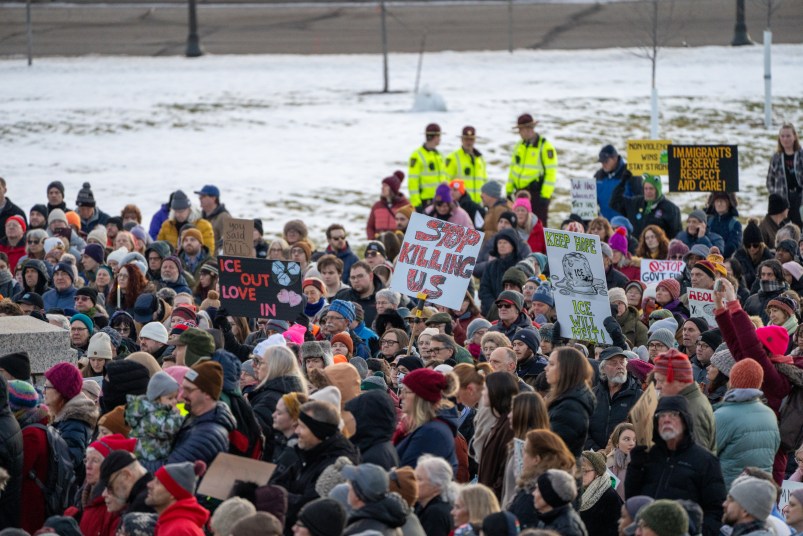
In Ward 10, the Minneapolis neighborhood where ICU nurse Alex Pretti was gunned down by federal agents, neighbors are turning to each other for everything from groceries to school dropoffs.
“We have people who are, every single day, taking their vulnerable neighbors’ kids to school for them; taking them to work; taking them to do their laundry; bringing groceries to folks so they can be safe in their homes,” Aisha Chughtai, the Minneapolis council member representing Ward 10, told Talking Points Memo.
“This is the most Minnesotan thing I know. This is the most compassion-for-neighbors thing I know.”
Federal agents have occupied Minneapolis and St. Paul, Minnesota since December as part of “Operation Metro Surge,” a deportation campaign aimed at the Twin Cities. That surge has resulted in the deaths of both Pretti and 37-year-old mother and activist Renée Good. As ICE increased its presence in the city this month, Minnesotans also stepped up, with tens of thousands braving harsh winter weather to protest, act as legal observers, and participate in mutual aid. These acts, Twin Cities residents say, constitute basic care for their communities. But the GOP wants to cast these support networks as something more sinister: a conspiracy, possibly even a criminal one.
It’s a familiar tactic by a Trump administration that has often alleged dark motives for acts of decency. In Minnesota, though, that tactic is backfiring on a historic scale.
“As the risk has gone up, other people — maybe people who have never organized or done rapid response or mutual before — are only showing up in greater numbers,” Kai Shelley, a community organizer who works as a senior policy aide for Chughtai, told TPM.
On Tuesday morning, Minneapolis residents were reviewing their digital safety measures. The previous day, FBI Director Kash Patel had announced on a right-wing podcast that he was opening a criminal investigation into Minnesotans’ Signal group chats, after a different right-wing social media personality complained that those groups were discussing the locations of ICE agents.
“This is clearly a coordinated infrastructure,” podcast host Benny Johnson told Patel, “and we’d like for the feds to take a crack at trying to get rid of this infrastructure the way they approach the mob or cartels or other terrorist networks, right?”
Anyone who opposes the Trump administration has heard this language before. The right is engaged in a long-term project of criminalizing dissent. A movement that first term swept into power on a tide of Pizzagate paranoia has turned the force of its conspiracy theorizing back on the less-powerful.
“As the risk has gone up, other people — maybe people who have never organized or done rapid response or mutual before — are only showing up in greater numbers.”
Kai Shelley, a community organizer and policy aide
Last year, President Donald Trump signed a pair of orders purportedly designating the broad anti-fascist movement as a terrorist organization, and instructing federal agencies to crack down on civil society nonprofits involved in alleged “criminal and terroristic conspiracies,” some of which boiled down to speaking against “foundational American principles (e.g., support for law enforcement and border control).” Trump has sought racketeering charges for protestors who heckled him at a restaurant this summer (it was a conspiracy involving paid protestors, he alleged) and elsewhere Republicans have sought similar conspiracy charges against people engaged in acts of care anathema to the conservative cause. Multiple states have pursued criminal conspiracy charges for people who help others obtain abortions, while in Georgia, Republicans pressed conspiracy charges against activists who operated a bail fund.
Outside the White House, the right-wing commentariat frequently denigrates things like group chats as “coordinated infrastructure” and smearing local organizers as “outside agitators.”
The latter term was applied in Minneapolis in 2020 after the murder of George Floyd by a police officer. It suggested two falsehoods: that Floyd’s community could not have possibly mustered the authentic anger that inspired the 2020 racial justice protests, and that the protests must therefore have been orchestrated by nefarious outsiders.
But the 2020 protests were real, and Minnesotans have learned from them, building support networks that are indeed coordinated — not like “the mob or cartels or other terrorist networks,” per Johnson, but by neighbors.
“This has always been an organized city,” Shelley said, citing the police killings of Floyd, Jamar Clark, and Philando Castile, as well as the arrest of CeCe McDonald. All four cases involved violent attacks on Black people in the Twin Cities, and led to protests in Minneapolis.
“There has always been some degree of mutual aid effort, and I feel like it exploded in 2020,” Shelley said. “Fast forward six years and there are even more people with knowledge about how to do mutual aid.”
Continuing the cause amid conspiracy accusations comes with challenges. Even before Patel threatened criminal investigations into local Signal group chats, those forums were already being mobbed by right-wing trolls intent on doxxing members. But participants did not give up. Instead they shifted text chains and took on code names, the Atlantic reported.
Indeed, if federal threats have had any effect, it has been to underscore the Trump administration’s lies about the Twin Cities and rally more people to the cause.
After an ICE agent fatally shot Renée Good on Jan. 7, federal officials accused her of “domestic terrorism,” contradicting the evidence of multiple videos. In a press conference on Good’s killing, Vice President JD Vance alleged that Good was “part of a broader left-wing network to attack, to dox, to assault and to make it impossible for our ICE officers to do their job.”
Vance then used the press conference to announce the launch of a new anti-fraud department run entirely out of the White House, subverting typical safeguards between the executive and investigative agencies. He decried that a “a group of left-wing radicals have been working tirelessly, sometimes using domestic terror techniques” to block immigration enforcement and said the new post would investigate the “financing networks and the domestic terrorism networks that legitimate this violence, that fund this violence and then of course engage in the violence.”
These conspiracy allegations, rather than demoralize Minnesotans, drew even more to the cause. A Minneapolis march last Friday drew a reported 50,000 participants, despite brutally cold temperatures. National outrage grew the following day when ICE officers shot and killed Pretti, a legal observer who was a lawful gun owner with a permit to carry, while he was on the ground and had been disarmed.
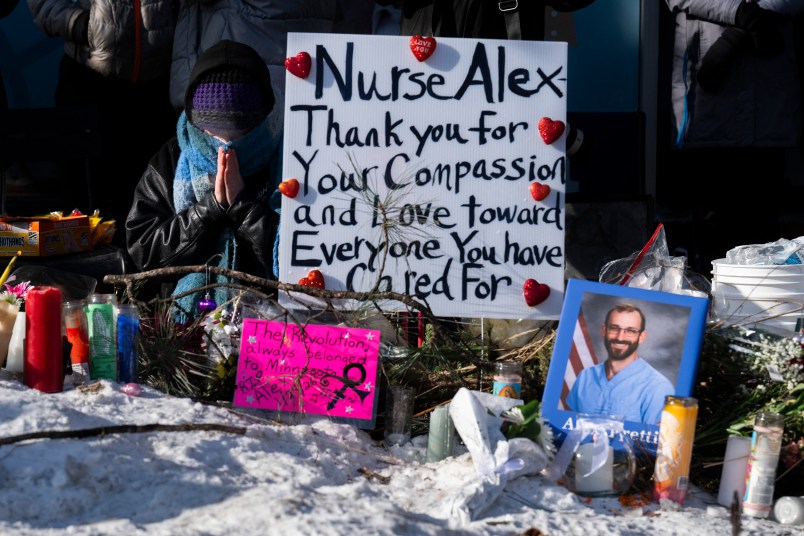
Chughtai, who spoke to TPM after visiting a memorial for Pretti, described hundreds of people gathered in the cold of a Tuesday night. That kind of care does not compute for the architects of Trump’s deportation machine, she said.
“These guys can’t possibly imagine that we care about each other because they don’t have an ounce of compassion in their hearts because they are the drivers of family separation,” Chughtai said. “This is what we do here. Minnesotans, when it snows we dig our neighbors’ cars out. We clear our elderly neighbors’ sidewalks. This is how we take care of each other.”
Eventually, she said, ICE will end its campaign in Minneapolis. When it does, the next cities in ICE’s sights will have to conduct organizing of their own. Meanwhile, the need for mutual aid in Minneapolis will continue as residents recover from a crackdown that has kept many from school or work for months. Already, organizers are eyeing long-term strategies like calling for a statewide eviction moratorium to protect locals who have lost wages while in hiding this month, and delivering hot meals to families in need.
It’s not a conspiracy. It’s just what neighbors do.
Correction: This post initially misstated the ward where Pretti was killed.



So you do to the least iof these, so you do unto me.
The right-wing are clueless about the demands of the faith they claim to hold.
Marble mouth Horman is giving a press Conf. from Minnesota now
Mostly BS
One of the highlights of the upcoming Epstein Season this year is the deposition of Les Wexner by the House Committee on Oversight and Government Reform, currently set for February 18, 2026, Wexler is exhibit #1 in Epstein’s modus operandi. Painful memories for Wexner, but should be enlightening.
This is a good article that gives me hope for our Democracy. The response of Minneapolis to the ICE attack was pretty much a surprise to the Trump crowd filled with right wing influencers and others like Stephen Miller who thought Minneapolis would cower and cave.
Anybody who knows anything about American history (admittedly the right wing influencers were too busy learning how to monetize their websites to learn history) realizes that Americans are not exclusively the insular transactional people portrayed on American media. They are not going to cower the way would be NAZIs think they should.
I have also learned that the tech bros at Apple are going to rue the day they put a really good movie camera in each phone. It is hard for the administration to do mischief when everything is captured from every possible angle.
After Minnesota I feel a whole lot better about the future of America.
“For heaven’s sake, children, fascism isn’t coming………. it’s here.” – Dorothy Parker, 1947, about HUAC