

One of my instrument panel watchwords for understanding politics is that all power is unitary. In the case of presidents, you don’t have one bundle of power in one area and a siloed, distinct and unaffected bundle in another. A president’s power is a uniform commodity wherever he reaches. What boosts it or drags it down in one area affects it everywhere else. That’s the best way to understand President Trump’s position 10 months into his second term. It’s hard to know whether it was the five-week government shutdown which focused public attention on draconian cuts to health care, the election night shellacking, the first signs of MAGA diehards defecting from the president, the grotesque and absurd Epstein cat-and-mouse game or a dozen other comparable examples. What makes it both hard to pick apart the different drivers of a president’s decline and perilous for the president himself is that the different drivers feed on themselves. They become both cause and effect in a mounting spiral.
Continue reading “Trump Has the Look of the Weak Horse; People Are Acting Accordingly”Trump Threatens Primaries Against Indiana GOPers Who Won’t Cave on Gerrymandering
Reacting to yet another obstacle in his path to redraw congressional district maps to help Republicans flip Democratic seats in as many states as possible before the midterms, President Trump slammed Indiana Republicans on Sunday for not bending the knee.
Continue reading “Trump Threatens Primaries Against Indiana GOPers Who Won’t Cave on Gerrymandering”Trump’s New Sham: The House Should Vote to Force Me to Release the Epstein Files That I Won’t Release
LOL Wut?
Poised to lose a House vote this week calling for the Justice Department to release its Jeffrey Epstein files, President Trump snookered a good chunk of political media by declaring in a social media post last evening that the House should vote to release the files.
Knowing he’s going to lose the vote — and knowing that the vote itself won’t be enough to pry the files loose unless the Senate agrees and he doesn’t veto it — Trump tried to redefine the setback by withdrawing his opposition to the vote, but not actually releasing the Epstein files.
But who in the world would be fooled by this?
The whole reason the House is voting is because the Trump DOJ — run out of the White House — won’t cough up the files. That is to say: Trump won’t release the files.
It’s not an about-face or a reversal. It’s a sham.
But It Gets Worse … It Always Gets Worse
Trump’s inane new position — that he wants House Republicans to vote to demand that he release the Epstein files that he refuses to release — comes after the president on Friday ordered the Justice Department to re-investigate everyone’s contacts with Jeffrey Epstein except his own.
While Trump has already broken the Justice Department — robbing it of its independence, capacity, and reputation — the demand to weaponize the Epstein case against Democrats will require a new level of Orwellian reality-denial by Attorney General Pam Bondi and FBI Director Kash Patel.
What’s groundbreaking about the new and improved Epstein investigation is that it wasn’t just career prosecutors but Bondi and Patel who said only a few months ago that there was nothing more to investigate. Trump is making them reverse and contort themselves in a degrading display of cult devotion that exceeds anything we’ve seen from them up to now. At this point, the only thing more cravenly loyal they could do is to investigate and indict themselves.
Bondi’s immediate public response to Trump’s demand: “Thank you, Mr. President.” She has turned the investigation over to the Manhattan U.S. Attorney Jay Clayton, who now faces his own loyalty test.
Perhaps the Most Important News Since Friday
The D.C. Circuit Court of Appeals — in a troubling and convoluted ruling — appears to have backed its way into not blocking U.S. District Judge James Boasberg from resuming contempt of court proceedings against the Trump administration in the original Alien Enemies Act case. I’m sorry if you had to read that sentence twice, but you have to read the fractured court ruling several times to make sense of it. Chris Geidner gives it his best shot.
This is a critical case in the closely watched question of whether federal judges will hold the line on Trump’s attacks on their constitutional role. If a district judge like Boasberg can’t proceed to investigate the administration for contempt in a historically important case where it was blatantly contemptuous, then the battle to sustain an independent judiciary will have been lost before it had barely begun.
The Retribution: Jim Comey Edition
Following the court hearing Thursday, that signaled Lindsey Halligan’s appointment as U.S. attorney may not pass muster with the judge reviewing it, Attorney General Pam Bondi took the almost unbelievable step of attempting for a second time to ratify, after the fact and retroactively, the appointment Halligan’s conduct before the grand jury that indicted Jim Comey.
The new filing from Bondi attempts to patch the hole in her previous ratification, when it was revealed in court by the judge that Bondi had reviewed an incomplete transcript of the grand jury proceedings:
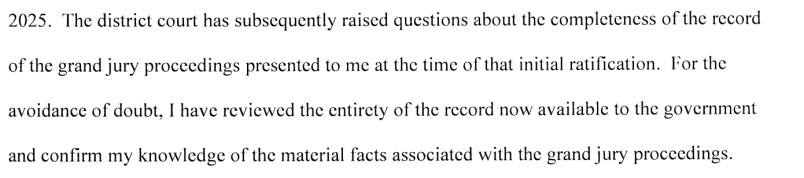
The Trump DOJ simultaneously filed a new declaration from Halligan that attempts to tamp down concern that parts of the grand jury proceedings weren’t recorded or are “missing.” Halligan attests that the gap in the transcript merely reflects the time when the grand jury was deliberating:

Halligan’s declaration clarifies some but not all of what happened in the grand jury proceedings. I had been assuming that after the grand jury returned the no-true bill as to one of the counts that Halligan would have gone back into the grand jury room and presented an alternative indictment on the two counts that they ultimately charged Comey with. But, according to her declaration, she had no further contact with the grand jury before it returned the two-count indictment.
Combine that with the paperwork fumbles (if that’s not too generous of a word) that the judge who accepted the indictment called Halligan out for in court, and there remains what Marcy Wheeler calls “a slew of problems” that I expect Comey’s lawyers will find a way to explore and possibly exploit.
Must Read
NYT: The Unraveling of the Justice Department … Sixty attorneys describe a year of chaos and suspicion.
The Corruption: Mike Flynn Edition
Former Trump national security adviser Mike Flynn and former Trump White House lawyer Stefan Passantino have joined the gravy train of Trump allies seeking to extract taxpayer-funded settlements from the Trump DOJ over claims they were the victims of politically motivated retribution. Flynn is seeking $50 million.
Georgia Fake Electors Case Back On?
Peter Skandalakis, the director of the Prosecuting Attorney’s Council of Georgia, has assigned the Georgia fake electors case to himself after being unable to find another prosecutor willing to take it on following the disqualification of Atlanta DA Fani Willis – but it’s not clear if he’ll continue to pursue convictions of President Trump and his alleged co-conspirators.
Venezuela Watch
- NPR reports for the first time on comments earlier this year by then-Trump DOJ official Emil Bove, now a judge on the 3rd Circuit Court of Appeals, that perhaps foreshadowed the administration’s lawless attacks on alleged drug-smuggling boats:
At a Justice Department conference in February, then-acting Deputy Attorney General Emil Bove told the department’s top drug prosecutors that the Trump administration wasn’t interested in interdicting suspected drug vessels at sea anymore. Instead, he said, the U.S. should “just sink the boats,” according to three people present for the speech.
- On Saturday, the U.S. killed three people in its 21st lawless strike against alleged drug-smuggling boats, bringing the death toll in the Caribbean and eastern Pacific to at least 83.
- The dubious and still-secret OLC memo that justifies the lawless U.S. campaign against drug-smuggling boat claims fentanyl is a potential chemical weapon threat, the WSJ reports.
- Rep. Adam Smith (D-WA), the ranking member on the House Armed Services Committee, says reports that the OLC memo contains language absolving everyone in the chain of command from criminal liability for the strikes is unusual: “It signals a fear that what they’re doing is illegal and that they could possibly be subject to criminal action under U.S. law and under international law.”
Quote of the Day
In a reality TV presidency, you need beefs, heels, betrayals, prodigals returning, and all manner of plot tricks to sustain the manufactured artificial drama. Who knows where this plot twist ends up going:
Preach, Sister
It’s striking to me that a lot of people want politics to be about their personal feelings, in which case they’re not engaged in politics, though they may be engaged in the sabotage of politics. …
[Y]ou vote strategically not expressively; you’re facing a ballot, not a Tinder/Grindr profile or a confessional, which I say because people often seem to speak as though they need their candidate to be someone who matches up to them in every way, even though they are only one of hundreds to hundreds of millions of voters, or see this as being about purity, aka choosing the candidate who is without sin or flaw, who they themselves will feel purer for voting for …
Do you like Morning Memo? Let us know!
Feds Go After the Antifa International
Hello it’s the weekend. This is The Weekender ☕️
The federal government demonstrated the latest example of how its putting Trump’s focus on Antifa into practice on Thursday by designating four European anti-fascist groups as foreign terrorist organizations.
The groups — Germany’s Antifa Ost, Italy’s Informal Anarchist Federation, and Greece’s Armed Proletarian Justice and Revolutionary Class Self-Defense — will lose access to the U.S. financial system. More importantly, its now a crime for “U.S. persons” (that’s a broader category than citizens) to provide any form of support to these groups.
Secretary of State Marco Rubio announced the designations, explicitly citing NSPM-7, the executive order that directed law enforcement to go after Antifa and to focus on vague ideological markers in doing so.
“Groups affiliated with this movement ascribe to revolutionary anarchist or Marxist ideologies, including anti-Americanism, ‘anti-capitalism,’ and anti-Christianity, using these to incite and justify violent assaults domestically and overseas,” Rubio said in the statement.
As I reported this week, a wide range of progressive-leaning nonprofits are already deeply intimidated by the administration’s threats towards the left.
But the foreign terrorist designations show how far this is going. This required coordination between government agencies, and for the federal law enforcement offices that oversee counterterrorism policy to have some idea of who they’re targeting. In other words: no matter how amorphous and ill-defined Antifa may be, these designations are real evidence to demonstrate that the administration is doubling down on making investigations into the left very, very real.
— Josh Kovensky
Thune Payout Provision Riles Up House Republicans
House Republicans are furious about the 11th hour payout provision Senate Majority Leader John Thune (R-SD) shoved into the continuing resolution (CR) that ended the shutdown earlier this week.
So much so that Rep. Greg Steube (R-FL) voted against reopening the government on Wednesday, saying he “could not in good conscience support a resolution that creates a self-indulgent legal provision for certain senators to enrich themselves by suing the Justice Department using taxpayer dollars.”
House GOP leadership is now working on bringing a standalone bill to the floor that would repeal the provision that would allow senators to sue the government for $500,000 or more if they discover their electronic records were seized without notification.
Thune’s provision comes as congressional Republicans have, in recent weeks, attempted to create a conspiracy theory out of the fact that former special counsel Jack Smith properly subpoenaed eight Senate Republicans’ phone records as a part of his investigation into President Donald Trump’s role in Jan. 6. As Politico noted earlier this week, the D.C. judge who approved the subpoenas did so with certain measures that blocked phone companies from notifying the senators that their data was requested as part of the investigation.
On the other side of the Capitol, Senate Republicans are largely distancing themselves from Thune’s provision.
Only one — Sen. Lindsey Graham (R-SC) — of the eight known GOP senators whose phone records were seized, has publicly said they are planning to take advantage of the measure Thune snuck into the bill.
“It bothers the hell out of me and I’m going to sue, and I’m going to create opportunities for others to sue that weren’t in the Senate,” Graham recently told reporters, per the Post and Courier.
Meanwhile, the others — Sens. Josh Hawley (R-MO), Marsha Blackburn (R-TN), Bill Hagerty (R-TN), Dan Sullivan (R-AK) and Ron Johnson (R-WI) — either said they would not sue or distanced themselves from the issue. A Sullivan spokesperson said the senator would support an effort to repeal the provision.
“I think the Senate provision is a bad idea,” Hawley said in a statement. “There needs to be accountability for the Biden DOJ’s outrageous abuse of the separation of powers, but the right way to do that is through public hearings, tough oversight, including of the complicit telecom companies, and prosecution where warranted.”
— Emine Yücel
DOJ Sues California Over Prop 50
In the latest news in the ongoing redistricting battle, the Justice Department filed a lawsuit in federal court on Thursday to try to block the new congressional districts in California that voters approved earlier this month, arguing that the new map used race as a “proxy to advance political interests.”
California voters approved Proposition 50 64% to 36% on Nov. 4, giving California officials the authority to temporarily bypass the state’s independent redistricting rules in order to create new congressional maps that will give Democrats an advantage in some Republican-led and swing districts in the state.
The measure was pushed forward by California Democratic Gov. Gavin Newsom as a way to offset the damage being done in Texas. GOP Texas Gov. Greg Abbott approved five new congressional maps in Texas that are expected to flip Democratic seats in the midterm elections.
The DOJ’s lawsuit joins a challenge from the California Republican Party, which claims that these new congressional district lines are “based on race, specifically to favor Hispanic voters, without cause or evidence to justify it.”
“Race cannot be used as a proxy to advance political interests, but that is precisely what the California General Assembly did with Proposition 50—the recent ballot initiative that junked California’s pre-existing electoral map in favor of a rush-job rejiggering of California’s congressional district lines,” the lawsuit states. “In the press, California’s legislators and governor sold a plan to promote the interests of Democrats in the upcoming midterm elections.”
Currently, GOP-led states, including Texas, North Carolina and Missouri have all succumbed to Trump’s pressure campaign to redraw their congressional maps mid-cycle as a way to ensure Republicans maintain control of the U.S. House in the midterm elections. But the approval of Proposition 50 in California, combined with a series of setbacks in red states across the country, could derail Trump’s gerrymandering blitz.
— Khaya Himmelman
Even MAGA Thinks Trump’s New Mortgage Scheme is a Bad Idea
At 37 years old, Bill Pulte, Trump’s Federal Housing Finance Agency Director and heir to the Pulte home builders empire, is younger than the now-40-year-old median first-time homebuyer. This didn’t stop him from promoting Trump’s new 50-year mortgage proposal which, by definition, the median first-time homebuyer wouldn’t pay off until they’re 90.
The media this week picked up on an idea Trump floated in a substanceless social media post over the weekend suggesting he wanted to institute a 50-year mortgage payment plan. Pulte quickly backed the president, posting on X that the administration was “indeed working on The 50 year Mortgage – a complete game changer.” The idea would be that government-backed home loans could be paid off over a longer period of time, thereby lowering monthly mortgage payments. But legally, the government can’t back a loan longer than 30 years.
And a lot of people, apparently even Trump’s MAGA allies, think the idea sucks.
First of all, 50-year mortgages generally have higher interest rates than the traditional 30-year mortgage. A buyer would spend decades paying interest only, unable to generate any equity in the property. Axios broke down the true cost of a $500,000, 50-year mortgage and showed that after 30 years, a buyer would still owe nearly $400,000. What’s more, monthly payments would only be $83 less than those for a 30-year loan.
Fox News’ Laura Ingraham put it more bluntly, telling Trump during an interview this week that the proposal garnered “significant MAGA backlash, calling it a giveaway to the banks.”
Luckily for borrowers, the proposal appears to be DOA. The plan would likely require legislation to change the post-global financial crisis Dodd-Frank Act. Even then, “borrowers will not do it,” Bruce Marks, the CEO of the Neighborhood Assistance Corporation of America told NPR. “They see through that. They will know that they will not generate any wealth.”
— Layla A. Jones
Post-Trump Reform Requires Reinvigorating American Democracy
After I wrote this “status interview” piece on Tuesday, I heard from TPM Reader AP who said, amidst general agreement, that he would either add to the list or replace DC/PR statehood with expanding the House of Representatives. I’m just seeing now that I hadn’t had a chance to respond yet to AP (I thought I had). But my response was going to be that I basically agree. And as I suggested in the original piece, despite presenting it as a checklist of five questions/agenda items, everything after the first two (filibuster and Supreme Court reform) might have been reclassified as ‘super important things that really need to be done.’ And to that list many more could be added. To go back to the original concept, the thinking behind that list wasn’t that it would be exhaustive but that it was a good list for determining who was serious and who was not, who is worth supporting and who needs to go.
But this potential addition gives me an opportunity to expand what a future era of reformism would need to accomplish because the House of Representatives is a good case study of a number of key trends that got us to this moment. The number of representatives was capped at 435 members in 1929 when the U.S. population stood at roughly 122 million people. That’s about a third of the current population. House districts now average a population of just over 750,000 of a million people. That’s a lot of people. The number was fixed when House districts had a bit over over 250,000 of a million people. Now it’s 750,000. That’s a huge difference and it matters since the House is meant to be the body closest to the people.
Continue reading “Post-Trump Reform Requires Reinvigorating American Democracy”Michigan Republicans Demand DOJ Send Federal Election Monitors for 2026
On Thursday, a group of Michigan Republican lawmakers sent a letter to U.S. Attorney Pam Bondi asking the Department of Justice to deploy federal election monitors to oversee Michigan’s primary and general elections next year. The reason for the request, as outlined in the letter, centers on a supposed conflict of interest around Democratic Secretary of State Jocelyn Benson, who is also running for governor in 2026.
Continue reading “Michigan Republicans Demand DOJ Send Federal Election Monitors for 2026”Firm Tied to Kristi Noem Secretly Got Money From $220 Million DHS Ad Contracts
This story first appeared at ProPublica, a nonprofit newsroom that investigates abuses of power. Sign up to receive our biggest stories as soon as they’re published.
On Oct. 2, the second day of the government shutdown, Homeland Security Secretary Kristi Noem arrived at Mount Rushmore to shoot a television ad. Sitting on horseback in chaps and a cowboy hat, Noem addressed the camera with a stern message for immigrants: “Break our laws, we’ll punish you.”
Continue reading “Firm Tied to Kristi Noem Secretly Got Money From $220 Million DHS Ad Contracts”Nevada Supreme Court Revives Fake Electors Case
Not Dead Yet
A unanimous Nevada Supreme Court reinstated criminal charges against six people who were allegedly involved in President Trump’s 2020 fake electors scheme. The case had previously been dismissed on grounds that it had been filed in the wrong county.
The six defendants — which include state GOP chairman Michael McDonald, vice chair Jim Hindle and the Republican National Committeeman Jim DeGraffenreid — were all quietly given preemptive pardons by President Trump a week ago. None of them have been charged federally.
Decision On Halligan by Thanksgiving
I was in court yesterday for the joint hearing in the James Comey and Letitia James cases over the challange to Trump lawyer Lindsey Halligan’s appointment as interim U.S. attorney. U.S. District Judge Cameron McGowan Currie gave no indication that she thinks Halligan was lawfully appointed, but she didn’t tip off what remedy she is leaning toward. You can read my full report here.
Trump DOJ Struggles To Defend Maureen Comey Lawsuit
After Maureen Comey, the respected federal prosecutor who was fired for being the daughter of Trump nemesis James Comey, sued for wrongful termination, the Justice Department struggled to find lawyers to defend the case.
Maureen Comey’s home office — the Southern District of New York — recused itself, and several other DOJ components declined to defend the lawsuit.
After the NYT first reported the internal dynamics yesterday, the Justice Department notified the judge in the case that “the Acting United States Attorney for the Northern District of New York agreed to accept reassignment of this matter.” That would be John Sarcone III, one of the toadier Trump interim U.S. attorneys, who was already rejected by the judges of the district but who serves on indefinitely with a new title.
The Retribution: Eric Swalwell Edition
Bill Pulte is at it again.
The director of the Federal Housing Finance Agency has made a criminal referral of Rep. Eric Swalwell (D-CA) on bogus mortgage fraud allegations.
Swalwell figured prominently in both of Trump’s impeachments, making him a prime target for the president’s campaign of retribution. Swalwell joins New York Attorney General Letitia James (D), Sen. Adam Schiff (D-CA), and Federal Reserve Board Gov. Lisa Cook, becoming the fourth Democrat to face a criminal referral from the eager-to-please Pulte.
In a major coverup, internal government watchdogs were fired en masse in recent weeks after looking into whether Pulte had improperly accessed the personal mortgage records of prominent Democrats.
Swalwell has long expected to face a vengeance-driven prosecution from the Trump DOJ.
More Trouble in Pulte World
Senior Fannie Mae officials were ousted after sounding the alarm that a confidant of Bill Pulte provided confidential mortgage pricing data from Fannie Mae to a principal competitor, the AP reports.
FBI Agent of Chaos
Garrett Graff on “the slow public unraveling of Kash Patel’s tenure director as FBI director”:
There was literally nothing in Kash Patel’s background to indicate he was going to be a good FBI director. He was a grifting conspiracist with no meaningful executive management or leadership background, who knew little about the bureau or its traditions, and had never served a day in the military or worked as an FBI agent nor as an intelligence or law enforcement officer. Unlike every modern FBI director before him, he’d never served in a Senate-confirmed role before.
Trump’s First Nominee For Attorney General
NYT: “For all the public furor over [Matt] Gaetz — who always asserted that he broke no laws even as the House Ethics Committee found that he violated Florida’s statutory rape laws — little attention has been given to the story of the girl, how she came to be exploited and how she has coped with what happened to her and the ensuing political scandal.”
Trump DOJ Moves To Block CA Redistricting
The Trump DOJ is seeking to intervene in an existing lawsuit challenging California’s new congressional districts map and block its use in the midterms. In a bitter historical irony, the DOJ’s Civil Rights Division — with a storied history of protecting minority voters from discrimination — is claiming that the California map is an “unlawful racial gerrymandering” because it favors Latino voters.
While it doesn’t explicitly say it’s fighting discrimination against white voters, the Trump DOJ argues that the new map “was adopted with the purpose of denying or abridging the right to vote on account of race or color in violation of Section 2 of the VRA.” Using Section 2 to stymie minority representation turns the Voting Rights Act on its head.
Venezuela Watch
- The 20th unlawful U.S. strikes on alleged drug-smuggling boats on the high seas killed 4 people in the Caribbean.
- The secret OLC memo from the Trump DOJ blessing the unlawful air strikes that have killed 80 people is based in part on a slew of false premises from the White House about cartels being terrorist organizations engaged in an armed conflict with the United States, the NYT reports.
- The family of a Colombian fisherman killed in September in a U.S. strike in the Caribbean wants justice.
Only the Best People
Racist comments in a group chat sank the nomination of White House staffer Paul Ingrassia, 30, to lead the Office of Special Counsel, but he’s now failing upward to become deputy general counsel at the General Services Administration.
Do you like Morning Memo? Let us know!
Digital Media’s Union Wave Helped Shape a Generation’s Thinking About Unions
When Maya Schenwar and her colleagues at Truthout began to talk about unionizing, the global economy had just imploded. It was 2008, and most people still thought of digital news outlets — particularly progressive or left-leaning ones like Truthout — as “blogs.”
“At the time, a lot of people saw online writing as something that you did for free,” Schenwar told me in July 2025. Unionizing allowed them to change that narrative, to insist in public that what they did was work, “not just someone’s LiveJournal.”
Legacy media, like the New York Times, had unions, and to most journalists, those were the dream jobs. But as the global economic crisis spread, the Truthout staff — around 20 people at the time — began to talk about their own precarity as well as the precarity they were covering, and to discuss what it might mean to make their own jobs into good jobs, jobs worth hanging on to.
They signed that first union contract in 2010, the first all-digital news site to unionize. Their union drive had contained a lot of “firsts.” They had to figure out how to build trust virtually — they all worked from home and Truthout had no central office — and even had the country’s first virtual card check to verify employees’ signed union cards. In doing so, they laid out a path that workers at dozens of media outlets have followed. Transforming their own working conditions helped change the reputation and power of digital publications, and to shape a generation’s thinking about labor unions.
Continue reading “Digital Media’s Union Wave Helped Shape a Generation’s Thinking About Unions”The Trump White House Is Trying to Hide Its Judicial Nominees From You
This article is part of TPM Cafe, TPM’s home for opinion and news analysis. It was originally published at Balls and Strikes.
Over the last seven weeks, Senate Republicans have picked up the pace in confirming judges whose unifying characteristic is their desperation to demonstrate their loyalty to President Donald Trump above all else. What’s worse, the Senate is processing them with less public scrutiny than usual and little resistance, even by Senate Democrat standards. And with a new vacancy on the Eighth Circuit, Trump has yet another chance to reinforce Republican dominance on the nation’s most lopsided appeals court.
Continue reading “The Trump White House Is Trying to Hide Its Judicial Nominees From You”