


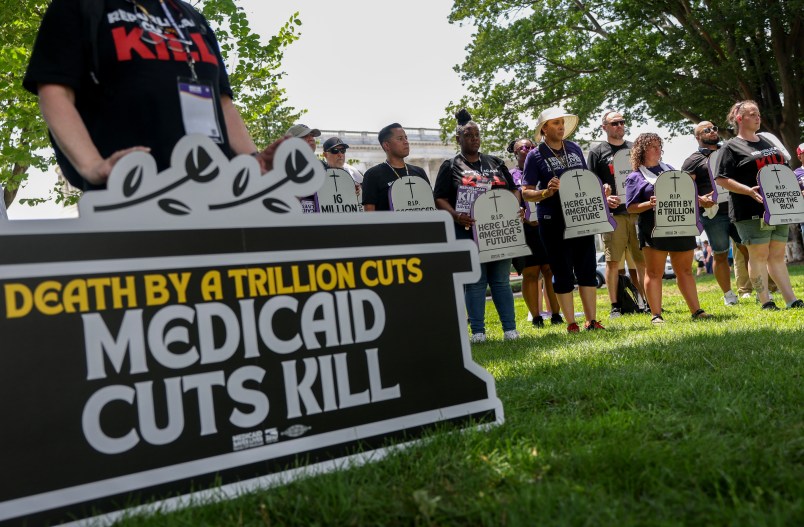
As Congress negotiated the details of the “One Big Beautiful Bill,” a parade of independent analyses warned about the impact it would have on millions of Americans’ health care. Noting those findings, a handful of Republican lawmakers expressed alarm that the Medicaid and Medicare cuts contained within the bill would directly harm their constituents, decimating funding for rural hospitals. Majorities in both chambers voted the bill through anyway.
What members were warned about is now coming to pass.
The hospitals most at risk of closure because of the bill’s massive cuts to federal spending on Medicaid and Medicare are located in communities that are mostly white and poorer on average than the rest of the nation. They’re also more likely to have supported President Donald Trump, and are mostly represented by Republicans in Congress, according to a Talking Points Memo analysis of a new report on rural hospitals from the University of North Carolina.
The Democratic National Committee is launching a messaging campaign “to show how Trump’s policies are hurting the people who voted for him the most,” putting up billboards outside rural hospitals that have had to close or cut back services. Per the DNC, at least 10 rural hospitals have announced full or partial closure since Trump took office. Among those hospitals were at least three that explicitly cited uncertainty around the future of federal funding in announcing their imminent closure. While some facilities decided to close before the federal spending bill passed, experts said hospitals — which plan their budgets several years out, rely on Medicaid accounts for one-fifth of hospital care spending — likely saw the writing on the wall.
“I’m deeply concerned about my rural constituents, folks in small-town Georgia,” Sen. Raphael Warnock (D-GA) told TPM.
“Even in the instances where the hospital doesn’t close,” he continued, “many of them will have to cut services — labor and delivery, for example, which is dangerous and potentially deadly for women who are trying to bring a child into the world.”
The legislation, which President Trump signed into law on July 4, is expected to slash $1 trillion in Medicaid funding over the next 10 years and lead to 10 million people losing their health insurance.
“In a lot of these rural communities, in mine, it’s true, 70% of these people voted for Republicans, voted for Trump,” said Rob Davidson, an emergency physician in rural West Michigan who serves as executive director of the Committee to Protect Health Care. His organization equips physicians with tools to explain to communities that their GOP legislators are responsible for Medicaid and Medicare cuts.
“I think it’s important that they at least understand this is why this hospital is going away. Because of these cuts,” he said. Davidson said his organization is “flooding the zone with the realities of this kind of legislation… and making sure [community members] understand who did this.”
Even before Trump’s bill was signed into law, many rural hospitals were under intense financial pressure. In Sen. Josh Hawley’s (R) state of Missouri, one hospital’s complete closure, announced in June, cost the community more than 300 jobs. Hawley voted in favor of the bill and its accompanying gutting of Medicaid before introducing his own legislation attempting to reverse cuts. (His new bill stands little chance of passing.)
Arkansas Valley Regional Medical Center in a deep red Otero County, Colorado — represented in Congress, until recently, by Trump ally Lauren Boebert’s (R-CO) — announced plans to lay off 5% of its staff in June. A top hospital official told Colorado Public Radio that the Republican budget bill would “absolutely hurt” the hospital and other rural facilities. “Cutting Medicaid funding would have dangerous, real-life consequences,” the official said.
Davidson said he’s glad some impacted hospitals are pointing the finger at policy and, by extension, politicians.
“In some ways it’s refreshing to see that they’re willing to put a name to the reason why they’re doing it,” he said.
While the budget bill did include $50 billion specifically for a rural hospitals fund, that sum is only a drop in the bucket compared to what these hospitals stand to lose, said Zachary Levinson, a hospital costs project director at KFF, a health policy organization.
“Overall, the $50 billion fund would cover a little over one-third of the estimated reductions in fed medicaid spending based on KFF estimates,” said Levinson.
Robinson put it more bluntly.
“I think we — probably all of us — need to stop saying that it’s a rural health fund,” he said.
“It’s $1 trillion in cuts over a decade and $50 billion to help try to shore it up,” Davidson said later. “That’s 5% of the problem in a 5 year span. That math doesn’t work out.”
More than 330 hospitals were highlighted in the University of North Carolina report, which was commissioned by four Democratic senators and published by the school’s Cecil G. Sheps Center for Health Services Research. Sens. Edward J. Markey (D-MA), Ron Wyden (D-OR), Jeffrey Merkley (D-OR) and Chuck Schumer (D-NY) sent a letter to Trump and other members of his administration detailing the study’s findings.
The report flagged hospitals that are either among the top 10% in terms of the proportion of patients on Medicaid,or which have reported negative margins for at least three consecutive years, or both, for their vulnerability to changes in federal health care spending.
Only eight hospitals were both top Medicaid providers and had longer-term negative margins. Six of them are in states Trump won in the 2024 election. Five are in congressional districts with Republican representatives. All but one have higher rates of poverty than the 11.1% national average, and all but one were in majority white congressional districts. That trend continues when you zoom out. Six of the top 10 states with the highest number of at-risk hospitals elected Trump in 2024. The list is led by Kentucky, which has 35 vulnerable rural hospitals, and Louisiana, which has 33. Heavily Democratic California ranks third, with 28.
Leadership at the eight most at-risk hospitals cited by the Sheps Center didn’t respond to TPM’s requests for comment.
Congressional districts with rural hospitals skew even more Republican. All but one of the top 10 are represented by a GOP congressperson, and each of the Republican representatives backed, and even celebrated, Trump’s spending bill. One such representative was Speaker of the House Mike Johnson (R-LA).
None of the Republican members of Congress who represented the most vulnerable rural communities responded to requests for comment from TPM.
Cuts to individual Medicaid coverage conveniently aren’t slated to begin until immediately after the 2026 midterm elections.
Emine Yücel contributed reporting.




So, the Senators and Representatives of places that are least affected seem more concerned than those with constituents that are most affected…
That is some upside down politics there. Now constituents should ask, why would that be?
“The Democratic National Committee is launching a [messaging campaign] “to show how Trump’s policies are hurting the people who voted for him the most,” putting up billboards outside rural hospitals that have had to close or cut back services.”
It’s a good start but they need to do more. Show up in town hall meetings that the Republicans won’t go to, even if it is not their district.
They should show up along with the potential Democratic candidates for office for that district and state. Let elected Senators and Representative introduce the alternatives for offices held by Republicans. Local politicians running for office can inform our elected Democrats in office and vice versa, while also informing constituents.
On the bright side… those communities are the least likely to have any Billionaires, and the whole point of Trump’s BBB was to help billionaires, so this was expected by anyone who reads and thinks. Moral: Republicans do not READ or THINK.
Everyone should scan this 34 page report from UNC that’s linked in the excellent article. Hospitals at risk are listed by state and by congressional district. I live in NY21 (Elise Stefanik) and we’ve got three listed at risk. I don’t think it’s just Medicaid that’s the choke point for rural hospitals, but Medicare Advantage too. I was billed $22,000 for a procedure at my at risk local hospital, my Medicare Advantage paid less than $1000 - the hospital had to absorb the rest. I’m assuming they outrageously padded my bill in desperation, but something has to give.