This story first appeared at ProPublica, a nonprofit newsroom that investigates abuses of power. Sign up to receive ProPublica’s biggest stories as soon as they’re published.
This fall, Americans got to see what it’s like to go without a safety net for the hungry. With the U.S. government shut down for multiple weeks and President Donald Trump refusing to fund SNAP, the federal food stamp program, a panic set in among the more than 40 million people who rely on it. Families skipped meals, and babies went unfed. Food banks ran out of food, and some people turned to dumpster diving.
It was just a glimpse of what’s to come. Starting next October, Trump’s so-called One Big Beautiful Bill Act will shift billions in SNAP costs from the federal government onto states. Some states won’t be able to afford this, and they could be forced to deeply cut or even shutter their SNAP programs altogether, according to the Congressional Budget Office.
Of the approximately 11 million undocumented immigrants living in the United States, over two thirds of them come from Mexico and South America, according to data compiled by the Pew Research Center last year. However, the population from other regions is growing sharply. Pew found that, as of 2022, there were 375,000 unauthorized immigrants from Africa living in the U.S., which was a striking 36% increase over three years.
Estimates show New York is home to nearly 8% of the nation’s undocumented African immigrants. The community was the primary focus of ICE’s Canal Street raid in late October. As TPM spent nearly two months examining the fallout from that sweep and Trump’s deportation machine in the city, we found that African migrants have faced threats and unique challenges. They’re also receiving help from a growing network of activists and advocates.
During President Donald Trump’s second term, dramatic raids staged by the Immigration and Customs Enforcement agency have become a part of life. We want to show you what that looks like up close and on the ground in one American city. It’s a story of fear, resilience, and resistance.
TPM has spent the past two months reporting on the effect of Trump’s mass deportation agenda in New York, one of the cities facing the prospect of a large-scale ICE invasion. We went inside the courts where Trump’s deportation machine is firing judges and snatching migrants from the halls. We walked those same corridors with masked agents and a growing network of volunteers, activists, and advocates who are determined to fight this new system. We also spent time with the immigrants who described the dangers that led them to leave their homes, the new fears they face in this country, and their drive to keep going despite these long odds.
U.S. District Judge James Boasberg has ordered testimony next week from Justice Department whistleblower Erez Reuveni and deputy assistant attorney general Drew Ensign in the criminal contempt of court inquiry in the original Alien Enemies Act case.
Not satisfied with what he called the “cursory declarations” from Department of Homeland Security Secretary Kristi Noem and top DOJ officials involved in the decision to continue with the AEA deportations in March despite his court order, Boasberg is taking his inquiry to the next level with the first live testimony.
Testimony from Reuveni is likely to be especially probative as he as already gone public with his account of his efforts to urge DOJ and DHS to abide by Boasberg’s order to stop the AEA deportations of Venezuelan nationals and turn around the planes en route to El Salvador. Reuveni also produced extensive internal DOJ communications that buttressed his account of that fateful weekend in mid-March that quickly became a flashpoint between the executive and judicial branches.
It was Reuveni who famously quoted then-DOJ official Emil Bove as telling attorneys under him that they might have to tell the courts “fuck you” if they tried to block the AEA deportations. Bove — now a judge on the Third Circuit Court of Appeal — unexpectedly filed his own declaration yesterday in the contempt of court inquiry. Like the others filed Friday, Bove’s declaration was cursory and raised the prospect of using attorney-client privilege as a shield to block further inquiry from Boasberg.
For his part, Ensign has been a willing pawn in an ongoing DOJ effort to stonewall, obfuscate, and mislead judges in some of the key Trump II deportation cases. Ensign was the lead DOJ attorney in front of Boasberg as the AEA deportations unfolded and much of Boasberg’s initial ire was directed at him.
The Trump DOJ may yet rush to the D.C. Circuit Court of Appeals to try to avoid allowing Reuveni and Ensign to testify, citing various privileges, including attorney-client privilege, but the appeals court in a muddled opinion last month already seemed to clear the way for Boasberg to proceed with his inquiry, after it delayed him for seven months.
Boasberg is zeroing in on whether Noem’s decision to continue with the AEA deportations despite his order was willful, a necessary element of a finding probable cause for criminal contempt.
GOP Congress Has Had Its Fill of Hegseth
In perhaps the most robust oversight this GOP-controlled Congress has yet conducted, the must-pass annual defense policy bill contains a new provision compelling the Pentagon to turn over (i) the specific orders for the U.S. military strikes on alleged drug-smuggling boats; and (ii) unedited video of the attacks.
The provision includes some teeth, too, the NYT reports: “It would withhold 25 percent of Defense Secretary Pete Hegseth’s travel budget if he failed to give the congressional national security committees a copy of the execute orders behind the strikes, or to outline how he planned to facilitate future briefings about the operation with lawmakers in accordance with federal law.”
SCOTUS Might Surprise on Birthright Citizenship
Steve Vladeck, on the way in which the Roberts Court accepted the birthright citizenship case last week: “That particular tea leaf is significant because it reinforces something I’ve believed since the Court first ruled on the emergency applications relating to the birthright citizenship cases back in June—that a majority of the justices are likely to rule against the administration on the merits and invalidate Trump’s executive order.”
No More Habba to Kick Around in New Jersey
Alina Habba has dropped her claim to be the U.S. attorney for New Jersey after a federal appeals court upheld a lower court decision that she was invalidly appointed. Habba will move to a new position as an advisor to Attorney General Pam Bondi on U.S. attorneys. Bondi indicated that she would continue to appeal the case to the Supreme Court.
An EDVA Clash Seems Inevitable
With the Trump DOJ continuing to pretend that Lindsey Halligan is the interim U.S. attorney in the Eastern District of Virginia despite a court ruling that she was invalidly appointed, I don’t know how the district judges can continue not to appoint an interim U.S. attorney, especially with ongoing public attacks on them like this from Attorney General Pam Bondi and Deputy Attorney General Todd Blanche:
Certain district court and magistrate judges in the Eastern District of Virginia are engaging in an unconscionable campaign of bias and hostility against U.S. Attorney Lindsey Halligan and her line AUSAs.
The Roberts Court gleefully took a sledgehammer not just to independent agencies yesterday in oral arguments, but to the Supreme Court’s own jurisprudence. For help sorting through the implications of the historic case:
Kate Shaw, William Baude and Stephen I. Vladeck chew over the oral arguments under the clever headline: “Looks Like the Supreme Court Will Continue to Overturn the 20th Century.”
Public policy professor Don Moynihan looks at the bigger political picture:
[T]he risks of a partisan public personnel system is not just poor public services, but that it worsens our democracy. Many of the points of friction between Trump and federal employees are about democratic values: the rule of law, how Congressional statute is to be interpreted, avoiding abuses of the power, and transparency. Again and again, the logic for Trump’s personnel actions is the logic of a personalist regime: loyalty to the leader above all else, removing individuals or downgrading agencies that are disfavored.
Sandwich Thrower Jurors Recount Deliberations
While they expected it to be an open-and-shut case, three jurors in the case of the D.C. sandwich thrower Sean Dunn told CBS News that they had to overcome an initial 10-2 split that led to some seven hours of deliberations before acquitting Dunn.
2026 Ephemera
TX-Sen: Rep. Jasmine Crockett (D-TX) is in and former Rep. Colin Allred (D-TX) is out of the Democratic primary to seek the seat held by Sen. John Cornyn (R). State Rep. James Talarico (D) of Austin is the other major candidate in the Democratic primary field.
Very on Brand
Gov. Greg Abbott (R) and Lt. Gov. Dan Patrick (R) announced a plan to open Turning Point USA chapters in every high school in Texas. The high school chapters are called “Club America.” I’m told “club” is not a verb.
Good Read
The Guardian: What activists from authoritarian regimes wish they’d known sooner.
Nancy Mace Went Full Karen on Airport Staff
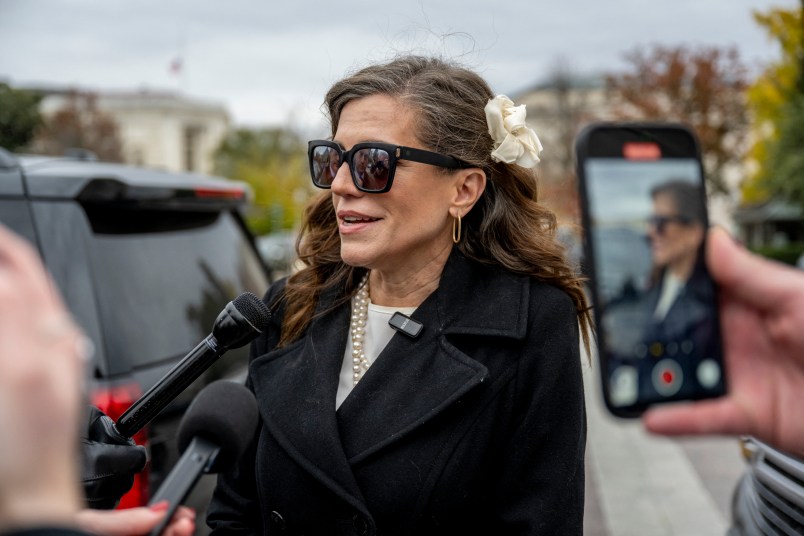
US Representative Nancy Mace, Republican of South Carolina, speaks to reporters at the US Capitol on Washington, DC on November 18, 2025. (Photo by DANIEL HEUER / AFP) (Photo by DANIEL HEUER/AFP via Getty Images)
The WaPo obtained the investigation report, transcripts of interviews with officers and officials, and video from the Oct 30. incident involving Rep. Nancy Mace (R-SC) at the Charleston airport. Upon arriving for a flight, Mace went ballistic when her vehicle was not met curbside at the airport by a police escort, the WaPo reports:
The airport holds “a certain level of responsibility” for a “minor miscommunication” about the color of the vehicle that Mace would arrive in, airport police chief James A. Woods wrote in the new report. But Mace’s “continued failure to follow established procedures at the checkpoint” escalated the situation into “a spectacle” and negatively affected airport staff, the report concluded.
After her arrival hiccup, Mace became enraged:
The investigation, which included several interviews with TSA staff and police officers, found Mace told officers “I’m sick of your s—,” said that they were “f—ing idiots” and “f—ing incompetent” and yelled in front of TSA officers and police using similar expletives as she proclaimed that she is a “f—ing representative.”
The incident left some airport employees “visibly upset” and “downtrodden,” according to the WaPo report.
Hot tips? Juicy scuttlebutt? Keen insights? Let me know. For sensitive information, use the encrypted methods here.
Chief Justice John Roberts scrambled around with a verbal broom and dustpan Monday, reflexively jumping into the arguments to downplay the obvious dangers his majority will soon unleash in its seemingly imminent decision to destroy independent agencies.
Simply extraordinary stuff coming out this morning about the battle over what used to be Time Warner and now goes by the name Warner Bros Discovery (which includes CNN in addition to the more lucrative media stuff). The company had agreed to be acquired by Netflix. So Paramount — now the vehicle of the Ellison family successor and a Trump state media entity-in-the-making — has launched a hostile takeover effort to swoop in and gobble up WBD for itself. In its public pitch, it has openly advertised to shareholders that it is the better acquirer because the Ellisons are tight with Trump, and the White House will never let a Netflix deal go through. Trump, in comments yesterday, as much as agreed. Trump has refashioned antitrust oversight to be little more than a personal veto for the Trump family. Friends can do mergers; foes can’t. Indeed, the indifferent and uncommitted can’t either. You need to get right with the Trump family.
When you ask why so much of corporate America is beholden to Trump now, this is why. A big diversified corporation simply cannot compete and thus, in practice, can’t exist with a determinedly hostile administration.
I’ve written a number of times over the years about the fact that Americans mostly believe that the post-World War II world order is the normal state of things. Of course, it is not. The last 80 years are unparalleled in global history for their general prosperity, lack of great power wars, a fairly predictable system of global rules. One has to say the obligatory caveats about all the ways the United States honored its values and rules in the breach, the slow run of proxy conflicts it participated in or fomented around the world. But these caveats only serve to illustrate the larger point in a paradoxical way. Things can always get worse and getting worse — conflict, instability, mass death — are the normal order of things in world history. Even a thin appraisal of the American ascendency shows its close to uniqueness in this regard.
A lot of weekend news to cover this morning, but I want to continue to keep front and center the contempt of court proceedings in the original Alien Enemies Act case.
The Trump DOJ faced a Friday deadline set by U.S. District Judge James Boasberg of D.C. to submit sworn declarations by the officials involved in the decision to continue with the AEA deportation flights in mid-March even after Boasberg ordered the deportations stopped and the planes turned around.
The Trump DOJ acknowledged that it was taking a narrow view of what Boasberg meant by “involved in the decision” and submitted declarations from only three senior officials:
Department of Homeland Security Secretary Kristi Noem
Of note, Blanche explicitly mentioned former DOJ official and now appeals court Judge Emil Bove has having been involved in providing what he asserts is “privileged legal advice” to DHS in the matter. It remains to be seen whether Boasberg will demand either a declaration or testimony from a sitting judge whose potential contempt of court occurred prior to taking the bench.
In its filing accompanying the declarations, DOJ pulled back from having earlier identified Deputy Assistant Attorney General Drew Ensign as involved in the decision and didn’t submit a declaration from him, saying he only relayed Boasberg’s oral and written orders.
In filing the declarations, the Justice Department remained defiant. Among other arguments, it told Boasberg that:
given the declarations, there is no basis for witness testimony in the contempt inquiry;
attorney-client privilege would prevent the lawyers (Blanche, Bove, and Mazzara) from testifying;
he could be in for a constitutional fight over compelling the testimony of Noem;
no criminal contempt occurred because his order was not “clear and reasonably specific.”
Seizing on the muddled mess that the laggardly D.C. Circuit Court of Appeals made of Boasberg’s contempt inquiry, the Justice Department leaned heavily on the concurring opinion of Appeals Court Judge Gregory Katsas: “[I]f a leading jurist like Judge Katsas concluded that Defendants’ interpretation of the TRO is legally correct, it is impossible to find beyond a reasonable doubt that Defendants’ interpretation is so unreasonable as to make their conduct criminally contumacious.”
Boasberg has moved the criminal contempt inquiry along as fast as the D.C. Circuit has allowed him to, so I would expect we’ll know what he wants to do next in the case as soon as today.
Another Wrongful Deportation Case
The Trump administration deported a Guatemalan man back to his home country despite an immigration judge order barring his removal to Guatemala because of fears he would face torture there. U.S. District Judge David Guaderrama of El Paso accused the Trump administration of “blatant lawlessness” in the case and ordered it to facilitate the return of Faustino Pablo Pablo to the United States by Dec. 12.
SCOTUS Takes Up Birthright Citizenship
The invented right-wing legal theory that birthright citizenship is not guaranteed by the 14th Amendment’s Citizenship Clause is going to get decided by the Supreme Court in its current term.
Pam Bondi Needs to Talk to Pam Bondi
Last year, before she became attorney general, Pam Bondi wrote a Supreme Court brief for the America First Policy Institute in which she argued: “Military officers are required not to carry out unlawful orders.”
Venezuela Boat Watch
Among the new developments:
Defense Secretary Pete Hegseth continues to deny that he ordered Special Operations forces to kill everyone aboard an alleged drug-smuggling boat during a Sept. 2 attack, but in a new twist NBC News reports that Adm. Frank “Mitch” Bradley told lawmakers in a classified briefing last week that Hegseth ordered everyone killed “because they were on an internal list of narco-terrorists who U.S. intelligence and military officials determined could be lethally targeted.”
The second strike of the boat killed the two survivors of the first strike, Bradley told lawmakers, but he ordered a third and fourth strike to sink the boat, according to the NBC News report.
Despite administration claims, the boat was not bound for the United States but to rendezvous with a larger vessel bound for Suriname, CNN reports.
Clash Over Halligan Looms
The DOJ’s Office of Legal Counsel has ratified keeping Lindsey Halligan in place as U.S. attorney for the Eastern District of Virginia despite a judge’s ruling that she was invalidly appointed to the position, the NYT reports:
The office has told department officials that because Judge Currie’s order did not require a specific measure to be taken, like removing Ms. Halligan, she could stay even though the judge declared her appointment invalid, the people said.
In other words, the administration’s position was that since the court order did not explicitly remove Ms. Halligan from the job, she could keep it.
Under Judge Currie’s ruling, only the judges in that district may now appoint an interim U.S. attorney — but they have not publicly moved to do so.
New Ruling Thwarts Re-Indictment of Comey
Over the weekend, U.S. District Judge Colleen Kollar-Kotelly of D.C. issued a temporary restraining order barring prosecutors from accessing material seized years ago that belong to Columbia University law professor Daniel Richman, a close friend of and attorney for James Comey. Because the materials at issue largely formed the basis for the now-dismissed indictment of Comey, the ruling may delay any effort by the Trump DOJ to re-indict him.
Trump DOJ Leads Attack on Voting Rights
Mother Jones: “Over the last six months, [the Trump DOJ] has demanded full, unredacted voter rolls from dozens of states in an effort to create the federal government’s first-ever national database of registered voters, accompanied by their private information: party affiliation, voting history, Social Security numbers, driver’s license information, even physical characteristics.”
The Death of Independent Agencies
Ahead of Supreme Court oral arguments today over whether President Trump can unilaterally fire a FTC commissioner, a D.C. Circuit Court of Appeals panel with two Trump appointees ruled that Trump lawfully fired — without cause — Cathy Harris, a Democratic member of the Merit Systems Protection Board, and Gwynne Wilcox, a Democratic member of the National Labor Relations Board.
The Destruction: Vax Edition
A Centers for Disease Control and Prevention panel stacked with Robert F. Kennedy Jr. allies has dramatically altered the recommendation for infants to immediately receive the hepatitis B vaccine, upending 30 years of wildly successfully public health policy.
The Corruption: Pardon Edition
Trump is big mad that his pardon of Democratic Rep. Henry Cuellar (TX) didn’t engender enough personal loyalty for Cuellar not to seek re-election, potentially costing Republicans a pick-up in the 2026 midterms.
Trump pardoned sports executive Tim Leiweke — who was convicted by Trump’s own Justice Department — after a round of golf with former Rep. Trey Gowdy (R-SC), who was one of Leiweke’s lawyers, the WSJ reports.
Convicted fraudster David Gentile, the former private equity executive whose seven-year sentence was commuted by Trump, will not have to pay $15.5 million in restitution by the terms of the clemency order, Politico reports.
The Trump DOJ says it will be up to Attorney General Pam Bondi and Pardon Attorney Ed Martin to decide which people and which crimes are covered by Trump’s sweeping pardons related to the 2020 fake electors scheme and other Big Lie related offenses.
Indiana Redistricting Hangs in the Balance
With the Indiana House having passed a new GOP friendly mid-decade congressional district map, all attention turns to the Republican-controlled state Senate, where its fate is not as cut and dry as you might expect.
Such a Big Boy
At the 0:42-second mark, Trump’s mask comes off for a moment and the insatiable neediness of an unloved child emerges:
Under a new Trump administration policy, Americans will no longer have free access to national parks on Martin Luther King, Jr. Day or Juneteenth, but will now have free access on June 14 — President Trump’s birthday, which coincides with Flag Day.
RIP V3 Camera
Over the weekend, the 38th episode in the eruption sequence that began at Kilauea volcano last December was particularly vigorous, with a laterally-jetting lava fountain knocking a remote camera on the crater rim out of commission:
In case you ever wondered what it would be liked to be engulfed in a lava fountain…
This video was recorded by the V3 camera, located on the south rim of Halema‘uma‘u crater at the summit of Kīlauea volcano on the Island of Hawai‘i. The camera, located in a hazardous closed… pic.twitter.com/7coXye39AK
This story was produced by The Hechinger Report, a nonprofit, nonpartisan news outlet focused on education.
Brown University, one of the most selective institutions in America, attracted nearly 50,000 applicants who vied for just 1,700 freshman seats last year.
The Trump administration’s policies may soon end that advantage that has been enjoyed by men, admissions and higher education experts say.
While much of the president’s recent scrutiny of college admissions practices has focused on race, these experts say his ban on diversity, equity and inclusion is likely to hit another underrepresented group of applicants: men, and particularly white men — the largest subset of male college applicants.
“This drips with irony,” said Ted Mitchell, president of the American Council on Education, or ACE, the nation’s largest association of universities and colleges, who said he expects that colleges and universities are ending consideration of gender in admission. “The idea of males, including white males, being at the short end of the stick all of a sudden would be a truly ironic outcome.”
Related: Interested in more news about colleges and universities? Subscribe to our free biweekly higher education newsletter.
For years universities and colleges have beentryingto keep the number of men and women on campuses evened out at a time when growing numbers ofmen have been choosing not to go to college. Some schools have tried to attract more men by adding football and other sports, promoting forestry and hunting programs and launching entrepreneurship competitions.
Efforts to admit applicants at higher rates based on gender are legal under a loophole in federal anti-discrimination law, one that’s used to keep the genders balanced on campuses.
But the Trump administration has consistently included gender among the characteristics it says it does not want schools to consider for admissions or hiring, along with race, ethnicity, nationality, political views, sexual orientation, gender identity or religious associations. The White House has so far largely not succeeded in its campaign to press a handful of elite schools to agree to the terms and sign a wide-ranging Compact for Academic Excellence in Higher Education in exchange for priority consideration for federal funding.
“The racial parts have gotten a lot more attention, but I know from having spoken with practitioners who work in college admissions, they have read very clearly that it says ‘race and gender,’” in the administration’s pronouncements about ending preferences in admission, said Shaun Harper, founder and chief research scientist at the University of Southern California Race and Equity Center.
“What I think they don’t understand is that taking away the ability of colleges and universities to balance the gender composition of their incoming classes will ultimately have an impact on the college enrollment rates of white males,” Harper said. “It is likely to impact them the most, as a matter of fact.”
At some private colleges, male applicants are more likely to get in
School
% of males admitted
% of females admitted
Brown University
7.0
4.4
University of Chicago
5.6
3.7
Yale University
4.6
3.4
University of Miami
22.5
16.5
Middlebury College
12.2
9.6
Baylor University
56.8
47.9
Pomona College
7.6
6.7
Tulane University
14.9
13.4
Vassar College
20.4
17.6
SOURCE: Hechinger Report calculations from universities’ Common Data Sets
Agreements that the administration has reached with Brown, Columbia and Northwestern universities to settle allegations of antisemitism discrimination also include language about gender.
In a statement announcing the Brown deal in July, Education Secretary Linda McMahon promised that “aspiring students will be judged solely on their merits, not their race or sex.”
Asked if that meant male applicants would no longer be admitted at higher rates than female applicants — which has helped Brown keep its undergraduate enrollment at almost exactly 50-50, even with twice as many female applicants — spokesman Brian Clark said, “We have made no changes to our admissions practices in this regard.”
The Trump administration has also vowed to make all higher education institutions submit details about the students they admit, including their gender, to find out whether they’re “discriminating against hard working American” prospective students, McMahon said in another statement.
Spokespeople for the Department of Education did not respond to questions about whether advantages in admission based on gender will be scrutinized in the same way as purported advantages based on race.
Universities are looking at the administration’s edicts “and they’re saying, ‘Well, we’d rather be cautious than stick our neck out’” by continuing to give advantages to male applicants, said ACE’s Mitchell, who was undersecretary of education under President Barack Obama. “I think we will see people dropping gender preferences, even though it is still within the law.”
Colleges that have been accepting men at higher rates are trying to avoid a marketing problem they fear will happen if their campuses become too female,said Madeleine Rhyneer, who headed admissions offices at four private universities and colleges and is now vice president of consulting services and dean of enrollment management for the education consulting firm EAB. Colleges worry, “Will men look at that and think, ‘That’s essentially a women’s college, and I don’t want to go there’?”
“For the Browns and Columbias and highly selective and very competitive institutions, it is a problem,” Rhyneer said. “They want to create what feels like a balanced climate.”
The results of ending this practice could be dramatic, experts predict. In 2023, the most recent year for which the figure is available, 817,035 more women than men applied to universities and colleges, federal data show. Boys also have lower mean scores on the SAT in reading and writing, score lower overall on the ACT and have lower grade point averages in high school.
“If we were going to eliminate preferences for men, the undergraduate population would skew to 65 percent female overnight,” Mitchell said.
Rick Hess, director of education policy studies at the right-leaning think-tank the American Enterprise Institute, pointed out that similar predictions were made after the 2023 Supreme Court decision effectively ending affirmative action based on race.
At the time, he said, colleges spoke “in apocalyptic terms of the implications for the racial composition of student bodies.” But the number of Black and Hispanic students enrolled at universities and colleges the next year rose, according to the National Student Clearinghouse Research Center. Then, said Hess, “there was a lot of, ‘Never mind.’”
The country’s top 50 private colleges and universities have 2 percentage points more male undergraduates than the top 50 flagship public universities, which do not consider gender in admission, according to research by Princeton economist Zachary Bleemer. He said this suggests that at least some are putting a thumb on the scale for male applicants.
Columbia took 3 percent of women applicants last year and 4 percent of men. At the University of Chicago, 5.6 percent of male applicants were accepted last year, compared to 3.7 percent of female applicants. The ratio at the University of Miami was 22.5 percent to 16.5 percent; and at Vassar College, 20.4 percent to 17.6 percent.
Besides Brown, none of these universities would respond when asked if they will continue to accept higher percentages of men than women, Neither would others that do it, including Yale, Baylor and Tulane universities and Pomona College.
Private institutions are allowed to consider gender in admission under Title IX, the federal law otherwise banning discrimination by universities and colleges that get federal funding. That’s due to a loophole dating from when the law was passed, in 1971.
At the time, the gender ratio was exactly reversed, and men outnumbered women on campuses by nearly three to two. One of the universities’ congressional allies, Rep. John Erlenborn, R-Illinois, successfully amended the measure to let private colleges and universities continue to consider gender in admission.
Erlenborn said at the time that forcing colleges to stop considering gender would be “one more giant step toward involvement by the federal government in the internal affairs of institutions of higher education.”
There’s little ambiguity for admissions offices now, said USC’s Harper.
“It says here, in writing, ‘no discrimination on the basis of race and gender,’” he noted. “It says that explicitly.”