

In the Trump administration’s latest effort to meddle in election administration, investigate baseless conspiracy theories about the 2020 election and sow doubt in the country’s election system ahead of the midterms, U.S. Immigration and Customs Enforcement investigators were reportedly granted access to voter files in counties in Texas and North Carolina.
Continue reading “ICE Agents Were Given Access to Local Voter Files As Trump Perpetuates Myth of Non-Citizen Voting”Trump Endorses Ossoff Challenger Who Is Extreme Even by MAGA Standards
There’s a particular genre of Georgia political reporting with which Americans nationwide might soon become much better acquainted. These stories often begin with some variation of a common refrain: “Mike Collins is once again under fire for…”
For hiring a chief of staff accused of various violent acts.
For replacing said staffer with someone caught in a white nationalist group chat.
For making light of the January 6th insurrection attempt, calling it a “self-guided, albeit unauthorized,” tour of the Capitol.
For tapping out any number of Islamophobic, antisemitic or racist social media posts.
For being one of the first elected officials to promote the sick conspiracy theory that former President Joe Biden ordered an attempted assassination of President Donald Trump.
On Tuesday, Georgia voters in the GOP Senate runoff will choose between Rep. Mike Collins (R-GA) and Derek Dooley, a candidate branded as a more traditional conservative and endorsed by governor Brian Kemp (R). Trump endorsed Collins via a Saturday night Truth Social post.
“Mike is strongly supported by the most Highly Respected MAGA Patriots in Georgia and beyond,” the president wrote. Trump made clear in the post that Dooley’s refusal to promote conspiracy theories about the 2020 election was a disqualifier, complaining that Dooley “said that I lost Georgia in 2020 when, in actuality, the facts have now proven that I won by a lot!”.
The winner will face Sen. Jon Ossoff (D-GA).
Dooley, a former NFL football coach, has never run for political office and even admitted he didn’t vote in the 2016 or 2020 presidential elections. A businessman who was elected to the U.S. House in 2022, Collins courts controversy and often wears it like a badge of honor. He rarely eschews outrage. But his brand of aggressive and vulgar social posting often draws on conspiracy theories and the dangerous and violent rhetoric that lives in the darkest parts of the MAGA-sphere and deeper, in corners of the extreme far right.
“Social media amplifies falsehoods, which is bad enough when they’re spread by the village idiot,” the conservative Wall Street Journal editorial board wrote in 2024 about Collins. “When the village idiot is in Congress, it gives conspiracies a credibility that more people might believe.”
That rebuke came after several posts from Collins blaming Biden for the July 2024 shooting at a Trump rally in Butler, Pennsylvania that left Trump and two others injured and one man killed.
“Joe Biden sent the orders,” Collins wrote the night of the incident, later urging the Butler County district attorney to “file charges” against the former president for “inciting assassination.”
That was neither the first nor the last moment people were alarmed by Collins’ attention-grabbing assertions of his purported beliefs.
Collins is the frontrunner in the Senate election. And even as he flirts with the far-right online, sometimes waving away the resulting controversy as an enthusiasm for memes, more than one of his staff picks has, in real life, drawn widespread criticism just weeks before the Tuesday runoff.
Shooting Guns and Sharing Murder Fantasies
The son of a Republican state rep., Collins spent his life before politics as a small business owner, running a trucking company with his wife. He ran unsuccessfully in the Republican primary for an open U.S. House seat in 2014, but lost to Rep. Jody Hice (R-GA). He reentered the political fray in 2021, when he launched his bid for Congress, branding himself as a full-throttle supporter of Trump.
Almost immediately, he got down to business online, posting a video to Twitter beneath the caption “Newsflash: Joe Biden and the Democrats stole the 2020 election.”
“Mike Collins here, your pro-Trump, America First trucker,” he begins. Holding a rifle, Collins goes on about his baseless belief that Georgia’s elections are full of fraud before firing his weapon and reducing what appears to be a plastic trash can labeled “Voting Machine” to shreds.
In that 2022 race, Collins wound up in a runoff against Vernon Jones, another election denier who is now a contender for Georgia Secretary of State and a long-time politician who’s faced a litany of his own political problems. Jones had been accused of rape in the mid 2000s, a fact Collins seized on, tweeting a photo of a rape whistle with Jones’ name on it and a pink handgun. “Although some use a rape whistle for protection against sexual assault, a 9mm is the more preferred form of protection,” the post read. Jones filed a police report about the post’s implied threat of “violence against Jones,” but officials declined to press charges.
After reaching Congress, Collins latched onto the right’s anti-DEI movement and linked a Norfolk Southern train derailment to corporate diversity efforts. The Biden administration’s focus on diversity and inclusion, he said on the House floor, “is forcing private companies to rethink their goals and one has to wonder, was Norfolk Southern’s DEI policies directing resources away from the important things like greasing wheel bearings?”
He’s leaned into an identity as the “Memer of Congress,” even though his content has consistently crossed the line from garden variety conservative trolling into violence, thinly veiled threats and explicit conspiracy theorizing. In February 2024, he referenced an extremist meme to imply that an immigrant who was accused of assaulting a police officer, and later exonerated, should be killed.
Collins quote tweeted another representative’s post about the incident and suggested they buy the accused “a ticket on Pinochet Air for a free helicopter ride back.” The post referenced right-wing Chilean dictator Augusto Pinochet, whose supporters were said to have thrown his political enemies from helicopters. Allusions to this practice and “free helicopter rides” are popular among white nationalists and other far-right, hyper-online extremists. Collins’ post was flagged by X as violating the platform’s rules but can still be viewed.
Collins reiterated the white nationalist fantasy weeks later when an undocumented immigrant was accused of killing nursing student Laken Riley. “Jose Antonio Ibarra would make a great first passenger for the new Pinochet Air,” he said of the man who would later be convicted of Riley’s death.
Republicans in Congress, joined by 46 Democrats, would in early 2025 pass the Laken Riley Act, which was sponsored in the House by Collins. It requires federal authorities to immediately detain undocumented immigrants accused of certain crimes, and lets states sue the federal government if it fails to do so.
In April 2024, Collins drew bipartisan ire when he interacted with a tweet from a highly anti-Semitic X account criticizing a Jewish Washington Post journalist. The account, which has the display name “Garbage Human,” reposted a New York Post article about the journalist with the phrase “In case you were wondering, yes she is,” which is often used online as a covert way to hatefully link a person’s actions with their (usually) Jewish heritage. “Never a second thought,” Collins replied. Collins claimed he was calling the journalist a “garbage human,” but his post remains live, even after the original account clarified it was definitely referring to the journalist being Jewish. Collins’ campaign told Jewish Insider he’s an “ardent supporter of Israel in Congress.”
The NAACP reprimanded Collins in May 2024 after the congressman celebratorily reposted a video of a group of counterprotesters opposed to a pro-Palestine gathering at the University of Mississippi that clearly shows at least one white male counterprotester making monkey-like sounds and gestures at a Black woman who was demonstrating in support of Palestine. “Ole Miss taking care of business,” Collins wrote.
In a rare moment of acknowledgement, Collins released a statement following that post asserting that he didn’t tolerate racism. “Frankly, I did not believe that to be the focal point of the video shared at the time, but I recognize that there certainly seems to be some potentially inappropriate behavior that none of us should seek to glorify,” Collins said.
The Atlanta Journal-Constitution reported the student seen making the sounds in the video was removed from his fraternity. Collins’ X post, however, is still up and public.
Before he set out to dismantle and remake U.S. public health policy, Robert F. Kennedy, Jr. was a 2024 presidential candidate running as an independent; many Trump allies resented his campaign, fearing it would take votes away from Trump. When news emerged of Kennedy losing part of his brain to a parasitic worm, Collins compared the incident to the killing of some of Kennedy’s family members.
“You either die a Kennedy with a hole in the brain or live long enough to become a Kennedy with a hole in the brain,” Collins wrote.
A spokeswoman for Collins told the Atlanta Journal-Constitution the post was a reference to a famous line from a Batman movie but “did not explain why Collins replaced the words in the quote with what appeared to be direct references to the deaths of the elder Kennedys,” the AJC reported.
The congressman’s deeply xenophobic social posts about Islam and Muslims are especially prolific. Most recently, he was mocked for complaining about the replacement of a Steak n’ Shake with a halal restaurant.
“This is equivalent to the Muslim conquest of Jerusalem in the 7th century,” he wrote.
Two Chiefs of Staff, a Series of Accusations and a White Nationalist Group Chat
Collins’ campaign X account made a post so disturbing in late May that the congressman had to come out and issue a rare, straightforward apology. The post was reportedly published by Collins’ campaign advisor Brandon Phillips. It mocked a woman who accused former television anchor Matt Lauer of rape and whose husband is now working for a PAC supporting Collins’ Republican opponent Dooley. The post replied to one by the operative that commented on polling in the Collins-Dooley runoff. “Matt Lauer’s sloppy seconds chiming in to take an L…” it said.
The stunning moment led the Senate hopeful to put out a statement describing the post as “a despicable and unauthorized twitter comment,” and to fire Phillips, who was already a controversial hire in the Collins camp.
Collins employed Phillips as his chief of staff before transitioning him to a senior campaign aid earlier this year. Phillips, a longtime Republican political operative, had been forced to resign from his role on the Trump campaign staff in 2016 after it emerged that he had years earlier plead guilty to criminal trespassing charges. In 2008, Phillips was arrested on felony charges of battery and criminal damage related to an incident with two other people wherein he inflicted “visible bodily harm” and property damage, according to local news reports; he ultimately pleaded guilty to lesser charges, according to the reports. Police also responded after he pointed a gun at a woman in a separate incident that year. In 2022, Phillips was charged with misdemeanor animal cruelty for kicking a dog. He also allegedly spit in the face of a Republican activist at a Trump event in 2024. Currently, Phillips is the subject of a House Ethics Committee investigation into whether Collins’ office improperly paid Phillips’ girlfriend for a sham internship.
Collins replaced Phillips in his role as chief of staff with Kip Talley earlier this year. That gave rise to a fresh scandal.
On May 28, Slate reported that Talley in December 2025 — while holding another role in Collins’ office — participated in a group chat with prominent white nationalists including Nick Fuentes and Richard Spencer. Talley on the chat said he was attempting to intervene to help Charles Johnson, a white nationalist and Holocaust denier who had been held in contempt of court as part of a racketeering case.
“I’m reaching out to my people at FBI and DOJ. Trying to get him out,” Talley reportedly wrote in the chat, which, Slate reported, had been organized by Johnson. “I’m going to try and use the levers of the legislative branch to check into his detention,” he also said.
Talley denied he acted in an official capacity at the request of Collins in a statement to Slate. Collins, Slate reported, declined to comment to them, and his campaign did not immediately respond to a request for comment from TPM.
Trump’s ‘Deal’ Is Just Suing for Peace in a War He Lost Months Ago
We again have a possible ceasefire agreement between the U.S. and Iran presented by President Trump as a deal to end the war he started back in February. It is a great victory, he claims. What we really have is a replay of a core feature of the spring and summer of 2026, as commentators and countries try to strip away the packaging and relentless razzmatazz from the White House and see what is really included in this deal. How much skepticism will the White House face since observers have been through maybe 1o or 20 cycles of this over the last four months?
And what’s in the deal this time?
Now’s the Time to Prepare for the Great Post-Trump Renewal
The Work of Our Lifetimes
In typically shitty Trump fashion, he mounted a late bid to fight the removal of his name from D.C.’s Kennedy Center, blew the court-ordered deadline Friday for taking it down, and mostly shielded his loss from public view with a tarp. But before the new deadline of noon Saturday, the center notified the court that the work was completed.
Make no mistake: This was the first step in what will be a decades-long effort to strip Trump from American public life and repair the damage he has done. It will be slow, painstaking, halting, and thankless work — and perhaps most frustratingly it will have to overcome the inertia of faux reconciliation and indifference.
The political dynamics of this renewal, America’s reconstruction history suggests, will be brutal.
Each effort to undo what Trump has done will be met with howls of outrage, real or not, to maximize the political price exacted. Elected officials will have to decide whether to expend political capital to pay that price. If the 2008 financial crisis and Trump I are any indication, the stomach will not be there to engage in these fights even in the immediate aftermath of Trump II, let alone for the decades it will take to finish the work.
The destruction of state capacity is the biggest and hardest thing to reverse. But the cosmetic and structural changes Trump has wrought without legal authority, in D.C., national parks, and the White House itself will carry symbolic weight that is likely to trigger the kind of backlash past Democratic administrations have avoided. If we don’t begin to confront now the scale and scope of the work ahead, we, too, will wilt when the times comes.
It won’t be easy for all the obvious reasons but also for a particularly Trumpy one: He hasn’t just broken things. He’s replaced them with crap. Trump’s own track record across decades in business and his first term in the White House strongly suggests that we will face the additional friction point of projects done poorly, on the cheap, and not built to last.
Shoddy work is a direct product of two Trump mainstays: corruption and performative spectacle. If it’s all just a grift, it doesn’t need to last. It just needs to wow the audience and produce the opportunity to cash in. The suckers are stuck with the aftermath.
Everything Trump manages to accomplish creates a double whammy of burdens for those who to seek to undo it: the actual cost of demolishing, repairing, rebuilding, and replacing plus the opportunity cost of what else could have been done instead.
That’s why blocking Trump at every turn now has double the benefits.
Federal Courts Need to Step Up the Pace
It’s been obvious from the get-go that President Trump was going to rush to make his vanity ballroom a fact on the ground before the federal courts could stop him.
From the earliest hearing in the case, Judge Richard J. Leon tried to head off this possibility, but the D.C. Circuit Court of Appeals did not back him up and let construction continue, with predictable results, as the Wall Street Journal reports:
The interim period has given the administration a reprieve it was able to drive an army of flatbed trucks through.
Now the same judges who gave the administration that breathing room are fretting over whether they effectively tied their own hands.
It is a repeated pattern that even 18 months into Trump’s second term, the federal courts have been reluctant to confront. “Even when litigants file cases quickly, the deliberative speed of the legal system is little match for Trump’s alacrity,” the WSJ notes.
Breaking: Trump Weighed Suspending Habeas Corpus
Just out this morning from the NYT: Early last year, Stephen Miller pushed President Trump to suspend habeas corpus for undocumented immigrants in order to turbocharge the mass deportation operation.
Judge Blocks $1.776B Slush Fund
I was in court in Alexandria, Virginia, on Friday when U.S. District Judge Leonie Brinkema ruled from the bench that the Trump administration’s assurances that the “Anti-Weaponization Fund” is dead weren’t enough and blocked it from moving forward with the fund.
The legal challenge to the fund will continue unless the judge receives within two weeks a sworn declaration, under penalty of perjury, from acting Attorney General Todd Blanche, Associate Attorney General Stanley Woodward, Jr., and Treasury Secretary Scott Bessent.
Here’s my report from court.
Meanwhile, in the underlying Trump v. IRS lawsuit in Florida — the collusive settlement of which spawned the “Anti-Weaponization Fund” — Trump’s lawyers were largely non-responsive to the three questions that the federal judge in Miami had ordered them to answer about whether a fraud had been perpetrated against the court. Instead, they argued that the judge was acting beyond her jurisdiction in scrutinizing what had transpired.
Trump DOJ Watch
- Manhattan: President Trump said over the weekend that he wants to make Sullivan & Cromwell partner James McDonald, one of his former personal lawyers, the new U.S. attorney in Manhattan — though it remains unclear if he intends to nominate McDonald to the Senate-confirmed post or to appoint him to the acting role. McDonald, unlike the outgoing U.S. Attorney Jay Clayton, has some experience as a federal prosecutor. Before that, he was a clerk to Supreme Court Chief Justice John Roberts and worked in the Bush II White House Counsel’s Office.
- Chicago: A federal judge repeatedly called out U.S. Attorney Andrew Boutros for not showing up in court personally for a Friday hearing on the dismissal of a fraud case because of prosecutorial misconduct in front of the grand jury: “Is Mr. Boutros here? I didn’t think so. This is serious … but he’s not here … ”
- Ohio: The FBI searched an office of the progressive group Ohio Organizing Collaborative on Thursday as part of a Trump DOJ investigation into its voter registration efforts.
Trump’s Crusade Against Trans Americans
The super knowledgeable Chris Geidner of Law Dork joined me Friday afternoon for a fast-paced rundown of the Trump administration’s multi-prong attack on transgender Americans:
Good Read
Following on TPM’s Josh Kovensky’s 2024 report on the secretive, far-right, all-male Society for American Civic Renewal, Politico tags along with SACR member Josh Abbotoy, who aspires to build conservative Christian “charter communities” throughout Appalachia.
The Destruction: National Parks Edition
U.S. District Judge Angel Kelley of Boston on Friday temporarily blocked the National Park Service from removing or revising signs, films and other materials at national parks across the country — and gave it three weeks to restore any exhibits that it had already been dismantled or altered under the Trump executive order with the Orwellian title “Restoring Truth and Sanity to American History.”
The Destruction: Measles Edition
The United States is on the verge of losing its status as a country that has eliminated measles. A Utah measles outbreak is nearing the one-year mark, which is a key public health metric for whether measles has been eliminated. The United States has enjoyed the status since 2000.
Is It Really a Mystery?
The Guardian: “An expansive US military campaign that has so far killed nearly 200 people across the Caribbean and eastern Pacific since September 2025 appears to have reached the fishing fleets of Ecuador and left eight men missing and presumed dead. But the Trump administration insists it had no part in these particular operations …”
Today’s Meditation
Kilauea erupted again over the weekend, the 49th episode of fountaining lava since the current eruption sequence began in December 2024. At one point during the 7.5-hour event, a whirlwind developed in the superheated air rising from the hot lava and advanced on one of the remote cameras along the crater rim:
An amazing TORNADO formed inside of the crater at Kilauea in Hawaii during the eruption today!
— Dutchsinse (@RealDutchsinse) June 15, 2026
Video from the USGS live stream here: pic.twitter.com/b2AIDWrSLR
Hot tips? Juicy scuttlebutt? Keen insights? Let me know. For sensitive information, use the encrypted methods here.
Trump’s MMA Extravaganza Was The Ultimate Symbol Of Our Dark American Moment
Like so many moments in the second Trump administration, the Ultimate Fighting Championship’s “Freedom 250” event on Sunday night began with money flowing to the president’s allies. The night of mixed martial arts bouts, which were staged on the White House’s South Lawn, was billed by President Donald Trump’s Cabinet as a “gift to the American people.” However, the public was only able to watch it with a subscription to Paramount Plus, the streaming arm of the media conglomerate owned by billionaire Trump backer Larry Ellison.
Continue reading “Trump’s MMA Extravaganza Was The Ultimate Symbol Of Our Dark American Moment “Dental Tourism Is Booming Amid Trump Admin Medicaid Cuts
Isabel Flores used to have nightmares about her teeth falling out when she was young. To this day, the 56-year-old Arizonian does her best to take care of her teeth to prevent that from happening. But her teeth are very sensitive, and her past struggles with substance use weakened them. Around 10 years ago, a dentist told her that she was losing bone in her teeth, and that she needed an emergency deep cleaning to scale plaque from below her gum line. But Isabel was on Medicaid at the time, and Arizona does not offer adult dental benefits to its program recipients.
Isabel drove 15 minutes to the U.S.-Mexico border, and crossed into Los Algodones, sometimes called “Molar City” for its booming dentistry scene. She found a dentist working out of a room in an alley.
Isabel has returned to Los Algodones for dental concerns several times. Since then, her teeth have become increasingly sensitive to the point that chewing food is often painful; her bridge and her fillings need to be replaced. She questions the quality of the care she received, but isn’t sure how she will continue to care for her teeth. She stresses about missing work if she gets a toothache, which for her “is one of the worst pains that you can have,” she says. “It’s not like I could make an appointment here [in the U.S.].”
Now, the Trump administration’s healthcare policies are pushing more and more people like Isabel to consider unorthodox or even risky alternatives for healthcare, and particularly dental care. A new report from CareQuest Institute for Oral Health, a healthcare advocacy group, found that nearly 10 million Americans have traveled outside the U.S. for dental care — the most common form of medical tourism in the U.S. Fifty-eight percent of those dental tourists cited lower costs abroad and an additional 9% cited their lack of insurance coverage in the U.S. as their reason for going. The Journal of International Oral Health estimates that “costs for dental care in Mexico are usually 50%-75% less than what is charged in the United States.”
The most critical driver of dental tourism in the coming years may be Trump’s nearly-trillion dollar cut to Medicaid, which serves as a safety net for people with disabilities and those living under the poverty line. The budget shortfall delivered under HR1, or the One Big Beautiful Bill Act, is getting passed onto states, which are responsible for administering the program for their residents. While several states do offer adult dental benefits through Medicaid, it’s not required — already, several legislatures are eliminating or reducing dental coverage to trim their budgets.
To add insult to injury, on June 1 the Centers for Medicare and Medicaid Services released the interim final rule on the Medicaid work requirement, which demands extensive proof of inability to work and would likely push millions people off of Medicaid. CMS also reversed a 2024 policy that allowed routine adult dental services to be considered an essential health benefit in ACA Marketplace Exchange plans.
Older adults are also being pushed to consider unconventional alternatives to their local dentist. Original Medicare, the public insurance program for adults 65 and over, has no dental coverage. More than half of all Medicare recipients, and approximately 10% of the U.S. population, are enrolled in Medicare Part C, also known as Medicare Advantage, which are managed care plans run by private insurers. Researchers at Mass General Brigham found that the vast majority of these plans do offer some dental coverage — but only 8.4% met quality standards, like no co-pays for bi-annual cleanings. Medicare Advantage insurers are downscaling those offerings further in response to slowing reimbursement rates announced by the Trump administration.
Wade Rakes, the CEO of CareQuest, says he expects the upward trends around dental tourism to persist in the coming years. “It is very likely in the near term, absent significant policy change, that individuals facing those four-figure and five-figure bills are going to look at their options,” he told TPM.
Finding a Needle in a Stack of Other, Less Useful Needles
Dr. Scott Stafford’s 30-year career in dentistry has always been near the U.S.-Mexico border. As the director of the Practice Administration Program for the School of Dentistry of UT Health San Antonio, he is very familiar with the costs of dental care. He estimates that a $1,500 crown in the U.S. might cost $200 to $400 in Mexico. He digresses about the materials he has trained dental students to use — gold, porcelain, medical grade zirconia, titanium — and how they are cast, milled, and cemented according to specific standards. During his 20 years in private practice, he used to see approximately two to five patients a week who needed follow-up care or corrections from dental work done in another country.
Researchers document wide variations in standards of care between and within countries, infection prevention protocols and adherence to those protocols in practice, the durability of materials, and provider education.
“There’s no calibration, there’s no accountability,” Stafford says, describing variations in regulations, licensure, and dental education from country to country. “And so the standards of care and the accountability in other countries can be very different than what I believe our U.S. citizens are accustomed to.” His very first week in private practice, he saw a patient whose dentist in Mexico had completely missed the cancer growing on the floor of his mouth. He recalls another patient who crossed the border and was unknowingly given several adjacent crowns all as one piece, meaning she couldn’t floss between them, causing gum inflammation.
“To be fair, I don’t see the success stories,” Stafford acknowledges. “They don’t seek me out.”
Dr. Partha Mukherji is a professor at Texas A&M College of Dentistry, and also a 2025 Texas Dentist of the Year. He has seen some of those success stories, and he has also had tough conversations with patients whose foreign dental work needed corrections.
“I had one [patient] that came in for a denture adjustment, and they actually got their work done overseas,” he told TPM. “And I’ll be honest with you, it was probably the most beautiful dentures I’ve ever seen.” He describes the complex procedure involving extractions and implants. “The ones here in the U.S. can cost anywhere between 40 to 50,000 [dollars]. Overseas, I think they can be anywhere between 10 to 15,000.”
He also points out that limitations to what insurance will cover sometimes creates a lower standard of care for his patients in the U.S.
Finding unbiased information about dental care abroad is like finding a needle in a stack of other, less useful needles. The internet is flooded with influencers describing how they got their pearly whites in Istanbul, forums where hopeful patients ask for recommendations from fellow travelers, brokers who market practices and medical travel experiences to foreigners, and aggrieved malpractice victims warning against a particular dentist. It’s an industry that is expected to be worth $65 billion by 2032.
“I would like to dispel the conception that just because [dental tourism] is cheaper that it’s automatically horrible care,” says Mukherji. “I’ve seen a lot of great work, but then again, I have seen some places that are like, ‘Oh my god, I wish you didn’t go through that.’”
‘The Mouth Is Attached to the Body’
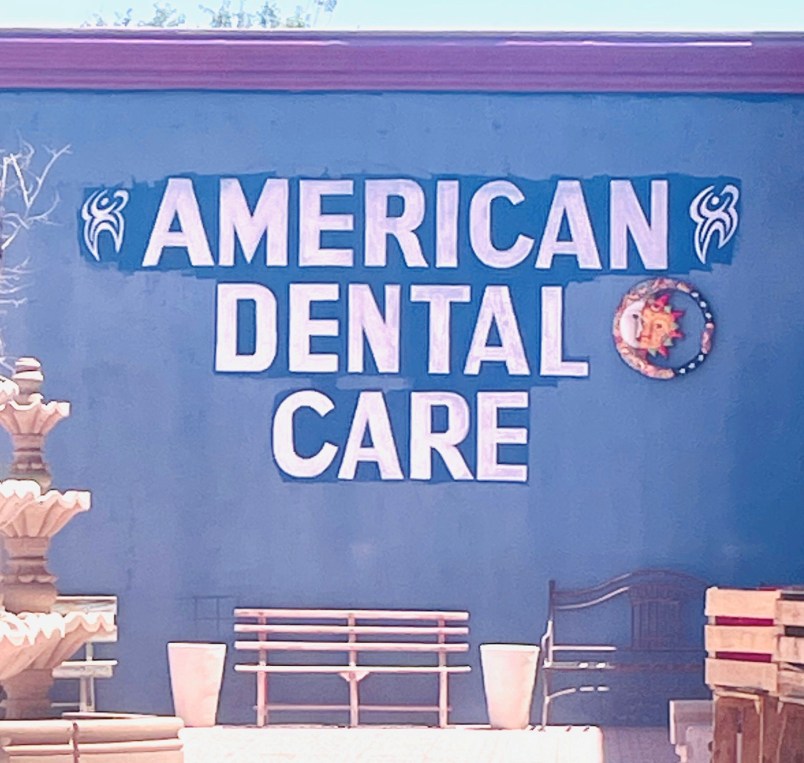
Deb, 72, and Mike, 78, have been married since 1979, one year after they met at a disco. The couple, who asked to go by just their first names to avoid any potential legal trouble, has lived in California for most of that time as educators. In their retirement, they kept up with their dental care despite having no dental coverage through Medicare. Then their dentist retired and the practice was bought by new management. They were quoted $2,000 each for a deep cleaning, and $5,000 for Mike’s four crowns — which wasn’t doable on their social security income. On the recommendation of a friend, they went to a dentist two hours away in Los Algodones who did the crowns for $1,200 instead, plus a $50 cleaning for Deb. Mike was able to receive the crowns on the same day as his fitting, rather than waiting multiple weeks as is common in the U.S. He says the work is holding up well two and a half years later.
“Seniors are at risk for some of the most needed but also most costly oral health procedures and services as they age,” says Rakes of CareQuest.
Over 30 bills to add dental benefits to Original Medicare have graced Congress since the 1990s, and were introduced in both chambers as recently as the 2025-2026 session. All attempts have failed, even though this is a solidly bipartisan issue: a 2021 Morning Consult poll found that 84% of U.S. voters and 79% of Republicans support the addition. Medicare dental coverage nearly became reality in the 2021 Build Back Better Bill, before opposition from Republicans and centrist Democrats saw it stripped from the final budget reconciliation (Nebraska Rep. Adrian Smith [R] called it “reckless government spending” at the time).
Even adults with private medical insurance may have no dental option. This is especially common for smaller employers with lower budgets. When Isabel Flores began getting commercial insurance at her job as an administrator at a small behavioral health agency, there was no dental plan, and she continued to get her dental care in Mexico. The last time Flores actually had her dental care covered was back in 2001, when she was incarcerated with the Arizona Department of Corrections.
But even for those who do have dental coverage, plan maximums kick in fast. People who reach their dental plan maximums are nearly three times as likely to have sought dental care outside of the U.S., according to the new CareQuest report. An organization that later became Delta Dental of California first began offering dental insurance in the 1950s “and at that time, the annual benefit was about $1,500 per person,” said Stafford. “And now we’re in 2026 and the average dental benefit from Delta Dental is $1,500.”
In the absence of coverage, costs are passed onto the patient. Dentistry is renowned as a high-overhead business, with operating costs exceeding 70% of revenue in some offices, according to Stafford. This is due to the nature of dental care, which he says almost always involves procedures with expensive equipment and materials. “Almost any time you come into the dental office, we are going to manipulate something. We are either going to perform a cleaning, or we’re going to remove tooth tissue and do a filling and replace it with a material,” he says. “The average drill is about $1,000. The chairs that you sit in are about $25,000.”
For Mukherji, the divide between medical and dental insurance doesn’t make sense for the health of Americans. He says that common chronic illnesses like cancer can have a negative impact on the teeth, and also that poor oral health is a risk factor for cardiovascular disease. Dental solutions are often part of treatment plans for airway issues and sleep disorders.
He puts it simply: “The mouth is attached to the body.”
Billboard Medicine
Within a few feet of the U.S.-Mexico border, the billboards begin. Dentists, opticians, and pharmacies vigorously advertise their affordable services in English to the Americans who have fallen through multiple safety nets. Flores and Deb and Mike visited two dental practices right next to one another in Los Algodones — but their experiences could not have been more different. Deb and Mike had their friend’s referral, and visited once before making an appointment to get their bearings. But Flores was desperate, and found a dentist through one of the many salespeople who wait on the Mexico side of the border to bring pedestrians directly to the practice they promote.
Despite its promise of affordability, dental tourism is plagued by similar inequities that brought people there in the first place. Just like in the U.S., patients are largely on their own, using their own resources to navigate an opaque system. Research suggests that dental tourism in Mexico and elsewhere booms while the oral health of the local population suffers.
In the absence of a better system, Mukherji says that patients should do their research regardless of where their dentist is. “Any provider that you see — doesn’t matter in your city, state, country, overseas, just always do your homework,” he says. “Look at their training, look at their regulations.” He also recommends patients communicate with their providers directly when something is unaffordable, because there may be other options, like low-cost care at dental schools or federally qualified health centers.
Flores knows she needs a lot of dental work, including some corrections for the care she received in Mexico. She thinks that she will look for sliding scale clinics in the U.S. first this time.
“It’s really disheartening that I can’t get the care here that I need, especially being born here,” she says. “I shouldn’t have to go somewhere else because I can’t afford it here.”
Even though dental care is cheaper in Mexico, it’s far from accessible. Although Deb and Mike liked their dentist in Los Algodones, the return trip across the border was physically difficult, as they stood in slow, long lines at the sparsely-staffed checkpoint. They don’t have plans to go back, as Mike now has a cardiac condition. “You’re talking about people in wheelchairs and walkers and canes all standing in the hot sun for over two hours,” Deb said.
“Every U.S. representative and senator should have to go to [Los Algodones] and stand in that line with their grandma, or with their elderly wife, or with themselves with a walker, to see what they are doing to us.”
What’s Really Going on With All the Celebrities Trying to Pinkwash AI
[Essay]
Rich Actresses Are Pushing AI
June brought a strange new chapter in the ongoing PR effort to pinkwash AI. Trae Stephens, Silicon Valley venture capitalist and co-founder of AI defense company Anduril Industries, joined Gwyneth Paltrow’s Goop podcast for an hour-long conversation about the divisiveness of modern politics, faith, and the Pope saying the war in Iran is evil.
You might wonder why a famous actor and wellness influencer invited a Peter Thiel acolyte whose company has a $20 billion counter-drone contract with the government on for a soft-focus chat.
The answer, according to Paltrow, is that she’s on a quest to connect with people with whom she may disagree. “I am trying to, in my journey through being an American right now, trying to, I don’t know, I guess sort of weave together lots of different points of view,” she said, “and also to get out of that place of, like, righteousness and anger and fear.” (Paltrow insists she is “not a Republican” and identifies as “completely an independent.” Cue the White Lotus memes).
But Paltrow is not the only blonde celebrity who wants us — and, specifically, her female audience — to open up to the idea of AI. Last month, actor Reese Witherspoon hopped on Instagram while making a smoothie to urge women to start using the technology so they don’t get left behind and to “make our everyday lives easier and better.”
Taylor Lorenz of Power User and Francesca Fiorentini of The Bitchuation Room both did smart podcast episodes questioning what’s going on with this “girlboss-ification of AI.”
As Lorenz put it, “AI is suddenly being sold to women, especially mothers and teen girls, as helpful, creative and aesthetic tools that can be woven seamlessly into everyday life. The goal is to shift perception of AI from existential risk and labor displacement towards AI as a lifestyle accessory that aids in self-expression and convenience.”
There’s a weirdly patronizing, faux feminist, “hey ladies” vibe to the messaging. Women are simultaneously encouraged to get on the AI bandwagon or risk losing out to job automation, or told ChatGPT is just a handy way for busy moms to recipe-plan for the week and that Claude allows teen girls to experiment with their personal style by picking out their outfits. The founders of these companies aren’t just out to make a profit off their ties to the Pentagon; they’re relatable podcast guests who worry about their kids’ personal safety and identify “most centrally” as a Midwesterner who grew up “in a lower-middle class household,” as Stephens told Paltrow. But there is of course a profit motive in marketing to women: new tech only takes off after women adopt it en masse. As Lorenz points out, that’s what happened with Spotify, Facebook, the iPod and iPhone, and fitness trackers. These services and products went from being niche, nerdy and primarily used by male tech enthusiasts to popular aesthetic and social platforms and devices used by much of the population after the companies started explicitly marketing to women.
There are legitimate reasons why women have been slower to adapt to AI. Women, who disproportionately bear the impact of environmental issues, are more concerned about the environmental and health harms caused by data centers. Research indicates they are also skeptical about the economic and employment benefits of AI, and are more likely to work in the service industry and in administrative and clerical roles that are disproportionately likely to be replaced by AI.
Those are the kinds of associations the industry is trying to shake. So don’t be surprised the next time a rich white woman celebrity shows up in your feed urging you to give AI another chance.
[Essay]
DOJ’s Disingenuous College Admissions Crusade
Under the influence of high-ranking White House official Stephen Miller, the Department of Justice has exposed the speciousness of conservatives’ stated belief in race-neutral alternatives to affirmative action.
For years, conservative thinkers appeared to support socioeconomic status as a race-neutral admissions criterion that could help increase college diversity without the implicit consideration of color or ethnicity. Back in 2004, the Department of Education under President George W. Bush published a report highlighting “socioeconomic approaches” as one of several “race-neutral alternatives” for academic communities. After the Supreme Court in 2023 outlawed the consideration of race in university admissions, Chief Justice John Roberts touted the “efficacy” of colorblind admissions in his majority opinion.
“Universities prohibited from engaging in racial discrimination by state law continue to enroll racially diverse classes by race-neutral means,” he lauded.
In his concurrence, Justice Neil Gorsuch suggested Harvard offer “socioeconomically disadvantaged applicants” additional financial aid and admonished the Ivy League for its lack of “socioeconomic diversity.”
But farther to the right, legal groups and conservative activists were wise to the gimmick of race neutrality. Smelling blood in the water ahead of the affirmative action takedown, they, in the early 2020s, began attacking the legality of considering economic disadvantage in admissions. Today’s U.S. government, led by far-right true believers who promote white supremacy, is now institutionalizing the idea that socioeconomic status is actually a proxy for race. This idea holds that since Black people are on average poorer, socioeconomic status can’t be used in admissions. From there, one needn’t reach far to reach the foundational white supremacist belief that Black people are inferior not because of changeable circumstances like access to education and financial attainment, but because they are Black.
A DOJ memo from last July rebuked admissions criteria “like socioeconomic status, first-generation status, or geographic diversity” if they were used to prioritize admissions based on race. How would one know if these criteria were being used explicitly to promote racial diversity? Harmeet Dhillon, assistant attorney general for the DOJ civil rights department, outlined the administration’s stance to Black people and higher education in a mid-May letter about Yale University allegedly preferencing Black students at its medical school. The argument goes like so: 1) socioeconomic status as a proxy for race acknowledges Black people are more likely to experience financial disadvantage in this country; 2) denying the use of socioeconomic status for admissions implies that at least that specific disadvantage cannot be made whole by addressing institutional factors like access to education and, therefore; 3) it must be inherent to the Black condition. The argument’s logical path ultimately reaches antebellum-era systems holding that “Black people are a subordinate class with intellectual inferiority,” as Justice Sonya Sotomayor wrote in her dissent to the 2023 affirmative action ruling. It ignores the impact of generations of well-documented federal policy that explicitly harmed Black communities like redlining, exclusion from higher education, and historically inequitable federal funding distribution for Black colleges and universities.
Madiba K. Dennie in a piece on Balls and Strikes pointed out the Trump Justice Department is flat-out saying that the 2023 Supreme Court decision should be decreasing the number of Black and Hispanic students. If the racial makeup of an incoming class didn’t change after that ruling, the DOJ says, that’s partial evidence a school must be breaking the law.
“This intent is confirmed by our data analysis below showing no change in racial disparity between admitted students before and after the Harvard decision,” Dhillon wrote.
To make its point, the DOJ highlighted the University of California, Davis’s consideration of socioeconomic disadvantage as an example of “racial proxies.”
Sotomayor spent part of her Harvard dissent highlighting a problem: socioeconomic status was not interchangeable with race. Turns out, the problem is actually that Trump’s DOJ believes it is.
[Muskism]

SpaceX and the New Social Contract
Friday, Elon Musk’s SpaceX had the largest IPO in history — by a considerable amount. Musk is now a trillionaire; VC and Private Equity firms who had invested in SpaceX got even richer; and according to the New York Times, 4,400 SpaceX employees are positioned to become millionaires, with 400 of those employees potentially worth over $100 million. It’s an almost unfathomable amount of wealth generated by a company that may be better at generating hype than value. For those on the outside, though, it’s likely another indicator that “the system” is rigged and reason enough to ponder what kind of system this even is.
Authors Quinn Slobodian and Ben Tarnoff note the many, many terms used to describe our current financial system (highlights: spiderweb capitalism, chokepoint capitalism, crack-up capitalism, and neopatrimonialism) before offering their own: Muskism. The term was chosen to draw an explicit comparison to industrialist Henry Ford and what became known in the early-to mid-twentieth century as Fordism. The defining feature of Fordism was that, in exchange for the labor necessary for mass production, workers would be given the wages and quality of life needed to enable mass consumption. This system held until roughly the 1970s when globalization and other factors led to a post-Fordism model where the beneficiaries were no longer wage earners but asset owners. The financial crisis and Great Recession would damage the post-Fordism model enough to pave the way for Muskism. So what is Muskism?
The concept as laid out by Slobodian and Tarnoff is too multifaceted to summarize here (you should read their article about it — they also wrote a book), but one way they describe it is, “In place of the social contract, in short, Muskism offers a fan contract. By entering the Musk fandom, one gains access to a privileged layer of amplified and monetized communication.” Unlike in the post-Fordism era where the social contract between the capitalists and the public was that what was good for the market was good for you, Muskism says that what’s good for Musk is good for his fans. Worse, as Slobodian and Tarnoff write, “Absent the capacity to persuade others in society that his rising tide will lift their boat too, Musk has opted to hysterically warn them about the tsunami of outsiders coming to swamp them.”
Musk may have subordinated the state to help finance his rocket ships, but that doesn’t mean all are welcome. For his supporters, however, the message is clear: get in, we’re going to the moon.
[Good Twetes]
Just Like Eric Adams Said
[TPM Trivia]

How Much of This Week’s News Do You Remember?
1) What reality TV show did Spencer Pratt make his name on years before he (unsuccessfully) ran for mayor of Los Angeles?
2) Name the three major candidates in the Maine Democratic Senate primary.
3) Which billionaire had to testify before the House Oversight Committee about his ties to Jeffrey Epstein this week?
4) Where was outgoing Rep. and failed South Carolina gubernatorial candidate Nancy Mace when she famously went ballistic at government employees, and what made her so upset?
Answers below
[Words of Wisdom]
Pay No Attention to That Man Behind the Curtain!
“Don’t blame Republicans. I know they say we control the Senate. We don’t.” – Ron Johnson of Wisconsin, part of the 51-seat Republican Senate majority
[In the Cafe]

In Defense of Mormons
Prolific poster and Utah Republican senator Mike Lee went on a tear last weekend after the Pentagon released a new, condensed list of officially recognized faiths that didn’t designate the Church of Latter Day Saints as a “Christian” religion. He was citing verses from the Book of Mormon. He was sharing music videos. He was beefing with Milo Yiannapolous (remember that guy?).
In her latest Church, Merch and State column, Sarah Posner explains how this snub of the Mormon Church is part of the bigger fight to ensure MAGA remains an evangelical Christian nationalist movement.
[No Words]
The White House, Brought to You by Monster Energy

Trivia answers: 1) The Hills 2) Graham Platner, Janet Mills, and David Costello 3) Bill Gates 4) Traveling through the Charleston airport. She told airport police officers and TSA staffers that they were “fucking idiots” after they failed to meet her car in a timely way
Ginsberg
A few days late (June 3rd, 1926) I wanted to wish a happy 100th birthday to Allen Ginsberg.
Autocracy Building in Ohio — Keep a Close Eye on This
We’ve talked a lot about what the Trump White House can and will do to subvert the 2026 midterms. The big picture is that with elections being run by states, based on the clear, black-letter law of the U.S. Constitution, what they can do is quite limited. And, as we’ve also noted, you build autocracies when you’re popular (often by goosing the economy in a smart and concerted way), not when you’re swirling the bowl with approval ratings in the mid-30s and falling. The point of returning to these facts is twofold. First is that a key aim of would-be autocrats is to demoralize the opposition, get people to lose hope and think there’s no point in fighting back. It’s important for democracy-defenders not to, with the best intentions, feed into that kind of psyop campaign. It is also to get people looking for the right things and not thinking in overly binary terms — elections vs. no elections, etc. This week we have news that focuses on the abuses of power we’re actually likely to see.
MS NOW broke the story that yesterday FBI agents fanned out across Ohio in pursuing some kind of investigation against a voting rights and voter registration group called Ohio Organizing Collaborative.
The White House Is Attacking Progressive Creators Like Me. Here’s Why It Won’t Work.
This article is part of TPM Cafe, TPM’s home for opinion and news analysis.
The White House recently published a new “Media Offenders” page on its official, taxpayer-funded website with a list of reporters and independent media who have criticized President Trump or the administration. This website included progressive content creators that it refers to as “deranged leftists” and “known liars.”
My name is on the list.
Continue reading “The White House Is Attacking Progressive Creators Like Me. Here’s Why It Won’t Work.”