





A week ago I wrote about a new CNN poll and how it showed Democrats were pretty evenly divided over “left” vs “centrist” politics (should the Ds “move to the left” or “move to the center”) but very united over fight vs accommodation. So focus on the latter and agree to disagree on the former. I also noted however that these terms are wildly over-determined and mostly don’t mean very much. For this specific question, those polling results are still broadly valuable because those are the catchphrases by which a major intra-party debate is identified. So if that’s the language being used and people split roughly down the middle, you know it’s very divisive and no one side is going to beat the other. It’s a standoff, and what you really want going into a critical midterm is unity.
But it’s still important to remember how little these terms actually mean, and to consider the complexities and uncertainties they paper over. I was reminded of this when I saw Axios describing a Reuters poll which Mike Allen said showed that independents are “progressive-curious.” The evidence was that substantial majorities of independents support higher taxes on corporations and billionaires (64%) and government-provided health care for all Americans (60%). But 43% are less likely to vote for a candidate who identifies as “democratic socialist.”
When news breaks — about, say, Graham Platner’s Senate campaign imploding over sexual assault allegations or Mitch McConnell’s hospitalization — I always scramble to open TPM’s Slack to see what my colleagues are posting about it. They’re so quick to share the latest updates or jokes that help add some levity to a grim situation.
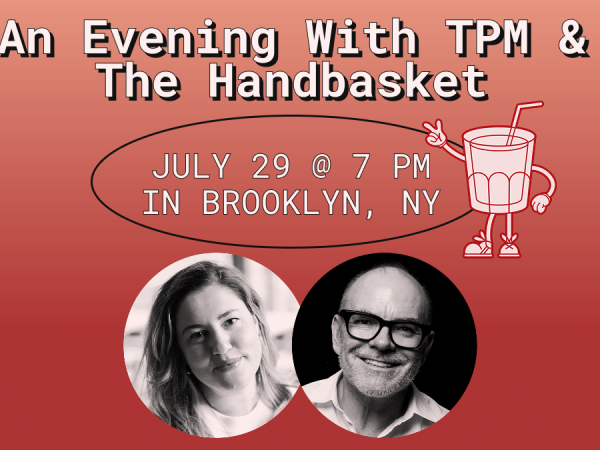
That’s the spirit of our upcoming event in Brooklyn on Wednesday July 29. Our own Josh Marshall and Marisa Kabas, independent journalist and founder of The Handbasket newsletter, will weigh in on whatever hell is currently breaking loose, in a conversation moderated by TPM publisher Joe Ragazzo. Marisa is a diligent chronicler of our current hellscape, who has broken stories about the takeover of the U.S. Institute of Peace and the Office of Management and Budget’s effort to freeze billions of dollars in federal grants and loans. (She also wrote an essay for our 25th anniversary last year about journalists becoming personal brands). So we’re thrilled to be able to bend her ear about the news of the day and making it work in independent media.
Nicole LaFond and I will kick off the event with some politics trivia for the audience, and we’ll end the night with a happy hour, where our staff hopes to meet readers of both The Handbasket and TPM. We’d really love to see you there.
Tickets are on sale now for $25 (or free for TPM Inside members). Get yours while they last.



Independent media can feel like an isolating place. Most of us operate as individuals or in small newsrooms with limited resources, throwing spaghetti at the wall to try to reach new audiences and get our stories in front of people in an ever-more-consolidated media environment.
But we’re in this together, as celebrated historian and writer Heather Cox Richardson reminded us in a generous live interview with TPM’s Kate Riga and Josh Marshall this afternoon.
HCR had Josh and Kate on to talk about what it’s like to report on today’s frenetic politics; the founding and future of TPM; and what independent media will look like in the years to come.
Read More

I’ve described to you many times how TPM was saved by an early shift to building a membership system. We began it at the end of 2012 and started building it in earnest in about 2014. That gave us a five or six year head start on almost everyone else. We were thus much better positioned when the collapse of the digital ad economy hit in the couple years just before the pandemic. But today I’d like to share with you another part of that transition because it intersects with a fascinating story of Trump era corruption published today in the New York Times. It’s the story of a couple Syrian-born billionaires, already in business with the Trump family, lining up Trump’s personal support to secure another vast payday. In “a sign of how powerful Mr. Trump has become,” Times reporter Eric Lipton says after laying out the basic facts of the story, “To get almost anything done in the nation’s capital requires not alienating a vexed and vengeful president, and, ideally, pleasing him.”
It’s that personalist rule I want to focus on.
And to do that let’s go back to TPM ad business.
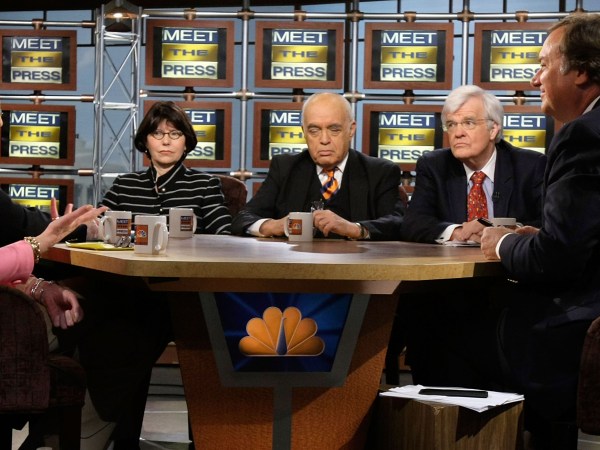

Over the weekend I noticed an example of one of the most significant features of the last decade-plus in American politics, though it’s one that still remains too little remarked upon. Lauren Egan writes a newsletter covering the Democratic Party for The Bulwark. Sunday night’s edition was about pundit and political analyst Stuart Rothenberg, “He Was a Legendary Independent Pundit. Then Trump Arrived.” Basically, How did Stuart Rothenberg come down with, as MAGA puts it, Trump Derangement Syndrome? Toward the end of the piece, Egan gets at what I think is the underlying issue here and some of the commonality I’m about to note.
Let’s start this story in the late ’80s and early ’90s. At the time, there were a handful of men — pretty much all men, as I recall — who played a very specific role in the political-journalistic ecosystem. They were rigorously, perhaps obsessively, non-partisan and were go-to people on basic questions of politics. They’d appear on shows, be on call for quotes for journalists at the big papers. Rothenberg and Charlie Cook played that role in the electoral analysis and predictions space. Larry Sabato also occupied that space, though he also played in the political analysis one. In the latter space were Norm Ornstein (AEI) and Thomas Mann (Brookings). I think they were on PBS Newshour for a long time as a pair. Their analysis was on the mechanics of governing, less the explicitly political stuff and generally not electoral stuff.