Facing expulsion vote, Swalwell resigns from Congress.
Quite apart from the gravity of the allegations, I simply cannot remember a more rapid and total campaign and, it would now seem, career implosion. Usually loyalists and especially senior staff hold out a bit longer. Just stunning in every dimension.
This post at Axios gives us the benefit of Barak Ravid’s reporting on the state of the U.S.-Iran negotiations. His sources suggest that the core hold up was the Iranian nuclear program, with the U.S. insisting on a 20 year moratorium on uranium production and the Iranians countering with something in the single digits. Note that this isn’t that different from what President Obama got with the JCPOA — a longterm but by no means permanent cessation. There’s also no mention in the Ravid piece about the Strait of Hormuz or the sanctions regime. Perhaps I’m wrong in what I noted here and the demand for sanctions relief is merely a bluff. But other reports say that Hormuz was in fact a major stumbling block, as one would expect. While I don’t question Ravid’s reporting as such, this article in the Times, I believe, captures the dynamic more precisely: Iran and the U.S. are now moving into a battle of economic privation, testing which player can endure more economic pain.
Conspiracy theories have become an inescapable part of American politics and political culture. I talked to Mike Rothschild, a journalist and conspiracy researcher who writes TPM’s Rough Edges column, about why some conspiracies endure, and what happens when fringe ideas are legitimized by some of the most powerful people on earth.
We got into the long tail of QAnon; just how many central banks the Rothschild family supposedly owns; and why MAGA conspiracy peddlers are turning on President Trump.
I wanted to share a few more thoughts on the current ceasefire and negotiations between the United States and Iran. As I noted earlier, there’s something so rich about sending JD Vance to lead the negotiations since the vice president has bent over backwards to signal to everyone who will listen (or write stories) that he was absolutely, positively against the war in the first place. President Trump has sent Vance to conduct and really own negotiations that almost certainly wouldn’t go well for the United States.
This cannot be an accident.
I started this post before the news broke that the first attempt at negotiations had broken down or, at least for now, had failed. That news just tightened the box into which Trump placed Vance. If the war resumes, Vance owns that continuation because he walked away from the negotiating table. It’s almost as though he gave the original order. If the negotiations fail, that’s on Vance too.
If you spent the weekend enjoying spring, you’ll be forgiven if you’re a tad disoriented this Monday morning.
Since we last convened Friday:
Viktor Orbán conceded defeat in Hungarian elections.
President Trump decided to shut down the Strait of Hormuz for Iran.
Eric Swalwell’s political career abruptly flamed out after serious sexual misconduct allegations emerged.
Trump openly beefed with the pope while portraying himself as an American Jesus.
And yet … stating things plainly like that doesn’t begin to capture the bonkers nature of the weekend’s news. Just ask JD Vance, who emerged as the biggest loser after an ignominious trip abroad that included a last-ditch campaign appearance for Orbán and the quick collapse of negotiations to end the Iran conflict he reportedly quietly opposed.
A Blow to Global Authoritarianism
If we’re lucky, Orbán’s defeat in Hungary will mark the beginning of the end of right-wing state capture. A few salient early reactions:
Political theorist Jacob T. Levy: “It’s not just that Orbán losing inspires hope in other competitive-autocratic countries ruled by right-wing nationalist authoritarians. It’s that his loss materially changes things in those other countries, because he’s been operating as a headquarters and funding source for the international ideological movement.”
Timothy Ash of Britain’s Chatham House: “People may go along with a kleptocracy for as long as an economy is doing well, but ultimately, if the economy starts failing, and they see all these guys lining their pockets, then you can expect a reaction.”
Political scientist Gabriela Greilinger in TPM: “If anything, the Hungarian election shows that authoritarians don’t ‘just lose.’ Rather, Hungary presented the perfect storm to defeat an authoritarian: a weak economy, scandal after scandal from the governing party, and an emerging opposition figure who rose to the occasion with the skill to lead a movement, highlight the government’s numerous failings, and increase the salience of issues that are of interest to the majority of voters.”
Latest on the Blockade of the Strait of Hormuz
Trump’s arc on the Strait of Hormuz goes something like: I will destroy Persian civilization if Iran doesn’t open the strait -> The strait will open automatically on its own after the ceasefire and we can all make money off of ships transiting through it. -> Fine, I’ll close the strait myself.
Contrary to President Trump’s assertion that the U.S. will blockade the strait, the U.S. military says it’s only a blockade of Iranian ports.
NATO allies are refusing to participate. It is not at all clear what the blockade is intended to accomplish or reasonably could achieve — or how it fits into Trump’s broader strategy, to the extent there is one.
A U.S.. strike Saturday on two alleged drug-smuggling boats in the eastern Pacific killed five people, raising the death toll in the campaign to at least 168 people.
Swalwell Under Criminal Investigation
After stories Friday by the San Francisco Chronicle and CNN alleging that Rep. Eric Swalwell engaged in repeated instances of sexual misconduct, including sexual assault, the California Democrat suspended his campaign for governor. In response to one alleged incident in New York City, the Manhattan District Attorney launched a criminal investigation into Swalwell.
In unrelated Swalwell news, the Trump DHS appears to be pursuing a new vindictive investigation of Swalwell for allegedly illegally employing a Brazilian nanny several years ago.
Trump Targets Pope Leo
We’re still nowhere near the bottom of Trump II’s descent into madness:
Deranged anti-Pope Leo screed from the current president of the U.S.
Some staff at the Whipple Federal Building in Minneapolis were given the Operation Metro Surge challenge coin pictured above, TPM’s Hunter Walker reports.
The Purges: Immigration Judges
The Trump administration has fired two immigration judges who dismissed high-profile deportation cases against pro-Palestinian international students Rumeysa Ozturk and Mohsen Mahdawi, the NYT reports.
The Corruption: Mass Pardons Edition
President Trump has repeatedly promised to issue mass pardons to members of his administration before he leaves office, the WSJ reports.
Those staffers can believe him at their own risk.
Pirro Touted Fed Subpoenas to Trump
I would imagine we’ll hear about this in the appeal of Judge Boasberg’s decision quashing D.C. U.S. Attorney Jeanine Pirro’s subpoenas of the Federal Reserve, via the WSJ:
On a Friday evening in January, President Trump received a call from the federal prosecutor he refers to as “Judge Jeanine.” His U.S. attorney in Washington, Jeanine Pirro, had a welcome update for the president: Her office had sent subpoenas to the Federal Reserve as part of an investigation into its chair, Jerome Powell.
Monumentalism Watch
In a Saturday order, the D.C. Circuit Court of Appeals sent Trump’s vanity ballroom case back to U.S. District Judge Richard Leon to sort out whether the project is ballroom or a bunker.
Trump unveiled plans for the gargantuan monstrosity he wants to erect at the foot of Memorial Bridge between Arlington National Cemetery and the Lincoln Memorial:
As screens fragment our attention, as AI pushes for speed and efficiency at the cost of our humanity, as the academy puts a pinch of incense on the altar of innovation, slowing down and revisiting a text again and again (whether sheet music, a book, a recording, a poem) is a revolutionary act. It turns you into a particular kind of reader, one attentive to the minute, to nuances, to how meaning can shift ever so slightly when this word is used rather than that.
Hot tips? Juicy scuttlebutt? Keen insights? Let me know. For sensitive information, use the encrypted methods here.
This article is part of TPM Cafe, TPM’s home for opinion and news analysis.
Sunday, April 12, brought long-awaited political change to Hungary. After 16 years in power, Prime Minister Orbán and his Fidesz party have been roundly defeated at the polls. Tisza, a new party led by Péter Magyar — a former Fidesz government insider who started openly opposing the Orbán regime after a clemency scandal rocked the government in 2024, leading to the president’s and the justice minister’s resignations — has won the election in a landslide.
The success came after more than a decade of Hungary’s slide towards authoritarianism, as Orbán’s government restricted media freedom, undermined the independence of the judiciary, eroded the rule of law, restricted civil liberties, and tilted the electoral playing field in its favour, among others. Right-wing leaders throughout Europe and in U.S. President Donald Trump’s MAGA movement took inspiration from his model.
Tisza won a clear majority in votes, which projections estimated would translate into a constitutional majority in parliament. Even with Magyar leading in the polls ahead of Sunday, few of those opposed to Orbán’s government felt this outcome was assured. Thanks to this super-majority, the party will now be able to implement fundamental reforms and undo parts of the authoritarian system Orbán has built over the past 16 years in power.
Contrary to most punditry, which suspected that the incumbent Fidesz party would resist, perhaps even challenge, a swift transfer of power, Prime Minister Viktor Orbán had conceded the race to Péter Magyar even before 50% of the votes were counted. Most likely, Fidesz realised that the opposing party’s winning margins were too wide across constituencies, thus undermining their ability to credibly challenge them.
Even though the Hungarian context differs fundamentally from the U.S. — and while the election in Hungary is, in the end, predominantly about Hungary — it does offer a few lessons on how far-right competitive authoritarianism can be defeated at the ballot box.
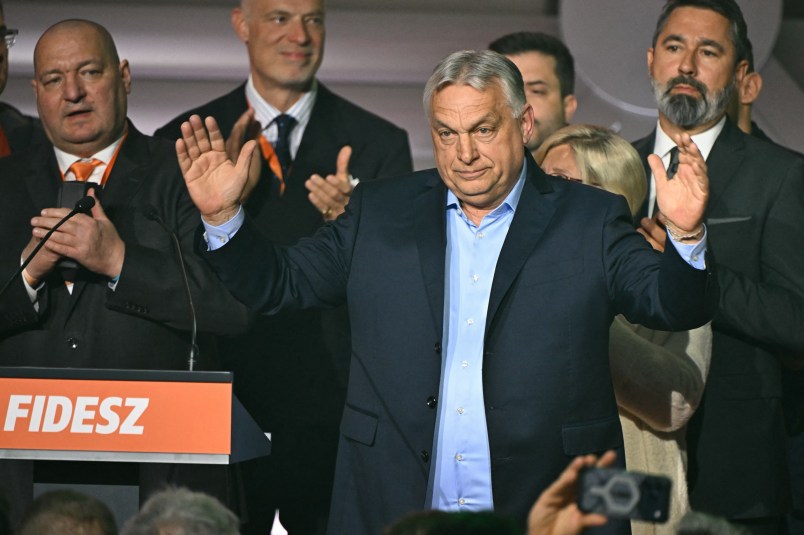
Hungary’s Prime Minister Viktor Orban salutes to supporters at the Balna centre in Budapest during a general election in Hungary, on April 12, 2026. Hungary’s nationalist Prime Minister Viktor Orban conceded defeat in parliamentary elections to his rival, conservative Peter Magyar, a former government insider and political newcomer who has promised “system change”. (Photo by Attila KISBENEDEK / AFP via Getty Images)
1) Campaigns are important, but it also matters where you campaign
Magyar’s victory did not come out of nowhere. In fact, it was the result of an arduous, almost two-year-long campaign across the country, involving hundreds of volunteers and individuals who sought change and supported the party.
Moreover, his landslide victory was also the result of intense campaigning in the smallest constituencies. Hungarian elections are overwhelmingly decided in smaller towns and rural areas, which have traditionally been Fidesz’s strongholds. Magyar drew on lessons from previous years and campaigned not only in big cities but also, overwhelmingly, in rural constituencies. Touring the country and visiting the smallest towns to spread his message helped him gain notoriety outside of government propaganda media that tried to misconstrue his message and portray him as a pro-Ukrainian, pro-war stooge supported by the EU establishment. Additionally, Magyar used his social media presence and the remaining independent online media to communicate with potential voters, once again enabling him to build momentum against the regime.
If there’s one lesson to draw for American democrats and Democrats, it’s to focus not just on big cities but also to establish a notable presence in rural areas and invest in personal contacts with voters.
2) A unified message behind one candidate
Although Magyar is a rather right-wing figure, coming from a politically conservative family tradition, his party’s voter base is majority left- and liberal-leaning. And yet, he managed to unite people behind him, create a big-tent organization, and mobilise voters. This was crucial in an electoral system in which Fidesz, the incumbent, can only be defeated with a strong, unified opposition party. Previous attempts at creating a coalition of parties to oppose Fidesz through Hungary’s parliamentary system notably failed. This time, however, Magyar managed to build a movement riding a wave of public discontent with the government’s performance and uniting voters of different ideological backgrounds behind a simple, unified message: No more business as usual; things must change. “Now or never” became the core slogan of the Tisza party, with “or never” cutting through, underscoring the urgency of removing the Orbán government, which had a tight grip on the country for the past 16 years and was likely to double down on its authoritarianism, while living standards for ordinary Hungarians would further deteriorate.
While Hungary shows that competitive authoritarianism can be beaten, that it will be is not a given. If anything, the Hungarian election shows that authoritarians don’t “just lose.”
“Now or never” is also a line from one of Hungary’s most well-known poems by a prominent national hero and revolutionary, Sándor Petöfi, which virtually every Hungarian knows. The message thus resonated broadly while also appealing to national pride, unifying Hungarians in their fight not just against but also for something: their homeland.
The lesson for other countries is to likewise build on what unites, rather than what divides. A fractured opposition — or, in the U.S. context, a fractured opposition party campaigning on different issues — is unlikely to effectively oppose an authoritarian.
3) Sowing hope
Notably, while Magyar’s key message was about opposing the Orbán regime and the soaring kleptocracy and corruption it allowed and encouraged, resulting in poor living standards, he also offered a strong message of hope. Repeatedly appealing to Hungarians, reminding them that their future is in their hands, that they do not have to live like this, and that they have an opportunity for change, motivated voters, keeping them engaged in an environment that seeks to make them politically disillusioned and disenchanted. As such, he campaigned not just against something but also, distinctly, for something, based on hope and trust in the country, namely: a better future and a better Hungary.
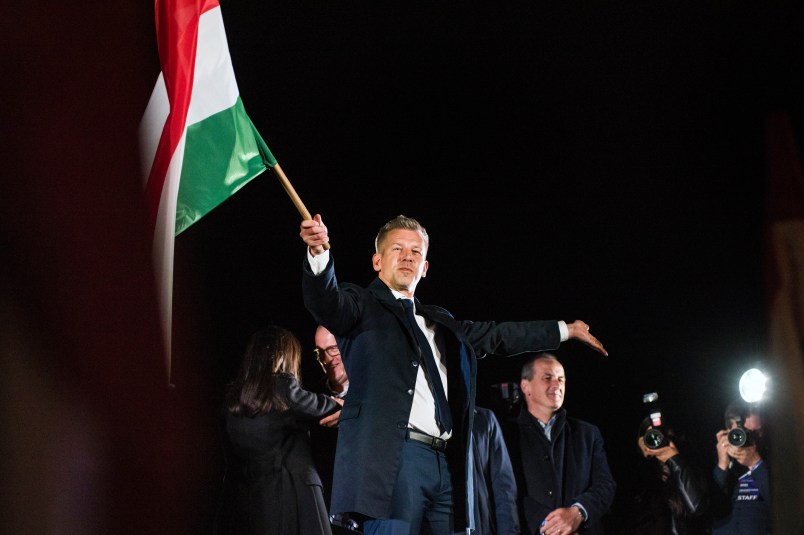
BUDAPEST, HUNGARY – 2026/04/12: Peter Magyar waves the Hungarian flag after his speech during the Hungarian Civic Alliance (FIDESZ) party’s election night event in Budapest. The election marked one of the most significant political transformations in Hungary in decades, as Péter Magyar’s Respect and Freedom (TISZA) party secured a decisive victory over Prime Minister Viktor Orbán’s Hungarian Civic Alliance (FIDESZ) party, which had been in power since 2010. Thousands gathered in Budapest to celebrate the result. Magyar, who emerged as a central opposition figure just two years ago, mobilized strong voter support with a campaign focused on anti-corruption, improving living standards, and restoring Hungary’s pro-European direction. (Photo by Attila Husejnow/SOPA Images/LightRocket via Getty Images)
This lesson is crucial, also for other contexts facing competitive authoritarianism. Authoritarians want people to feel a sense of helplessness and despair, to demobilise them and suppress dissent. Offering messages of hope, allowing voters to dream of a better future, and reminding them that it’s in their hands helps them maintain morale, particularly in competitive authoritarian regimes with mostly free but unfair elections.
No one size fits all
Obviously, every election is context-dependent, and opposition strategies depend on local circumstances, salient issues, electoral systems and rules. As such, there is no one-size-fits-all solution to defeating authoritarianism, and Hungary’s lessons, as a distinct case, are limited.
While Hungary shows that competitive authoritarianism can be beaten, that it will be is not a given. If anything, the Hungarian election shows that authoritarians don’t “just lose.” Rather, Hungary presented the perfect storm to defeat an authoritarian: a weak economy, scandal after scandal from the governing party, and an emerging opposition figure who rose to the occasion with the skill to lead a movement, highlight the government’s numerous failings, and increase the salience of issues that are of interest to the majority of voters.
Beating a party entrenched in power requires not just a good strategy, but also the right conditions and someone able to take advantage of them. This includes building a strong, unified opposition that focuses on local mobilization and campaigns on salient issues that affect and resonate with everyday people across the board.
The defeat of Viktor Orbán is a big, big deal. He’s not only a core symbol of the global authoritarian movement. His regime was also its laboratory, its rallying point and a source of funding, a location to operate from. It’s important to note that he was defeated by what is essentially a center-right party, led by a defector from Orbán’s party. But from appearances, at least, it’s a center-right party that plans to operate within the structures of civic democracy. I wanted to note that, perhaps in spite of himself, Orbán, bad as he is, managed to again illustrate just what a weak and fraudulent man Donald Trump is. He managed to do what Trump has never been able to do: concede defeat.
This is a big and consequential defeat for global Team Strongman.