Seven Reasons Listicles Didn’t Suck, Actually (And One Of Them May Surprise You)

“The human animal differs from the lesser primates in his passion for lists of Ten Best.” —H. Allen Smith.

The listicle — that staple of 2010s digital journalism — was often maligned, not least by other journalists. The format was decried as lazy, on the part of both publishers and consumers, in an age of shortening attention spans; as a killer of “real journalism,” and as “pseudo-journalism that has become a drain on our collective intelligence”; as emblematic of an era defined by vacuous, money-grabbing clickbait. In 2017, Lake Superior State University in Michigan proposed to ban the term “listicle” itself, as part of an annual “List of Words Banished from the Queen’s English for Mis-Use, Over-Use and General Uselessness.” (The irony was not lost on the authors.) The Oxford English Dictionary notes that usage of the word is still “frequently disparaging.”  

These days, listicles feel like a relic of a different online age — one of scale-chasing and peppy social virality; of BuzzFeed (perhaps the pioneer of the listicle) and Upworthy — that has been superseded by today’s fractured web. They are often remembered not as journalism, or even good content, but as trash, engineered to entice users to click on a link while scrolling Facebook (something young people once did), stay on the page for as long as possible, and, preferably, share it on with family and friends. (Listicle-adjacent concepts included “listflation,” or the idea of stretching listicles to ever greater numbers of items, and the “demolisticle,” a piece of content targeted at a niche audience — Berkeley grads, say, or children of Irish parents — but primed for sharing among the communities that saw themselves represented.) As I see it, though, listicles deserve to be remembered more favorably — and may not be dead yet. Here are seven reasons why, because of course.

Continue reading “Seven Reasons Listicles Didn’t Suck, Actually (And One Of Them May Surprise You)”

Trump Wants to Scrap the Filibuster Because He Doesn’t Care About the Republican Party

Fine! Scrap it! 

President Trump has become an unexpected ally in the progressive quest to eliminate the filibuster, deciding that anger over the government shutdown catalyzed Tuesday’s blue wave. 

Continue reading “Trump Wants to Scrap the Filibuster Because He Doesn’t Care About the Republican Party”

The Insider Politics Sheets Are Scurrying for New Conventional Wisdom

One of the most important things to understand about politics is the danger of literalism, assuming the straightforward meanings are the important ones. You can be following the libretto but the real action is in the score. Closely related to this is the danger of assuming that politics operates by a kind of Newtonian cause and effect. Object A moves when it’s hit by Object B. That’s logical and straightforward. But that’s often not how things work. You can see some of this this morning in the DC insider sheets that distill conventional wisdom.

This morning’s Punchbowl newsletter runs with the headline “Political winds whip the MAGA movement.” The movement is rocked by an argument about antisemitism, good or bad? Trump’s tariffs, his central policy, are on the rocks. Trump’s out of sync with the congressional Republicans on the shutdown. Republicans are losing the shutdown. He’s unpopular. Their policies are unpopular. Costs continue to rise. It all sounds pretty bad, and the Punchbowl editors add in the bad election night too. What’s notable though is how much of this was the case before Wednesday morning, before which they were generally saying that things were going great for Trump and the GOP.

Continue reading “The Insider Politics Sheets Are Scurrying for New Conventional Wisdom”

Heritage Foundation Implodes Over Carlson-Fuentes Lovefest

The Groyper Takeover of the GOP

Heritage Foundation President Kevin Roberts’ initial defense of Tucker Carlson’s interview with the raging antisemite Nick Fuentes has now ignited an open revolt at the venerable right-wing think tank, the WaPo reports.

While Roberts has backed away some from his initial full-throated defense of Carlson, his apology didn’t keep a staff meeting at Heritage on Wednesday from turning into a shitshow. Some of the highlights from the WaPo:

  • “Legal fellow Amy Swearer during the meeting called Roberts’s handling of the controversy ‘a master class in cowardice that ran cover for the most unhinged dregs of the far right’ and described a loss of confidence in his leadership.”
  • “Asked later in the meeting about his use of the term ‘globalists’ — a common dog whistle for a conspiratorial view of world ‘Jewry’ — Roberts said he didn’t mean to imply criticism of anyone of any particular faith.”
  • When Roberts’ speechwriter complained that countering the accusations of antisemitism might mean he would be required to attend a Shabbat dinner and violate his own faith, another Heritage executive shot back, “I’m deeply sorry that you could not see that as a generous offer but rather a personal attack on you.”

At least five members of Heritage’s antisemitism task force have resigned in protest, including lawyer Ian Speir, who emailed the WaPo:

When Kevin Roberts repeatedly defended Tucker Carlson after his kid-glove treatment of Nick Fuentes, I lost faith that Heritage is the right institution to lead this important fight. We cannot let this malevolent evil make further inroads into our politics and civil discourse. It will literally destroy us.”

At one level, it’s entertaining to watch conservatives squirm over the Groyperism of their party — although they’ve been very slow in responding to what has been obvious for years.

“The distance between Fuentes and the mainstream Republican Party isn’t really that large,” Richard Hanania told the NYT, whose description of him is itself instructive: “a conservative writer who once posted under a pseudonym in white supremacist forums. (He has since denounced his past writings.)”

Back at Heritage, Roberts threw his own chief of staff under the bus for writing the speech that got Roberts in so much hot water:

On Monday, Roberts reassigned his chief of staff, Ryan Neuhaus, to a lower-ranking role. By Tuesday, Neuhaus was no longer employed by Heritage. On Wednesday, Roberts called him a “good man” who “made a mistake,” and said he was largely responsible for drafting Roberts’s controversial remarks.

The kicker was this line: “Two people close to Neuhaus said he views his departure as an attempt to appease Jewish Republicans.”

Good Read

WaPo: The secretive donor circle that lifted JD Vance is now rewriting MAGA’s future

Bad Day for Trump Tariffs at SCOTUS

You could feel the legal community breathe a sigh of relief that even the Roberts Court couldn’t bring itself to embrace President Trump’s tariffs. His wildly expansive view of presidential power at the expense of Congress was a bridge too far in oral arguments yesterday. How many justices will rule against Trump and how they get there remain open questions, but the alternative — a ruling in Trump’s favor — would have resulted in nearly boundless executive power and collapsed the already teetering constitutional order:

  • TPM’s Layla A. Jones: Liberal Justices Cheekily Use Conservatives’ Favorite Legal Theories to Push for a Ruling Against Trump On Tariffs
  • WSJ: A Justice-by-Justice Breakdown on Trump’s Tariffs
  • Politico: 5 takeaways from the Supreme Court’s oral arguments in Trump’s tariffs case

Trump: ‘They’ll Most Likely Never Obtain Power’

Trump: "They're gonna make DC a state and they're gonna make Puerto Rico a state. So now they pick up two states, four senators. They're gonna pick up electoral votes. It's gonna be a very, very bad situation. Now, if we do what I'm saying, they'll most likely never obtain power."

Aaron Rupar (@atrupar.com) 2025-11-05T13:43:43.699Z

Early Theories of the Election

It will take some time to analyze Tuesday’s election results — and early takes are often wrong — but among the many analyses floating around in the ether, these three caught my eye:

  • Pollsters struggled to identify the expected electorate — the partisan makeup of who would actually vote. Angela Kuefler, the pollster for the Mikie Sherrill and Abigail Spanberger campaigns, told the WSJ that the most accurate partisan mix turned out to be the 2017 election, first year of Trump’s first term. “Polls that used the 2017 electorate as a guide produced a 12- or 13-point Sherrill victory, which tracked the actual outcome,” the paper reported.
  • Democrats succeeded at winning over “a modest but meaningful sliver” of Trump supporters, Nate Cohn reports. “[T]he available data generally suggests that Democratic gains were driven slightly more by flipping Mr. Trump’s supporters than by benefiting from a superior turnout,” according to Cohn’s analysis of the governor’s races in Virginia and New Jersey.
  • Perhaps the internecine argument over whether to attack Trump or focus on kitchen tables issues is a false dichotomy, Greg Sargent writes: “The Democratic Party’s blowout wins on Tuesday night underscore a fundamental reality about the Donald Trump era: Anti-Trump politics is affordability politics, and affordability politics is anti-Trump politics.”

Judge Scolds Comey Prosecutors

In an early procedural hearing in the prosecution of former FBI Director James Comey, U.S. Magistrate Judge William E. Fitzpatrick deplored the government’s “indict first and investigate second” approach.

A frustrated Fitzpatrick said the prosecution was not a “traditional case” and that “the procedural posture of this case is highly unusual.”

Fitzpatrick largely sided with Comey, ordering prosecutors to turn over by today “all grand jury transcripts and materials from the current prosecution as well as evidence that FBI agents seized during a prior leak investigation in 2019 and 2020,” NBC News reported.

Quote of the Day

“Obviously some of these conditions are, in my word, disgusting. To have to sleep on the floor next to an overflowed toilet, that’s obviously unconstitutional.”–U.S. District Judge Robert Gettleman of Chicago, who ordered the federal government to provide bedding, hygiene supplies, daily showers, clean toilets and three meals a day at the ICE facility Broadview

For Your Radar …

In the case of Chanthila Souvannarath, who was deported to Laos last month despite a federal court order barring his deportation, U.S. District Judge Shelly D. Dick of Baton Rouge has allowed limited written discovery into the circumstances of the deportation.

It’s “clear that there are factual questions about the timing and circumstances of the alleged violation of this Court’s TRO,” Dick said in her latest ruling. The Trump administration claims it didn’t receive the court order until after Souvannarath had already been deported.

In echoes of the wrongful deportation of Kilmar Abrego Garcia, the Trump administration is arguing, among other things, that Dick lacks jurisdiction because Souvannarath was removed from her judicial district to Alexandria, Louisiana, while the case was pending and because she can’t compel the government of Laos to return him.

Venezuela Watch

The Trump DOJ is working on a legal justification for targeting Venezuelan President Nicolás Maduro as part of a military operation, the WSJ reports.

Someone Should Ask the Groper-in-Chief About This

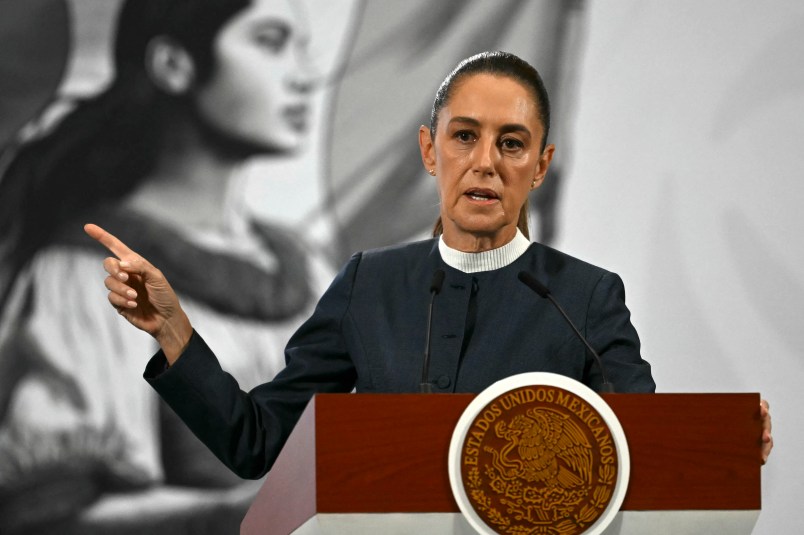
Mexico’s President Claudia Sheinbaum at Palacio Nacional in Mexico City on November 3, 2025. (Photo by CARL DE SOUZA / AFP) (Photo by CARL DE SOUZA/AFP via Getty Images)

Mexico President Claudia Sheinbaum is pressing charges after being groped on the street while walking from the National Palace to the Education Ministry: “If this is done to the president, what is going to happen to all of the young women in our country?”

Do you like Morning Memo? Let us know!

The Summer the Internet Found Empathy — And How Quickly We Lost It

In May 2020, a nation already cracked by a pandemic convulsed further as the world watched the murder of George Floyd, his final breaths captured and uploaded, looping endlessly across screens. 

Digital media didn’t just amplify his murder; it made the pain unavoidable, everywhere at once, and for a fleeting moment, it seemed to wake mainstream American journalism up. Empathy became a part of American digital life in an unprecedented way: suddenly, stories about racism, police violence, and systemic injustice were not only homepage news, but treated with a solemnity, care, and nuance rarely seen. And Black-led outlets and journalists, who were driving the shift, saw a surge in attention and investment. 

As someone who was just entering the industry full-time, it felt like this was how it might always be. Editors who, just weeks earlier, seemed immune to my pitches on police violence, were suddenly not only receptive but proactive. They wanted frontline dispatches and Black perspectives, and they wanted them now. That summer, the sixth-largest news website in the world commissioned me to cover protests in Chicago and Kenosha, Wisconsin. My fifth-ever professional byline, a dispatch from the night Kyle Rittenhouse shot three protestors, killing two, garnered 1 million views in 24 hours. 

The story’s digital life took on a logic of its own: death threats in my DMs, emails from grateful readers who found catharsis in my words, and comments from colleagues saying my work was “necessary.” It was, in digital terms, “viral empathy”— and what a strange, exhausting thing it was. Still, it seemed necessary for a future where American journalism might best serve the country’s most vulnerable. 

I didn’t yet realize how quickly tides could turn.

Continue reading “The Summer the Internet Found Empathy — And How Quickly We Lost It”

MAGA Suddenly Worried It’s Not Talking About Affordability Enough

It might be too much to expect MAGA world to realize that its incessant attacks on its enemies and welcoming embrace of the fringiest of figures might not play well with voters. What, after all, would MAGA be without enemies and fringe figures?

Nonetheless, a few prominent MAGA voices suggested Wednesday that the party’s anti-trans vitriol and demonization of immigrants may not make for a winning campaign platform, an epiphany stemming from Democrats’ nationwide victories on Tuesday evening, when voters roundly rejected what’s been going on during the first nine months of Trump’s second term.

It appears that Trump’s allies are looking for somewhere to focus their messaging after the party’s pretty universal Election Night shellacking. And they’re looking toward the Democratic socialist in New York they’ve spent the last several months demonizing and attempting to turn into a national MAGA foil, Zohran Mamdani, as well as Democratic candidates in Virginia, New Jersey and elsewhere who ran on a platform of affordability and spoke to voters directly about their skyrocketing cost of living concerns.

Both the Democratic candidates for governor in New Jersey and Virginia pulled off double digit victories in their respective states with cost of living messaging. Democrats also were able to flip 13 seats in the Virginia House of Delegates on such a platform. And Mamdani, of course, built his entire political rise the past several months on a message of affordability — freezing the rent on rent-stabilized apartments, opening city-run grocery stores and making it free to ride city busses. It was a message that he successfully used to defeat not just his Republican opponent but also the city’s current (scandal-plagued) mayor and, most impressively, former Gov. Andrew Cuomo, the head of a New York political family dynasty who was widely considered the frontrunner when he entered the race last spring and who President Trump pseudo-endorsed in the waning days of the general election.

White House deputy chief of staff for legislative, political and public affairs James Blair announced to Politico on Wednesday that Trump would now pivot to focusing on affordability issues across the country.

“The president is very keyed into what’s going on, and he recognizes, like anybody, that it takes time to do an economic turnaround, but all the fundamentals are there, and I think you’ll see him be very, very focused on prices and cost of living,” Blair said during an interview Wednesday.

He went on to gently criticize Republican gubernatorial candidates in New Jersey (Jack Ciattarelli) and Virginia (Winsome Earle-Sears) for focusing on the wrong things:

“Jack didn’t really talk about that,” Blair said. “He talked about taxes, and he won the tax vote, but he didn’t address those key issues of affordability very effectively. He was mostly talking generically about change to Jersey. And I’m not denigrating Jack, but it was not in line necessarily with what voters were saying. Two, in Virginia, over half of Winsome Sears’ ads talked about transgender. And it’s not even the top five issues, according to voters.”

Former 2024 Republican primary presidential candidate Vivek Ramaswamy, who is running for governor in Ohio and remains an ardent Trump supporter, posted a video on Twitter Wednesday acknowledging that “we got our asses handed to us” in Tuesday night’s elections and suggested MAGA should start focusing on affordability as well, and “cut out the identity politics.”

“No. 1, our side needs to focus on affordability. Make the American dream affordable. Bring down costs — electric costs, grocery costs, health care costs and housing costs — and lay out how we’re going to do it,” he said.

“And No. 2: Cut out the identity politics,” Ramaswamy said. “It doesn’t suit Republicans. It’s not for us. That’s the woke left’s game, not ours. We don’t care about the color of your skin or your religion. We care about the content of your character. That’s who we are.”

— Nicole LaFond

Kansas Redistricting Push Faces Roadblock

The Trump-backed redistricting campaign in Kansas has hit a roadblock after the GOP House Speaker Dan Hawkins announced this week that Republicans do not have the votes needed to convene a special session.

The redistricting push in Kansas is part of the Trump administration’s larger pressure campaign to gerrymander congressional maps in red states to ensure Republicans maintain control of the House in the midterm elections. 

“Planning a Special Session is always going to be an uphill battle with multiple agendas, scheduling conflicts and many unseen factors at play,” Hawkins said on Tuesday. 

The decision to press pause on a potential redrawn map comes as the nation witnessed major Democratic wins on Election Night, which some experts say may make some red states reconsider their interest in following President Trump’s gerrymandering pressure campaign because the move could ultimately make some safe Republican districts more competitive.  

— Khaya Himmelman

Trump Wants Filibuster Abolished in Wake of Election Losses

President Trump seems convinced that the reason Republicans did so bad in Tuesday night’s elections is because Americans blame Republicans for the ongoing government shutdown, which is the longest in U.S. history as of this week. He posted as much on Truth Social as the night wrapped up.

During a call with Senate Republicans on Wednesday morning, Trump reportedly told senators that they would become “do nothing” Republicans if they didn’t figure out a way to get rid of the filibuster in the Senate, which is the rule that makes it mandatory for legislation to have 60 votes in support in order to pass. Per Axios:

“If you don’t terminate the filibuster, you’ll be in bad shape,” the president told GOP senators during the televised portion of the breakfast remarks.

— Nicole LaFond

In Case You Missed It

Liberal Justices Cheekily Use Conservatives’ Favorite Legal Theories to Push For a Ruling Against Trump On Tariffs

Emboldened by Election Night Wins, Dem Leadership Asks Trump for Another Sit-Down to Discuss Shutdown

In First Chance For Voters to React to Trump II, All Kinds of Democrats Steamrolled Republicans

Chasing the Dress Into the Viral Traffic Abyss

What a Glorious Time for Criming in America

Yesterday’s Most Read Story

Pam Bondi Waves Magic Wand To Solve Her Lindsey Halligan Problem

What We Are Reading

Mississippi Democrats Break Republican Senate Supermajority: ‘We Are a Battleground State’  

U.S. orders 10% cut in flights at several airports as shutdown drags on

Trump Humiliation Worsens as Fresh Info Reveals Scale of GOP Losses

Liberal Justices Cheekily Use Conservatives’ Favorite Legal Theories to Push For a Ruling Against Trump On Tariffs

Wednesday’s Supreme Court oral arguments on President Donald Trump’s use of an emergency declaration to apply steep, worldwide tariffs saw liberal justices — and a former Obama-era acting solicitor general, arguing for the plaintiffs — somewhat trollishly embrace two legal theories most often deployed by the court’s right-leaning justices: the so-called major questions and nondelegation doctrines.

Continue reading “Liberal Justices Cheekily Use Conservatives’ Favorite Legal Theories to Push For a Ruling Against Trump On Tariffs”

Mamdani Will Need To Continue Explaining to New Yorkers What His Democratic Socialism Is and Is Not

I was excited by Zohran Mamdani’s candidacy, which brought many young and minority voters, who had been turned off by the Biden-Harris years, back into the fold. I have been a democratic socialist since the late 1960s, so I also welcomed his attempt to run as one. That said, I wasn’t crazy about his victory speech. 

Continue reading “Mamdani Will Need To Continue Explaining to New Yorkers What His Democratic Socialism Is and Is Not”

Emboldened by Election Night Wins, Dem Leadership Asks Trump for Another Sit-Down to Discuss Shutdown

Emboldened by Tuesday’s Election Night wins for Democratic candidates and causes across the nation, Senate Majority Leader Chuck Schumer (D-NY) and House Minority Leader Hakeem Jeffries (D-NY) on Wednesday renewed their request for a meeting with President Donald Trump to discuss the ongoing shutdown — which is on its 36th day, now making it the longest government shutdown in U.S. history 

Continue reading “Emboldened by Election Night Wins, Dem Leadership Asks Trump for Another Sit-Down to Discuss Shutdown”