


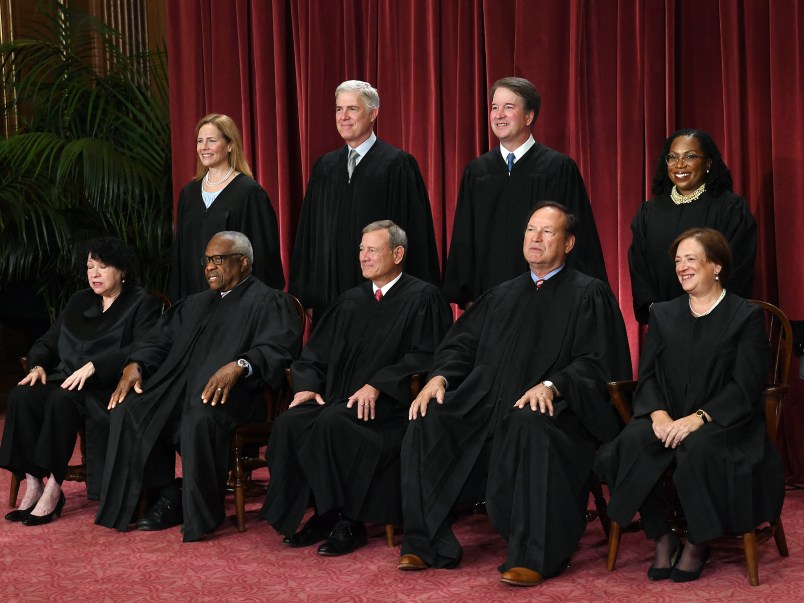
Wednesday’s Supreme Court oral arguments on President Donald Trump’s use of an emergency declaration to apply steep, worldwide tariffs saw liberal justices — and a former Obama-era acting solicitor general, arguing for the plaintiffs — somewhat trollishly embrace two legal theories most often deployed by the court’s right-leaning justices: the so-called major questions and nondelegation doctrines.
Both theories, in recent years, have been invoked by the conservative majority with increasing frequency as it struck down actions by Democratic presidents and their executive branch regulatory agencies. Throughout arguments Wednesday, the liberals sought to convince the conservative justices most amenable to those theories that the Republican president had significantly overstepped his authority based on both, or either, and that the tariffs were therefore illegal and should be revoked.
Justice Sonia Sotomayor set the tone early in the more than two-and-a-half hour proceedings, when she highlighted to Solicitor General D. John Sauer the crux of the argument against Trump’s emergency tariffs: that tariffs are taxes, and taxation is a congressional authority.
Sotomayor didn’t understand any argument, she said, “that foreign powers or even emergency can do away with the major questions doctrine. Didn’t we recently say that an emergency cannot make clear what is ambiguous?” she asked, referring to an earlier Supreme Court ruling against the executive branch during the COVID-19 pandemic.At issue in this case is whether Trump can use the International Emergency Economic Powers Act, or IEEPA, to bypass Congress’s power of the purse to levy tariffs against virtually every country in the world through presidential national emergency declarations.
The first of the two conservative theories to receive significant attention during oral arguments, the major questions doctrine, holds that in the event a president issues a policy of what the court labels “vast economic and political significance,” the statute used must explicitly grant the executive those powers. It has consistently been used to inhibit Democratic policies, and was applied especially frequently to oppose many of former President Joe Biden’s priorities, including student loan forgiveness. Then, liberal justice Elena Kagan decried the use of the doctrine as a “danger to democratic order.” Today, her political allies on the court attempted to use it to illuminate to their conservative colleagues what the court’s positions in past cases should mean for this one.
Sauer’s responses, stated and restated several times throughout the proceedings, dismissed the major questions doctrine under the theory that it didn’t apply in a “foreign policy context,” and that IEEPA’s use of the verb “regulate” naturally implied tariffs anyway.
“So Biden could have declared a national emergency on global warming and then gotten his student forgiveness to not be a major questions doctrine?” Sotomayor followed.
Conservative justices at times also seemed happy to entertain the line of argument their liberal colleagues had teed up for them, suggesting they, too, thought the major questions doctrine was at least relevant here, and at most imperiled Trump’s IEEPA tariffs.
“Sometime ago, you dismissed the applicability of the major questions doctrine,” said Chief Justice John Roberts. “I want you to explain that more. It seems it might be directly applicable.”

The nondelegation principle, the other legal theory favored by conservatives that saw heavy rotation Wednesday, holds that Congress cannot delegate its legislative and lawmaking authority to any other body.
A later line of questioning from Trump-appointed Justice Neil Gorsuch pressed on the issue of congressional delegation and challenged the idea that Congress would’ve given a president such sweeping powers to impose raise revenue via tariffs, even in a foreign policy context.
“Can Congress delegate to the president the power to regulate commerce with foreign nations as he sees fit?” Gorsuch asked.
“Explain how you draw the line,” said Gorsuch, leaning on Sauer’s foreign affairs exception argument. “If that is true,” he continued, “what would prohibit Congress from just abdicating all responsibility to regulate foreign commerce — for that matter, declare war — to the president?”
Gorsuch at times seemed unsatisfied with the government’s responses and emphasized just how difficult it would be, if IEEPA did in fact give the president tariff powers, for Congress to wrest those powers back from the executive.
“If I can cut through those words, I think you are saying, no, the president does not have inherent authority over tariffs in peacetime,” Gorsuch, at one point, said.
That these issues were being raised by the liberals became a bit of a joke during arguments from Neal Katyal, the counsel for an Illinois-based toy company suing the administration over tariffs and a former Obama administration acting solicitor general.
“I wonder if you ever thought that your legacy as a constitutional advocate would be, ‘the man who revived the nondelegation argument,’” Justice Sam Alito asked Katyal, to laughter from the crowd.
Highlighting the irony, Katyal took it a step further.
“Heck yes, Justice Alito,” he said. Referring to an earlier line from Gorsuch — asking whether allowing Trump to apply tariffs to IEEPA would broadly overstep the nondelegation theory — Katyal affirmed: “I think Justice Gorsuch nailed it on the head.”
Even outside of discussions about the two legal theories in question, the justices, including at least some of the conservatives, seemed skeptical about the government’s arguments, probing the validity of the way in which Trump’s national emergency declarations could apply to such a diverse range of foreign entities.
“Across the board, is it your contention that every country needed to be tariffed because of the threats to the industrial base?” asked Justice Amy Coney Barrett. “Spain? France?”
William Reinsch, former president of the National Foreign Trade Council which represents companies in tax and foreign trade policy issues, told TPM in an email after arguments concluded that while major questions and nondelegation rose as two of the central pieces of Wednesday’s hearing, he didn’t have a clear picture of where the justices stood related to Trump’s actions. Reinsch, who is currently senior adviser at the Center for Strategic and International Studies, said he was modestly surprised during oral arguments by Gorsuch, “who seemed more open to ruling against Trump than I had expected.”



I am betting 5-4 against the tariffs. The majority: Jackson, Sotomayer, Hagen, Barrett, Gorsuch. The corrupt dissent: Roberts, Alito, Thomas, Kavanaugh.
Neal Katyal is a treasure and a genius.
Going back to prior precedents and legal theories would be fine, if it wasn’t for the fact that the corrupt six just rule however they want anyway and then come up with some legal word salad to justify it.
Though in this case, as TSF is messing with the money, they may eventually knock him back at the end of this term, when he’s been able to have them in place for months longer
It’s already clear that we have two Constitutions: one giving Republicans very expansive powers, another much more restrictive one for Democrats. Examples: clinics offering reproductive care, including abortions, are can be required to post notices advising pregnant women of alternatives to terminating a pregnancy. But those alternatives cannot be required to post notices advising pregnant women of alternatives to giving birth.
Conversion therapy is “just talk” protected by the First Amendment, and can’t be forbidden by state regulatory bodies. Compare that non-regulation with what constrains the legal profession, which is also just talk. You can’t advise your client to rob a bank!
If the Court constrained Republicans to the extent that it has constrained Democrats, we would be in a much different place.
Is it considered an emergency when a Canadian province posts something that hurts POTUS’ feelings? If not, then why did he say he was changing the rate?
The Calvinball 6 making up the rules as they go along? Say it ain’t so.