



Florida Jumps First
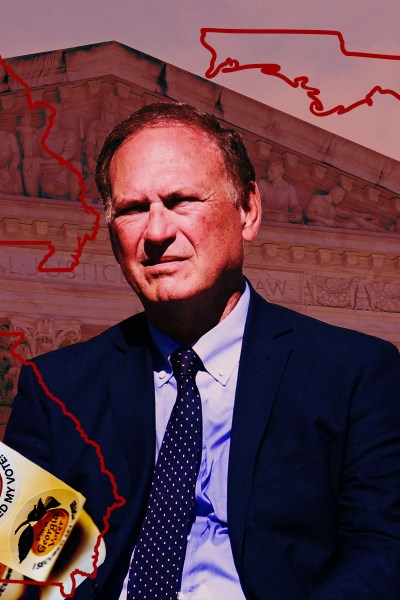
Republicans across the nation are cheering the sweeping and devastating Supreme Court ruling Wednesday that eviscerated the Voting Rights Act — and, by rendering it nearly impossible to prove that racial discrimination has taken place in redistricting, significantly diminished the likelihood that map makers who use race in drawing future congressional maps will face legal challenges.
Due to election administration deadlines for primary elections, there are only a handful of states whose congressional maps could be impacted by the Supreme Court ruling in Louisiana v. Callais today for the 2026 midterm elections — though those states comprise dozens of congressional seats. The states include Florida, Georgia and Missouri, as well as potentially Tennessee and South Carolina. Republicans in nearly all of those states have already put out statements either celebrating the victory for their states’ future gerrymandering efforts or calling for maps to be redrawn ahead of the midterms.
In Florida’s case, the state legislature, already in a pre-scheduled special session for redistricting, passed the new maps literally today, just hours after the SCOTUS ruling. Florida Gov. Ron DeSantis released the new maps — which are aimed at flipping four seats for Republicans — publicly earlier this week. The maps were always expected to face a series of legal challenges in Florida, as Democrats claimed they ran afoul of voter-passed, anti-gerrymandering provisions in the Florida Constitution designed to prevent political gerrymandering and to protect minority-performing districts. As the new maps passed the state Senate this afternoon just hours after they passed the House, DeSantis claimed that the U.S. Supreme Court’s ruling will also void the Fair Districts provisions in the state Constitution as unconstitutional.
DeSantis also suggested in a Twitter post celebrating the decision that his redraw of at least one of the districts in his state was done with the implications of this potential SCOTUS decision in mind.
“The SCOTUS ruling also invalidates the below provisions of the FL Constitution requiring the use of race in redistricting: …districts shall not be drawn with the intent or result of denying or abridging the equal opportunity of racial or language minorities to participate in the political process or to diminish their ability to elect representatives of their choice,” he continued.
Republicans in Georgia similarily praised Wednesday’s ruling, though Georgia Gov. Brian Kemp (R) has not, as of this writing, put out a statement indicating whether he will direct his state legislature to act ahead of the midterms. Lieutenant Gov. Burt Jones and businessman Rick Jackson, the top two Republican candidates for governor in the state, each called for districts to be redrawn, specifically districts that were ordered redrawn after a 2023 federal court decision that found the state map discriminated against Black voters.
“I agree that in a society built on the equal protection of law, no state should be directed to draw legislative maps on the basis of race,” Jones said in a statement Wednesday. “Given that Georgia was ordered to do so in its last round of redistricting, I fully support redrawing our state’s legislative maps in compliance with today’s decision.”
“In light of today’s Supreme Court ruling, redrawing the maps must be added to the agenda,” Jackson said. “Georgia must act now to ensure secure elections in Georgia and counter the Democrats’ national assault on our elections.”
A Georgia state senator who is running for lieutenant governor also went on Twitter to call for a special session in Georgia, immediately.
“Now is not the time for Republicans to be weak-kneed,” state Sen. Greg Dolezal wrote. Georgia’s primaries are on May 19.
In Tennessee and South Carolina, candidates who are running for governor have also put out statements encouraging the state legislatures there to act on the SCOTUS ruling as soon as possible. In South Carolina, Republican gubernatorial candidates urged state lawmakers to nix the state’s one majority-minority district that is held by Rep. James Clyburn (D-SC). Rep. Ralph Norman (R-SC) alluded to the same, though he did not say whether this redistricting should happen now or ahead of the 2028 election.
“What happened today is a turning point,” Norman told the Times in a statement. “It means states like ours can finally take a hard look at districts that were designed to be untouchable.”
Republican leadership in other southern states like Alabama have already put out statements indicating they’re eager to redrawn maps in light of the ruling, likely ahead of the next election cycle in 2028.
There’s also the question of Louisiana, whose second majority-Black district was the subject of today’s ruling. Gov. Jeff Landry (R) did not address questions of whether district lines would or, frankly, could be redrawn ahead of the state’s May 16 primary elections for Congress. But the state attorney general suggested it might be possible for the state legislature to act beforehand. Per the New York Times:
In terms of when Louisiana will redraw its map, which was at the center of the case, the state’s attorney general, Liz Murrill, is deferring to the legislature. But she said that she believed it to be possible for the legislature to act and pass a new congressional map before the November midterm elections.
— Nicole LaFond
DoD Estimates the Iran War Already Cost $25 Billion
Acting Pentagon comptroller Jules Hurst said that the Iran war has already cost an estimated $25 billion during Wednesday’s House Armed Services Committee hearing. That’s the first time the Department of Defense has provided an estimate for the war’s price tag, which has already been going on for two months.
According to the Congressional Budget Office estimates, that’s bigger than a year’s worth of Supplemental Nutrition Assistance Program (SNAP) cuts Republicans enacted in the 2025 reconciliation bill — dubbed the One Big Beautiful Bill Act.
— Emine Yücel
Delaware Takes Seriously Trump’s Threat to Nationalize Elections
Delaware is taking concrete steps to protect itself from President Trump’s threats to interfere in election administration, with the recent announcement of its creation of a new election task force.
Democratic Gov. Matt Mayer signed an executive order last week, establishing the Delaware Task Force on Free, Fair and Secure Elections as a way to “safeguard Delaware from unconstitutional federal interference.”
The task force will protect against a number of threats, including: disinformation, federal overreach, voter intimidation, cybersecurity and physical security risks.
“The U.S. Constitution is clear: elections are run by the states, not the federal government,” Meyer said in a statement announcing the task force. “That’s a responsibility we take seriously in Delaware, and we will continue to administer elections that are secure, fair, and trusted by the public. If the federal government tries to highjack the will of the people, we will be ready.”
“Given the dangerous rhetoric we’ve been hearing from this federal administration, I’m very glad that Delaware is taking this proactive step to protect the most fundamental and important right we have: the right to vote,” state House Speaker Melissa Minor-Brown said in a statement last week.
In February, Trump threatened to “nationalize” elections during a podcast with MAGA conspiracy theorist and former deputy FBI Director Dan Bongino.
“The Republicans should say, ‘We want to take over,’” Trump told Bongino. “We should take over the voting, the voting in at least many — 15 places. The Republicans ought to nationalize the voting.”
Of course, this is not the only evidence of Trump attempting to exert control over election administration. For the last several months, the Trump administration has also been trying to get ahold of sensitive, protected voter data from 48 states and Washington D.C. to seemingly create some sort of national voter file and exert control over election administration.
— Khaya Himmelman
In Case You Missed It
If you read anything on today’s SCOTUS ruling, read this from Kate Riga: Supreme Court Rules in Lockstep with Trump Admin’s Vision of a Whiter America
Also this: Alito Pens Decision That ‘Eviscerates’ The Voting Rights Act
The latest on the Fed, from Layla A. Jones: Fed Nominee Warsh Advances But Powell Says He’ll Stay On, Frustrating Trump’s Bid For Control
New EXCLUSIVE out this morning from Hunter Walker and Josh Kovensky: The House Dem Task Force Running War Games To Prep For Trump’s Election Threats
Supreme Court Conservatives, Sauer Defend Trump on Haiti Racism in TPS Oral Arguments
Khaya Himmelman: How the SCOTUS VRA Decision Could Impact the Midterms and Beyond
Yesterday’s Most Read Story
New Comey Charges Are Just More Evidence of Trump’s Collapse
What We Are Reading
Bessent Says Powell Staying On Is ‘Violation’ of All Fed Norms
Trump rejects Iran’s offer, says blockade stays until nuclear deal
New records show paper trail of DOGE voter data pact with election deniers






nil.
Bullshit. This authoritative figure comes courtesy of the comptroller of the same organization that has NEVER SUCCESSFULLY PASSED AN AUDIT. I’m going to guess the true cost is nearer to twice that much all told.
With the legislation starting in Delaware, we can look forward to right-wing groups crying foul and running to SCOTUS to demand they put Delaware and other States interested in protecting their citizens’ right to vote in its place.
In the hands of the justices. Where it belongs. [/s]
Why gerrymander now? Only one reason. To further hate, division and chaos so Republicans can need your money for the “national security” that a ballroom brings.
If you believe in the strength of a united country, vote Democratic.
If you want to accept what politicians tell the media, vote Republican.
Then there’s no need for a big hullabaloo over districting.
You don’t need demographers pouring over the races of residents. Just draw some areas of equal-ish numbers of people and call it a day. It’ll take maybe an hour.
Unless this is about manipulating the results of elections… your Honors.