


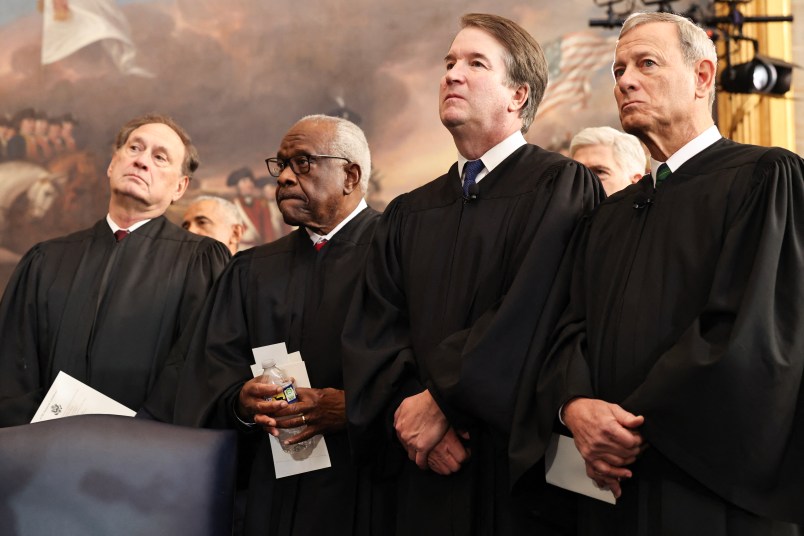
In a major blow to the Voting Rights Act, the Supreme Court, in a 6-3 decision in a case known as Louisiana v. Callais, struck down Louisiana’s second Black-majority congressional district, ruling that the map was an unconstitutional racial gerrymander.
The decision does not strike down the Voting Rights Act altogether, but will limit the use of consideration of race in future maps, and, as experts explained to TPM, will impact the fate of the Trump administration’s broader gerrymandering blitz.
“It is hard to overstate what an earthquake this will be for American politics,” legal scholar and UCLA law professor Rick Hasen wrote in a post for Election Law Blog.
Michael Waldman, president and CEO of the Brennan Center for Justice at NYU Law, called Wednesday’s decision a “devastating setback in the long fight for equality in political representation for all Americans.”
The case began in 2022 after a group of Black voters sued the state, arguing that a new post-2020 census map diluted the vote of the district’s Black voters and violated Section 2 of the VRA. In response, a federal court asked the Louisiana legislature to adopt a new congressional map with two Black-majority districts.
In another federal lawsuit, a group of white voters then challenged this new 2024 map, arguing that the map was unconstitutional and a racial gerrymander in violation of the Fourteenth Amendment. A panel of judges ruled in favor of the white voters, causing plaintiffs from the earlier case to appeal the decision to the Supreme Court.
As explained in a report from Issue One, this decision could impact maps in several states and throw a wrench in the overall impact of Trump’s until-now floundering redistricting war. Georgia, Missouri, and Florida, for example, might now hypothetically redraw maps, eliminating or changing majority-Black districts, and potentially flipping Democratic seats to the GOP.
Some Republicans are already jumping on this decision as an opportunity to call for new maps for the midterm elections.
“I urge our state legislature to reconvene to redistrict another Republican seat in Memphis. It’s essential to cement @realDonaldTrump’s agenda and the Golden Age of America,” Sen. Marsha Blackburn (R-TN), wrote in a post on X. “I’ve vowed to keep Tennessee a red state, and as Governor, I’ll do everything I can to make this map a reality.”
Kyle Kondik, managing editor for the University of Virginia’s Sabato’s Crystal Ball, told TPM that this decision means that the redistricting battle of 2025 and 2026 will continue into the next cycle, and may force some states to redraw their maps.
“Texas, I would assume, will redraw again, based on this decision,” he said. “You might see other states too — North Carolina, Mississippi, maybe some blue states redraw based on this decision. So again, it’s just gonna be a huge continuing fight.”
Only a handful of states have filing deadlines late enough and political interest in redrawing maps at this late stage of the 2026 midterms cycle, as Issue One points out.
“In many states, primaries are over or nearly so,” Hasen notes. “It is hard to imagine a state ordering a rerunning of primaries under new districts to gut old Section 2 districts. But it’s possible. And it could affect places still redistricting for 2026, including most importantly Florida. It could also affect state and local elections, from school boards and city councils to state legislatures.”
Daniel Nichanian, founder and editor-in-chief of Bolts, also noted on Bluesky that the decision will impact down-ballot races too.
“Everyone is discussing CONGRESSIONAL districts,” he wrote. “But the VRA’s effects were up and down the ballot, with huge implications for who holds local power.”
Correction: This article originally misidentified which chamber of Congress Blackburn serves in. TPM regrets the error.







Y’know, so someday soon some white folks can sue a Blue State for discrimination …
I assume the decision permits revisions only in the Black to White direction?
In a previous ruling in a case that was an obvious redistricting to reduce Black districts, this same Supreme Court ruled that it was NOT racial but political gerrymandering and therefore allowed.
So if this court was consistent, don’t laugh, you merely have to say it is for political advantage and not about race.
But I would not be surprised if this Republican first and only Supreme Court took a different view based only on the results.
Funny how the Republicans bend over backwards to protect all things Israeli but when it comes to our minorities, not so much.
So, as I see it, a map created with districts drawn to minimize minority population cannot be remedied with maps intended to reflect minority population, because that would violate the Equal Protection Clause. Louisiana is 1/3 Black population with only a single Black representative. Unintentional?
Also, what happened to the principle – created by the Court – that districts can’t be jiggered too close to an election? That principle was invoked to preclude a challenge to the Texas redistricting maps.