


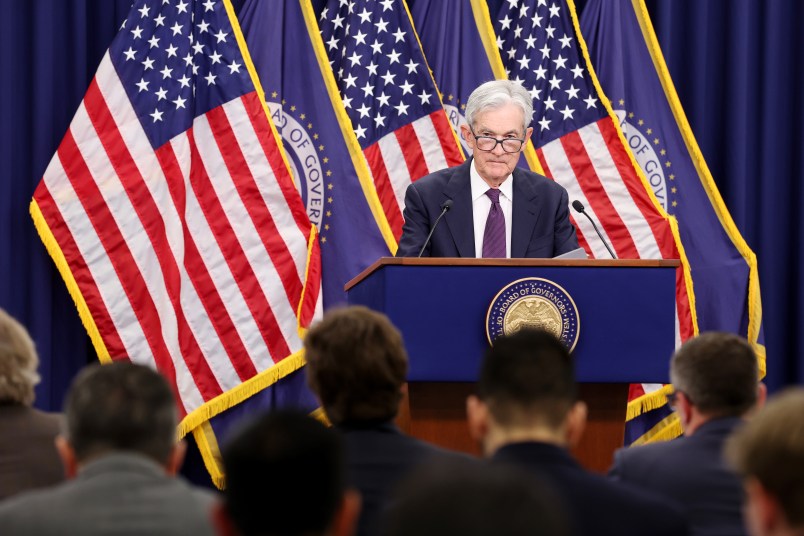
On the same day that Trump’s nominee for Fed chair advanced after a long stalemate, the current chair made clear that Trump’s bid for control over the central bank still had a long way to go.
Kevin Warsh’s nomination for Federal Reserve Chair advanced out of the Senate Banking Committee on Wednesday along party lines after his first nomination hearing before the crucial panel ended without a vote. With a 13-11 vote, Warsh’s nomination was able to move out of committee. Every Democrat voted “no by proxy,” except Sen. Raphael Warnock (D-GA), who voted no in person.
Later that day, Fed Chair Jerome Powell announced he will stay on the board as a governor even after his term as chair ends. Powell made the announcement following the Federal Open Market Committee meeting, where governors voted to hold interest rates steady. Only the Trump-appointed governor Stephan Miran voted to cut rates, as he does at every meeting. Powell cited Trump’s attacks as the reason he’ll remain on the board, at least until all investigations are concluded.
“The things that have happened really in the last three months have, I think, left me no choice but to stay until I see them through at least that long,” Powell said Wednesday.
Every part of Trump’s attempts to commandeer an independent central bank has blown up in his face. The DOJ investigation stalled Warsh’s nomination, and the administration’s refusal to commit to dropping any further investigation of Powell has now kept the influential Fed leader on the board.
Trump’s attacks on Fed independence may also be causing Fed governors to pause before voting to cut rates, Liz Pancotti, managing director of policy and advocacy at Groundwork Collaborative, told TPM.
“In fact, they are looking down the barrel of a gun potentially being asked to serve at the pleasure of the president and his desires,” Pancotti said. “This entire sort of theatrical performance has really made the other sitting governors look around at each other and question who they’re about to serve… I think they’re all looking around at each other in solidarity.”
In March, experts told TPM Warsh’s impact on the 12-voting member board could be diluted if Powell opted to remain on.
“Powell will carry immense ‘persuasive authority’ on the Board, much more than the new chair,” Richard C. Hockett, Cornell Law professor and Federal Reserve policy consultant, said. “So the latter’s attempts to ‘build a consensus’ in favor of Trump’s priorities will have to win over Powell too, or bypass him — neither of which would be easy even assuming it somehow possible (a stretch).”
Powell is the first Fed Chair to stay on as a governor in 78 years. When former Chair Marriner Eccles remained on the board, he was responsible for helping architect the agreement that established Fed independence. For that reason, Pancotti, who worked as a Boston Fed researcher, said Powell’s decision is also symbolic at a time when U.S. central bank independence is under attack.
“Given the moment we’re in right now,” said Pancotti, “…you have to imagine that that is something that is weighing on him heavily.
Trump has suggested he may fire Powell if he stays on. The Supreme Court is currently weighing the legality of Trump’s attempt to remove another member of the board, Lisa Cook.
With a Republican-controlled Senate, Warsh’s confirmation is all but secured. Despite Sen. Thom Tillis’ (R-NC) previous blockade on Warsh’s nomination, every Republican on the committee, including Tillis, expressed support for Trump’s Fed Chair nominee. Tillis refused to vote on Warsh’s nomination until the Trump administration dropped its sham criminal investigation into current Fed Chair Jerome Powell, purportedly related to the cost of Federal Reserve building renovations The investigation was mostly seen as an attempt to retaliate against Powell — one of Trump’s main, perceived foes — for not caving to Trump’s demands for the Fed to cut interest rates.
“I want to thank the Department of Justice for the assurances that they gave me,” Tillis said Wednesday. “They are going through with the appeal, the appeal has no impact on reopening the investigation.”
Tillis’ remarks came after Banking Committee Ranking Member Elizabeth Warren (D-MA) blasted what she called Trump’s illegal attempt to take over the Fed through bogus criminal investigations via a politicized Justice Department, weaponized to carry out Trump’s retribution. Democrats and some economic experts worry that Warsh will compromise the independence of the Fed by acquiescing to Trump’s very public rate setting demands — during his confirmation hearing, Warsh ominously suggested that Fed independence must be “earned.” Trump himself reportedly even talked to Warsh about lowering interest rates if the nominee was confirmed.
“No one is fooled,” Warren said Wednesday. “Trump is still going after control of the Fed and he is keeping the threat of bogus criminal charges alive until he gets what he wants.”
Warsh was previously a governor on the Federal Reserve Board from 2006 until 2011. He has since been hyper-critical of the central bank, railing against its more than $6 trillion balance sheet containing mostly U.S. Treasury securities. Warsh has said this substantial holding of U.S. debt means the central bank is overstepping its monetary policy mandate. During his initial hearing last Tuesday, Warsh advocated for “regime change” at the Fed, wouldn’t commit to maintaining the current eight-meeting rate-setting schedule, and opposed the central bank’s reliance on data. He’s spoken publicly about lowering interest rates — aligning with Trump’s primary goal — arguing that the AI revolution will increase productivity and output without increasing prices. Critics note this policy represents a potential political flip-flop, as Warsh was previously known as an interest rate hawk hesitant to cut rates. As chair, Warsh would likely have influence over the board’s policy setting. But with 12 total voting members, most of whom have not been appointed by Trump, Warsh won’t be able to set rates unilaterally.




No one in his second term has stood up to Trump. I very much doubt that Warsh will be the first person in this maladministration to hold the line.
Given that he wasn’t willing to say that Biden won the 2020 election, I think that is a pretty good bet…!
The Chair of the Fed is just the Chair of a group of people. The Chair never had unilateral power to decide anything. I know this fact escapes the White House which seems to believe that a single person can simply order things to happen. This country and parts of the government apparatus is not a sole proprietorship. Some voters don’t seem to understand this.