


The Roberts Court finally achieved its years-long goal of killing the Voting Rights Act Wednesday, publishing a ruling that will make proving racial discrimination in redistricting virtually impossible.
“Under the Court’s new view of Section 2, a State can, without legal consequence, systematically dilute minority citizens’ voting power,” writes Justice Elena Kagan in her dissent.
“Of course, the majority does not announce today’s holding that way. Its opinion is understated, even antiseptic,” she continues. “The majority claims only to be ‘updat[ing]’ our Section 2 law, as though through a few technical tweaks. But in fact, those ‘updates’ eviscerate the law…”
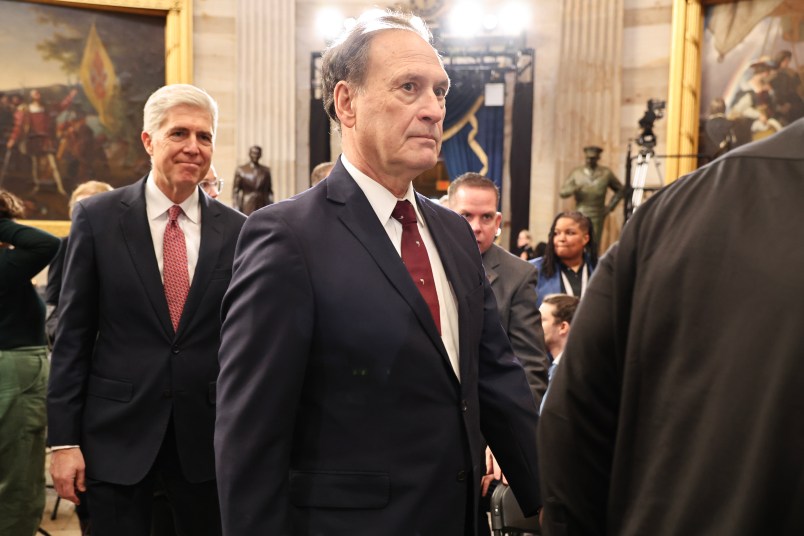
Justice Samuel Alito wrote the majority opinion, joined by all five other justices in the bench’s right wing. Kagan was joined in her dissent by Justices Sonia Sotomayor and Ketanji Brown Jackson. Justice Clarence Thomas also wrote a concurrence joined by Justice Neil Gorsuch.
Ignoring Congress, Imposing Impossible Tests
Alito defangs the law by unilaterally cancelling out congressional fixes to it — primarily, that plaintiffs bringing claims of racial vote dilution no longer have to prove that the legislators drawing the maps did so to purposefully discriminate. This bar had proved so difficult to overcome, especially as legislators became more adept at using facially neutral language, that Congress adopted amendments to the VRA in 1982 asserting that if the maps have a discriminatory effect, that’s enough. Chief Justice John Roberts, then working in the Reagan administration, spearheaded the unsuccessful effort to doom the passage of those amendments.
Alito hand waves this history away, in part, by echoing Roberts’ reasoning in an earlier decision that eviscerated the VRA’s preclearance requirement, which required jurisdictions with histories of racially discriminatory voting practices to submit changes in election laws to the federal government for approval before they could take effect. Roberts, in Shelby County v. Holder, said that the country had made such great strides in racial equality that the preventative measure was no longer necessary — ushering in a flood of new voter restrictions, particularly in the states that comprised the old Confederacy.
“Vast social change has occurred throughout the country and particularly in the South, which have made great strides in ending entrenched racial discrimination,” Alito writes.
He also grounds his ruling in the 15th Amendment, a grotesque perversion of the Reconstruction Amendments to justify an opinion that will disenfranchise Black voters and, likely, severely diminish Black representation in the south.
Alito makes plain the impossibility of meeting his new standard — which seems to amount to a demonstration of racially discriminatory intent — given the long history of racially polarized voting in the United States.
“When a State defends a districting scheme on the ground that it was drawn for partisan purposes, plaintiffs have a ‘special’ burden to overcome,” he writes. “To prevail, the plaintiff ‘must “disentangle race from politics” by proving “that the former drove a district’s lines.””
Disentangling race from politics, as he knows, is impossible, particularly in the parts of the country that the VRA has been used to police most attentively.
He muddies the water further by offering that plaintiffs can still win their case if they can produce another map “that achieves all the State’s objectives — including partisan advantage and any of the State’s other political goals.” So now, a voting rights group would have to somehow produce a map of Louisiana that fulfills its Republican leadership’s desire for an entirely Republican congressional delegation while also giving minority voters — usually Democrats — an opportunity to elect the candidates they prefer. It’s nonsense.
The same deficiency plagues much of Alito’s decision, as he has to situate his new discriminatory-intent test within a history of a similar Supreme Court ruling that Congress explicitly rejected when it passed the 1982 VRA amendments that only require discriminatory effects.
After huffily denying the dissent’s assertion that he is reinstituting an intent test, he writes: “The circumstances must give rise to a strong inference of racial discrimination.” How that differs from an intent test is a mystery.
Thomas, joined by Gorsuch, briefly chimes in to add that Section 2 of the VRA should never have been used to challenge maps in the first place. In a more roundabout way, he got his wish.
‘Today’s decision renders Section 2 all but a dead letter’
In her dissent, Kagan traces the Roberts Court’s unrelenting hostility to the VRA, from Shelby County in 2013 to Brnovich v. Democratic National Committee in 2021 — which essentially ended plaintiffs’ ability to use the VRA to overturn discriminatory voting practices — and now to Louisiana v. Callais, which destroys the law’s last remaining weapon.
Today’s finding, she writes, is the “last, and surely the hardest, for just three Terms ago the Court upheld a vote-dilution challenge to a districting map in a case much like this one — preserving Section 2 as a tool to prevent racially discriminatory redistricting.”
She adds: “It avails itself again of the tools used before to dismantle the Act: untenable readings of statutory text, made-up and impossible-to-meet evidentiary requirements, disregard for precedent, and disdain for congressional judgment.”
The majority doesn’t bother to explain how a Section 2 case under the new requirements could possibly be won. How can plaintiffs draw a map that advances a red state’s partisan goals while also creating minority districts that will likely vote Democrat? How do they prove racially discriminatory intent? Do they need leaked emails or phone conversations in which legislators voice their desire to disempower Black voters?
“Presumably, the majority thinks that the details do not much matter,” she writes, adding that with the majority’s new requirements, “virtually all vote-dilution cases will fail anyway.”
Kagan also notes the majority’s aggressive tonal shift on partisan gerrymandering, in lockstep with the Republican Party’s unprecedented, shameless embrace of it. The Court ruled in Rucho v. Common Cause in 2019 that federal courts could no longer hear challenges to partisan gerrymanders. While that was a bad ruling, Kagan says, the Court at least admitted that partisan gerrymandering was a cancer in a democracy, but ruled that federal courts lack the competence to hear those cases.
Any distaste for parties picking their own voters has fallen away completely from the majority’s view, in which Alito asserts that it is states’ ironclad right to further their political aims by contorting their districts to ensure that their preferred candidates cannot be beaten.
“Today, though, the majority straight-facedly holds that the Voting Rights Act must be brought low to make the world safe for partisan gerrymanders,” Kagan quipped.
Wednesday’s decision, while expected in the voting rights world, annihilates the crown jewel of the Civil Rights movement, the best bulwark against states demoting minority voters from full citizenship. Red state legislators will have free reign to draw maps that silence Black voters, to ensure that only the white voters in their states are represented in their government. It is a backsliding of epic proportions.
“The consequences are likely to be far-reaching and grave,” Kagan writes. “Today’s decision renders Section 2 all but a dead letter. In the States where that law continues to matter — the States still marked by residential segregation and racially polarized voting — minority voters can now be cracked out of the electoral process.”
Read the opinion here:





We knew it was coming. That doesn’t make it any easier.
I don’t have any cat photos on this computer to ease the blow.
Bet he has a chapter in his book on it, too.
Correct. Dems in all blue states like mine (NJ) should really rush to gerrymander. I’ll give credit to Newsom in CA for being aggressive. We should be as well. We are gonna win midterms, keep that in mind. We really will clean up regardless.
That’s what I was trying to decipher from the Guardian article.
So, race of color can no longer be used to gerrymander. Got it.
This is going to be a very dark (and no pun intended) period in judicial history, which is going to have to be resolved by a future bench.
Unpopular Opinion:
Packing minority voters into minority-majority districts dilutes overall minority voting strength. And nobody in the lily-white districts that result is going to give a shit about the minority’s concerns.