


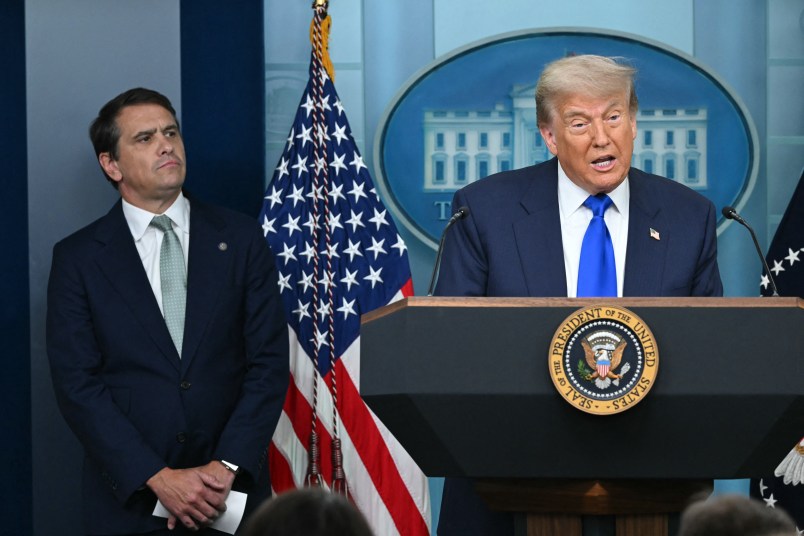
President Donald Trump’s Department of Justice announced the creation of a nearly $1.8 billion fund — dubbed the “Anti-Weaponization Fund” — on Monday to compensate those people who claim they “suffered weaponization and lawfare,” a group that includes many of Trump’s friends and allies, as well as the assorted right-wing activists who stormed the Capitol on Jan. 6, 2021, to block Trump’s election loss.
The slush fund, part of a settlement agreement that resolves Trump’s lawsuit against his own Internal Revenue Services (IRS) over the leak of his tax returns, is a “remarkable move that degrades not one but both of the other branches of government,” David Super, law professor at the Georgetown University Law School, told TPM. The fund creates a large pool of money without congressional signoff or oversight that can be distributed to the president’s allies in any way he sees fit, experts said — and it’s a tactic that can be repeated going forward. The fund dramatically undermines checks on the executive branch by the judicial and the legislative branches, experts said.
“It is using collusive litigation, which the Supreme Court has repeatedly condemned and says is contrary to Article three of the Constitution,” said Super, referring to the fact that the president settled with two agencies directly under the executive branch.
“The litigation was entirely collusive,” Super said. “As President Trump recently admitted, he has complete control of both the plaintiffs and defense lawyers. So none of the accusations of the lawsuit are tested by a court, none of them are even tested by an independent lawyer. He structured this specifically to avoid court scrutiny, and he can use this mechanism again, as many times as he wants.”
Super added, “it also eliminates Congress’s role in controlling public funds, which violates the appropriations clause of Article One of the Constitution.”
Bobby Kogan, senior director of federal budget policy at the Center for American Progress, agreed, saying that the creation of this slush fund creates a “profound loophole in the appropriations process.”
The Appropriations Clause of the Constitution, which establishes Congress’ power of the purse, states that federal funds cannot be distributed unless Congress designates the money for a particular purpose.
“No Money shall be drawn from the Treasury, but in Consequence of Appropriations made by Law,” the constitution reads.
But Trump and the DOJ’s so-called anti-weaponization fund would allow them to bypass the annual appropriations process entirely, using taxpayer dollars out of the Treasury to reward whoever the President and his DOJ decides to.
That sets a dangerous precedent that allows any administration to fund any program it wants without input from Congress.
“He can just make up a lawsuit — it doesn’t have to be anything that would survive in court because he simply orders his Justice Department to settle it. He can build the ballroom this way, he can build his triumphal arch this way, he can fund the Iran war this way.”
David Super
Using this formula, the administration could even channel Treasury money to help elect their own allies to office, experts told TPM.
“This case is nothing but a racket designed to take $1.7 billion of taxpayer dollars out of the Treasury and pour it into a huge slush fund for Trump at DOJ to hand out to his private militia of insurrectionists, rioters, and white supremacists, including those who brutally beat police officers on January 6, 2021, and sycophant accomplices to his election stealing schemes,” Rep. Jamie Raskin (D-MD), the top Democrat on the House Judiciary Committee, said in a statement.
On a larger scale, “this is yet another instance of the president using the government to reward his allies and, in this case, himself,” Kogan told TPM.
“We have seen this from the very beginning,” Kogan continued. “For Trump, his thinking is, if you’re on our team, we use the power of the government to help you; if you’re not in our team, we use the power of the government to hurt you. And this is that as well.”
With mounting concerns over the slush funds legality, the question then becomes who can intervene.
“Congress generally doesn’t have a lot of standing to sue,” Super told TPM. “The court’s general attitude has been that if Congress thinks that its prerogatives have been violated, that it should change the law. So I don’t think the Supreme Court will allow anyone — either Congress or taxpayers — to sue over this fund.”
“But I think that’s a policy choice by this court,” Super added. “And a different Supreme Court might view it differently.”




It’s griftoriffic.
This smells like Russell Vought , he is the lynchpin in this regime.
I want all dems out there saying categorically that this is theft of US taxpayer money and the single most corrupt thing every done by any president in the US ever. I’m hearing too much hedging in their statements.
It had to be $1.776 billion, because branding is everything, but I’m surprised he didn’t name it the “Patriot Fund” or something similar. Media, please break into Republicans’ House and Senate offices, find them hiding under their desks, and get an “I don’t know anything about that” on the record from every fucking one of them.
Can we please just release the Epstein files in their entirety? Most, if not all, of our problems would either vanish or become totally immediately doable.
If not, I’ve been paying federal taxes, and if Trump’s corrupt plan for his “slush fund” is allowed by the courts and the IRS, may I have my money back please? Otherwise I am indirectly funding a fraud and I would be participating/funding criminal acts.