

Send us your photos of what you saw at the No Kings protest in your neck of the woods.
Photos: ‘No Kings’ Anti-Trump Protests See Massive Turnout Across the Country
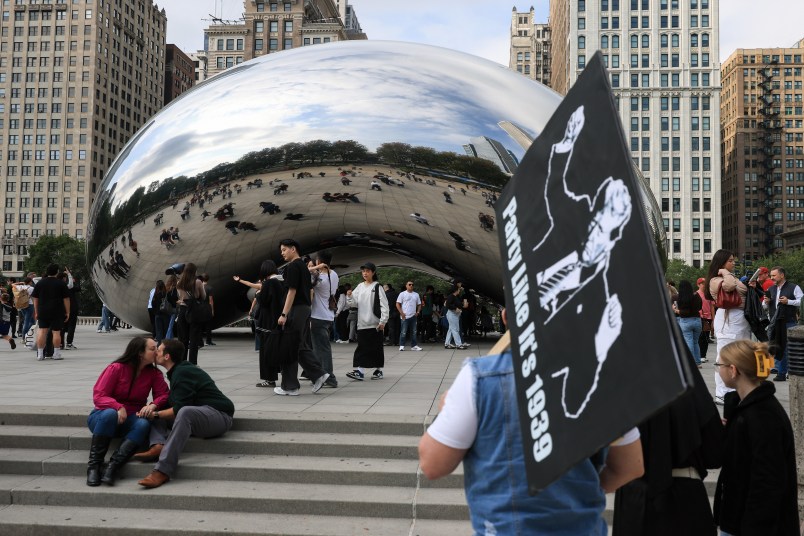
An estimated 7 million people turned out Saturday at more than 2,700 No Kings protests across the United States, as well as around the world, targeting the Trump administration’s attacks on free speech and mass deportation of immigrants. Check out photos and videos from some of the rallies.
Atlanta, Georgia
Berlin, Germany

Chicago


Florence, Italy


Howell, Michigan


London, UK
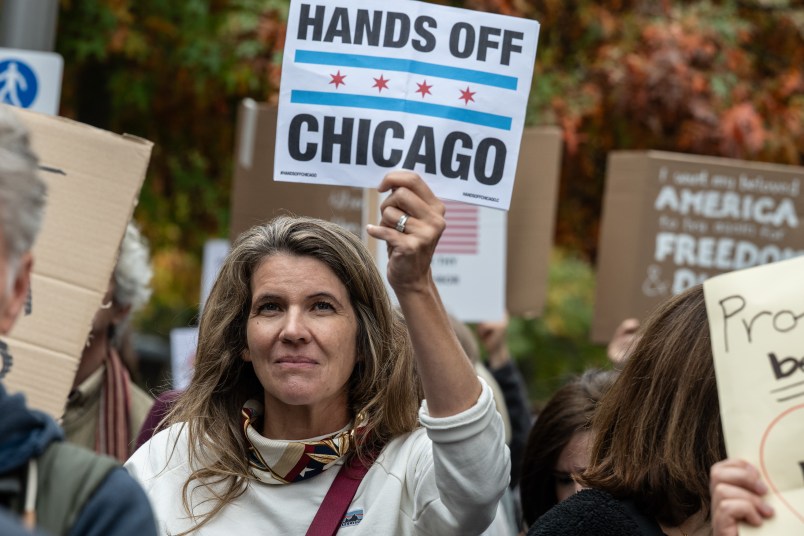


Madison, Wisconsin

New York City


Orlando, Florida
Washington, D.C.

Waxhaw, North Carolina
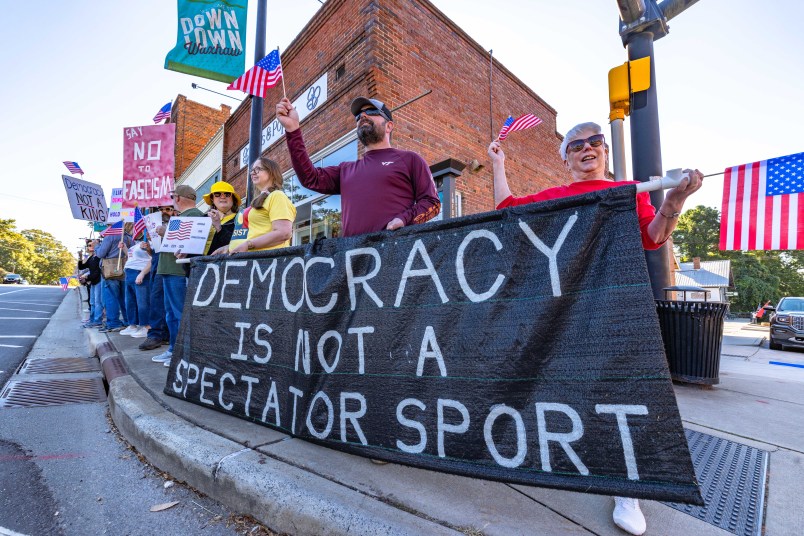
West Palm Beach, Florida

There Is No Quiet Part Anymore
Hi, it’s the weekend. This is The Weekender ☕️
On Tuesday, we published a long look at the Proud Boys, which included details on encrypted apps where one of their most extremist leaders is suggesting some of his compatriots have joined President Trump’s Immigration and Customs Enforcement agency. This is one of the first indications that people on the militant far-right fringe have responded to the Trump Department of Homeland Security’s mass deportation recruitment drive, which has included nods to white supremacist memes and other racially charged themes.
One instance of this occurred this week when blatantly anti-Semitic X accounts began sharing a promotional Facebook video from the U.S. Border Patrol that was soundtracked with a controversial 1996 song from Michael Jackson that included the slur “kike.” As news of the video — and its embrace by extremists — made the rounds on Wednesday, Border Patrol took the clip offline.
DHS spokesperson Tricia McLaughlin provided a statement to TPM on Friday arguing the situation was a non-issue.
“We deleted the post and will update with different music. End of story,” McLaughlin said.
But there clearly is a story here. And it’s about more than the Proud Boys and DHS’ online content. On Tuesday, there was another situation that exposed how Nazi themes and ideas are increasingly at home in more mainstream Republican circles. Politico published a story based on a trove of leaked Telegram chats from a nationwide network of leaders of the Young Republicans groups. The conversations included jokes about gas chambers, racist comments about Black people and one particularly blunt message: “I love Hitler.”
That bombshell wasn’t even the only story related to the GOP and Nazism that came out this week. On Wednesday, an X user shared images from a Zoom call with a staffer in the office of Rep. Dave Taylor (R-OH) that showed an American flag emblazoned with a swastika hanging behind him. Taylor and other GOP members later claimed the situation was part of a “ruse” where a group posed as conservatives and handed out altered “optical illusion” flags to multiple Republican offices.
Even if this one situation really was some kind of complex prank, there are issues with GOP Hill staffers who have been involved with neo-Nazism. Overall, between DHS apparently attracting the Proud Boys, anti-Semites enjoying slurs in Border Patrol videos, and Young Republicans making Hitler jokes, it is increasingly clear that a more open embrace of extremism is a real feature of the GOP in the Trump era.
In the past, reporters and others used to have a saying when people with extremist sympathies would accidentally expose them. It was called “saying the quiet part out loud.” Now, with the Proud Boys increasingly emboldened and government agencies sharing memes that seemed ripped out of 4chan, there isn’t really a quiet part any more. It’s all very loud and clear: White nationalist extremism is at the core of the Republican Party and the current administration.
One person who seems to agree with that is the online streamer and unashamed admirer of Hitler, Nick Fuentes. On Tuesday, Fuentes claimed on his show that his followers, who are known as groypers, are “all over the government.”
“There’s groypers in government,” Fuentes said. “There’s groypers in every department, every agency, OK?”
— Hunter Walker
Here’s what else TPM has on tap:
- A bipartisan group of senators are pushing a vote that would block the government from conducting ground strikes on Venezuela.
- The former Democratic governor of Maine who is challenging Sen. Susan Collins (R-ME) in the midterms made the disappointing-for-progressives announcement on Thursday that she supports keeping the filibuster in place if she is elected.
- Some Democrats are pushing for a guarantee that laid-off federal workers will be rehired if Democrats help Republicans reopen the government.
- House Democratic leadership is looking for more ways to offset the impacts of President Trump’s power grab, as he successfully forces Republican state legislatures across the nation to engage in mid-cycle gerrymandering so that the GOP can keep the House in 2026.
✨TPM is Turning 25✨
Join us at the Metrograph Theater in Manhattan on Thursday 11/6 for a live recording of the Josh Marshall Podcast Featuring Kate Riga and an oral history of TPM with some esteemed alums, moderated by me, Nicole LaFond, your Weekender curator 🙂
Weekender subscribers can get 33% OFF ticket prices using discount code WEEKENDER at this link.
Please come! Would love to meet you in person!
— Nicole LaFond
3 Sens Force War Powers Vote on Venezuela
A bipartisan group of senators are pushing a vote that would block the government from conducting ground strikes on Venezuela.
This week saw more escalation in the U.S.’s military buildup near Venezuela. President Trump said that he had authorized the CIA to conduct operations in the country. The Air Force flew B-52s off the coast while special forces reportedly hovered nearby in helicopters. The administration blew up another boat, this time with two survivors who are reportedly being held by the military.
Now, Sens. Tim Kaine (D-VA), Rand Paul (R-KY), and Adam Schiff (D-CA) are introducing a War Powers Resolution that would block an attack on ground sites in Venezuela. A broader resolution that would have blocked more actions failed after the GOP withheld support earlier this month. It’s not clear where this will go, but it’s a testament to the urgency of the situation.
— Josh Kovensky
Mills Fails the Most Important Litmus Test
Janet Mills, former Maine governor and Democratic leadership’s preferred candidate to challenge Sen. Susan Collins (R-ME), would support keeping the filibuster if elected, per the Bangor Daily News.
No one (sane) would question the Democratic candidate for this seat leaning right on some issues; there’s a reason a Republican has enjoyed such staying power in a state that routinely votes for Democratic presidential candidates by large margins. But supporting the filibuster is simply not the same thing as being more supportive of gun rights or border protection than the typical Democrat.
If Democrats ever win a trifecta again, they’ll have to pass significant, by today’s standards, radical reform to ensure that no one else can rise in Trump’s image and so weaponize the federal government. That would include neutering the Supreme Court, making Washington D.C. a state, devising a new way to protect civil servants from at-will firing. It’ll be the kind of reforms that make the right-wing and mainstream media howl about extremist overreach, the kind that today’s brand of mainstream Democrat absolutely couldn’t stomach. Abolishing the filibuster is the least of these, and a candidate who can’t even commit to getting rid of a fairly new, made-up obstacle to majority rule that overwhelmingly benefits Republicans is unfit for the job ahead.
— Kate Riga
Some Dems Want Guarantee That Fed Workers Will Be Rehired If They Help End Shutdown
We’re three weeks into the government shutdown — 18 days to be exact — with no signs of change on the horizon. Democrats have not backed away from their health care demands, including their ask to extend the Affordable Care Act subsidies that are set to expire at the end of the year. And Republicans continue to say they will not negotiate.
But amid the White House and the Office of Management and Budget’s attempt to do mass layoffs of federal workers, a new Democrat ask may be on the horizon: a commitment that employees subjected to reductions in force, aka RIFs, will be rehired before Democrats agree to give Republicans the votes they need.
“It’d be pretty unconscionable to open it up and still have to put up with those thousands and thousands of firings,” Rep. Don Beyer (D-VA) said, per Politico.
Rep. Steny Hoyer (D-MD) also said cancellation of the RIFs “certainly should be on the table.”
Senate Minority Leader Chuck Schumer (D-NY) has, of course, denounced the RIFs but hasn’t said if he thinks backtracking the layoffs should be a part of a deal to reopen the government.
Hoyer added that he thinks they will also be reversed by the courts.
A federal judge on Wednesday did issue a temporary restraining order, blocking the Trump administration from laying off almost 4,000 federal workers during the government shutdown, though that is not a guarantee of a victory for the unions who are suing the government over the RIFs. Meanwhile OMB Director Russ Vought continues to insist the initial RIFs were just “a snapshot” of what is to come.
— Emine Yücel
Dems Look to Maryland and Illinois to Offset GOP Redistricting Campaign
As Republicans cave to President Trump’s pressure campaign to engage in mid-decade redistricting efforts, Democrats are looking towards Maryland and Illinois to draw new district maps to offset the Trump power grab, according to reporting from NBC and Politico.
The Trump administration is openly pushing GOP-held legislatures to redraw congressional maps to help Republicans keep the U.S. House in the midterms. Democrat counter-efforts are underway in California, where voters are being asked to weigh in on a ballot measure to temporarily approve new House districts that would favor their party, and they are under discussion in other blue states, too.
Earlier this week, House Minority Leader Hakeem Jeffries, per NBC, met with Democratic Maryland Gov. Wes Moore, as well as members of the Illinois congressional delegation, about possible redistricting plans in the state.
Jeffries has also reportedly been in contact with Illinois Democrats to discuss redistricting efforts. Although no revised maps have been shown during these conversations some potential revised boundaries were, according to Politico.
Illinois Gov. JB Pritzker previously acknowledged in an interview with NPR that redistricting is something he would consider.
“None of us want to do it. None of us want to go through a redistricting process. But if we’re forced to, it’s something we’ll consider doing,” he said.
— Khaya Himmelman
The ‘Domestic Terrorists’ Who Weren’t: Chicago Protest Cases Collapse in Court
Ever since the Trump administration started to blitz Chicago with a surge of federal immigration enforcement, it’s touted the arrests of people who’ve gathered to protest the operations.
Continue reading “The ‘Domestic Terrorists’ Who Weren’t: Chicago Protest Cases Collapse in Court”Listen To This: Beaming In From No Kings Terrorist HQ
Kate and Josh discuss the upcoming No Kings “terrorist rally” and the latest from the corrupt Supreme Court.
Continue reading “Listen To This: Beaming In From No Kings Terrorist HQ”Niall Ferguson, the Gulf Princes and Their Man, Donald Trump
I first encountered Niall Ferguson in a real way when I was writing a review essay for The New Yorker at the end of 2003. The editors had sent me a small stack of books about what we might call the “neo-imperial” moment that took hold of Washington, D.C. in the aftermath of the 9/11 attacks. One of these books was by Ferguson, a fairly rousing and unabashed celebration of the British Empire. If anything it was among the more indirect and implicit versions of the story told by the various authors, celebrating the glories of empire and leaving it to the reader to draw the conclusion it was time to bring them back. As I’ve read columns of his here and there over the last couple decades, the historianness has receded as the tendentious provocateur has moved to the front. But something different struck me about the piece he published in The Free Press earlier this week (subscription required) about Trump’s Gaza peace plan: that was how much it matched in key outlines the piece I wrote on the same topic last week. If you recall, I wrote that the Trump plan was actually a fairly big deal and one that for a variety of reasons only Trump was in a position to pull off. The basis of the agreement is the common authoritarianism and corruption that now knits together Washington, Riyadh, Abu Dhabi and other regional capitals through the personal relationships binding together Trump family and the princely families of the Gulf.
Continue reading “Niall Ferguson, the Gulf Princes and Their Man, Donald Trump”Jury Acquittal Hands Jeanine Pirro a Big L
Three-Time Loser
In a closely watched case, a federal jury acquitted a woman Thursday on charges of assaulting a federal law enforcement officer over the summer during a transfer of detainees to ICE outside of the D.C. jail.
Federal grand juries had declined three times to indict Sydney Reid on felony charges for the incident. Rather than dropping the case, D.C. U.S. Attorney Jeanine Pirro charged it as a misdemeanor and took it to trial. U.S. District Judge Sparkle Sooknanan said it may have been the first time any criminal defendant has been charged federally in D.C. with misdemeanor assault on a federal officer, WUSA’s Sophie Rosenthal reports.
While the case has widely been seen as an example of jury nullification, it’s more accurately categorized as on overcharged case. The evidence against Reid was weak, but that didn’t matter. Pirro had ordered her prosecutors to impose the stiffest federal charges possible during Trump’s retaliatory surge of law enforcement into D.C. Some federal judges have balked at some of the cases that have wound up in federal court that might normally have been pursued in D.C. Superior Court — or not pursued at all.
For prosecutors, seeking maximum charges has made winning cases harder. But in Reid’s case, prosecutors did themselves no favors.
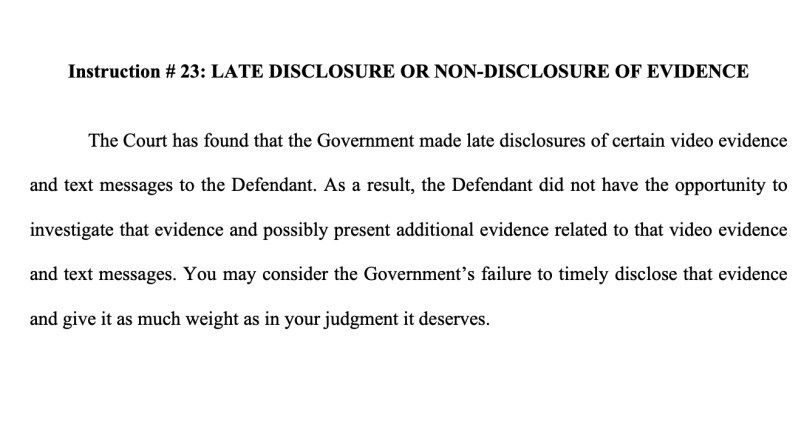
Prosecutors — and the two federal officers who were the purported victims in the case — were late in turning over discovery. Some discovery was never turned over at all, leading to admonitions from Judge Sooknanan during trial this week. “These are games,” Sooknanan told prosecutors at one point.
The discovery failures by prosecutors ultimately led Sooknanan to give a curative instruction to the jury:
Before the jury even got the case, Sooknanan acquitted Reid of the misdemeanor as to one of of the federal officers because of insufficient evidence she’d assaulted him. The officer in question had testified to the grand jury that Reid has initiated physical contact, but video of the incident showed that wasn’t true, Sooknanan said in court.
That left the jury to decide whether Reid had assaulted the other officer, the sole witness for the prosecution. That officer didn’t turn over some of her text messages about the case until the first day of trial, and even then one was missing. “The missing message was only discovered in the middle of cross-examination,” WUSA reported.
The prosecutor argued that the missing message was the result of a mistake the officer made while screenshotting the messages. But Judge Sooknanan was out of patience. “That seems to be a common theme with all your witnesses. Did they lie, or did they continuously make mistakes?” Sooknanan told the prosecutor.
Reid issued a statement after the jury verdict:

To sum it up, Pirro lost three times:
- three grand jury no bills;
- one acquittal by the judge;
- one acquittal by the petit jury.
Juries are doing their jobs, but it should never come to this.
The Bolton Indictment Is Still Crooked
As expected, the federal indictment of John Bolton in Maryland was more solid, evidence-based, and plausible than the bogus charges wielded against the other indicted Trump nemeses, James Comey and Letitia James. There’s no evidence that career prosecutors balked at the charges, and the acting U.S. attorney in Maryland is herself a career prosecutor.
In addition, Bolton comes off in the indictment as downright dumb in additional to careless and even reckless in how he allegedly handled classified information, sharing while Trump’s national security adviser more than 1,000 pages of “diary-like” entries with two family members, reported by the WSJ to be his wife and daughter. This alleged exchange is peak WTF:
![35. On or about July 23, 2018, BOLTON sent Individuals 1 and 2 a message that stated,
"More stuff coming!!!" A few minutes later, BOLTON sent Individuals 1 and 2 a 24-page
document which described information that BOLTON learned while National Security Advisor.
Less than three hours later, BOLTON sent Individuals 1 and 2 a follow-up message that stated,
"None of which we talk about!!!" In response, Individual 1 sent a message that stated, "Shhhhh."
Individual 2 then sent a message that stated, "The only interesting thing is what [senior U.S.
Government official] might have said from [foreign language] interpreter, which you didn't tell
us..." Approximately two minutes later, Individual 1 sent a message in response that stated, "More
to come with cloak and dagger...or something. So he says...."](https://talkingpointsmemo.com/wp-content/uploads/2025/10/bolton-indictment.jpg?w=804)
But plausible criminal charges by themselves do not eliminate the stink that Trump has put all over this investigation. I’d go further than Joyce Vance, who writes that Trump has “undercut the integrity of the criminal justice system.” John Bolton would not have been indicted but for his role as a critic of Trump. The investigation, which began in Trump I, had been closed under the Biden administration, but was revived once Trump took office again. It’s a travesty of justice that this case is being brought at this time in this way.
The WaPo drops a little tidbit in its story on the indictment:
John Eisenberg, head of the Justice Department’s National Security Division, was at the White House on Wednesday, according to a person familiar with the matter who was not authorized to discuss it publicly. His division has been involved in the Bolton investigation, which is typical for cases involving classified documents.
In Trump I, Eisenberg was a deputy White House counsel and legal advisor to the National Security Council, starting before Bolton arrived, who was involved in some key first term moments. The WaPo story implies but doesn’t outright say that Eisenberg was briefing the White House on the Bolton indictment. But at this point, I’m not sure fleeting accounts of DOJ officials being sighted at the White House carry the same weight as they used to. As Morning Memo has noted repeatedly, the Justice Department is being run out of the White House.
The same day Eisenberg was at the White House, Attorney General Pam Bondi, deputy Attorney General Todd Blanche, and FBI Director Kash Patel together made an Oval Office appearance with President Trump in which he publicly called for them to target former Special Counsel Jack Smith, former federal prosecutor Andrew Weissmann, and former deputy Attorney General Lisa Monaco.
Mass Deportation: Chicago Edition
The Trump administration’s assault on Chicago — which lives in the Republican mind as a post-apocalyptic hellscape beset by urban (read: Black) violence and decay — is running hard up against federal judges:
- A three-judge panel of the 7th Circuit Court of Appeals consisting of Trump, Obama, and Bush I appointees unanimously upheld a district court injunction barring the deployment of the National Guard in Illinois.
- U.S. District Judge Sara Ellis of Chicago said she will order federal immigration enforcement officers to wear and use body cams.
- U.S. District Judge Georgia Alexakis of Chicago ordered prosecutors to ship back from Maine on a flatbed trailer the vehicle of a Border Patrol agent involved in a hotly contested incident in which he shot a woman after their vehicles collided earlier this month. Defense attorneys demanded that it be returned to the Chicago area so that they can examine it.
Trump’s Venezuela Misadventure
In the latest developments:
- Adm. Alvin Holsey is stepping down as head of the U.S. Southern Command after less than a year in what is typically a three-year term. Holsey has overseen the buildup of forces in the Caribbean and the unlawful U.S. attacks on alleged drug-smuggling boats. Holsey’s impending departure comes after he “raised concerns about the mission and the attacks on the alleged drug boats,” the NYT reports.
- Only one of the 27 people killed in the U.S. high seas attacks in alleged drug-smuggling boats has been tentatively identified publicly. “[D]espite the mounting death toll, no authority has come forward to publicly release the names of any of the dead,” the NYT reports.
- Analysis by the WaPo shows that the U.S. military’s elite Special Operations aviation unit has likely been operating in Caribbean waters off the coast of Venezuela in recent days.
- Venezuelan President Nicolás Maduro is making a show of deploying his forces to fend off any U.S. attack.
Thread of the Week
The federal budget apparatus is exceedingly complicated and byzantine, but one of the reasons for that is the constitutional structure that is meant to keep the power of the purse from becoming a tyrannical tool. Now President Trump and his OMB are tearing at the fabric of those constitutional restraints in new and dramatic ways:
Propagandist-in-Chief
The drumbeat of stuff like this out of the White House is constant and never-ending, polluting the political atmosphere with a steady stream of propaganda and disinformation:
Special Offer for Morning Memo Readers
Our big celebration of TPM’s 25th anniversary has officially begun with the publication of the first in a series of 25 essays by a group of A-list contributors on the history of digital media.
We’re going to be marking the milestone over the next three weeks, culminating with a two-day extravaganza in NYC on Nov. 6-7. Tickets for both nights are on sale now.
Morning Memo readers can get 33% off tickets to the live show on Thursday, Nov. 6 by using the code “MorningMemo” at checkout. I’ll be joining other TPMers past and present on stage that night for a reminiscence of our shared history and hijinks.
Please join us and hang for one or both nights. I’m looking forward to meeting more of you in person, but I especially delight in watching y’all get to meet each other.
Do you like Morning Memo? Let us know!
DC’s Access Journalists Turned the News Into a Luxury Good
Before the internet, what would today be called a “paywall” was just a place where people could buy a newspaper or magazine. Your subscription or newsstand purchase didn’t pay for every far-flung reporter; media outlets subsidized access to readers with advertising and other revenue streams. But though the barrier to entry was relatively low, it was still a barrier. You had to acquire the physical object hosting the material, and unless you went to the library every day or got your hands on a discarded copy in a coffee shop, you would have to pay for it.
Once all articles got posted on websites, tension grew between the idea that information wants to be free and the need for reporters and editors and production teams to afford food and shelter. At first, legacy subscriptions and digital advertising covered the nut; I remember the New York Times and Washington Post segmenting stories into sections so readers had to click repeatedly to finish them, ringing up more ad impressions. But Google and Facebook robbed publishers of the ad revenue that made this (sort of) work, and ever since, media companies big and small have been grasping for an alternative.
They have mostly failed. Between 2004 and 2022, over 2,100 newspapers have gone out of business, according to data from the University of North Carolina. New media pivots from words to video and back again have proven disastrous. Layoffs have touched everyone in this industry; friends and colleagues habitually call me asking for advice or referrals for hiring.
Those of us remaining to report the news have settled on a noble idea: A community of readers can pay to get the information they need. Sometimes the “reader” is one rich person keeping things alive, but that usually ends in tears. A broader base of support is far more sustainable, and there are several outlets, from my site The American Prospect to the one you’re reading right now, that are making this work.
In some ways, it’s a throwback to the pre-internet era, or even the premodern era of patronage. But the pay-to-play trend in journalism is happening at a time of runaway income and wealth inequality, when the top 10% of income earners account for nearly half of all the spending. This has created a strange paradox: The average news consumer today has more available to read than at any time in human history, yet less ability to understand what’s really going on.
Continue reading “DC’s Access Journalists Turned the News Into a Luxury Good”The Trump Admin’s Very Telling Decisions About Which Gov’t Programs to Fund
In the hours immediately after the government first shut down earlier this month — which happened only after Republicans refused to work with Democrats to extend Obamacare subsidies in order to secure their votes to keep it open — the Trump administration and Republicans in Congress began publicly hand-ringing about the funding that would quickly run out for active duty military pay and for funding WIC, a federal supplemental nutrition program for low income mothers.
Continue reading “The Trump Admin’s Very Telling Decisions About Which Gov’t Programs to Fund”7th Circuit: ‘The Administration Remains Barred From Deploying the National Guard of the United States Within Illinois’
A 7th Circuit Court of Appeals panel ruled unanimously Thursday to maintain the district court’s block on National Guard deployment in Chicago.
Continue reading “7th Circuit: ‘The Administration Remains Barred From Deploying the National Guard of the United States Within Illinois’”