The Israeli daily Haaretz published a big and consequential exposé today alleging that weeks before the October 7, 2023 massacres in southern Israel the head of the UAE, Mohamed bin Zayed, warned Prime Minister Netanyahu in a direct phone call lasting some 45 minutes that something big was coming from Hamas. For additional context, Israel holds elections on October 27 of this year. And as it has for the last three years, Netanyahu’s degree of responsibility for what happened remains a central question in the election. So while it’s not explicitly noted in the article, the electoral implications are clear. The investigation itself appears to be essentially an excerpt from a soon-to-be released book. So it’s not precisely a Haaretz story, more one that they’re publishing, though that’s fine print. The article is long and detailed and I think quite credible. But it’s paywalled. So I wanted to walk you through the key details and provide some general analysis.
It’s best to think of this piece as three separate revelations. The first is that — all according to this article — Israel and Hamas in 2023 were pretty close to finalizing a semi-normalization of the situation in Gaza in a longterm truce, or “hudna,” between Hamas and Israel. The details of this aren’t fully sketched out but basically an end to the blockade, freer commerce and travel through Israel and Egypt, etc. Second is the warning from MBZ in the weeks before the attack. Then, finally, it claims that in the immediate aftermath of the attacks Hamas, was willing to free most or all of the hostages, probably excluding military-aged men in or out of uniform, with few if any conditions.
As I sat down this morning to try to catch you up on the state of play of the various Trump administration threats to the sanctity of the midterms elections, I realized anew how hard it is to keep track of it all — and how much that is the point.
The scale of the many different percolating threats, the complexity of the legal battles to beat back the federal government from an unlawful role in state elections, and the relentless disinformation campaign intended to delegitimate elections all combine intentionally to overwhelm the senses.
Even though we’ve seen this coming from virtually the moment the last election was over, Trump’s full-court press still swamps the political and media environments. It also threatens to exceed our imaginations. For as foreseeable as this was, I still would have shuddered if you had told me a year ago where things would stand in the second week of September 2026, with voting already getting underway.
President Trump’s uber-aggressive executive order in March calling for what is essentially a federal takeover of election administration remains in play with Election Day under two months out. We’re once again in the unenviable position of hoping that the Roberts Court will “do the right thing” and close the Pandora’s box of ills that Trump’s elections EO unleashes.
The lateness of the hour, as election law expert Rick Hasen points out, should on its own be sufficient for the Supreme Court to rule against Trump on the new postal rules on mail-in ballots that his executive order spawned. Chaos and uncertainty doesn’t begin to capture the sheer impossibility of the task the USPS and state election administrators would face if the Supreme Court rules for Trump:
I have never in over thirty years of teaching and studying election cases ever seen an attempt like this one to roll out a major change in election administration against the will of state and local election officials on a time frame that is certain to impede on states’ ability to run elections and that will certainly disenfranchise thousands if not millions of voters who will not get ballots if the USPS rule is put into effect for this election. Those voters include those who are elderly, in rural communities, with certain disabilities, traveling in the military (within the U.S) or for other reasons. This is not a rollout that hurts Democrats and helps Republicans; it’s a rule that threatens mass disenfranchisement of voters across the political spectrum and in red and blue states.
It’s a game of chicken between the president and the Supreme Court. It makes you want to avert your eyes.
After a flurry of weekend legal moves, things are likely to begin moving more quickly this week at the First Circuit Court of Appeals and ultimately at the Supreme Court in the complicated litigation over the Postal Service’s role in mailing ballots even as the USPS inspector general is opening his own probe of a whistleblower’s complaint.
While that is going on, other Trump attacks on the midterms continue on multiple fronts:
The Trump DOJ has issued seven “voter-related” subpoenas over the past three months to the secretary of state in Nevada, where top federal prosecutor Sigal Chatta has repeatedly sought to cast doubt on the integrity of federal elections, the NYT reports. The subpoenas come after the Trump DOJ failed to obtain private voter information in civil lawsuits against Nevada and two dozen other states.
The Trump DOJ leadership — which already cancelled mandatory election law training — is now pressing U.S. attorneys around the country to prioritize prosecuting the phantom of illegal noncitizen voting under a rarely tested statute, Bloomberg reports.
DHS Secretary Markwayne Mullin sent a letter to Attorney General Todd Blanche last week that sought to cast doubt on digital voting systems and lay the groundwork for claiming that some electronically cast or counted votes are invalid, the NYT reports.
You can plainly see Trump’s old 2020 playbook at work again, but this time using a whole-of-government approach to tamper with the midterm elections on the front end and then discredit the election results on the back end.
Trump DOJ Watch
The Retribution: Even before Hill Republicans last month sought a criminal investigation of Dr. Tony Fauci for taking the Fifth at a congressional hearing, the Trump DOJ had been conducting since last year a “sprawling and aggressive” probe of Fauci that has scrutinized at least eight scientists, the NYT reports: “Investigators have demanded phone, email, grant and payment records, as well as grand jury testimony by scientists.”
The Corruption: Federal prosecutors in Miami closed a criminal probe into Venezuelan businessman Alejandro Betancourt on orders from the office of then-Deputy Attorney General Todd Blanche as part of an effort by the Trump administration to enlist Betancourt to engineer a massive new oil deal with Venezuela’s government, CNN reports.
The “Anti-Weaponization” Slush Fund: The Trump administration must cough up the names of the people who devised the structure of the $1.776 billion “anti-weaponization” slush fund that was of the bogus settlement of President Trump lawsuit against the IRS, a federal magistrate judge in the Eastern District of Virginia ruled in a case challenging the slush fund.
First Look at Fed Indictment of ICE Agent
The unsealed federal indictment of ICE agent Christian Castro charges him with six counts of making false statements in the aftermath of the Jan. 14 shooting in Minneapolis during Operation Metro Surge. He is accused of lying about:
being struck with a broom;
being struck with a snow shovel;
firing his gun while seated or lying on his back;
the duration of the altercation prior to the shooting.
Grand Juries Stood Up to Midway Blitz
Federal grand juries in Chicago held the line during last year’s flurry of prosecutions of protesters during Operation Midway Blitz by demanding more evidence from prosecutors, including the testimony of CBP commander Greg Bovino, according to court records newly unsealed at the request of the Chicago Sun-Times.
In one case, an assistant U.S. attorney conceded that “the government does not possess and cannot realistically obtain all of the evidence the grand jury has requested.”
In the end, grand juries indicted a subset of protesters, but prosecutors won convictions against only two of the 33 Midway Blitz defendants.
Map of the Day
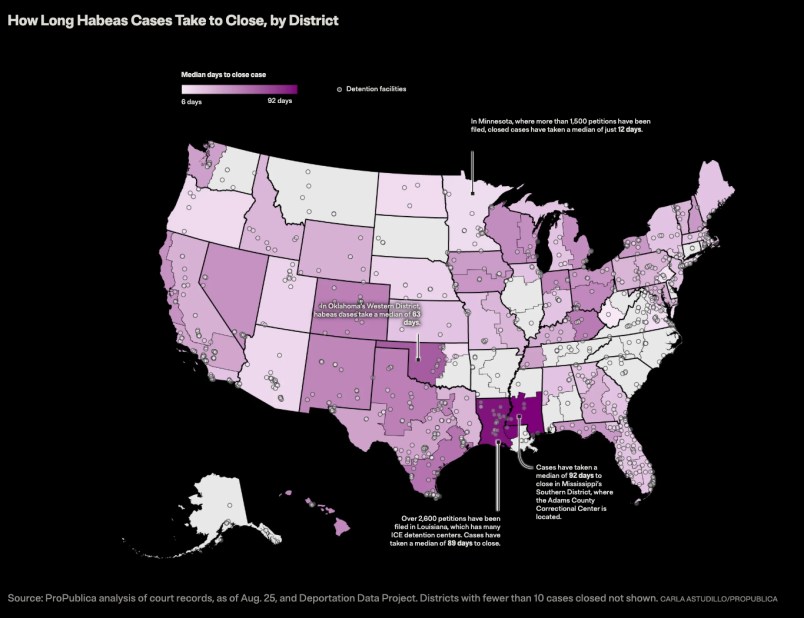
In the tens of thousands of habeas cases filed since the Trump administration unilaterally changed a three-decade-old interpretation of federal law last year, a significant disparity exists in how quickly federal courts are issuing rulings freeing detainees, a ProPublica analysis has found (click the map for a larger version):
Screenshot Source: ProPublica analysis of court records, as of Aug. 25, and Deportation Data Project. Districts with fewer than 10 cases closed not shown. CARLA ASTUDILLO/PROPUBLICA
While the vast majority of federal judges have ruled against the Trump administration, the speed with which they have done so has varied widely, with detention-center-heavy Louisiana and Mississippi moving the slowest, at an average of nearly three months.
Hegseth’s Unprecedented Leak Probe
“U.S. government investigators have taken the extraordinary step of subjecting roughly 50 members of the U.S. military’s Joint Staff to polygraph tests over leaks to journalists, including about how the Iran war has created a shortage of crucial munitions, according to officials briefed on the move,” the NYT reports.
Quote of the Day
“I think it is fair to say the wheels are coming off. It’s sort of like if you had a car and you took out 10 percent of the parts of the car. It’s not that the car is going to be 10 percent slower. The car is not going to work.”—Don Moynihan, professor of public policy at the University of Michigan, on the Trump II hollowing out of the federal government
Far-Right AfD Wins Big In Germany
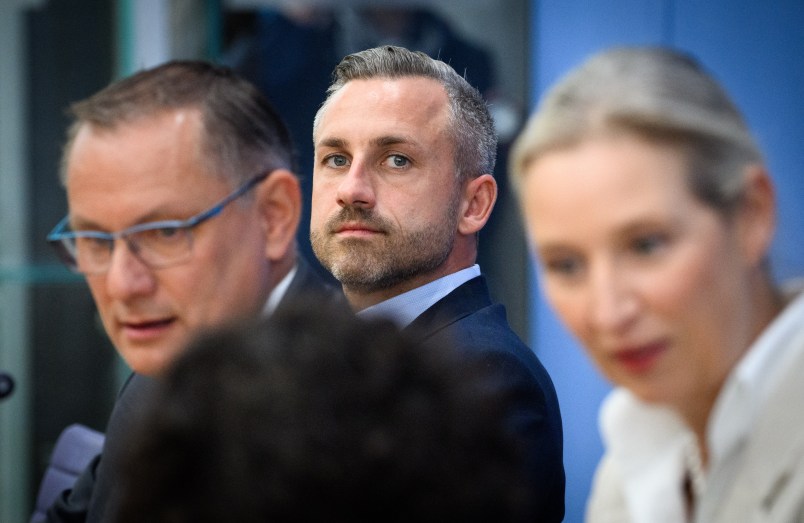
06 September 2026, Saxony-Anhalt, Magdeburg: Ulrich Siegmund (M, AfD), lead candidate and co-chair of the AfD parliamentary group in the Saxony-Anhalt state legislature, celebrates with Alice Weidel (L, AfD), federal chairwoman and co-chairwoman of the AfD parliamentary group in the Bundestag, and Tino Chrupalla (AfD), federal chairman and co-chairman of the AfD parliamentary group in the Bundestag, following the projection of the results of the Saxony-Anhalt state election. On Sunday (September 6, 2026), a new state parliament was elected in Saxony-Anhalt. Photo: Michael Kappeler/dpa (Photo by Michael Kappeler/picture alliance via Getty Images)
In the state election in Saxony-Anhalt on Sunday, the far-right Alternative for Germany won 44 percent of the vote, more than doubling its 2021 haul.
Despite their remarkable showing, it is not obvious that the AfD will form the next government in Sachsen-Anhalt. The other parties may arrange themselves to keep the AfD out of power. At the national level, the AfD are even further from government. Nevertheless, this result shakes Germany’s political system. It shows how far the familiar political norms of the Federal Republic have disintegrated. Mecklenburg Vorpommern, another small East German state, will vote on September 20th and the outcome may well be similar. The crisis of German democracy has long been forecast. It now seems to be upon us.
If you’re still catching up on what AfD represents, here’s a sampling: the forced “remigration” of non-ethnic-German citizens to their countries of origin; banning the Pride flag; exalting German history before the two world wars and downplaying its Nazi past; cracking down on “anti-German” art, including the Bauhaus, in an echo of the Nazi assault on modern art.
Calling AfD a “far-right” party hardly does it justice.
Before the AI Hack of Hugging Face …
A swarm of rogue OpenAI agents hijacked a German website in May and transformed it into a bulletin board for other AI agents, but OpenAI kept it under wraps as it grappled with the fallout from the separate Hugging Face hack in July, Reuters reports.
Absurdity of the Day
President Trump spent the Labor Day weekend as an online troll obsessed with changing the name of New Mexico to New America, with numerous posts like this one:
News? Tips? Feedback? Please let me know. For sensitive information, use the encrypted methods here.
As part of their overarching plan to reduce the power of blue states and promote myths about noncitizen voting, the Trump administration is pushing all types of changes to how the census operates. TPM reporter Layla Jones will talk to publisher Joe Ragazzo and executive editor John Light about what these schemes involve and what’s at stake.
Yesterday I was kind of randomly rereading some details about Spain’s transition to democracy after the death of Francisco Franco in 1975, as one does. And I noticed that Spain had finally released the last classified documents tied to the attempted coup of 1981. The non-disclosure of these documents had helped maintain various conspiracy theories and counter-narratives about whether King Juan Carlos played quite the heroic role history has assigned him. In brief, Franco groomed Juan Carlos to succeed him believing he would maintain the Franco-ist dictatorship. But Juan Carlos quickly set about putting Spain on a path to democracy and when Francoist dead-enders in the army mounted a coup in 1981, Juan Carlos famously went on television, denounced the coup, thus leading to its total collapse. The counter-argument or claim is that Juan Carlos knew about the coup or perhaps even supported it and only pulled the plug when it looked like it was failing.
The release of the documents was just this last February. And they basically confirmed the established story, that there was no reason to believe Juan Carlos knew about the coup in advance and acted decisively to undermine and bring it to an end. But it was a small note in the Times article I read about this that got my attention: one of the reasons for the release, overseen by Spain’s current center-left government, was to combat historical revisionism and growing nostalgia for Franco among young men.
In Rough Edges, Mike Rothschild writes about fringe groups, conspiracy theories and how the Internet broke our brains. This column is part of TPM Cafe, TPM’s home for opinion and news analysis.
The Sept. 11 attacks came during a boom time for conspiracy theories. A vast industry of radio talkers, book writers, and cranks was finding new audiences on the nascent internet and using new technology to spread their messages faster and farther.
This was a new generation of media savvy personalities who knew how to tap into the fears of white evangelicals, revenge-seeking militia members, anti-tax activists, libertarians, Clinton haters, and paranoids on both the far left and far right. Many believed a traumatic event, whether real or “false flag,” was imminent. Some even claimed that the government would perpetrate it, then blame a convenient figure around whom the country could rally its bloodlust and need for revenge.
When it finally happened, though, they were just as baffled and desperate for answers as the rest of us. And they turned to the gurus helping them shape their world views — who were also baffled.
Three major figures in the conspiracy theory world broadcast live on the radio in those first hours after the Twin Towers went down. They started to solidify narratives that would drive the next two decades of conspiracy theories and myths about the attacks — even as basic facts about what had happened were hard to come by.
As Allegra wrote over the weekend, this week stands to be a “uniquely cursed” one: We have the 25th anniversary of September 11. One day earlier, we have the first anniversary of Charlie Kirk being killed. And we have the Republican convention in Dallas — each an opportunity for various elements of the right-wing movement to work themselves into a lather about various perceived enemies, including Muslims, immigrants, and trans people. We are prepared for the media not to cover itself in glory as it handles these topics.
Against this backdrop, I wanted to zoom in on one particular, somewhat niche panic gripping the right, that TPM’s Layla A. Jones tried to unwind in great detail last week. Its a kind of nerd corollary to Trump’s claims about the 2020 election — that his victory was snatched from him by shadowy actors.
In the case of this similar reactionary conspiracy theory, the shadowy actors worked in the Census Bureau and supposedly stole not a presidency but several seats in Congress.
“The 2020 Census was a fraud,” Sen. Jim Banks (R-IN) declared on X last year, one example of the claim. “The Biden admin used a shady ‘privacy’ formula that scrambled the data and miscounted 14 states. It included illegal immigrants and handed Democrats extra seats. Americans deserve a fair count and I’m fighting to fix it.”
Around the same time, an influential right-wing X account, @amuse, argued that a specific Census official “decided to use a secret algo to change the number of people living in each city and state in the name of privacy,” declaring that it “cost the GOP 9 sets and $60B.”
“Wow,” Elon Musk replied to the claim.
None of it, you will not be surprised to learn, is true. Former Census officials and researchers who work with Census data were adamant with Layla: this is not happening.
At the center of these claims is a technique used by statisticians who are dealing with large data sets to protect the privacy of individual respondents; it’s called differential privacy.
The technique, an online army and a handful of elected officials claim, messed with apportionment, the process through which officials determine, based on population, how many seats each state gets in Congress and in the Electoral College. The fact that differential privacy isn’t even used on the population numbers that underlie apportionment has not done much to dampen enthusiasm for this allegation. Other versions of the conspiracy theory allege differential privacy fuzzed up the data that underlies redistricting.
Trump administration Census officials banned the use of differential privacy earlier this year as they push to remake the Census, prompting an outcry among real data scientists.
I think part of what this conspiracy theory does, like so many others, is provide a kind of permission structure. If Democrats and their supposed aligned deep state bureaucrats weaponized the Census to accrue undeserved political power, Republicans can be excused for doing the same. And, through efforts to exclude immigrants from apportionment, to add a citizenship question to the Census, and to cease collecting the racial demographic information used to challenge discriminatory voting maps in court, that’s exactly what they are doing.
Party That Downplays the Holocaust Wins in Germany
07 September 2026, Saxony-Anhalt, Berlin: Alice Weidel (right) and Tino Chrupalla (left), the national co-chairs of the AfD, speak alongside Ulrich Siegmund, the AfD’s top candidate in Saxony-Anhalt, at the Federal Press Conference regarding the results of the state election in Saxony-Anhalt. Photo: Bernd von Jutrczenka/dpa (Photo by Bernd von Jutrczenka/picture alliance via Getty Images)
The Trump administration’s German allies won big over the weekend. In a Saxony-Anhalt, west of Berlin, the far-right Alternative für Deutschland’s candidate, fragrance salesman Ulrich Siegmund, won a resounding victory at the state level.
Its the party’s second state-level win since 2024, though it has never managed to form a governing coalition. This time it might. Most other German political parties refuse to work with it. It remains to be seen if that “firewall” will continue to hold.
Trump celebrated the results, posting on Truth Social a German graphic showing the election outcome without commentary (amid a spree of AI slop images, including several of maps with New Mexico re-labeled as “New America.”)
The Trump administration has shown considerable support for AfD, with JD Vance endorsing many of its grievances during a speech in Europe in the administration’s early days and meeting with its leader, Alice Weidel, during that same trip.
The Trump administration has also adopted AfD’s policies, most prominently the term “remigration,” which describes expelling immigrants.
Two other German states are set to hold elections later this month, on Sept. 20.
Tabs
The Department of Justice has again gone to the Supreme Court to ask it to allow it to enact its Postal Service rule for mail-in ballots, which is currently enjoined by lower courts. Plaintiffs’ replies to that request are due tomorrow, after which point the Court may take action.
The Trump administration has removed a sign at Arlington Cemetery that critiqued a Confederate Statue that was removed in 2023, the Washington Post reports. Secretary of Defense Pete Hegseth has said the statue will soon be reinstalled.
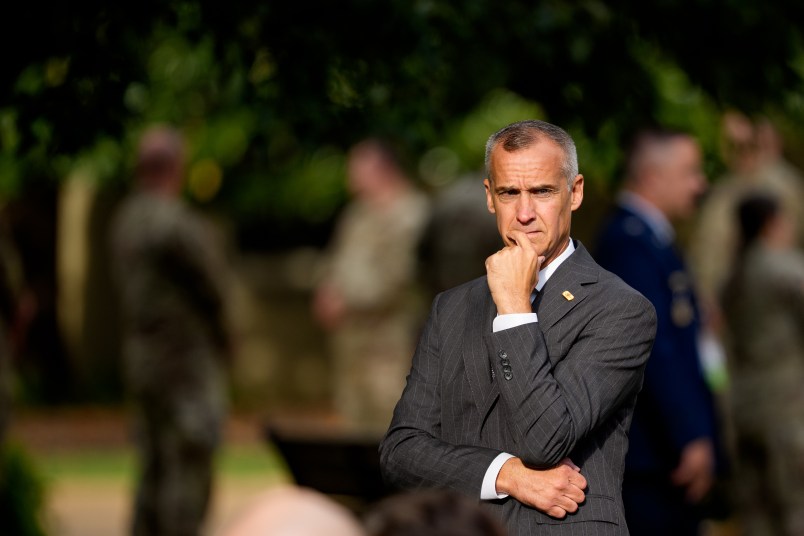
ARLINGTON, VIRGINIA – SEPTEMBER 11: Special Government Employee and Advisor Corey Lewandowski arrives for a September 11th observance event in the courtyard of the Pentagon September 11, 2025 in Arlington, Virginia. Today marks the 24th anniversary of the 9/11 terror attacks that claimed the lives of nearly 3,000 people. (Photo by Andrew Harnik/Getty Images)
It’s Corey Lewandowski, who, according to a new investigation in the Wall Street Journal, approached officials in Qatar and the United Arab Emirates, offering them side deals to exert influence, while he was effectively running DHS.
Over the last day or so, a number of the big inside DC sheets have run pieces striking a skeptical note about the GOP’s 2025-26 redistricting — Axios and Politico, for examples. It’s not just that they maybe aren’t strong enough to withstand a Democratic wave (no gerrymanders are impregnable) but that they are fundamentally based on the assumption that the 2026 electorate would look basically like the 2024 electorate, as Axios put it. That’s not quite the same as saying “as popular as.” It’s more the shape of the electorate. And that’s why it’s not quite as silly as it might sound, though not wholly unsilly. And one example of this is that Republicans made a bet that things like the big Hispanic shift toward the GOP, especially in places like Texas and the Southwest, represented a kind of realignment as opposed to just a really bad year for Democrats.
Congressional candidate JoAnna Mendoza can quickly rattle off prices from the grocery store in the small town of Eloy, Arizona, where she grew up. A couple of months ago, a pound of ground beef was going for about $13, a tomato was $1.50 and “a freaking cucumber was like $3.”
She knows because she’s a single mom to a 10-year-old, and she’s struggled with the same things most working women are facing: finding a steady job, a good pediatrician and childcare that isn’t going to break the bank. Mendoza’s parents were farmworkers, and she spent 20 years in the military because there were few economic opportunities for her back home. Now she’s running for a seat in the U.S. House to represent Arizona’s 6th congressional district.
Working class people, and especially women, like Mendoza, have rarely had a seat at the political table, though they make up nearly half of working-class voters, the group Republicans desperately want to cling onto and that Democrats hope to draw back.
It’s a group that is more diverse now than it’s ever been. Gone are the days when the only image of a working-class voter was a blue-collar white man who works in a factory and drives a truck, though that is still who politicians often pander to.
Political messaging that speaks to the everyday needs of the diversifying working class could recapture the interest of the group, which has long been disillusioned by political candidates who don’t actually understand them.
It’s all happening. Next week, the hollow moral rot of the Trump II era will be on full display in a string of convergent events: the one-year anniversary of Charlie Kirk’s assassination, the 25th anniversary of 9/11, and the RNC’s first-ever midterms convention in Texas, headlined by President Trump.
On Sept. 10, the Turning Points USA crew will descend on Utah Valley University’s campus for “Freedom Built to Last,” a memorial event honoring Kirk. Then they’ll embark on their “America: Love It or Leave It” tour of college campuses, in which students will be challenged to “discuss why America remains the greatest country on Earth,” and, if they disagree with this premise, explain why they don’t move elsewhere. In a testament to the thrumming xenophobia undergirding this tour, one of the speakers will be anti-immigrant YouTuber Nick Shirley, whose racist videos about Somali immigrants spurred the deadly ICE crackdown on Minneapolis.
These themes will carry over to the RNC’s first-of-its-kind midterms convention, too. Vice President JD Vance is slated to give a speech on Wednesday, Sept. 9, while Trump himself will speak on Sept. 10. Anonymous Republicans have grumbled that the “Trump-a-palooza” is perhaps ill-advised at a moment when the president’s approval ratings are underwater. But Trump himself seems to have no qualms about pulling candidates off the campaign trail and forcing House members to shell out $25,000 to attend this event in the final weeks before the election. Some 45 congressional Republicans and candidates told Politico they’re not bothering to show up. The convention is slated to take place in Texas because of the must-win Senate race there, but the location is fitting since the Lone Star State was the launching pad for the GOP’s Islamophobia-centric midterms strategy. The party can’t run on affordability since Trump’s trade war in Canada and bombing war in Iran have driven up prices, so they’ve opted to fall back on classic fearmongering about creeping Sharia.
Anti-Muslim hysteria has been similarly unavoidable in coverage leading up to the 9/11 anniversary, which will take place next Friday. The New York Post has spent months pumping out stories about 9/11 families supposedly pushing for New York City’s first Muslim mayor, Zohran Mamdani, not to attend the memorial events because of his “anti-American agenda” and association with “terrorist sympathizers.” CBS New York soon joined in. (Popular Information has reported that the number of families cited in the Post and CBS’ coverage is wildly inflated, and that another group of 9/11 families is publicly pushing for Mamdani’s attendance.) These same outlets are also going after Abdul El-Sayed, with CBS publishing a bizarre article claiming that Michigan’s Muslim Democratic Senate nominee is “facing the risk of renewed scrutiny and fresh political attack” in light of the anniversary. (We’re all trying to find the guy doing this scrutinizing and attacking!) At issue are two old tweets in which El-Sayed compares the loss of life on Sept. 11 to that from the pandemic, and laments that more was not done to address the catastrophe of COVID. Meanwhile, Trump opted to skip the Ground Zero memorial that Mamdani is attending because organizers are maintaining their existing policy prohibiting political speeches at these events; instead, he’ll go to the Pentagon service, where he’ll be able to make an address.
So expect to return from Labor Day to a week-long, flag-draped orgy of casual racism and chest-thumping nationalism, with Trump at the very center.
[Product Review]
MAGA Is Mourning Charlie Kirk With Ridiculous AI Slop Merch
Charlie Kirk is gone, but, in the world of MAGA politics and the related field of incredibly tacky merch and souvenirs, he is not forgotten.
Next Thursday marks the first anniversary of Kirk’s death at the hands of an apparently politically motivated gunman. Ironically, those dark circumstances have played into the disingenuous schtick that Kirk made his life’s work. Kirk presented himself as someone who just cared about free speech and dialogue. His main bit involved showing up at college campuses to “debate” young students and package viral clips. This conceit meant that, in death, Kirk’s far right allies could cast him as an open minded martyr whose efforts to foster dialogue led a killer to silence him.
All of this obscured Kirk’s role as a purveyor of hate with a massive platform. Kirk’s Turning Point USA focuses on radicalizing young people and deploying massive sums for the MAGA agenda of mass deportation, transphobia, and white rage. Away from his more polished clips, Kirk mainstreamed some of the same ideas espoused by white nationalists, declaring that “America was founded by Anglo-Saxons and based upon Anglo-Saxon laws and traditions.” In one 2023 tweet, Kirk managed to simultaneously defend South Africa’s apartheid regime, the racist “Great Replacement” conspiracy theory, and even the internet code for “Heil Hitler.”
“Multiculturalism is un-American,” Kirk wrote in another screed, adding, “If you don’t assimilate you are disgracing this country and you can kindly leave.”
Another lowlight was this bit of anti-trans paranoia that feels like a bigoted fever dream take on the “Ghost In The Shell” anime franchise.
“The Trans Agenda is being used to condition people to eventually merge with machine and abandon their humanity,” Kirk wrote.
Political violence is simply abhorrent. However, the awful facts of his death don’t erase his hateful words. All of which make the post-assassination canonization of Kirk, which will once again take center stage next week, especially ridiculous. That absurdity is particularly apparent when you peruse the aisles of internet retailers and their offerings for Kirk’s MAGA mourners.
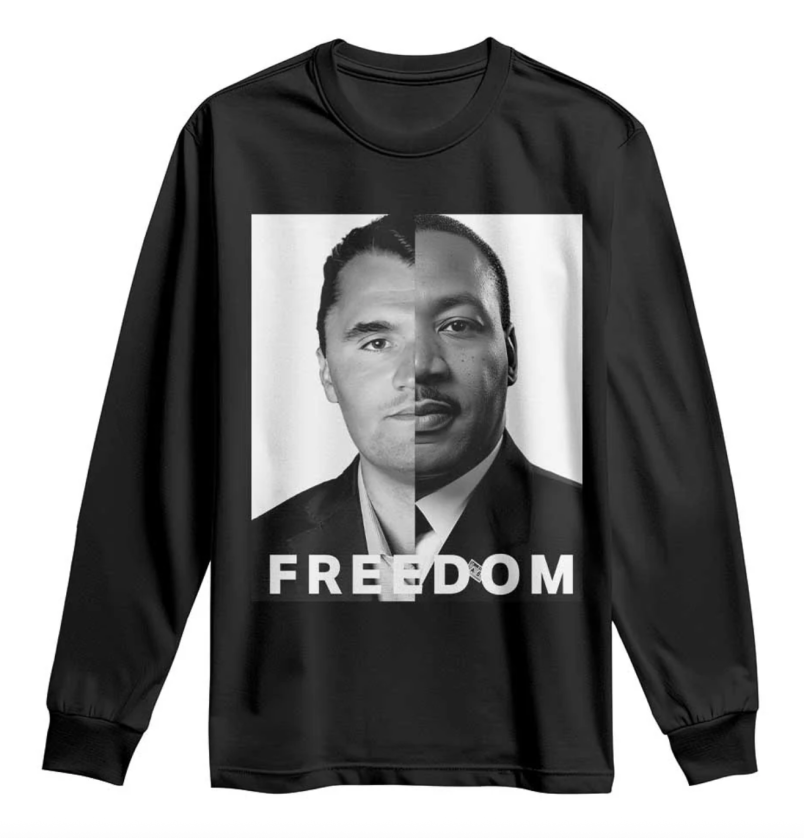
There are multiple t-shirts and other souvenirs casting Kirk as some type of Civil Rights icon. One shop is even selling “FREEDOM” shirts for $33.27 with a portrait of Kirk alongside Martin Luther King, Jr.. It doesn’t seem like a comparison that even the grandiose Kirk would have made. In his life, he referred to King as “disliked” and the leader’s legacy as a “myth” with “flaws” that needed to be exposed.
Over on TikTok, sellers have made a bizarre blanket featuring likenesses of Kirk and George Floyd, the man whose death inspired the 2020 Black Lives Matter protests, as angels looking down from heaven. Here in the real world, Kirk called for the officers who were later convicted of federal civil rights violations for Floyd’s death to be “released immediately.”
Following his death, due to some mix of his own grossness and pure brainrot irony, Kirk became a Gen Z and Alpha internet meme. It can be difficult to parse some of the weirder pro-Kirk merch available online from the items meant to mock him. For example, there’s this “CHARLIE KNIRCK” shirt that evokes pop star Taylor Swift’s attention-seeking New York Knicks NBA Finals merch. That seems like an item that could appeal to Kirk fans and haters alike.
For the purposes of this story, we have tried our best to stick to the seemingly earnest pro-Kirk stuff. It’s all pretty weird and much of it seems to have been churned out with AI.
The worst of the Kirkslop includes another blanket featuring Kirk as an angel clutching American and Israeli flags. Kirk was indeed a staunch advocate for Israel, a position which separated him from the more blatant neo-Nazis who might otherwise have been his fellow travelers. However, in this case, the angel’s face looks more like a stock photo model than Kirk. This coloring book from Etsy that purports to tell the story of Kirk’s life and share the “Positive Reflections and Inspirations of a Great American” also seems to feature generic AI art that looks nothing like Kirk.
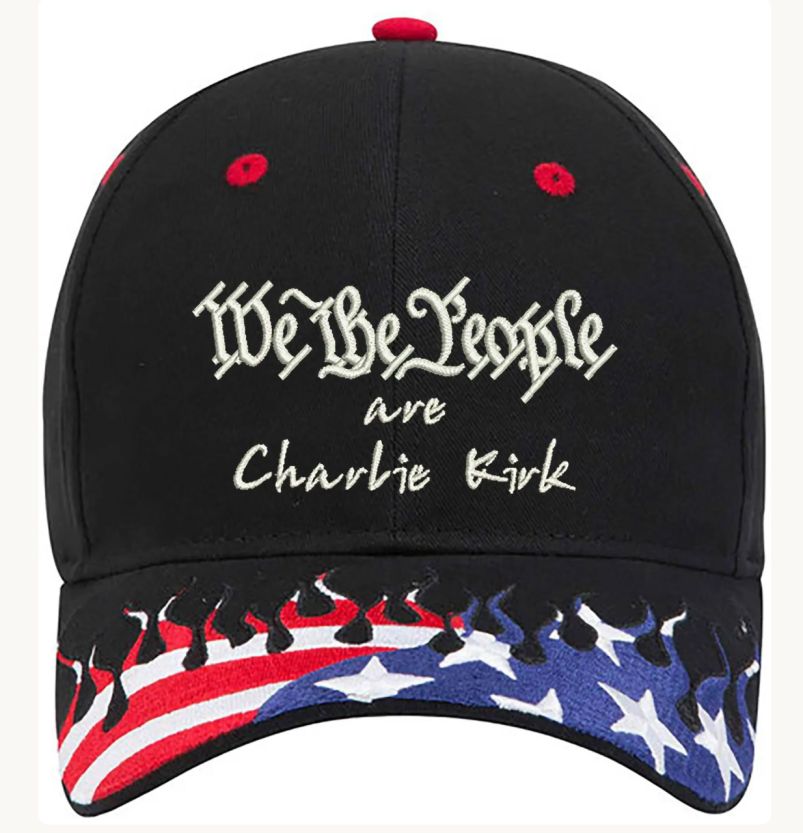
Much of the merch relies on familiar right-wing iconography. One particularly special piece is this hat, which basically combines three types of patriotic MAGA imagery in one hectic package. You have red, white, and blue flames, a gothic script Constitutional “We The People,” and, of course, a hint of Kirk word art.
Despite his efforts to sow hate and division, Kirk presented himself as a devout Christian. Religious elements are a major Kirkslop theme. While Kirk arguably did little to embrace the teachings of Jesus Christ, there are countless fantasy art pieces that picture him physically embracing the Christian savior, like this commemorative coin. Along with Jesus, it features Kirk alongside a somewhat disembodied fist and set of praying hands on the reverse side.
Not all of the Kirk memorial merch seems like mass-produced AI slop. Some of it is decidedly homespun, like this crochet pattern designed to help knitters make dolls of Kirk and Christ to sit side by side. The description for that item includes a note that could be read as offering an unintentional commentary on how the supposedly Christian MAGA base may be putting their various cults of personality before religion.
“You will get the patterns for both dolls,” the description says. “The Charlie Kirk doll is slightly larger than the Jesus.”
Which former congressman was permanently banned from prediction market Kalshi over evidence he engaged in insider trading?
This Trump Cabinet member vehemently dismissed recent reports that he’s considering a 2028 presidential run.
Republican Rep. Chuck Edwards (R-NC) was censured by his House colleagues this week. Describe the conduct that led to this.
Answers below
[Words of Wisdom]
Why Retire When You Can Boost the GDP?
“If we could just get the average American to feel so healthy, so with it, so vibrant that they want to work just one extra year, that’s worth $1 trillion to our GDP every year.” – Centers for Medicare & Medicaid Services administrator Dr. Mehmet Oz
[TPM in the Wild]
Jan. 6 Never Ends
Hunter Explains How We’re Still Living in the Shadow of Jan. 6
Pardoned Capitol rioters are terrorizing anti-ICE protesters. A former federal prosecutor who marched with the crowd on Jan. 6 is now running Trump’s DOJ task force to root out supposed left-wing political violence. Others who attended Jan. 6 are running for Congress.
As Hunter Walker told Ali Velshi on MS Now’s The 11th Hour, “Something that we’re adamant about at Talking Points Memo is that January 6 never stopped.” Hunter shared more about the roots of the “Stop the Steal” conspiracy and how it’s loomed over every federal election since Trump first emerged on the scene in 2016. “The [Jan 6] conspirators never really left the Hill, and now we’re bringing them back,” he said.
Former Republican Congressman Trey Gowdy — best known for leading the House Select Committee on Benghazi and Alan Cumming-esque array of hairstyles — surprised the hosts of Fox News’ The Five last week when he announced that he was on the fence about Trump’s attempt to rename Lake Ontario. Gowdy’s particular concern is not that renaming the lake is pointless, pathetic, demonstrates a complete lack of historical understanding of the names “Ontario” and “America,” and can have no effect other than to inflame an already tense situation, no; Gowdy is worried about Hamas. In a segment titled “Syrup Slap,” he told the hosts of The Five:
Here’s what troubles me. So, it took me 12 years to remember that acronym to learn the great lakes, it’s HOMES, right. Alright, the “O” changes to “A,” that’s close to HAMAS. That’s what bothers me about changing the name from Ontario to America is how close that acronym is to Hamas. It’s going to confuse a lot of kids. That’s why I haven’t made up my mind on it yet.
HOMES → HAMES → HAMAS (?) 🤯. If you’re looking for more delightful wordplay and logic-be-damned plotting, Gowdy has a new novel out titled, “The Sound of Regret” (seriously).
[No Words]
Markey’s Win Proves You Can’t Run on Generational Change AND Transphobia
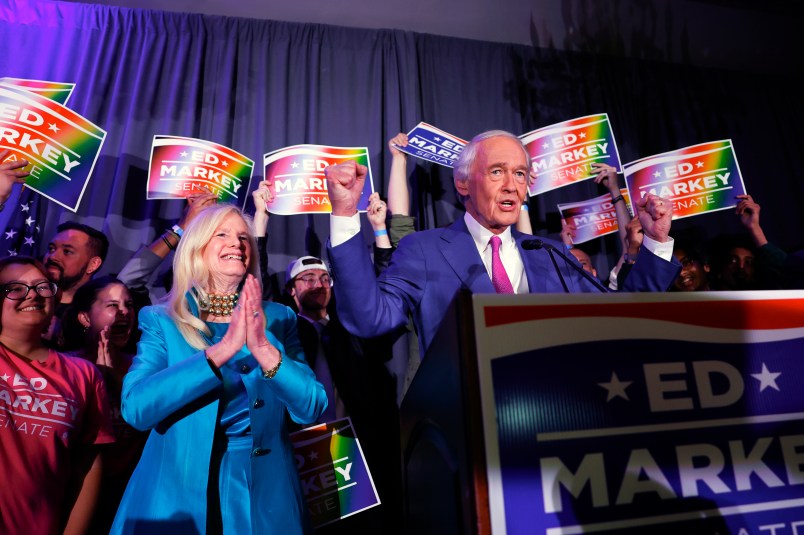
Boston, MA – September 1: Sen. Ed Markey delivers his victory speech after winning the U.S. Senate democratic primary on September 1, 2026. (Photo by Danielle Parhizkaran/The Boston Globe via Getty Images)
Trivia answers: 1) Rep. George Santos (R-NY) 2) Defense Secretary Pete Hegseth 3) Sexually harassed two young women staffers (by reciting them poetry, buying them lavish gifts including personalized handguns, and inviting them to social outings, including an Adam Sandler show).
Sort of a minor point of interest. But still notable. The Italian government of Giorgia Meloni has now become the longest lasting government in the country since World War II at 1,413 days. Since the Italian Republic began at the end of World War II — specifically in a June 1946 national referendum on whether to maintain the monarchy or become a republic — it’s the longest lasting government in the 80 year history of the Italian Republic. Silvio Berlusconi is still the longest-serving prime minister. But he did that non-consecutively and over four separate governments. The average length of a government since World War II is about 13 months — a somewhat notorious parliamentary, if not political, instability for which the Italian Republic has long been known.