

As you’ve probably already heard, Donald Trump went on Truth Social late last night and announced that the time had come for his senators to pass a clean “continuing resolution” to reopen the government with a simply majority vote by abolishing the filibuster. The only proper response to this is “bring it on.” It’s never good to cower, of course. “Give it your best shot” is always the proper posture. But if Trump is able to accomplish this (I’m skeptical — more on that in a moment), that’s great news.
Continue reading “Trump Wants to Abolish the Filibuster? Please Proceed, Degenerate …”A Hunger Cliff Is Days Away. Women, Children and Food Banks Will Feel It First.
This story was originally reported by Barbara Rodriguez of The 19th. Meet Barbara and read more of their reporting on gender, politics and policy.
Food banks in several states, including Idaho and Maine, are bracing for an influx of visitors. In South Carolina, a state emergency relief fund will be tapped to respond to demand. And in North Dakota, the state’s sole food bank has started an emergency fundraising campaign.
As lawmakers in Congress extend a nearly record-breaking federal government shutdown into possibly another month, massive cuts to critical aid are looming for the nation’s most vulnerable people — including women, postpartum parents and children.
The Supplemental Nutrition Assistance Program, known as food stamps or SNAP, is set to run out of money beginning Saturday, the start of November. Separately, the Special Supplemental Nutrition Program for Women, Infants, and Children, known as WIC, has no long-term funding for November. (The White House tapped some contingency funding for WIC in October, but advocates warn it’s set to run out over the next few weeks.)
SNAP, which has been around for 60 years, ensures nearly 42 million low-income Americans, including nearly 16 million kids, can access money to buy groceries. The funding is typically issued through debit-style cards that are not scheduled to be refilled on November 1 (or throughout the month since some states administer the program on a staggered calendar.)
“The fact that we’re talking about so much money and so many families that depend on it — not having the benefits go out next month is really going to be a crisis,” said Marlene Schwartz, director of the Rudd Center for Food Policy & Health at the University of Connecticut.
WIC, developed in the early 1970s, provides some money for food purchases, but it primarily offers resources aimed at making sure low-income new parents can raise healthy babies. That includes prenatal care, nutrition education and breastfeeding support. The program is a lifeline, serving 7 million people, including nearly half of all babies born in the United States.
Cutoffs to one or both programs would be unprecedented — Congress has never let funding for these vulnerable populations lapse, even during previous shutdowns. The ripple effect could be hungry families and pregnant and postpartum parents with fewer resources — including formula in some cases — to keep their babies healthy.
Food banks — the charitable aid system that distributes food to pantries and meal programs around the country and is funded through a range of sources, including private donations — are offering help as panic begins to set in among families. Many existing recipients of food pantries don’t qualify for SNAP because their income threshold, while potentially low, might not be low enough. It means strained resources for more people.
“Food banks and food pantries are going to step in during this period as a little bit of a bridge,” said Eric Hodel, chief executive officer for the Midwest Food Bank, which distributes food that reaches nonprofits in 25 states and runs distribution sites in two international facilities. “At times, we’ve maybe bridged some people for a day or for a week. If we have extended delays in the administration of SNAP, I think at the food bank we’re preparing that we may have to bridge that a little bit longer and further — so we’re continuing to do what we do to the best of our ability.”
But it’s not expected to be enough. Feeding America, the organization that provides a nationwide network of food banks, estimates that food pantries provide about one meal to every nine provided by SNAP.
“The most challenging and heartbreaking situation for staff members and volunteers is when the pantry shelves are empty, and they must turn people away — veterans, seniors, families with young children. Yet, with increasing demand and the high cost of food, this is already the harsh reality for so many and, without immediate action, will become a reality for countless more people across the country,” said Claire Babineaux-Fontenot, CEO of Feeding America, in a statement.
It’s a dynamic playing out amid rising grocery prices. Schwartz added: “The charitable food system is there to support families, but it is tiny compared to the amount of money that is available through SNAP.”
That would be particularly relevant for the separate WIC program, explained Nell Menefee-Libey, senior public policy manager at the National WIC Association, which advocates for WIC staff who are based around the country. WIC is the nation’s largest breastfeeding support promotion program — a resource that cannot be filled by the charitable food system. The program also provides tailored foods that meet the specific nutritional needs of pregnant and postpartum parents, as well as those of children from infancy through their fifth birthday. It would also be at the whims of potentially inconsistent food offerings at food pantries.
And if a family is using infant formula, that can be the sole source of nutrition for a young child. For the most part, food banks have not historically supplied infant formula, said Menefee-Libey.
“It’s a pretty delicate supply chain, so trying to figure out what it would look like to get additional infant formula to food banks to support families in the event of a widespread disruption to WIC is incredibly challenging,” she said.
Advocates for SNAP benefits note that the U.S. Department of Agriculture (USDA), which administers WIC and SNAP, has contingency funds — between $5 billion and $6 billion, according to some estimates, for SNAP alone. The agency claims it’s unable to use those funds for the program. Nearly 60 percent of SNAP beneficiaries are children and older adults.
“Bottom line, the well has run dry,” reads part of a message on the USDA website.
Bottom line, the well has run dry.”U.S. Department of Agriculture
The assertion is being challenged in court. On Tuesday, a coalition of 25 Democratic-led states and the District of Columbia filed a lawsuit against the Trump administration over its plans to cut SNAP access.
“The funds are available to continue SNAP right now without any interruption,” said Democratic Sen. Peter Welch of Vermont during a news conference this week. “So that is a decision the president is making on his own — on his own — to allow people to go hungry.”
While lawmakers in Washington remain deadlocked over how to reopen the government, some are also discussing stand-alone legislation that could continue to fund food assistance. The idea has bipartisan support, but whether there’s enough political will to do something within days is unclear for now.
USDA tapped $150 million in contingency funds for WIC in October, and then a separate $300 million transfer from tariff funds. Menefee-Libey said if there is no clarity soon, the consequences will include WIC staff being furloughed, which would impact how families are able to access resources.
“I think we’re really fortunate that this is a program with broad bipartisan support, that the White House and USDA have both stepped in to provide quite a bit of support for the program during the shutdown,” she said. “But even all of the extraordinary measures that have been taken only get us through October. It is entirely fair to say that there needs to be a certain amount of urgency to make sure that we don’t see folks losing access to WIC benefits as soon as November.”
Carolyn Vega is associate director of policy analysis at Share Our Strength, a nonprofit that seeks to address hunger and poverty and oversees a No Kid Hungry campaign that is focused on ending child hunger.
Vega worries about the different groups who are most likely to suffer, including single-parent households and children who may show up to school hungry. (There are federal food assistance programs offered at schools, including for breakfast and lunch, which are not expected to be impacted by the shutdown.)
“The fastest and best way to address the looming hunger cliff is for USDA to step in and provide the benefits that families are eligible for and are counting on,” Vega said.
This cliff comes as the Trump administration announced in September that it would stop tracking food insecurity in American households through an annual report, claiming through a news release that the work was redundant, costly and politicized. Schwartz criticized the move, and its broader implications amid the shutdown.
“That measure has been around for as long as I can remember, and I’ve been in the field for a pretty long time,” she said. “The fact that they’ve just decided not to measure it — it’s like they’re trying to make it harder to really document the harm that’s occurring.”
Trump-Appointed Judge Praises Suspended DOJ Prosecutors
Down The Memory Hole
During the sentencing of a pardoned Jan. 6 defendant in an unrelated case, U.S. District Judge Carl Nichols of D.C. praised the two prosecutors who were suspended by the Justice Department this week after they referred to those who attacked the Capitol as a “mob of rioters.”
“In my view, both Mr. Valdivia and Mr. White did a truly excellent job in this case,” said Nichols, a Trump appointee, while the two suspended prosecutors watched the proceedings from the audience.
After suspending the two prosecutors, the Justice Department submitted a new sentencing memo in the case that edited out the “mob of rioters” section. Online access to the original sentencing memo was apparently blocked by the court clerk, Politico reported. Nichols said he hadn’t ordered the original sealed memo and that the Justice Department would have to justify deep-sixing it in a motion for his consideration.
Comey Attacks Indictment on Multiple Fronts
Former FBI Director James Comey filed the last of his planned pre-trial challenges to the politicized indictment against him, fleshing out a multi-prong attack on the legitimacy of the case. For those keeping close track, Comey has filed three distinct motions to dismiss, based respectively on
- the unlawful appointment of Lindsey Halligan as U.S. Attorney
- vindictive and selective prosecution
- the fundamental ambiguity of Sen. Ted Cruz’s questions to Comey and the literal truth of Comey’s answers
In addition, Comey is seeking (i) a bill of particulars from the government that lays out the charges against him with more factual specificity; and (ii) the transcript and audio
recordings of the grand jury proceedings, arguing that potential misconduct and other irregularities may form the basis for additional motions to dismiss.
Of particular note, Comey alleges that a FBI agent may have infected the grand jury proceedings because he was tainted by exposure to “privileged communications” between Comey and one of his lawyers obtained in an earlier investigation. The details of that episode are largely redacted in Comey’s motion so the details remain a bit murky.
Quote of the Day
U.S. Pardon Attorney Ed Martin, calling into question the validity of President Biden’s pardons, in an email to House Oversight Committee chair James Comer (R-KY) obtained by CNN:
As the Pardon Attorney, I can tell you unequivocally that my Office cannot support the validity and ongoing legal effect of pardons and commutations issued during the Biden Administration without further examination.
Their validity must be fully examined in light of what we now know – and I suspect ultimately by a Court with a presentation of the evidence you and others have gathered.
The Retribution: Abrego Garcia Edition
The big evidentiary hearing scheduled for next week on Kilmar Abrego Garcia’s claims of vindictive prosecution is looking increasingly in jeopardy, with both sides raising the prospect of delays.
Abrego Garcia’s defense team is urging the judge to hold the Trump administration’s feet to the fire by dismissing the case outright if its doesn’t cough up requested discovery on the vindictive prosecution claim and comply with a subpoena of top DOJ officials.
For its part, the Justice Department wants the judge to quash the subpoena and if he fails to do so to give prosecutors time to appeal that decision.
The Justice Department filing in the matter was signed by Stan Woodward, the former Trump world criminal defense attorney who is now the No. 3 at DOJ. It was his first appearance in the case and creates the unusual tableau, noted by Adam Klasfeld, of the No. 3 at DOJ trying to keep the No. 2, Deputy Attorney General Todd Blanche, from having to testify in the case of a man who six months ago was rotting away indefinitely in an El Salvadoran prison after his unlawful deportation.
The White Nationalism Ain’t Subtle
NYT: “The Trump administration is drastically cutting the number of refugees it will admit to the United States, rejecting thousands of people fleeing war and persecution while reserving the record-low number of slots for mostly white Afrikaner South Africans.”
Deep Dive
TPM’s Kate Riga takes a closer look at the argument by Georgetown law professor Marty Lederman in the Illinois National Guard case that made the Supreme Court ask for more briefing and may be an elegant offramp that could limit President Trump’s militarization of America cities.
Trump’s Cloistered Cabinet
The NYT has a follow-on to The Atlantic’s report on the prevalence of Trump II officials living in military housing usually reserved for flag officers. Among the sheltered few: Pete Hegseth, Marco Rubio, Kristi Noem, Stephen Miller, Daniel Driscoll, and John Phelan.
Gunboat Diplomacy Watch
- Trump administration officials have let it be known that they have “identified” military targets within Venezuela for potential air strikes, framing it misleadingly around combating drug trafficking rather than regime change.
- The Trump administration froze out Senate Democrats by briefing only Republican senators on a secret target list and purported legal rationale for its military strikes in the Caribbean and eastern Pacific.
- In a separate bipartisan briefing on the House side, Pentagon officials told members that they do not know precisely whom they have killed in the military strikes that have left at least 57 people dead, according to Democratic lawmakers in attendance.
‘Aggressively Partisan’
Texas Attorney General Ken Paxton (R) has been modeling for years the kind of politicized weaponization of the legal system that the Trump DOJ is now adopting — but things are much worse in Texas now that Paxton is also a candidate for U.S. Senate.
Do you like Morning Memo? Let us know!
‘Biblical Justice’: How North Carolina’s Chief Justice Transformed His State and America
This post first appeared at ProPublica, a nonprofit newsroom that investigates abuses of power. Sign up for Dispatches, a newsletter that spotlights wrongdoing around the country, to receive our stories in your inbox every week.
In early 2023, Paul Newby, the Republican chief justice of North Carolina’s Supreme Court, gave the state and the nation a demonstration of the stunning and overlooked power of his office.
The previous year, the court — then majority Democrat — had outlawed partisan gerrymandering in the swing state. Over Newby’s vehement dissent, it had ordered independent outsiders to redraw electoral maps that the GOP-controlled legislature had crafted to conservatives’ advantage.
The traditional ways to undo such a decision would have been for the legislature to pass a new law that made gerrymandering legal or for Republicans to file a lawsuit. But that would’ve taken months or years.
Newby cleared a way to get there sooner, well before the crucial 2024 election.
In January — once two newly elected Republican justices were sworn in, giving the party a 5-2 majority — GOP lawmakers quickly filed a petition asking the Supreme Court to rehear the gerrymandering case. Such do-overs are rare. Since 1993, the court had granted only two out of 214 petitions for rehearings, both to redress narrow errors, not differences in interpreting North Carolina’s constitution. The lawyers who’d won the gerrymandering case were incredulous.
“We were like, they can’t possibly do this,” said Jeff Loperfido, the chief counsel for voting rights at the Southern Coalition for Social Justice. “Can they revisit their opinions when the ink is barely dry?”
Under Newby’s leadership, they did.
Continue reading “‘Biblical Justice’: How North Carolina’s Chief Justice Transformed His State and America”Watching the Podcast Bubble Burst From the Inside
I started my first podcast in 2009. It wasn’t anything special, just a venue to practice documentary audio and force myself to publish something every two weeks. I was a kindergarten teacher in New York City, trying to figure out how to break into public radio. What I couldn’t have imagined then was that within less than a decade, I’d find myself inside a podcast industry bubble — a bubble that many of us correctly suspected would eventually pop.
Continue reading “Watching the Podcast Bubble Burst From the Inside”Trump Admin Slowrolls Census Effort To Accurately Count Non-White Americans
Quyen Dinh didn’t even remember that, in 2024, she was selected as one of 23 appointees to the Census 2030 Advisory Committee. The group has been disbanded since March by order of President Donald Trump, eradicating professional expertise from the planning of the decennial census.
Continue reading “Trump Admin Slowrolls Census Effort To Accurately Count Non-White Americans”One Amicus Brief May Have Given Supreme Court an Out in Chicago National Guard Case
The Supreme Court is, apparently, reading its amicus briefs — and one of them may provide an offramp from immediately having to decide whether President Trump has the power to deploy the National Guard into Illinois.
Continue reading “One Amicus Brief May Have Given Supreme Court an Out in Chicago National Guard Case”Portland Points to Random Use of Force by Fed Officers as It Fights Nat’l Guard Deployment
Startling to Watch
One figure has emerged repeatedly in the first two days of a trial over President Trump’s attempted deployment of the National Guard to Portland: The out-of-control, tear gas-happy federal officer.
Continue reading “Portland Points to Random Use of Force by Fed Officers as It Fights Nat’l Guard Deployment “The MAGA Disinfo Machine Takes New Aim at Jack Smith
The Retribution: Arctic Frost Edition
Republicans on the Hill and right-wing media, in tandem with the Trump administration, are creating a MAGA feedback loop by releasing DOJ and FBI records from the “Arctic Frost” investigation, pretending they contain new and damaging revelations not already publicly reported or contained in Special Counsel Jack Smith’s own report, and howling in faux outrage over the supposed Deep State conspiracy against President Trump and Jan. 6 participants.
It is a model of disinformation first perfected in the B-E-N-G-H-A-Z-I attack and constantly re-adapted for the Trump era.
One of the challenges is that each far-flung conspiracy theory develops its own argot that pretty quickly becomes impenetrable to outsiders but remains a tribal signifier to powerful effect.
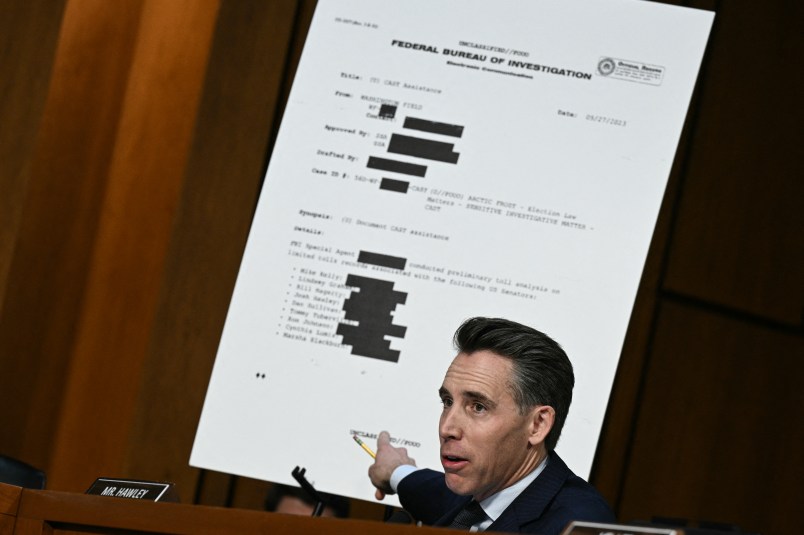
Suffice to say for our current purposes that Arctic Frost was the FBI investigation of the conspiracy to subvert the 2020 election that ended up being a precursor to Smith’s investigation. All the noise a few weeks ago about Smith getting the toll records (flagrantly miscast as tapping the phones) of GOP members of Congress? That was a legal and already known part of the Arctic Frost investigation, but Hill Republicans seized on newly-released documents to portray it as a scandal they had just unearthed. The demand for Smith to testify on the Hill is part of this latest outbreak of targeted outrage.
While mainstream outlets struggle to cover the true dynamic of these disinformation campaigns, the latest ever-evolving Deep State conspiracy becomes a staple of right-wing media, fed by supposed new disclosures from the administration and laundered through Hill Republicans.

While Smith has been in Trump’s crosshairs since the day he was appointed special counsel, the new drip-drip-drip of “revelations” is fueling the fire to seek retribution against Smith at a new level of intensity. Given the current prosecutions of former FBI Director James Comey and New York Attorney General Letitia James and President Trump’s repeated threats against Smith, we may well look back on this new spasm of disinformation as softening the ground for a bogus prosecution of Smith.
It gives President Trump another opportunity to demand that Smith be investigated and imprisoned without necessarily directly ordering it: “These thugs should all be investigated and put in prison. A disgrace to humanity. Deranged Jack Smith is a criminal!!!” Trump posted yesterday.
Down the Memory Hole
After suspending prosecutors who dared to refer to Jan. 6 as involving a “a mob of rioters,” the Trump DOJ filed a new sentencing memo in the case of Taylor Taranto, who is set to be sentenced today.
By the time he was pardoned by President Trump for his role in Jan. 6, Taranto had been convicted on unrelated threats and firearms charges after being arrested in June 2023 near the D.C. home of the Obamas.
Here’s what was redacted in the new sentencing memo
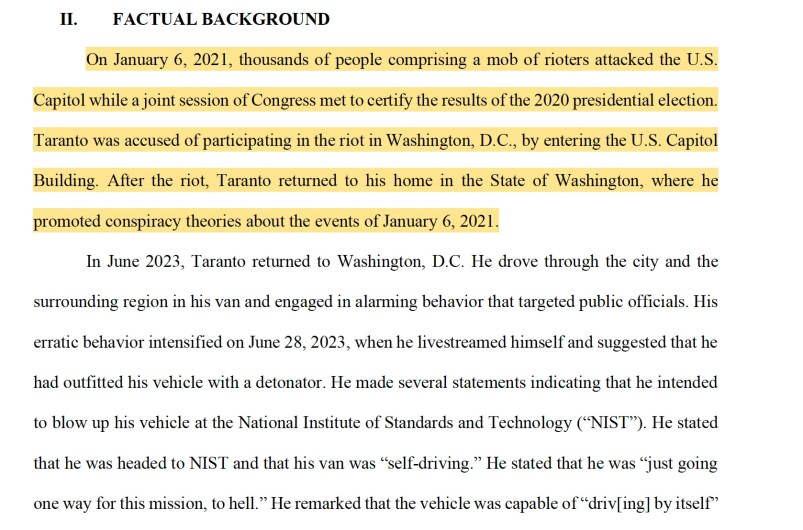
It’ll be interesting to see if the judge has anything to say about this during sentencing. Stay tuned …
Operation Midway Blitz Watch
- The Trump administration immediately appealed the order by a federal judge in Chicago requiring CBP commander Greg Bovino to report to her daily in person on the use of force in Operation Midway Blitz. The 7th Circuit Court of Appeals temporarily paused the part of the order requiring Bovino’s daily reports while it considered the appeal.
- The Supreme Court asked for additional briefing in the case challenging President Trump’s plan to deploy the National Guard to Chicago. The high court appears to have zeroed in on an elegant possible way out of the case identified by Georgetown law professor Marty Lederman.
- The Pentagon has ordered the National Guard to create “quick reaction” forces in every state and territory by January to respond to riots and civil unrest, the WSJ reports.
The Dystopia Is Now
Immigration officers are using facial recognition technology on American streets to confirm citizenship status, 404 Media reports.
Keep an Eye on This …
The U.S. attorney in the criminal case against Kilmar Abrego Garcia revealed to the judge yesterday that he had received new documents he had never seen before from the Homeland Security Investigations supervisory agent overseeing the probe into alleged human smuggling.
The revelation comes in the context of the Trump administration fighting tooth and nail to avoid providing discovery to Abrego Garcia in support of his vindictive prosecution claim. Suddenly coughing up “a significant number of documents” the day before the judge’s deadline for providing him with ex parte access to the discovery is … suspicious.
The judge has scheduled two days of hearings next week to adjudicate the vindictive prosecution claim, but the discovery dispute is jeopardizing that schedule.
The OTHER Abrego Garcia?
DHS claims it was not served with a federal court order barring the removal of a 44-year-old man who has lived in the United States since he was an infant until after it had already deported him to Laos. The ACLU has joined the case and is asking the judge to order the repatriation of Chanthila Souvannarath.
The Anti-Voting Rights Long Game
Anticipating that the Roberts Court will eviscerate the Voting Right Act, the Louisiana legislature passed a bill pushing back next year’s primary elections by about a month in hopes that it will have more time to redraw its congressional maps. Louisiana is challenging a key provision of the Voting Right Act at the Supreme Court, where oral arguments were heard earlier this month. A decision in the case wouldn’t typically be expected until the first half of next year, creating a time crunch that some red states are looking to ease by pushing election dates back.
Between a Rock and a Hard Place
DNI Tulsi Gabbard, with help on the Hill, is trying to wrest primary responsibility for counterintelligence away from the FBI, prompting a fierce turf battle.
Neither Gabbard nor FBI Director Kash Patel are qualified to lead counterintelligence efforts, but at least the FBI has the experience and capacity. The idea of this administration overhauling counterintelligence operations is chilling.
Gunboat Diplomacy Watch
- The U.S. conducted a fourteenth lawless attack Wednesday on an alleged drug-smuggling boat, this time in the waters of the Eastern Pacific.
- Deep dive: Just Security examines the Trump administration’s two irreconcilable positions on the status of the drug cartel Tren de Aragua.
Man Acquitted of Soliciting Trump’s Murder on Bluesky
A federal jury in the Eastern District of Virginia acquitted a former Coast Guard officer accused of soliciting President Donald Trump’s assassination on Bluesky. Prosecutors argued that a Feb. 18 post and earlier social media posts amounted to inducing others to commit violence. Defense attorneys contended it was speech protected by the First Amendment and that the defendant didn’t take any affirmative steps to engage in violence.
Charges Dropped Against Man Jailed for Charlie Kirk Meme
The Tennessee man jailed for more than month for posting to Facebook a Charlie Kirk meme has been released after prosecutors dropped the charges.
Do you like Morning Memo? Let us know!
Anti-Vax Facebook Groups Ushered in Our Current MAHA Nightmare
In 2007, Oprah Winfrey featured Jenny McCarthy, the former Playboy model turned anti-vaccine activist, on her show to talk about her son Evan’s autism diagnosis. “The University of Google is where I got my degree from,” she said during that appearance. McCarthy would go on to become one of the most visible purveyors of disinformation around vaccines and autism, encouraging countless parents to believe that vaccines give children developmental disabilities.
Before she embarked on this dangerous new path, McCarthy was like other moms — and a majority of caregivers for autistic people are women, particularly moms — trying to figure out how to help their children through the diagnosis. The medical community has a history of marginalizing and discrediting women’s health concerns, and for many years, scientists blamed autism on unloving mothers. So it’s understandable that women like McCarthy went online to try to learn more about the complex, largely misunderstood condition.
McCarthy is an easy target given her large media profile. But throughout the 2000s and through the 2010s, scores of less famous families and solo bloggers spread misinformation through their smaller platforms. These so-called “mommy bloggers” frequently focused on autism and vaccines, even as scientists repeatedly debunked the theory that vaccines played a role in autism. All of this made mainstream media efforts to push back against the lies around vaccines and autism all the more difficult.
Continue reading “Anti-Vax Facebook Groups Ushered in Our Current MAHA Nightmare “