


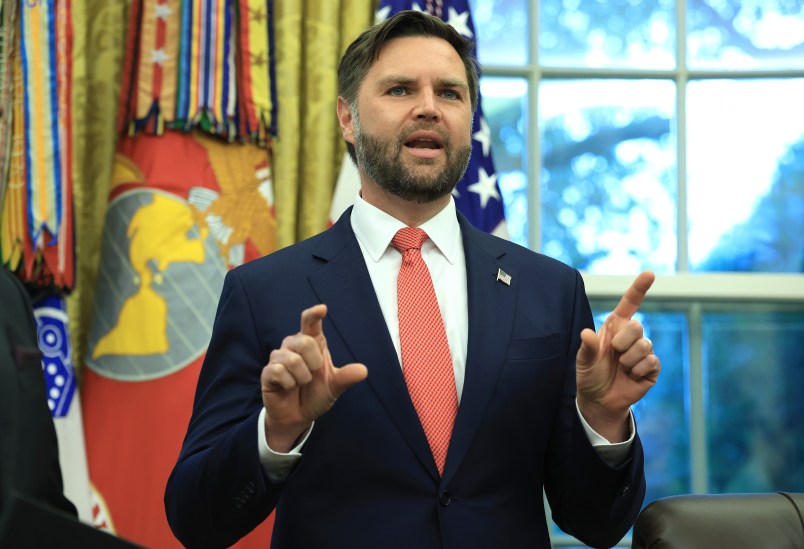
The day after President Trump signed a bill that throws unprecedented amounts of money at ICE, extends tax cuts for the wealthy, and slashes health-care and social services to do so, Vice President JD Vance was in San Diego. And while he might have been far away from Washington, the administration’s immigration crackdown was front of mind: he was there to give a keynote address at a dinner hosted by the Claremont Institute, the southern California nonprofit that’s earned a reputation as a “nerve center” for MAGA thought.
At the core of Claremont thinking is immigration. The think tank pushed for an end to birthright citizenship long before that objective entered the mainstream of the GOP; it claimed ownership over Vance’s thinking on the topic after Trump chose him as his running mate last year.
It was not wrong to do so. During the 2024 Republican National Convention, Vance tried to sand down the idea of what it means to be an American citizen to a more European level: the country belongs more to those who share its “common history,” he said, not just those who ascribe to its values. He put Claremont’s intellectual approach to nativism into action last year, stoking racial tensions over Haitian immigration to Springfield, Ohio.
On Saturday, Vance took up the theme again. But this time, he had more to point to than theoretical arguments or viral campaign moments. The second Trump administration is pumping huge amounts of cash into the country’s detention and removal infrastructure for immigrants; it’s moved to end birthright citizenship; it’s staged high-profile civil liberties abuses with various efforts to remove people quickly and scare off others from coming; it is contemplating denaturalizations. Its radical actions do not undercut the fact that there was also a strong messaging component to Vance’s Saturday remarks: the administration wants to talk about immigration to the exclusion of nearly everything else.
What Vance expressed to the friendly Claremont audience was a dramatically reduced vision of American citizenship. It’s one in which having ancestors who have lived here for generations entitles you to more; a vision of citizenship that’s long existed around the world, with a notable and aspirational exception in the United States.
“Identifying America just with agreeing with the principles, let’s say, of the Declaration of Independence — that’s a definition that is way over-inclusive and under-inclusive at the same time,” Vance said.
He explained that such a definition “would include hundreds of millions, maybe billions of foreign citizens who agree” with the principles of the Declaration of Independence, dubbing it “the logic of America as a purely creedal nation.”
By the opposite token, Vance said, conceiving of American citizenship “purely as an idea” would “reject a lot of people that the ADL would label as domestic extremists, even though those very Americans had their ancestors fight in the Revolutionary War and the Civil War,” he said, referencing the Anti-Defamation League, a nonprofit that was founded to combat antisemitism and that, among other activities, tracks far-right groups.
“I think the people whose ancestors fought in the Civil War have a hell of a lot more claim over America than the people who say they don’t belong,” he concluded.
Dog whistles aside (you can count quite a few in the above), Vance is channeling an idea that undergirds the administration’s most aggressive immigration policies — policies that are, after the additional $170 billion that Congress appropriated for enforcement this month, set to expand.
Vance wasn’t talking about an America that’s entirely closed off to new immigrants; rather, it’s an America where “heritage” counts as much as values.
Watching this, it’s easy to go too far down the opposite path: thinking that what Vance is describing is a leap towards something new; assuming that America has always found a way to offer people citizenship based on values and not descent from some old stock.
And it is, in part, new: Vance is making this argument to support, fawn over, and give his boss and his boss’s favorite policies a highbrow sheen. The vice president hit a familiar note in setting up New York City mayoral candidate Zohran Mamdani (D) as a foil, demanding that he show “gratitude” to the country and attacking him for not being sufficiently patriotic on the Fourth of July.
“I wonder, has he ever read the letters from boy soldiers in the Union Army to parents and sweethearts that they’d never see again?” Vance asked.
Yet that bizarre line of argument was revealing in its own way.
For all Vance’s — and those on the new right’s — talk of imposing a new order on American politics, they’re still reactionaries of a very old variety. Birthright citizenship, after all, was enshrined in the Constitution after those Union soldiers’ victory in the Civil War. What he described on Saturday was fundamentally regressive: a vision of American citizenship anchored far in the past.
Correction: This piece originally misquoted Vance’s description of an America based purely in the principles of the Declaration of Independence. He described that vision as one of a “purely creedal nation.” TPM regrets the error.






That is quite literally the most Orwellian thing I’ve seen in a while.
I wonder what he says when he has dinner with his in-laws.
“Thank you!”
When did we start granting American citizenship to someone merely because she agrees with the principles of the Declaration of Independence? Is he trying to confuse me?
Yes, reactionary is the word for the contemporary GQP.