Since President Trump first came back to the White House, he has predictably taken significant steps to white wash the entire episode in 2021, which culminated in a violent mob of his supporters storming the U.S. Capitol in an attempt to halt the Electoral College certification of President Biden’s 2020 victory.
We’ve got about 20 tickets left for our 25th Anniversary Live Show next Thursday Nov. 6 at Metrograph in Manhattan. If you’ve somehow missed our messaging on this show until now, the programming includes an oral history of TPM with current and former TPM staff, a live edition of the Josh Marshall Podcast featuring Kate Riga, and an (open bar) cocktail reception. If you’ve been waiting for the absolute best time to score a seat, the time has come. Just click here.
I still have some relative confidence that the Gaza ceasefire deal will make its way through the current flare-ups. That’s because the deal itself has very powerful stakeholders behind it, ones who can apply overwhelming pressure to the warring parties if they choose to. But what we’re now seeing all the reasons you’d expect a deal like this with Donald Trump to go south.
First is attention. The best argument against this deal sticking has always been that Trump will get bored and lose interest. It’s pretty clear that’s already happened. We heard his press secretary say only days ago that his main priority is building the new White House ballroom.
In what is now the third such ruling, a federal judge disqualified Bill Essayli as acting U.S. attorney in Los Angeles, ruling that his appointment was a Trump administration workaround that violated federal law.
Essayli has been ineligible for the post since the end of July, concluded U.S. District Judge J. Michael Seabright of Hawaii, who was brought in to the hear the challenge because local district judges have the power under one statutory scheme to appointment acting U.S. attorneys.
The decision follows similar rulings against Alina Habba in New Jersey and Sigal Chattah in Nevada that have thwarted a Trump White House effort to install loyalists and avoid or at least delay the toils of Senate confirmation.
The latest ruling has major implications for the corrupt political prosecutions of former FBI Director James Comey and New York Attorney General Letitia James, who are both challenging on similar grounds the appointment of Lindsey Halligan as U.S. attorney for the Eastern District of Virginia.
But there are a couple of twists to the judge’s ruling against Essayli, whose appointment was challenged by three different criminal defendants and consolidated into one case:
While Essayli may not perform the functions of U.S. attorney, he remains the first assistant U.S. attorney and “may perform the functions and duties of that office.”
The judge did not dismiss the indictments of the defendants because “they were lawfully signed by other attorneys for the government and there has been no showing of due process violations or other irregularities in Defendants’ prosecutions resulting from Essayli’s unlawful service as Acting United States Attorney.”
The fact that no other attorney signed the Comey and James indictments other than Halligan looms large. Unlike the indictments Essayli obtained, both Comey and James argue that there was highly irregular conduct in their cases as part of a larger scheme of vindictive prosecutions.
Earlier yesterday, before the Essayli decision became public, the outside judge hearing the Comey and James challenges to Halligan gave the Trump DOJ a Monday deadline to provide to him for his sole review “all documents relating to the indictment signer’s participation in the grand jury proceedings, along with complete grand jury transcripts” because he “finds it necessary to determine the extent of the indictment signer’s involvement in the grand jury proceedings.”
The judge has set a joint oral argument on Halligan’s appointment for Nov. 13. Stay tuned …
Big Ruling in Oregon National Guard Case
The full 9th Circuit Court of Appeals has vacated a panel ruling that upheld President Trump’s deployment of the National Guard to Portland and will re-hear the case. The move comes after the dissenting judge on the panel essentially begged the full court to take up the case.
Bovino Required to Meet Judge Daily
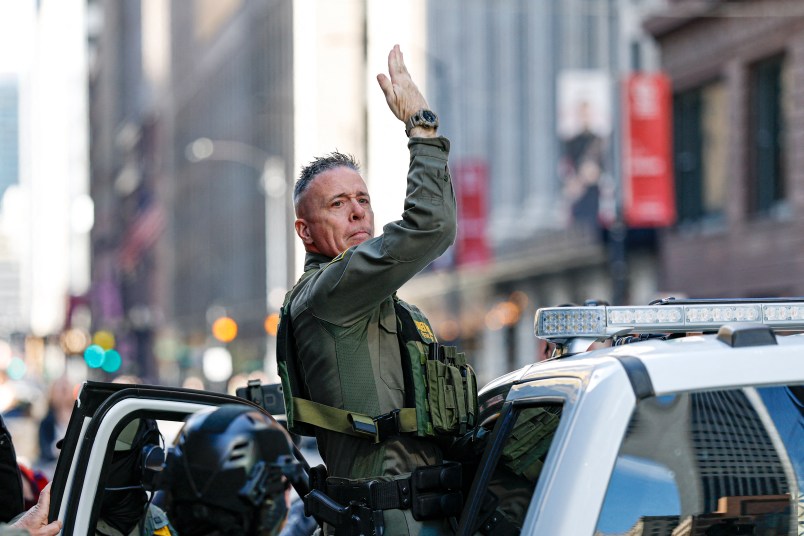
US Customs and Border Patrol Commander Gregory Bovino leaves federal court at Dirksen Federal Building after his hearing in Chicago, Illinois, on October 28, 2025. Bovino was ordered to appear in federal court for violating a temporary restraining order issued by District Judge Sara Ellis that orders immigration enforcement agents to limit use of tear gas and other crowd-suppression items except when there is an imminent threat. (Photo by KAMIL KRZACZYNSKI / AFP) (Photo by KAMIL KRZACZYNSKI/AFP via Getty Images)
In a closely-watched hearing in Chicago, Customs and Border Protection commander Greg Bovino was ordered to meet every weekday at 6 p.m. CT with U.S. District Judge Sara Ellis to report on the use of force in “Operation Midway Blitz.”
Ellis summoned Bovino to court after lawyers complained that he had personally violated her court order on the use of tear gas by deploying it himself without warning. Ellis didn’t dig too deeply into the specifics of the incident involving Bovino, according to reports from court, but she did order Bovino to begin wearing a body cam and deliver to her all reports on the use of force and existing body cam footage from Sept. 2 to the present.
DHS Busted for Propaganda
The Trump administration has used false or misleading footage on at least six occasions in government-produced videos promoting its mass deportation agenda, according to an analysis by WaPo that found some of the footage was from different times and locations than the videos claimed.
Another Abrego Garcia?
The Trump administration deported a man to Laos despite an Oct. 23 federal court order barring his removal, the AP reports.
Chanthila “Shawn” Souvannarath, 44, who was born in a refugee camp in Thailand and lived in the United States since before the age of 1, claims to have U.S. citizenship. He was taken into ICE custody in June in Alabama and had been detained at the immigrant detention center at Angola State Penitentiary in Louisiana.
U.S. District Judge Shelly Dick of Baton Rouge entered an ex parte TRO on Thursday after finding that Souvannarath had made a “substantial claim” of having U.S. citizenship. But by Sunday, Souvannarath messaged his wife on WhatsApp that he was in Laos.
The ACLU, which is representing Souvannarath, called it a “stunning violation of a federal court order.”
We Are So Cooked
Here’s the genius argument a Trump DOJ attorney put forwardin court yesterday to defend mass layoffs of federal workers during the government shutdown:
A Justice Department attorney defending the administration at the hearing Tuesday, Michael Velchik, said the firings were lawful and represented the will of the electorate expressed through President Donald Trump’s victory at the polls last year.
“The American people selected someone known above all else for his eloquence in communicating to employees that, ‘You’re fired!’” Velchik said, referring to Trump’s trademark line on his television show, “The Apprentice.”
U.S. District Judge Susan Illston of San Francisco rejected the Trump administration’s position and indefinitely extended her order banning reductions in force at most major government agencies during the government shutdown.
White House Fires Art Commissioners
The Trump White House sacked all six Biden-appointed members of the Commission of Fine Arts in preparation for stacking the independent agency with loyalists. The commission was expected to review plans for Trump’s new White House ballroom and a triumphal arch in D.C.
New U.S. High Seas Attack Kills 14
The U.S. continued its lawless conduct on the high seas with a series of three strikes on four alleged drug-smuggling boats Monday that killed 14 people in the Pacific off the coasts of Central and South America, according to Defense Secretary Pete Hegseth. A man survived one of the strikes in waters near Mexico and Guatemala and was apparently rescued by Mexican authorities. No word on his status.
Too Crazy Even for Kash Patel
Joe Kent, the Senate-confirmed director of the counterterrorism center and close adviser to DNI Tulsi Gabbard, obtained FBI files on the assassination of Charlie Kirk without the knowledge of senior FBI officials, the NYT reports.
Kent was reportedly investigating whether the man facing state charges for killing Kirk had help from other people or entities, according to the NYT. DOJ officials were alarmed that Kent was jeopardizing the criminal investigation.
The incident led to a White House meeting that included Kent, Gabbard, FBI Director Kash Patel, Vice President JD Vance, White House chief of staff Susie Wiles, and unnamed top DOJ officials, according to the report.
Man Jailed for Posting a Charlie Kirk Meme
A Tennessee man has been in jail for more than a month after posting a meme to Facebook that trolled the memorial service for the slain conservative activist Charlie Kirk.
The meme draws on a quote from Donald Trump following a January 2024 school shooting in Perry, Iowa: “We have to get over it.” The post on the What’s Happening in Perry County, Tennessee Facebook page prompted the sheriff to obtain an arrest warrant for Larry Bushart Jr. Here’s how The Intercept describes the, ummm, confusion:
It’s possible, perhaps, to imagine how the Trump meme might have set some members of the Facebook group on edge — at least upon first glance. The post invoked a school shooting at a “Perry High School.” The local high school in Linden is called Perry County High School. Moreover, just one month earlier, Weems had reported an alleged threat against the school, prompting administrators to cancel all classes “for the safety of our students and staff.” Still, it was easy to discern that, apart from the name “Perry,” there was nothing connecting the meme to Linden.
The indefatigable Phil Williams of Nashville New Channel 5, interviewed the Perry County (Tennessee, just so we’re clear) Sheriff Nick Weems, who managed in one sitting to pretty much blow up his own case. He admitted law enforcement knew it was an existing meme circulating on the internet, but claimed upset members of the public did not know that.
Weems said the arrest could have been avoided if Bushart had just taken down the post: “Whenever we sent Lexington Police Department out to speak to him and he refused to do that, I mean, what kind of person does that?” Weems asked. “What kind of person just says he don’t care?”
On July 8, something happened to Donald Trump that I’ve not seen happen in the entire decade he has dominated presidential politics. As his base clamored for more disclosures about sex trafficker Jeffrey Epstein, his superpower — his ability to grab and redirect attention — briefly failed him. “Are you still talking about Jeffrey Epstein?” he whined when a journalist asked about the Justice Department’s decision to abort any further disclosure of documents related to the case. “This guy’s been talked about for years.”
I’ve spent years tracking Trump’s favorite attention-management tactics, including in a 14-part podcast. And for several weeks in July, he cycled through all of them, attempting to focus attention somewhere other than Epstein. He tried polarization, claiming that the Epstein scandal, which his own aides and oldest son had stoked just months earlier, was instead just a Democratic hoax. He tried threats, attacking those who clamored for more. “I’ve lost a lot of faith in certain people,” he complained, “Some stupid Republicans and foolish Republicans fall into the net, and so they try and do the Democrats’ work.” Even after Deputy Attorney General Todd Blanche met with Epstein’s associate, the convicted sex trafficker Ghislaine Maxwell, conducting a scripted proffer designed to minimize her crimes, Trump was left offering up a list of things he wanted people to cover instead of his own ties to Epstein. The most successful ploy was the same one he has used since 2018, chanting Russia Russia Russia. On July 18, Director of National Intelligence Tulsi Gabbard renewed old complaints about the Russia investigation, screaming treason and blaming Barack Obama.
It took 10 days, threats against right-wing influencers still focused on Epstein, and Gabbard’s conspiracy theory before Trump started to reclaim his ability to redirect the media’s attention.
The Trump administration wants everyone to see what it’s doing in Chicago. The city is bearing the brunt of mass deportations. Over the past several weeks, federal agents have staged aggressive, high-profile operations. They’ve prompted protests, violence and potential violations of court orders over the use of tear gas.
The full 9th Circuit Court of Appeals voted Tuesday night to vacate a panel’s decision allowing the National Guard to deploy to Portland, and will rehear the case.
President Trump’s deployment of National Guard troops to U.S. cities that are led by elected Democrats, under the guise of a crackdown on crime and immigration, has been nothing short of an extremely transparent effort to flex power over his political enemies — both to get revenge on the local Democratic leaders who oppose him and the residents who didn’t vote for him.
I’ve made versions of this argument here in the Editors’ Blog and on the podcast many times. But it’s so critical and so beyond dispute I wanted to state it here as clearly as possible. There is no future for civic democracy in this country without reforming the Supreme Court. Putting that more specifically, the only way to recover from Donald Trump’s rapid lunge into an authoritarian American future is a future point at which Democrats regain control of the federal government — a trifecta — and institute a series of laws which cut off the channels Trump has exploited to get us to this point. That doesn’t solve the problem of Trumpism. The core issue is that very large minority of Americans who support his style of autocratic government. But that cuts off many of the paths Trump has used to build a presidential autocracy under the thinnest cover of law. You need, among other things, a federal law to place strict limits on partisan and racial gerrymandering. It’s only one example out of many – you need laws re-instituting true independent agencies, drastically limiting the use of military forces on US territory, barring president’s from claiming budgeting authority, et al. I note this example because it came up today when Kate and I recorded this week’s podcast. But even this comparatively uncontroversial federal statute would certainly be overturned by the Republican justices.