I want to return to a topic I’ve alluded to in several recent posts. The U.S. Constitution, U.S. law and U.S. civic culture all have a deep resistance to the use of the military in civilian spaces, except under the most extreme circumstances. Even then, we rely almost exclusively on what are in effect state and part-time militias, which are incorporated into the federal U.S. military but still distinct from it, at least largely based in the communities in which they are occasionally deployed. This issue came to the fore early in the second Trump administration with federalized National Guard troops deploying in various blue states and even “hostile” red states at least offering to deploy their guards into blue states. But the real game is Immigration and Customs Enforcement and Customs and Board Patrol and other, increasingly super-sized federal policing forces within the Department of Homeland Security. And they’re not military.
Over time, I’ve realized I’m being too literal about this. As a legal and constitutional matter, these aren’t military forces. They’re civilian policing agencies. But the aversion to military deployments in civilian areas isn’t simply a matter of technical designations, the formal unfreedoms of military service, the different legal code, the focus on war-fighting. There is a substantive reality of the desire to menace and dominate civilian spaces as though they are enemy territory, conquered rather than governed.
In what looked like a hostage video, Federal Reserve Board Chairman Jerome Powell announced Sunday evening that he is the target of a retaliatory criminal investigation by the Trump administration that resulted in subpoenas Friday to the Federal Reserve itself.
What made Powell’s announcement reminiscent of a hostage video wasn’t the quality of the recording or the failure of Powell to be a stalwart against Trump’s repeated attempts to bring the Fed under his thumb but the fact that Powell was put in the position at all: a central banker facing banana republic tactics and forced to make a direct appeal to the public (read: financial markets).
Video message from Federal Reserve Chair Jerome H. Powell: www.youtube.com/watch?v=KckG…www.federalreserve.gov/newsevents/s…
Powell, originally appointed as Fed chair by Trump, was unabashed in saying that the criminal investigation into his testimony to Congress about renovations to the Feds’ D.C. headquarters is pre-textual, a poorly veiled attempt to muscle the independent Federal Reserve into lowering interest rates in the short term, as Trump wants, and subordinating monetary policy to the political exigencies of the sitting president in the long term.
“The threat of criminal charges is a consequence of the Federal Reserve setting interest rates based on our best assessment of what will serve the public, rather than following the preferences of the President,” Powell said.
By going public, Powell put financial markets and central bankers around world on notice about Trump’s most extreme move yet to undermine Fed independence.
The criminal investigation and the subpoenas it yielded were just the latest step in Trump’s year-long effort to bring the Fed to heel. He already attempted to fire Federal Reserve Governor Lisa Cook on bogus claims of mortgage fraud. That case — which tests whether the Fed will remain truly independent — is pending before the Supreme Court, which will hear oral arguments next week. More broadly, the Federal Reserve is at risk from Trump’s wide-ranging attack on independent agencies, though the Roberts Court has already indicated that may be a bridge too far even for justices enthusiastic to extend their ahistorical unitary executive theory.
While Powell is the proximate target of this retaliatory criminal investigation, he may not be the ultimate target. Powell’s term as Federal Reserve chairman ends in May, and Trump says he’s already decided on a successor for Powell, though he hasn’t divulged yet whom it will be. As the Wall Street Journal’s Greg Ip notes, the subpoenas are a message to new incoming chair and the other fed governors (Powell’s term as a governor doesn’t end until 2028) that the president has them on a short leash.
Among the details:
Federal Housing Finance Agency Director Bill Pulte was a “driving force” behind the subpoena, Bloomberg reports. For his part, Pulte said, “I don’t know anything about it, and I would defer (sic) you to the DOJ.”
“I don’t know anything about it,” Trump told NBC News, using an oft-repeated phrasing that has sometimes proven in the past to be patently false.
D.C. U.S. Attorney Jeanine Pirro “approved” on the investigation in November, the NYT reports, and prosecutors in her office have made “multiple” document requests of Powell’s staff regarding the renovation project.
“I will oppose the confirmation of any nominee for the Fed—including the upcoming Fed Chair vacancy—until this legal matter is fully resolved,” Sen. Thom Tillis said on X.
Headline Whiff of the Day
If your headline on the bogus pre-textual “investigation” of the Federal Reserve is indistinguishable from what you would have used for a good old-fashioned political scandal, then you are 100% doing it wrong:
WSJ: U.S. Prosecutors Are Investigating Fed Chair Jerome Powell.
WaPo: Justice Department opens a criminal investigation of Fed chair
NYT: Federal Prosecutors Open Investigation Into Fed Chair Powell
CNN: Federal prosecutors open criminal investigation into the Fed and Jerome Powell
Chart of the Day
What can history teach us about what happens when a populist strongman with an idiosyncratic taste for low interest rates undermines central bank independence?
“The total capture of the DOJ, seemingly with very little pushback or resistance, is one of the most striking examples of the capitulation of American elites in the face of authoritarianism. It’s been less than a year, and federal prosecutions or investigations are already completely discredited.”–Filipe Campante, professor at Johns Hopkins University
DOJ Watch
Christopher G. Raia, the head of the FBI’s NYC office, is expected to become deputy FBI director, a return to having a career agent in that role following the departure of Dan Bongino.
Former Special Counsel Jack Smith has launched a new law firm with Tim Heaphy, the lead investigator on the House’s select Jan. 6 committee; Thomas Windom, a former member of Smith’s team investigating the Jan. 6 case; and David Harbach, who worked the Mar-a-Lago classified documents case.
Trump Still Living in the Big Lie
President Trump told the NYT last week that he regretted not having the National Guard seize voting machines in swing states after the 2020 election.
Midterms Rat-fucking Watch
In a ruling Friday, U.S. District Judge John Chun of Seattle blocked the Trump administration from threatening to withhold federal election funding for states that refuse to alter their voter registration forms or voting systems to comply with a Trump executive order.
The WaPo has a rundown of the many unprecedented ways Trump is trying to manipulate the outcome of the 2026 midterms:
The administration has gutted the role of the nation’s cybersecurity agency in protecting elections; stocked the Justice Department, Homeland Security Department and FBI from top to bottom with officials who have denied the legitimacy of the 2020 election; given a White House audience to people who, like the president, promote the lie that he won the 2020 election; sued over state and local election policies that Trump opposes; and called for a new census that excludes noncitizens. The wide-ranging efforts seek to expand on some of the strategies he and his advisers and allies used to try to reverse the 2020 results that culminated in the attack on the U.S. Capitol on Jan. 6, 2021.
2026 Ephemera
Former Rep. Mary Peltola (D-AK) will challenge incumbent Sen. Dan Sullivan (R-AK), a big candidate recruitment win for Democrats trying to improve their long-shot chances of winning the Senate this year. Peltola lost her 2024 re-election bid to Republican Nick Begich III.
Racism Remains Trump’s Rosetta Stone
In a NYT interview, Trump said the civil rights movement resulted in white people being “very badly treated.”
Sign of the Times
A suspect has been arrested in an arson attack on a Jackson, Mississippi synagogue.
Mass Deportation Watch
After being shut out of the federal investigation, Minnesota has launched its own probe of last week’s fatal ICE shooting.
On Thursday, the day after the Minneapolis shooting, DHS Secretary Kristi Noem reinstated limits preventing lawmakers from making unannounced visits to immigration facilities. On Saturday, officials used the new guidance to block Minnesota Democratic Reps. Angie Craig, Ilhan Omar, and Kelly Morrison from accessing a detention facility in Minneapolis.
Since July, ICE has fired into or at vehicles 13 times leaving at least eight people shot with two confirmed dead, the WSJ reports.
Today in Population Trends
The U.S. population is projected to peak at 364 million people in 2056 and then begin to decline, according to a new Congressional Budget Office estimate that reduces the population peak from prior estimates and speeds up the date when the U.S. population begins to decline.
Hot tips? Juicy scuttlebutt? Keen insights? Let me know. For sensitive information, use the encrypted methods here.
This article is part of TPM Cafe, TPM’s home for opinion and news analysis. It was originally published by The Conversation under a Creative Commons license.
Christian Reconstructionism is a theological and political movement within conservative Protestantism that argues society should be governed by biblical principles, including the application of biblical law to both personal and public life.
It was born from the ideas of theologian R. J. Rushdoony, an influential Armenian-American Calvinist philosopher, theologian and author. In his 1973 book, “The Institutes of Biblical Law,” Rushdoony argued that Old Testament laws should still apply to modern society. He supported the death penalty not only for murder but also for offenses listed in the text such as adultery, blasphemy, homosexuality, witchcraft and idolatry.
The movement helped knit together a network of theologians, activists and political thinkers who shared a belief that Christians are called to “take dominion” over society and exercise authority over civil society, law and culture.
These ideas continue to resonate across many areas of American religious and political life.
Origins of Christian Reconstructionism
Rushdoony’s ideas were born from a radical interpretation of Reformed Christianity — a branch of Protestant Christianity that follows the teachings of John Calvin and other reformers. It emphasizes God’s authority, the Bible as the ultimate guide and salvation through God’s grace rather than human effort.
Rushdoony’s ideas led him to found The Chalcedon Foundation in 1965, a think tank and publishing house promoting Christian Reconstructionism. It served as the movement’s main hub, producing books, position papers, articles and educational materials on applying biblical law to modern society.
It helped train Greg Bahnsen, an Orthodox Presbyterian theologian, and Gary North, a Christian reconstructionist writer and historian, both of whom went on to take key leadership roles in the movement.
At the heart of reconstructionism lies the conviction that politics, economics, education and culture are all arenas where divine authority should reign. Secular democracy, they argued, was inherently unstable, a system built on human opinion rather than divine truth.
These ideas were, and remain, deeply controversial. Many theologians, including conservatives within the Reformed tradition, rejected Rushdoony’s argument that ancient Israel’s civil laws should apply in modern states.
Christian dominionism and different networks
Nonetheless, reconstructionist ideas grew as people who more broadly believed in dominionism began to align with it. Dominionism is a broader ideology advocating Christian influence over culture and politics without requiring literal enforcement of biblical law.
The broad network of those who believe in Christian dominionism includes several approaches: Rushdoony’s reconstructionism, which provides the theological foundation, and charismatic kingdom theology.
Charismatic kingdom theology, which emerged in Pentecostal and charismatic circles, teaches that believers — empowered by the Holy Spirit — should shape politics, culture and society before Christ’s return.
Unlike reconstructionism, it emphasizes prophecy and spiritual authority rather than formal biblical law; it seeks influence over institutions such as government, education and culture.
Taken together, I argue that these strands have reinforced one another, creating a larger movement of thinkers and activists than any single approach could achieve alone.
From reconstructionism to the New Apostolic Reformation
Christian reconstructionist and dominionist ideas gained wider popularity through C. Peter Wagner, a leading charismatic theologian who helped shape the New Apostolic Reformation, or NAR, by adapting elements of Christian Reconstructionism. NAR is a charismatic movement that builds on dominionist ideas by emphasizing the use of spiritual gifts and apostolic leadership to shape society.
Wagner emphasized spiritual warfare, prophecy and modern apostles taking control of seven key areas — family, church, government, education, media, business and the arts — to reshape society under biblical authority. This is known as the “Seven Mountains Mandate.”
Wagner’s dominion theology, however, adapts Christian Reconstructionism to a charismatic context, transforming the goal of a Christian society into a spiritually driven movement aimed at influencing culture and governments worldwide.
Doug Wilson and homeschooling
Another key bridge between reconstructionism and contemporary dominionist thought is Doug Wilson, a pastor and author in Moscow, Idaho.
Doug Wilson, a pastor and author in Idaho, Moscow. Liesbeth Powers/Moscow-Pullman Daily News, CC BY
He has promoted Christian schools, traditional family roles and living out a “Christian worldview” in everyday life, bringing reconstructionist ideas into new areas of society.
Through his writings, teaching and leadership within the Communion of Reformed Evangelical Churches — the CREC — network, Wilson encourages a vision of society shaped by Christian values, connecting reconstructionist thought to contemporary cultural engagement.
Wilson’s publishing house, Canon Press, and his classical school movement have brought these ideas into thousands of Christian homes and classrooms across the U.S. His local congregation — the Christ Church in Moscow, Idaho — numbers around 1,300.
The Christian homeschooling movement offers parents a curriculum steeped in reformed theology and resistance to secular education.
Enduring influence
Some critics warn that the fusion of dominionist and reconstructionist theology with political action can weaken pluralism and democratic norms by pressuring laws and policies to reflect a single religious worldview. They argue that even moderated forms of these visions challenge the separation of church and state. They risk undermining the rights of religious minorities, nonreligious citizens and others who do not share the movement’s beliefs.
Supporters frame their mission as the renewal of a moral society, one in which divine authority provides the foundation for human flourishing.
Even among those unfamiliar with Rushdoony, the political and theological patterns he helped shape remain visible in modern evangelical activism and the ongoing debates over religion’s place in American public life.
In the 48 hours since ICE officer Jonathan Ross shot and killed Renee Nicole Good in Minneapolis, the Trump administration has concocted a few justifications: she was trying to run the agents over, she’s a “domestic terrorist,” part of a “lunatic fringe,” that the poor, innocent agents were simply trying to free their car from the snow.
I’ve seen some comments that whatever the hideousness of it, President Trump’s and the GOP’s insistent defense of Minneapolis shooting is actually good politics — the thinking being that it pulls the public conversation away from Jeff Epstein and the cost of living and refocuses it on to protestors and blue cities, things that feel like they’re in the GOP’s comfort zone. I don’t buy this. It is in their comfort zone. But comfort zones don’t equal good politics.
If you’ve been watching reportage and viral videos of immigration raids over the last six months, you’ll remember that often there will be law enforcement officers or agents with uniforms that simply say “DHS Police.” Not Immigration and Customs Enforcement or Customs and Border Patrol, just “DHS Police.” As far as I know, there is no such agency under DHS. DHS employs some 80,000 law enforcement officers spread across nine agencies and offices. So I think that the uniforms just provide a general designation that these are law enforcement officers from within the Department of Homeland Security. That’s a vast amount of coercive power concentrated in this one department, notwithstanding the fact that most of these offices and agencies exist for fairly narrow areas of enforcement, administering points of entry into the U.S., inspecting persons and luggage getting on to commercial passenger jets, protecting federal officials and federal installations.
But what was clear from DHS’s creation was that that power could all be directed and concentrated toward some corrupt or illegitimate purpose. And that, among many other things, is what we’ve seen over the last year.
National outrage continues to escalate over the Trump administration’s violent immigration crackdown. Over the past two days, protesters urging Immigration and Customs Enforcement and Customs and Border Patrol to leave their cities took to the streets from Minneapolis and Chicago to Houston, Texas; Portland, Oregon; New York; Oakland and San Diego, California.
This article is part of TPM Cafe, TPM’s home for opinion and news analysis. It was originally published by The Conversation under a Creative Commons license.
Instead of all U.S. children routinely receiving them, these six vaccines are now optional – available to families who request them after consulting a clinician, through a process called shared clinical decision-making, officials said. All six – hepatitis A, hepatitis B, influenza, rotavirus, meningococcal disease and COVID-19 – will still be covered by federal programs such as Medicaid and the Vaccines for Children program, and by private insurers, at least through 2026.
I’m a health policy researcher and the co-author of the book “Vaccine Law and Policy.” I’ve spent years studying how vaccine laws and regulations affect uptake – and who gets left behind when policies change.
Shared decision-making sounds straightforward: a patient and their doctor putting their heads together to make an informed choice. But when applied to routine childhood vaccines, the concept shifts the burden of deliberation onto already-stretched clinicians and parents.
What is shared decision-making?
Shared decision-making is an approach doctors use when there’s genuinely more than one reasonable choice – say, weighing two cancer treatments with different side effects – and the “right” answer depends on what matters most to the patient. The idea is that doctor and patient talk it through together to help make the decision that feels right for that patient.
The Centers for Disease Control and Prevention uses this term for vaccines that aren’t automatically recommended for everyone but that might make sense for some people after a conversation with their doctor.
The key difference is what happens if no conversation takes place. For routine vaccines, the default is yes. Children get the shot unless there’s a medical reason not to. For shared clinical decision-making vaccines, there’s no default. If the conversation doesn’t happen, neither does the vaccine.
That distinction matters because the federal vaccine advisory committee has historically reserved shared decision-making for narrow situations. One example is the HPV vaccine for adults 27 to 45. Most people in that age group have already been exposed to HPV, so the vaccine helps some individuals but won’t change infection rates overall. In that case, a conversation with your doctor makes sense: The benefit depends on your personal circumstances.
Childhood vaccines against rotavirus and hepatitis B are different. They’re not for a small subset of people who might benefit – they prevent tens of thousands of hospitalizations a year. https://www.youtube.com/embed/vqynVys3RTI?wmode=transparent&start=0 On Jan. 5, 2026, federal health officials cut six vaccines from the childhood immunization schedule.
When a vaccine is routine, it pops up as an alert in a child’s medical records and becomes part of the clinic’s standard workflow. The nurse draws it up, the doctor gives a heads-up to the parent, and the shot happens before the family leaves. Parents and other caregivers typically encounter it as part of normal pediatric care rather than as a separate decision to weigh.
That’s important because even in well-resourced practices, pediatricians already have limited time to cover many priorities – growth, feeding, sleep, development, safety and any questions the family may have. For lower-income families, who often face even shorter appointments and have fewer options for follow-up visits, that limitation can get magnified.
Studies have found that many low-income families do not receive all recommended care, in part because their time with the doctor during routine visits is so short.
What this looks like for a family coming in for a checkup
Even before this policy change, lower-income children in the U.S. were falling behind on vaccines. From 2011 to 2021, kids in higher-income families got more of their shots on time, while kids in lower-income families didn’t keep pace – and that gap kept widening.
Here’s how the new policy could make things harder:
A mother brings her 2-month-old to a clinic that serves mostly low-income families – the kind of practice that sees 25 or 30 kids a day for well-child visits. Under the old schedule, the visit runs on rails: The nurse pulls up the baby’s chart, sees that six vaccines are due, draws them up, and the doctor gives them during the exam. By the time Mom is buckling the car seat, the shots are done. The whole vaccine portion takes a few minutes.
Under the new policy, two of those vaccines – rotavirus and hepatitis B – are no longer automatic. Now, the doctor has to stop and have a conversation to explain what rotavirus and hepatitis B are, walk through the risks and benefits of each vaccine and ask what the parent wants to do.
That’s fine if there’s time. But this visit is 15 minutes long, and the doctor still has to check the baby’s growth, ask about their feeding and sleep habits and make sure development is on track. If the mother has questions or feels unsure, the clinic might ask her to come back or wait for a phone call. But she took two hours off her shift to get here and she doesn’t have paid leave. There may not be a next visit.
Now multiply that by every baby on the schedule that day. And this is just the 2-month visit. The same thing will happen at other ages when other vaccines that moved out of the “routine” category come due. Something has to give. Often, it’s the vaccines that no longer happen automatically.
Why more ‘choice’ can mean less access
Talking with families about vaccines already takes time. According to the American Academy of Pediatrics, more than half of pediatricians report spending from 10 to 19 minutes counseling parents about vaccines, and nearly 1 in 10 spend more than 20 minutes – often several times per day.
Shared decision-making takes even longer. When vaccines are routine, the system does most of the work. When they require shared decision-making, that work lands on the doctor and parent in an already-packed appointment. The doctor must walk through the disease and the vaccine’s benefits and risks, ask what concerns the parent has, make sure they understand, and then document the whole conversation.
That’s one more barrier to vaccination, and one that won’t fall evenly. Getting medical care can take more time for families with fewer resources. When a policy change adds steps, those families feel it most.
The data might end up showing that some parents “chose” not to vaccinate. But for many families, it won’t really be a choice – it will be a reflection of who had time to come back, and who didn’t.
As far back as early last year, the Trump administration was game-planning for how to respond to state prosecutions of federal agents engaged in its mass deportation operation.
The upshot of the planning, which reportedly included White House deputy chief of staff Stephen Miller, was: “Don’t give an inch, and protect the accused agents ‘no matter what'”, Zeteo reports, quoting a senior Trump administration official.
It fits to a tee the public response of the Trump administration so far in the aftermath of the fatal ICE shooting in Minneapolis. But it’s not merely a rhetorical game plan for winning the messaging war.
The Trump administration has already squeezed out state investigators and prevented them from independently probing the shooting. That move was reportedly driven by Trump-appointed Minnesota U.S. Attorney Daniel Rosen, who had no prior experience as a prosecutor. Defending the firewall the administration quickly erected, DHS Secretary Kristi Noem said that Minnesota “had not been cut out,” declaring that it “doesn’t have any jurisdiction in this investigation.”
While it may seem from the outside that state investigators could proceed on their own, legal experts say being shut out of the federal investigation creates nearly insurmountable obstacles to winning a conviction on state charges:
Without cooperation from federal agencies, it will be close to impossible for state officials to put together a case, said Emmanuel Mauleón, a law professor at the University of Minnesota. State prosecutors are now unlikely to have access to any further evidence—body-worn camera footage, if it exists, interviews with the officer and witnesses, medical reports—and any other investigative material that could be part of a case, Mauleón said.
Minnesota elected officials balked at being shut out of the probe, especially while the Trump White House was making conclusory statements about the incident and vilifying the woman who was killed. “By not allowing Minnesota to participate, and the prejudgment that’s already been made by leadership, creates a very, very dangerous situation,” Gov. Tim Walz (D-MN) said.
Without a state investigation, that leaves the Trump DOJ, which is fully under the control of the White House.
“If the FBI is the only investigative agency and you have Kash Patel, who is basically an extension of Donald Trump’s right arm, doing this investigation, we all know it’s going nowhere,” Rep. Dan Goldman (D-NY) said on The Daily Blast podcast. “It’s not a legitimate investigation.”
CBP Shoots Couple in Portland
Oregon officials are launching their own investigation of a Thursday incident in Portland where Customs and Border Patrol officers shot a couple during a vehicle stop. No video has yet emerged of the incident.
Mass Deportation Watch
In a Dec. 12 email, the head of Enforcement and Removal Operations for ICE warned agents to be “prepared to take appropriate and decisive action should you be faced with an imminent threat” from protestors, the NYT reports.
At least 100 more federal agents are being deployed to Minnesota.
Two Democratic members of Congress are introducing a bill to end qualified immunity for ICE agents, they tell Greg Sargent.
During Trump’s mass deportation operations, federal agents have fired at vehicles at least 10 times.
A retired ICE agent who oversaw use of force investigations for DHS takes a dim view of the fatal ICE shooting in Minneapolis:
U.S. Citizen Released After 25 Days in ICE Detention
It took 25 days for a 22-year-old Maryland woman to be released from ICE detention while her lawyers kept providing evidence that she is U.S.-born citizen.
No Doubt Who Runs DOJ Now
The White House is no longer even trying to hide that it’s running the Justice Department directly.
Vice President JD Vance announced in a press conference that a new assistant attorney general — ostensibly tasked with investigating fraud — will be “run out of the White House” and report directly to him and President Trump.
As the NYT’s Alan Feuer put it: “The assertion by Mr. Vance that he and Mr. Trump intended to exercise direct supervision over a senior Justice Department official was one of the administration’s most brazen efforts to date to toss out the traditional boundaries that have long existed between the White House and investigations conducted by federal law enforcement.”
The Retribution: Letitia James Edition
The Trump DOJ — foiled by multiple grand juries in its attempt to indict Letitia James on bogus mortgage fraud charges — is now zeroing in on her hairdresser in a new investigation seeking to carry out President Trump’s campaign of retribution against the New York attorney general, the NYT reports.
James’ longtime hairdresser Iyesata Marsh was indicted last month in federal court in the Western District of Louisiana on bank fraud and aggravated identity theft charges in connection with the purchase of a vehicle that doesn’t appear to have any direct connection to James, according the newspaper:
The investigation is still in its early stages, but prosecutors are interested in talking to Ms. Marsh about past financial transactions involving Ms. James or her campaign, according to people familiar with the matter who spoke on the condition of anonymity to describe the inquiry.
There is no indication that Marsh is cooperating with the investigators targeting James.
USA Sarcone DQ’d In James Case
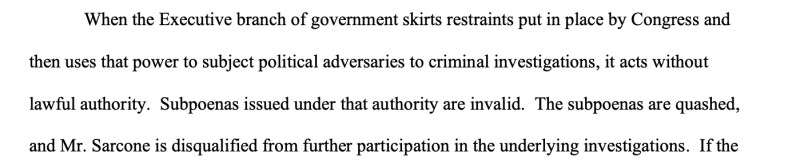
A federal judge in the Northern District of New York quashed subpoenas issued to New York Attorney General Letitia James by acting U.S. Attorney John Sarcone III, ruling that he was invalidly appointed by the Trump administration:
Screenshot
The judge also barred him from any further involvement in the James cases “regardless of his title.” The ruling adds to the list of disqualified U.S. attorneys in New Jersey, California, and Nevada (plus the Eastern District of Virginia on slightly different grounds), as judges thwart Trump’s effort to bypass Senate confirmation and the law that gives judges the power to appoint interim U.S. attorneys after their initial terms expire.
You Can Tell It’s an Election Year
The signs are real — though they may be fleeting — that Republicans on the Hill are not in lockstep with President Trump to the same degree that they have been for the past year:
The Senate — with five GOP defections — voted to block further military action in Venezuela. Trump blasted the defectors by name, saying they “should never be elected to office again.”
The House — over objections from Trump and Speaker Mike Johnson (R-LA) — passed a clean three-year extension of Obamacare subsidies, with 17 Republicans defecting.
Senate Votes to Display Jan. 6 Plaque
With Speaker Mike Johnson (R-LA) still refusing to abide by a 2022 law honoring the officers who defended the Capitol on Jan. 6 — burying the commemorative plaque, still in its crate, in the basement of a House office building like the closing scene of Raiders of the Lost Ark — the Senate votedunanimously yesterday to hang the plaque on its side of the Capitol until it “can be placed in its permanent location.”
The Attack on Higher Ed
Austin Peay State University in Tennessee has reinstated a professor fired for a social media post in the wake of Charlie Kirk’s assassination and agreed to pay him $500,000 to settle the case.
Texas A&M’s new policy restricting classroom discussions of race and gender will adversely affect some 200 courses in the College of Arts and Sciences and has already claimed Plato as an early victim.
Ballroom: Updated plans for President Trump’s vanity ballroom indicate that it will be as tall as the White House itself, a disproportionate architectural monstrosity. A one-story addition to the West Wing colonnade is also under consideration, the project architect told a planning commission.
What a Legend
A whimsical end to a brutal news week, featuring a mailman with absolutely the best sense of humor:
Hot tips? Juicy scuttlebutt? Keen insights? Let me know. For sensitive information, use the encrypted methods here.
People who don’t like Donald Trump are kinda gun-shy talking about turning points. Turning points of course can mean very many things. But as I watched first the videos of the murder of Renee Nicole Good and even more the official reactions to it I’ve started to think that we’re in the process of seeing one. I don’t mean Donald Trump is doomed politically, though perhaps he is. I mean a turning point in the public perception of ICE (and the Border Patrol) and their newly hyper-militarized role in American cities beginning last summer.
What we see in the videos of Good’s shooting is some mix of a moment of confusion or perhaps minor panic on the part of Good as the driver. And we see this ICE agent draw his weapon in a fairly calm and methodical way and fatally shoot Good in the face.