County Attorney Will Seek Death Penalty for Alleged Charlie Kirk Killer Tyler Robinson

Tyler Robinson, a 22-year-old from Utah, was charged with seven counts on Tuesday afternoon for allegedly shooting right-wing influencer Charlie Kirk at Utah Valley University last Wednesday.

Utah County Attorney Jeff Gray held a press conference, during which he read aloud from the charging documents. Those documents are available here, and include an alleged text exchange in which Robinson confessed to his roommate that he had killed Kirk, and discussed his attempts to retrieve his weapon later that day.

Robinson had his first court appearance virtually from the jail Tuesday evening, during which the judge said he’ll be assigned a lawyer. He is being held without bail.

Was Robinson a Big Left Winger? That’s Not What the Evidence Says.

We’ve now heard the first official word about the murder of Charlie Kirk as part of the official charges brought against him today. I want to reiterate a point I made yesterday. Despite the concerted effort to portray Tyler Robinson as a proponent of “left-wing ideology,” as Kash Patel put it, that’s really not clear at all from the evidence contained in the charging documents. What we have in there are mostly statements from Robinson’s mother to the police that he “had started to lean more to the left” over the last year and become “more pro-gay and trans-rights oriented.”

I want to point you to a report from Ken Klippenstein, who got access to parts of the much-discussed Discord channel that Robinson and fellow gamers spent time on. Klippenstein’s report sheds more light on Robinson and his milieu than basically anything that’s appeared in the mainstream press over the last week. I really recommend you read it. There’s no bombshell. Just a general impression of the guy. But still very revealing.

Continue reading “Was Robinson a Big Left Winger? That’s Not What the Evidence Says.”

5 Points on Trump’s High-Stakes Onslaught Against Fed Governor Lisa Cook

An appeals court ruled late Monday that Federal Reserve Governor Lisa Cook could not be fired by President Donald Trump while his administration’s legal claims against Cook continue to play out in court.

Continue reading “5 Points on Trump’s High-Stakes Onslaught Against Fed Governor Lisa Cook”

Trump Loses Bid to Keep Lisa Cook off the Federal Reserve

A lot of things happened. Here are some of the things. This is TPM’s Morning Memo. Sign up for the email version.

Appeals Court Backs Lisa Cook … for Now

In a late night ruling, the D.C. Circuit Court of Appeals declined to block a lower court order that reinstated Trump-target Lisa Cook to the Federal Reserve Board. The decision, less than 48 hours before an important meeting of the Fed, sets up a likely race to the Supreme Court by the Trump administration.

In a 2-1 decision, Biden appointees Bradley Garcia and J. Michelle Childs ruled that Cook was likely to prevail on the underlying appeal. They were especially focused on the lack of due process given to Cook. Trump appointee Gregory Katsas dissented.

The decision came the same day Senate Republicans confirmed Trump White House official Stephen Miran to the Federal Reserve Board. Miran is not giving up his White House post to serve on the ostensibly independent Fed. Senators were racing to confirm him ahead of the same Wednesday meeting of the Fed that Trump is trying to block Cook from attending.

Meanwhile, Reuters turned up yet more information that confirms Trump’s mortgage fraud claims against Cook are a bogus pretext for bringing the Federal Reserve to heel. After reviewing records at Reuters request, the property tax authority in Ann Arbor, Michigan, said that Cook hasn’t broken rules for tax breaks on a home there that she declared her primary residence.

For Your Radar …

Longtime federal prosecutor Maurene Comey, the daughter of former FBI Director James Comey who was fired by the Trump administration without cause or explanation, has filed a well-crafted wrongful termination lawsuit alleging she was retaliated against because of her father and/or the perception of her own political beliefs.

Comey was prosecuting major cases in the Southern District of New York when she was abruptly terminated in July. Among the defendants she named in the lawsuit: the Justice Department, Attorney General Pam Bondi, and the Executive Office of the President.

Comey’s case will be an important one to watch as the lawless Trump DOJ purge of career prosecutors and investigators is challenged in court.

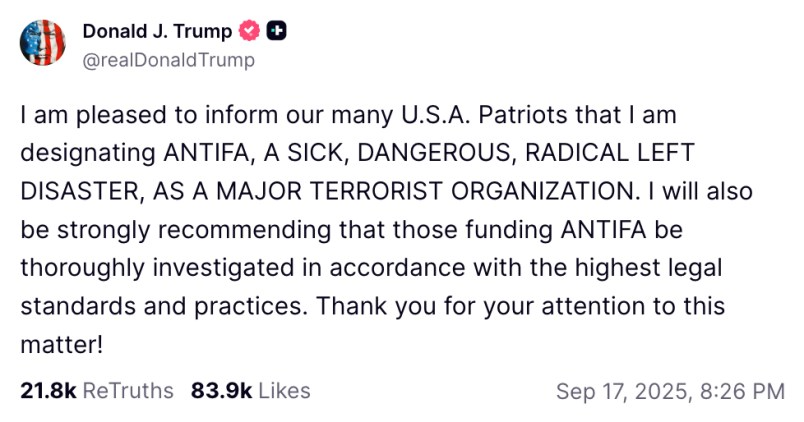
When Every Political Foe of Trump Is a Terrorist

The labeling of all the political foes of President Trump as terrorists and falsely ascribing bad acts to them is a searing threat to democratic life whose historical analogues are universally sobering:

Stephen Miller: “We are gonna channel all the anger we have over the organized campaign to led to this assassination to uproot & dismantle these terrorist networks … we are going to use every resource we have at the DOJ, Homeland Security & throughout this govt to dismantle & destroy these networks"

Aaron Rupar (@atrupar.com) 2025-09-15T17:43:59.400Z

Quote of the Day

HuffPost’s Paul Blumenthal:

Conservatives’ efforts to blame some vague “they” for these attacks are not a slip of the tongue: It crafts a narrative of victimhood aimed at enacting retributive repression or violence against their political opponents. This is made explicit in calls to indict billionaire liberal donor George Soros, investigate and dismantle liberal nonprofits and target media companies, none of which appear to have had any involvement, as a response to Kirk’s murder.

Trump Lawlessly Attacks Another Boat on High Seas

Three people were killed in a second U.S. attack on a boat in international waters off Venezuela that was allegedly smuggling drugs. No evidence was produced to bolster this claim. Trump touted the attack in raw terms on social media.

Former State Department attorney Brian Finucane has a new piece out prompted by the first attack earlier this month on why this is a dangerous departure from the Global War on Terror.

Trump Files Nuisance Suit Against NYT for $15 BILLION

In an absurd defamation lawsuit filed in federal court in Tampa, Florida, President Trump is claiming billions of dollars in damages from the NYT coverage of him, citing numerous stories. The 85-page complaint reads like a survey of a wounded man’s fragile ego.

Chutkan Says She Has No Jurisdiction in Ghana Case

U.S. District Judge Tanya Chutkan of Washington, D.C., overnight refused to intervene in the case of the Trump administration using Ghana as middle man to re-deport migrants to their home countries because U.S. law prohibits them being sent there directly. Chutkan deplored the administration’s conduct but ultimately concluded she did not have jurisdiction to intervene in the case.

Trump’s Great Whitewashing of American History

The Scourged Back. The scarred back of an African-American slave named Gordon who escaped from Mississippi and reached a Union Army camp in Louisiana in 1863. The photograph is attributed to two photographers, McPherson and Oliver, who were in the camp at the time. It became one of the best known photographs of the Civil War and a powerful weapon for abolitionists. Gordon served in the Union army African American regiment and reached the rank of sergeant. (Photo by: Ken Welsh/Design Pics/Universal Images Group via Getty Images)

A print of the “The Scourged Back” is among the many signs, exhibits, and educational tools reportedly being removed from national parks by the Trump administration as part of a sweeping revisionism of American history that blots out the often excruciating experiences of people of color.

Another Shining Moment for the Roberts Court

At the Supreme Court, it’s open season on trans rights, TPM’s Kate Riga reports.

Robert Redford, 1936-2025

Robert Redford during 2002 Sundance Film Festival – Filmmakers’ Brunch at Sundance Rehearsal Hall in Sundance, Utah, United States. (Photo by George Pimentel/WireImage)

The movie icon and independent film cultivator died early this morning at his home in Utah.

Do you like Morning Memo? Let us know!

Keep An Eye on What We Know (And Don’t)

This is kind of a secondary issue. But it’s important to focus on for a number of reasons. In the past, generally speaking, you could use formal communications and background briefings from federal law enforcement, within important parameters, as a guide to the state of an investigation. It’s a given that they would be sure to make you think that whoever they thought was guilty was definitely guilty. They could also be relied on to speak in the institutional interest of their department or agency. But for a general understanding of what an investigation had uncovered, you could learn a lot from it, so long as these critical points of skepticism were borne in mind. Federal law enforcement, certainly off the record, could also often provide some constraint or filter on what the administration was saying. My point isn’t to romanticize the old system. But it was, from a journalistic perspective, often a key source of information.

In the current environment I think it’s fair to say there’s really no reason to believe anything we’re hearing from federal law enforcement, either formally or on background to reporters.

Continue reading “Keep An Eye on What We Know (And Don’t)”

Trump and Vance Use Kirk’s Killing to Announce Ominous Plans to Investigate ‘the Left’

In remarks to the media on Sunday, President Trump made it clear he will continue to use the assassination of right-wing activist Charlie Kirk as grounds to investigate those he sees as his political foes. In fact, he suggested, that work is already underway.

Continue reading “Trump and Vance Use Kirk’s Killing to Announce Ominous Plans to Investigate ‘the Left’”

Republicans Are Using an Arcane Oversight Rule to Permanently Dismantle Federal Land Protections

This story was originally published by Grist. Sign up for Grist’s weekly newsletter here.

In the spring of 1996, lawmakers quietly buried a rider in a humdrum bill meant to make life easier for small businesses. That addition, the Congressional Review Act, granted Congress the power to kill new federal regulations with a simple majority vote. Thirty years later, Republican lawmakers are wielding it to quietly upend how the country manages public lands. 

One of the act’s sponsors was Ted Stevens, an irascible Republican from Alaska. Known on Capitol Hill for his temper and the Incredible Hulk tie he sometimes wore, Stevens framed the measure, known as the CRA, as a way to reclaim legislative authority from an overreaching executive branch. Stevens soon collided with scandal: He and other Alaska politicians proudly dubbed themselves the “Corrupt Bastards Club,” after a federal investigation uncovered cash bribes and secret tapes of debauchery with oil executives. The saga exposed the sway that extractive industries hold over political decision-making — a grip soon to tighten as lawmakers use Stevens’ law to wipe out federal land-use plans nationwide. The Congressional Review Act allows Congress to overturn rules finalized in the previous 60 legislative days with a simple majority. This prevents federal agencies from ever creating similar regulations. In its first two decades, the oversight law was used just once. But when Donald Trump took office in 2017, a Republican-led Congress swiftly used the CRA to repeal 16 Obama-era regulations, ranging from environmental protections to labor and financial rules. (Congress also used it three times during President Biden’s first term.)

Now, conservatives want to use it to advance President Trump’s extraction agenda in a way that tests the bounds of the law. In July, Alaska Representative Nick Begich proposed a bill to overturn the federal management plan for 13 million acres — an area four times the size of New York — across his state’s northwest flank. The region includes land near the proposed Ambler road, which would cross 211 miles and through Gates of the Arctic National Park to mineral deposits. The plan provides environmental protections for important salmon spawning grounds, where runs have recently dwindled, and critical caribou habitat. 

The move comes amid an ongoing campaign by the Trump administration to radically remake how the nation’s resources are managed. The Bureau of Land Management, for example, just announced plans to rescind a Biden-era rule that placed conservation on equal footing with other uses of federal land. It also follows nationwide outcry over a proposed giveaway of public lands; Representative Ryan Zinke, who opposed the transfer of Western lands this summer, nevertheless voted in favor of the Central Yukon’s resource management plan. (Zinke did not respond to requests for comment.)

Begich made clear that he intends to streamline development of the region. “It is federal overreach that is ensuring that Alaska’s wealth stays in the ground, unavailable to the people of one of America’s most impoverished regions,” he said on the House floor. 

The Bureau of Land Management finalized Central Yukon’s latest resource management plan last year after more than a decade of extensive public engagement involving tribes, local communities, and state and federal agencies. It concluded that over 3 million acres should be considered areas of critical environmental concern, and protected. Contrary to Begich’s claims, Alaskans largely supported this decision. The process cost the federal government $6.7 million. Ignoring it, said Mollie Busby, who lives in the affected area in the small town of Wiseman, ignores the voices of those directly impacted by the plan. She worries that without the plan’s protections, the natural resources her family and neighbors depend upon will disappear. “This plan should not be overturned on a whim by Congress,” she said. 

Should the legislation — which passed the House on September 3 and is now before the Senate — become law, resource management plans nationwide could be at risk. Republican lawmakers have introduced bills to upend plans regulating fossil fuel and mining in the Powder River Basin in Montana, and swaths of North Dakota. “We are in uncharted territory here,” Representative Sarah Elfreth, a Democrat from Maryland, said during a House Rules Committee hearing in July. “Congress has never used the Congressional Review Act to overturn a resource management plan, or any other similar land use plan in our history.” 

Because the Department of the Interior has never considered these plans eligible for review under the CRA, it never submitted them to Congress. The CRA requires that before a “rule” can take effect and the 60-day look-back period begins. After the Government Accountability Office, or GAO, determined in June that the Central Yukon resource management plan qualifies as a “rule,” Congress may now rescind it. This precedent may unravel decades of land policy. “Hundreds of resource management plans that have been finalized since 1996 will never have technically taken effect,” says Justin Meuse, government relations director for The Wilderness Society. That, he said, calls into question everything built on them — “oil and gas leases, drilling permits, rights of way, timber allotments.” 

The likely result, he argued, is a cascade of uncertainty for the industries Republicans champion. “It should be scary to oil and gas companies, to anybody who farms, grazes, or uses timber on public lands,” Meuse said. A letter sent to Congress by 31 law professors concludes the move “threatens to paralyze public land management nationwide.”

This summer, the GAO also determined that the Biden’s administration’s 2022 decision to close 11 million acres of Alaska’s National Petroleum Reserve to oil leases was subject to the CRA, opening it up to repeal. By pushing the CRA beyond its customary look-back window, lawmakers could begin unraveling hard-won protections long after they were thought secure.

Meuse called these determinations a dangerous expansion of the Congressional Review Act’s scope, one that may have sweeping implications beyond conservation. “We’re seeing the CRA being applied much, much more broadly than we ever have before,” he said. Other federal agencies — such as the Environmental Protection Agency or the Department of Transportation — could face challenges to long-standing regulations never previously treated as “rules,” potentially sparking litigation and halting years of carefully planned programs.

As the House passed Begich’s bill to repeal the Central Yukon plan in early September, Jack Reakoff watched in disbelief. A longtime Wiseman resident, he fears scuttling the plan will open the door to a transfer of federal land to the state. 

The lands at stake are not empty wilderness, as they are often portrayed, but a vibrant network of rivers, migration corridors, and food for residents. They are managed for a variety of uses under federal rules that prioritize rural food security, and give those communities a voice through the Federal Subsistence Board. The 2024 Central Yukon plan maintained federal oversight over millions of acres, including federal subsistence protections for residents like Reakoff that are not allowed under the state constitution. 


The use of the CRA is just one of many avenues the state is pursuing to seize control of millions of acres of federal land to benefit extractive industries. Bruce Westerman, a forester and the chair of the House Committee on Natural Resources, explicitly cited the Ambler Industrial Access road as a reason to overturn the management plan. The unpopular road, which the Biden administration scuttled, would threaten North America’s largest protected region, disrupt caribou migration, and pollute waterways — while using state funds to subsidize a road that would primarily benefit mining companies.

“It is not all about Ambler and the utility corridor, but the entire district,” Reakoff says, adding that using the CRA “throws the baby out with the bathwater.” Reakoff says the state doesn’t have the resources to appropriately manage the lands it already controls, and he fears the state will open the area to ATVs that tear up fragile tundra and non-resident rifle hunting that could decimate wildlife already threatened by climate change. He’s also concerned about additional industrial traffic, and whether the state will have the budget to maintain the road. 

The Busbys, meanwhile, say using the CRA ignores the voices of many small businesses that currently have federal permits to access Gates of The Arctic, plunging their operations into limbo.

Legal experts remain uncertain about the broader implications of this unprecedented move. If the bill passes the Senate, where a vote is expected this week, it’s still unclear what will replace the 2024 plan. It could potentially revert to resource management plans approved in 1986 and 1991, over the objections of six tribal councils. It’s also uncertain what the CRA’s restriction on issuing a “substantially similar” plan may mean and could make crafting a modern replacement might never be possible.

This legal ambiguity carries serious consequences for communities across Alaska. Karma Ulvi, chief of the Native Village of Eagle, said the repeal threatens the ability of tribes to have a meaningful voice in managing the lands they rely on. “It’s going to have an impact on our culture, our food sovereignty,” she said. The central Yukon salmon populations have already crashed, she says, and mining or additional infrastructure could harm their chances of recovery. “Our Congressmen need to consult with the tribes, and ask how this could impact us,” she says. “I’m really afraid that the priorities now are just extraction and money.”

What Makes TPM TPM?

This is a post about TPM. So that’s just as a heads-up. It’s not about the news of the moment. It’s inwardly looking about this website.

On Friday, I did an interview tied to our 25th anniversary celebration. It should be out closer to the date of the anniversary in mid-November. Toward the end of the conversation, the interviewer asked me if I thought TPM had stayed true to the vision I originally had for it and, if so, what that was. I began by referencing a point I’d made earlier in the interview which was that it couldn’t be true to the original vision because I didn’t have any clear sense of what I was trying to do at the beginning. But pretty quickly I did. When I thought about the site and its continuity I realized there are three things that make up TPM. Oddly, in the interview, I only mentioned two of them. I probably just lost my train of thought. It was toward the end of an hour-long interview. But I wanted to share with you what those three things are.

Continue reading “What Makes TPM TPM?”

Kirk’s Posthumous and Paradoxically Fitting Employment Reign of Terror

I’ve written several times over the last few days not only about the scourge of political violence which we must not only denounce but be genuinely against in every way. Notwithstanding my own personal inclination to say little of the dead for a respectful period, I want to note a particular dynamic that the right is creating in the reign of firing terror it’s unleashed in the aftermath of Kirk’s death. On X over the last few days, countless numbers of high-profile right-wing accounts’ feeds are made up almost entirely of screen grabs of random people’s reactions to Kirk’s murder and demands that they be fired from their jobs. In many cases the demands are heeded and then that fact is triumphantly posted as well.

Continue reading “Kirk’s Posthumous and Paradoxically Fitting Employment Reign of Terror”