


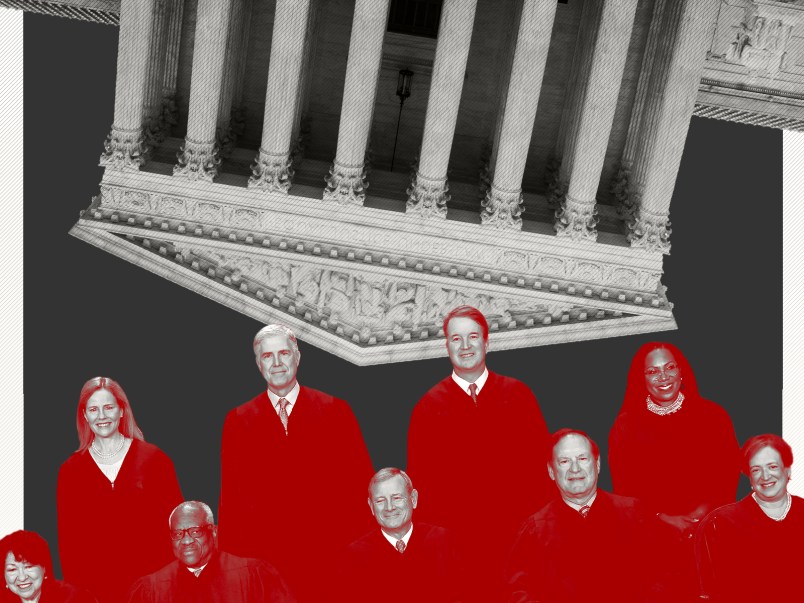
Sensing an opportunity, red states have passed a tranche of anti-trans laws, gunning to get some of them before the Supreme Court.
There, they hope to win permission to discriminate against trans people even more broadly, as they goad the Court to state decisively that trans Americans do not get heightened legal protections.
The cause for this right-wing salivation lies in the resolution of the big trans rights case last term — U.S. v. Skrmetti. The conservative majority found that a Tennessee law banning gender-affirming care for minors was not subject to heightened review under the Equal Protection Clause. In other words, despite the ban applying only to trans minors (other minors were free to pursue the exact same medical treatment for diagnoses like precocious puberty), Chief Justice John Roberts wrote that the law did not discriminate based on sex. The Court then decided that the law satisfied the lowest level of constitutional review.
In that decision, Justices Amy Coney Barrett, Clarence Thomas and Samuel Alito said explicitly that they don’t think trans people constitute a suspect class, or a category of people that has been historically discriminated against and deserves greater protection from laws targeting it.
“The Sixth Circuit held that transgender individuals do not constitute a suspect class, and it was right to do so,” Barrett wrote unequivocally.
Combine those cheery tea leaves for the anti-trans right with Justice Neil Gorsuch’s profound silence on the case: The justice who joined with Roberts to find that Title VII forbade discrimination against trans people in the workplace in 2020 was nowhere to be found, staying mum during oral arguments and wordlessly joining the majority in Skrmetti.
Having notched a significant win on banning trans health care for minors, the anti-trans states are now targeting the other fracture point in the debate where the public is mostly on their side: trans girls in sports.
There has been a significant shift in public opinion over the last three years in favor of increasing restrictions on trans people, a change inextricably linked to its greater salience in right-wing (followed by mainstream) media and Republican governing. Pew reported that, since 2022, significantly fewer people now support trans girls playing on girls’ sports teams, trans minors being able to access gender-affirming care and trans people using whichever bathroom matches their identity — all popular right-wing talking points.
The Court took up a staggering two cases born of trans girls and women this term — one in middle school and one in college — fighting for an exception from their states’ bans to play on girls’ sports teams at their schools. Neither is an elite athlete. In the case out of Idaho, Lindsay Hecox has recently dropped her initial suit, volunteering to quit her recreational sports teams at Boise State University due to “negative public scrutiny” the case has brought upon her. The state has yet to respond to her motion to moot the case.
Even if the case is dropped, though, a parallel one out of West Virginia is still currently live. The medical nuances will be even more complex in that case as lawyers for B.P.J. — the trans middle school girl at its center — write that she never went through male puberty, likely negating the supposed physical advantages for trans women over cisgender ones. Ignored by the Supreme Court, her lawyers pointed to that medical murkiness as a reason for the Court to butt out until the lower courts develop a larger body of expert-based evidence and testimony. The Court took up the case anyway. West Virginia is asking whether either the Equal Protection Clause or Title IX prohibits its law that segregates sports teams by biological sex at birth.
If, as it seems poised to, the Court’s majority rules that trans people do not belong to a protected class, red states will quickly write restrictions into law beyond the subtopics where they enjoy greater public support, even more than they already have. The right is well-versed in this technique, having publicly focused on the more sympathetic entry points of parental consent for minors and women’s physical and emotional safety in its quest to legislate abortion out of existence.
In a docket already notably full of anti-LGBTQ assaults, the Court also made time for a challenge to Colorado’s conversion therapy ban for clients under 18. There, Kaley Chiles, a licensed professional counselor backed by the major right-wing legal group Alliance Defending Freedom, argues that the ban violates the Free Speech Clause.
Conversion therapy is a discredited, often brutal practice to “turn” LGBTQ people “straight.” Roughly half of the states have similar laws to Colorado’s.
Lawyers for Chiles argue that the ban infringes on her speech rights, and should thus be reviewed under strict scrutiny, the hardest level for a law to survive. Colorado counters that it’s not pure speech, but professional — medical — conduct, which the state has always had the right to regulate. And even if it is reviewed under strict scrutiny, the state argues, the law would stand anyway.
“The Court should review Colorado’s law under a rational-basis standard, but it satisfies any level of scrutiny,” the state wrote in its brief. “The State’s interest in protecting minors from ineffective and harmful healthcare practices is of the highest possible order.”
The Court’s docket will fill further when the new term begins, likely with many cases stemming from the Trump administration’s dismantling of the federal government, its imposition of armed federal troops in blue cities, its extralegal ICE raids and detentions. And for many terms now, the Court has embraced its role as frequent culture warrior on the topics that most inflame its political allies, dealing them wins on gun rights, abortion restriction and the disenfranchisement of minorities. But this term’s focus on anti-LGBTQ, specifically anti-trans, attacks reveals the extent to which the Court is walking in ever-tighter lockstep with the cultural right and devoting precious docket space to its current fixations.




It’s bad enough that we have a president who is damaged by Adderall addiction and showing signs of dementia and Alzheimer’s disease. His anti-American acts of sweeping people off the street, including citizens and disappearing them to Africa and who knows where else without due process. Sending the American army to American cities in opposition to the wishes of mayors in those cities.
Not supporting NATO allies in their wish to avoid Russian aggression. Doing everything but an armed take over of the US Central Bank with his attacks on the federal reserve. Whipping up hatred in the hours and days, and probably weeks after this recent assassination of an extremist influencer with a large political action committee.
Not to mention the entire Fox News, listening half of the country now wagingwar on trans citizens, despite them being peaceful and good citizens. I’m sure they pay more taxes than many billionaires. The connection to the Salt Lake City shooter is about as thin as it gets.
It is not just this president, but his entire administration. And enabled by US House of Representatives and Senate. Majority of the US Supreme Court is supportive for what he is doing and says that if the president does it, it’s legal. A supreme court that issues shadow docket rulings with no opinion, explaining reasons for president overturning decisions. And then tells lower courts that they must rule as SCOTUS did, without explaining why SCOTUS ruled such as they did. And if they don’t rule as SCOTUS would, that such a grievance act could be compared to contempt of the Supreme Court
It would be bad enough if it were just the president. With the whole of the federal government, tearing down the federal government, institutions, and now free speech and the rest of the US Constitution, I don’t see our country’s way out of this. Why, oh why was he reelected after the negligence and the malfeasance of the first administration?
“Privilege is presuming to speak for others you know nothing about.”
― DaShanne Stokes
Well said!
Tax free status for religious organizations is state sponsorship of ALL religions, not an express lack of endorsement for one.
The First Amendment has been ignored completely in this regard. Of course, in those days, there were just Protestant churches - except for Maryland.
How can a church that claims that Jesus wants you to be rich pass even the slightest of smell tests? Tax-free status means support of the establishment, that is, the generationally wealthy.
The church has been pimping for the rich since God had the body of a man and the head of a dog.
And Rhode Island (a general religious sanctuary colony which included Catholics) and Pennsylvania (a more specifically Quaker sanctuary colony)–people often forget that there were serious disputes in the UK/England within the nominally “Protestant” groups. There was the “High Church” vs. the “Low Church” conflict (which was the largest conflict) but there were lots of smaller groups that everybody loved to hate on (like Quakers).