Jon Cohn has a good piece in The Bulwark on the challenges ahead for Abdul El-Sayed. The “brutal path ahead,” Jon calls it. I’ll note here that Jon is based in Michigan, despite beginning his journalism career in the East Coast cities where most political journalists are based. (In other words, his report isn’t based on parachuting into the state for a few weeks.) He notes the two, equally accurate narratives coming out of this primary battle. El-Sayed built a potent and victorious movement. Sanders-style progressive Democrats seldom win these contests in purple states. El-Sayed did. And he did it in the face of concerted opposition from the state’s Democratic establishment, the national establishment and an ocean of outside money, mostly from AIPAC.
It’s also true that Republicans will now run a viciously Islamophobic campaign against him, which will get extra traction from his association with the willfully inflammatory Hasan Piker. There’s another dynamic we’ve seen across numerous establishment-progressive battles. The Platner campaign pitched itself as appealing to working class or at least culturally working class voters who are usually unreachable by Democrats. But the polling showed that the demographic profile of Platner’s supporters looked pretty similar to what most Democrats have gotten over the last couple decades, and especially since Trump — the educated and affluent. The loose outlines of El-Sayed’s victory in Michigan look similar. Both make a pitch about young voters but they tend to appeal most to educated and downwardly mobile voters — so again, another version of standard early 21st century Democratic coalition.
Introducing America to ‘Abdulrahman Mohamed El-Sayed’
It’s not at all surprising, but it was nonetheless quick: With the Michigan Democratic primary over, Republicans are trying to reap whatever they can from drawing an opponent in a crucial state for Senate control who has a foreign-sounding name.
“I spent years hunting terrorists and bringing Osama bin Laden to justice,” said his opponent, Mike Rogers, in a statement. “Never in a million years did I think that I would be running against someone who believes America deserved 9/11.”
It’s unclear where exactly Rogers hunted terrorists — though he served in the military in the ’80s, he was in Congress in the years after 9/11. Twitch streamer Hasan Piker, not El-Sayed, said America “deserved 9/11” before apologizing.
The National Republican Senatorial Committee made a point of calling him by his full name, “Abdulrahman Mohamed El-Sayed,” and put out a statement by Sen. Tim Scott (R-SC) claiming El-Sayed supports “terrorist organizations.” “An alliance of communists and Islamists is taking control of the Democrat party,” the Senate Republican Conference posted on social media.
In an interview last night with MS Now, El-Sayed was asked directly about the attacks and offered an optimistic take on the electorate. “Of course, he’s going to do the same thing that MAGA always does, which is try to divide us,” he said of Rogers.
“I know that Michiganders are open-minded,” he continued. “They’re big-hearted. They’re less interested in how you pray than what you pray for. And we all pray for the same things. We want what’s good for our kids and our families. We want clean air, clean water, healthcare we can afford.
“So they’re going to use Islamophobia because their ideas are tired, their economy sucks. They’re taking us to a war we shouldn’t fight. And we have an opportunity to actually focus on bringing us together.”
As Nicole LaFond noted last night and Khaya Himmelman will have more on today, another predictable aspect of the GOP’s response to Tuesday’s election has been to undermine its validity. As much as the election denial-tinged freakout around California seemed half-baked — did reality star turned Los Angeles mayoral candidate Spencer Pratt ever really have a path? — the Michigan discourse on the right is transparently aimed not at any particular outcome (it’s a primary contest between Democrats, after all) but more broadly at sowing distrust. “Anyone want to bet that when the mail in ballots come in in Michigan there will be a HUGE surge for Haley Stevens?” Sean Spicer said in one representative social media post echoing the president. It was an assertion that Democrats somehow manipulate elections to reach their preferred outcomes, a necessary conspiracy theory to breathe life into ahead of whatever Trump may try in November.
One of the Weirdest, Loudest Members of Congress Faces a Primary Challenge
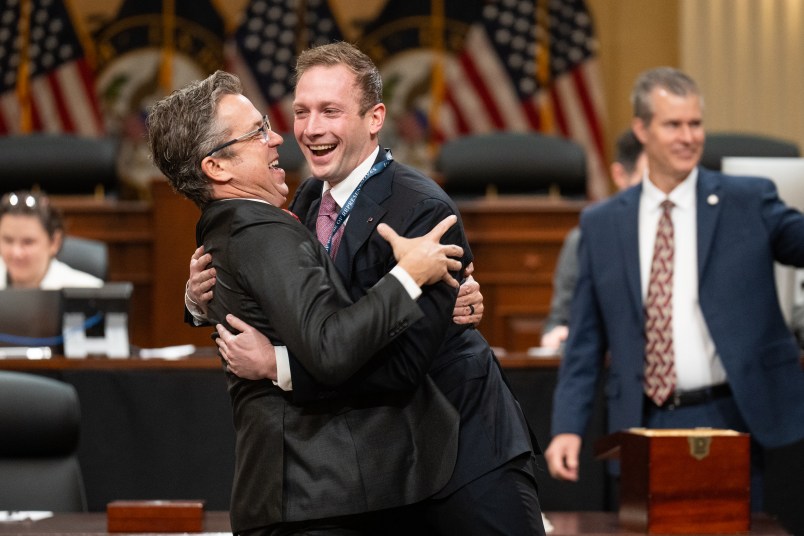
UNITED STATES – DECEMBER 2: Rep.-elect Max Miller, R-Ohio, right, is hugged by Rep.-elect Andy Ogles, R-Tenn., after drawing the number one pick in the House new member room lottery in the Cannon House Office Building on Friday, December 2, 2022. (Bill Clark/CQ-Roll Call, Inc via Getty Images)
Rep. Andy Ogles (R-TN) — who you may know for his legislation seeking to denaturalize and deport New York Mayor Zohran Mamdani, or for his lies about a six-figure personal loan to his campaign that drew comparisons with George Santos, or as the man seeking to amend the Constitution so Trump (but not Barack Obama) can run for a third term — is facing a primary challenge today.
Former Tennessee Agriculture Commissioner Charlie Hatcher (R) has raised more money than Ogles and has the endorsement of Governor Bill Lee (R), The Downballot reports. Ogles has Trump’s endorsement.
There is scant polling of the race, but Ogles seems to have a small lead.
Trump’s subservient Department of Justice did Ogles a favor, too: Immediately before a new gerrymander of the state — primarily seeking to deny Black voters the ability to pick their own candidate, but also drawing Ogles a largely new district with a different electorate — it said it would drop an investigation into whether he committed campaign finance fraud and return or destroy the evidence it had collected.
Tabs
Perhaps surprisingly, the U.S. greenhouse gas emissions are projected to fall — not, of course, because of anything the federal government is doing, but due to increased reliance on cleaner (if not always entirely clean) fuels.
Trump speaks often with his new Fed chair, Kevin Warsh, the Wall Street Journal reports — an encroachment on the Fed’s independence.
Man of the Hour
It’s Tom Smith, who won his primary race in Michigan despite having suspended his campaign in July; Trump’s preferred candidate, Amir Hassan, came in second. The candidate Smith endorsed, Al Lemmo, came in third. Lemmo speculated to the New York Times that Smith won because of his “plain-Jane American name.”
Are We at War?
Yes, and Trump is mad that we’re running out of munitions. And mad that we know he’s mad that we’re running out of munitions.
This book excerpt is part of Cafe, TPM’s home for opinion and news analysis.
For most of human history, trying to identify an oligarchy has been difficult. Part of that has to do with the definition of the term “oligarchy” in the first place. Aristotle first popularized the word thousands of years ago, pointing out that an oligarchy — which literally means “rule of the few” — is indeed all about a small number of individuals steering a given country, nation, or empire. But even then, Aristotle added, it wasn’t just about the number of individuals that mattered, but also about how much wealth they controlled. In order to have an oligarchy, a state had to be run not just by the few, but by the wealthiest few.
The other part that’s made “oligarchy” such a tricky thing to define is that, for centuries, oligarchic figures tended to operate out of sight, or by playing down their impact on politics. Not always, necessarily; the so-called “robber barons” of the Gilded Age — oligarchs by another name — were front and center in American society in the late 19th and early 20th century. But by and large, oligarchs tended to downplay their influence, and even their wealth. Since they could operate as the powers behind the throne, they tended to keep themselves (and their wealth) out of the spotlight, making it even trickier to nail down who an oligarch actually is, or what oligarchy looks like when it’s taken over a democracy.
Those two factors — the difficulties in defining “oligarchy,” and the struggles in identifying oligarchs themselves — made analyzing the topic, let alone writing a book about it, an uphill battle.
And then, in January 2025, all of that changed. Because there, in the U.S. Capitol, as President Donald Trump once more swore the oath of office for the presidency, stood a suite of men, just off to the side, all standing in a row. They looked out over the audience, smiling in their suits. In that moment, those figures — Elon Musk, Mark Zuckerberg, Jeff Bezos, and a small number of others — made oligarchy impossible to miss. Looking out at a man they’d propelled back to office — at a man who would usher in not only the most corrupt administration in American history, but who is himself oligarchy made flesh — they forced Americans to an inescapable realization. We’d once, as a country, had a Gilded Age. But now, with more wealth inequality than ever prior, and with more power concentrated in the hands of a small number of select men, we have something else: the Age of Oligarchy.
In the wake of now-Michigan Senate candidate Abdul El-Sayed’s narrow victory over the Democratic establishment-backed candidate Rep. Haley Stevens in Tuesday’s primary, President Trump is back to his old ways, giving a platform to MAGA conspiracy theories about how Detroit runs its elections.
We’re now over 80% of the way toward this year’s goal in our Annual TPM Journalism Fund Drive. We need your help to get to the final goal, at least $500,000. Right now we’re at $423,276. If you’ve been meaning to contribute but haven’t found the right moment yet, now is definitely that moment. Please take just about 90 seconds this moment and join us. Click right here. You’ll truly be glad you did and will have our undying appreciation.
Missouri Republicans have been transparent about their strategy to drag out the response to a challenge to their new 7-1 congressional map, with state Attorney General Catherine Hanaway (R) saying publicly during a radio interview earlier this year that “delay works in our favor.”
While most of the reflecting pool coverage focuses on the reality TV-style palace intrigue among the ridiculous personas of Donald Trump, Jeanine Pirro, and Doug Burgum, pay attention to how hard the former criminal defendants in the now-dismissed “vandalism” cases push for court-ordered consequences for the misbegotten prosecutions.
As a first step, attorneys for David Hearn are asking a judge to dismiss the case with prejudice, which would keep Pirro from recharging him later. Pirro has sought to dismiss the charges without prejudice and keep her options open.
They take particular exception to Pirro’s claims that prosecutors were not aware of the fatal flaws in their case until shortly before they moved to dismiss the case. They provide a timeline of what prosecutors learned as the case unfolded that challenges the sequence of events Pirro provided the court in her motion to dismiss.
As Empty Wheel’s Marcy Wheeler notes, Hearn’s counsel also suggested to the judge in the latest filing that the court could still revisit their pending request for the grand jury materials — or review them in chambers.
There are also three other similar cases Pirro is trying to dismiss, as she tries to point the finger at Burgum and the Interior Department, save her job, and avoid court-ordered sanctions or ethics reviews.
And yet … I realize the palace intrigue has some appeal, so here you go:
NYT: Inside the Oval Office Showdown Between Trump and Jeanine Pirro
Politico: Jeanine Pirro struggles to give Trump the wins he craves the most
WSJ: Pirro’s About-Face in Pool Case Followed Prosecutors’ Private Concerns
The Toll on the Federal Judiciary
U.S. District Judge John McConnell, the chief judge in Rhode Island, goes on the record about the numerous threats he’s faced after issuing several important rulings adverse to the Trump administration.
McConnell was among the judges to have received unrequested pizza deliveries, as a way a warning “We know where you live.” In his case, the name on the pizza order was Daniel Anderl, the slain son of U.S. District Judge Esther Salas, who was killed by a disgruntled lawyer in an attack at the judge’s New Jersey home.
Jan. 6 Never Ends
U.S. District Judge Amit P. Mehta, reluctantly granting the Trump DOJ’s motion to dismiss the seditious conspiracy indictment against eight members of the far-right Oath Keepers militia, including Stewart Rhodes, all of whom were convicted but later had their sentences commuted by President Trump:
This is the last of the prosecutions seeking to hold accountable those responsible for the events of January 6. That book is now closed. Today’s epilogue diminishes the gravity of that day, denigrates the work of the prosecutors and law enforcement officers who secured these convictions, and excuses criminal acts that caused a centuries-long pillar of our democracy—the peaceful transfer of presidential power—to buckle. The court cannot write a different ending.
Profile in Courage Ducking for Cover
Facing a tough re-election in a key Senate race, Maine Sen. Susan Collins is being given cover by Senate Republicans to vote against the nomination of Todd Blanche for attorney general. She didn’t announce her opposition until after Blanche cleared the Senate Judiciary Committee yesterday. With two senators still officially undecided, there remains some faux drama around the confirmation, but Collins getting a get-out-of-jail-free card confirms where this is headed.
2026 Midterms Watch
Michigan-Senate: In a nail-biter that pre-election polling did a poor job of picking up on, Dr. Abdul El-Sayed eked past Rep. Haley Stevens in the Democratic primary. The race was too close to call for much of the night, but the AP has now declared the race for El-Sayed, who hold a 49-48 lead with 99% of the votes counted.
Missouri-01: In a rematch of the 2024 Democratic primary, Rep. Wesley Bell defeated former Rep. Cori Bush.
Virginia-05: Former Rep. Tom Perriello (D) won the Democratic primary to challenge incumbent Rep. John McGuire (R).
House GOP Scandal Update
Rep. Chuck Edwards (R-NC) has dropped his re-election bid in the aftermath of a cringey-as-hell House Ethics Committee report with excruciating details about his awkward and uncomfortable behavior toward two young women staffers in his office.
Rep. Max Miller (R-OH), who has been accused of abusive behavior by multiple women, including his ex-wife, the daughter of Sen. Bernie Moreno (R-OH), went on CNN to defend himself in an extended interview with Jake Tapper and, oh boy:
🤯 Rep. Max Miller's interview with Jake Tapper was one of the most self-destructive things I've ever witnessed on cable news. Here's the whole thing:
TPM’s Hunter Walker: Colorado Republicans Attack Jewish Gov Candidate With AI ‘Cartoon Devil Horns’ Graphic
Make America Wipe Again
From a NYT Mag profile of Dr. Sean O’Mara, whose dietary recommendations have been embraced by Vice President JD Vance, Health Secretary Robert F. Kennedy Jr., Commerce Secretary Howard Lutnick, and Transportation Secretary Sean Duffy:
“When you start eating healthy, you don’t need toilet paper,” he claimed. “Animals in the wild have no residual stool on their anus.” He described a proper bowel movement to me this way: odorless, wipe-free, over in three to seven seconds and “nearly orgasmic.”
“I could have a bowel movement behind a sheet at a dinner party in the corner of the room,” he said, “and nobody would know.”
I just can’t with this.
News? Tips? Feedback? Please let me know. For sensitive information, use the encrypted methods here.
Three Republicans were running in Michigan’s 8th Congressional District primary. Trump in June endorsed Amir Hassan, a Navy Veteran, former Guantánamo guard, and Department of Homeland Security official. Hassan was up against Thomas Smith, a retired engineer, and Al Lemmo, an anti-abortion activist. In July, Smith suspended his campaign and endorsed Lemmo, who had decried Hassan as a “possible Trojan Horse candidate and lifelong Democrat.”
On Tuesday, Smith, who was no longer running, won a pretty clean victory over his Trump-endorsed former opponent.
Though the AP called Abdul El-Sayed the winner of the Democratic nomination for Senate in Michigan as I went to publish this post, this race turned out to be much, much closer than people expected or what polls predicted. The margin ended up being just under 1% or about 15,000 votes. We become so entranced by polls that we often fall into thinking that a candidate like El-Sayed bobbled the race at the end or Stevens mounted a comeback. There may have been some late movement. But it’s important to remember that our narrative of the race was built around polls that were simply wrong. Very wrong. It was probably always much closer than people realized. Indeed, the margin is close enough that those polls might actually have shifted the outcome of the race by depressing Stevens’ turnout or juicing El-Sayed’s. It’s a good reminder that whether you’re a volunteer, a voter, an activist, or a campaign worker you play these things out till the very end. Polls are usually right. And they’re a good guide. Except when they’re not. And this was a big “except.”