

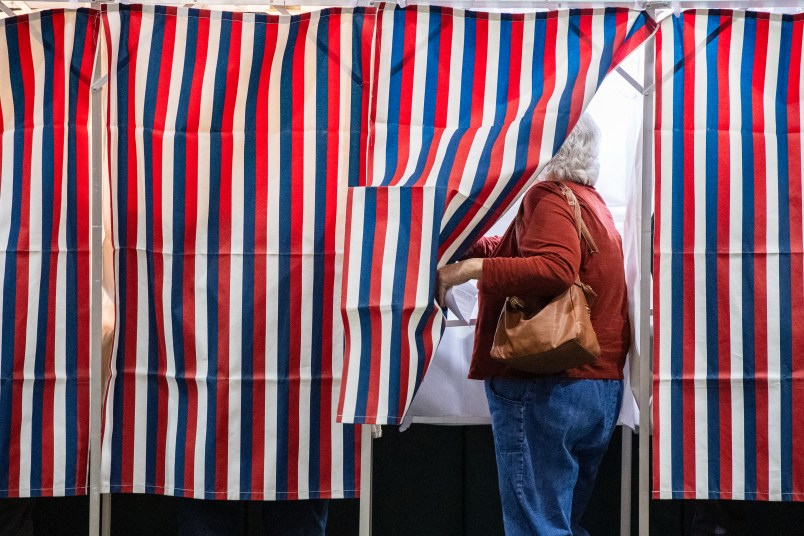
This article is part of TPM Cafe, TPM’s home for opinion and news analysis. It was originally published at Balls and Strikes.
Last Tuesday, early voting began in the primary elections to choose nominees for Texas’s upcoming U.S. Senate race. One of the Republican candidates for that Senate seat, Texas Attorney General Ken Paxton, marked the occasion by publishing a “legal advisory” informing Texans that a host of normal election activities are actually crimes.
Texas effectively makes it illegal for you to encourage people to vote for a particular person or proposal if you’re in the vicinity of a ballot. Under state law, any in-person interaction that occurs “in the physical presence of an official ballot or a ballot voted by mail” and is “intended to deliver votes for a specific candidate or measure” constitutes “vote harvesting services.” If you offer or receive “compensation” or some “other benefit” in exchange for such “services,” you face up to ten years in prison, and up to $10,000 in fines.
“Other benefit” is a broad term, and local civic organizations fear that the law may cover a broad array of interactions. If a campaign gives its get-out-the-vote volunteers free t-shirts to wear while door-knocking, both the campaign and its volunteers may have broken the law. If a voter gives those volunteers a few glasses of water so they can keep knocking on doors in the Texas heat, that voter may have broken the law, too. “Vote harvesting is a felony,” Paxton’s advisory warns, in bolded text.
Texas’s ban on canvassing voters is one of a slew of measures that Republican legislators enacted in response to President Donald Trump’s repeated false claims that widespread fraud cost him the 2020 election. Local civic organizations filed a lawsuit in 2021 arguing that the law infringed their free speech and was impermissibly vague, violating the First and Fourteenth Amendments. In September 2024, federal district court judge Xavier Rodriguez agreed and struck down the law, noting that the canvassing restriction didn’t solve an “actual problem.” Rodriguez, an appointee of President George W. Bush, also found that Texas “failed to offer any evidence” that canvassers were confusing or improperly influencing voters, and that there was no evidence that existing limits on mail-in ballot assistance were insufficient to root out the “few alleged instances of misconduct” in the state.
In other words, the district court found that Texas was stifling people’s core political speech and meddling in elections for no good reason. But earlier this month, the Fifth Circuit Court of Appeals reversed the district court’s decision. In LUPE v. Abbott, a panel of three Republican judges insisted that voter fraud is a huge problem that states have every right to solve by punishing voters and the people who assist them.
Judge Edith Jones, who was appointed by President Ronald Reagan, declared that mail-in voting is “unsurprisingly” a “rich field for fraud.” Joined by two Trump appointees, Jones, in the register of a conservative conspiracy theory email forwarded to you by your least pleasant extended family member, described “vote harvesting” as a scheme in which “operatives” prowl “targeted precincts” and persuade people to sign up to vote by mail—or, “more nefariously,” forge the applications themselves. Once voters receive the ballots “requested by canvassing or by forgery,” Jones continued, the operatives come back to collect and “ensure” that the ballots were cast for their preferred candidate. To support her claim that this is a serious problem, she contended that “72% of all election prosecutions undertaken by the Texas Attorney General” between 2004 and 2021 “involved mail ballot fraud.”
Jones cited no sources to substantiate any of these propositions. But in July 2021, Austin news outlet KVUE obtained a list from the Texas Attorney General’s office of alleged election law violations from 2004 onwards. The records show that, as of March 2021, the office had filed 1,044 election law charges, 724 of which were related to mail ballot fraud since 2004. This is about 69 percent. Seeing roughly 720 out of roughly 1000, one can understand how Jones may have arrived at the 72 percent figure.
One can excuse dubious arithmetic. But one cannot excuse a deceptive argument. Context matters, and context is what Jones’s opinion obscures. Data on the prevalence of mail ballot charges among voter fraud prosecutions provides no information about the actual prevalence of mail ballot fraud. Furthermore, a majority of the mail ballot fraud charges on KVUE’s March 2021 list—414 of the 724—were marked as “pending” prosecutions. Pending charges are unproven allegations, and provide no information about how much mail ballot fraud actually exists.
The number of cases marked “resolved” similarly provides no useful information about the prevalence of fraud if the number does not specify how those charges were resolved. An April 2022 version of the election violations tracker was filed as an exhibit in the case, for example, and shows four defendants who were charged with 134 felony counts. Their cases were “resolved” when they pled guilty to one misdemeanor each.
A passing glance at voting data in Texas over the past two decades shows just how misleading Jones’s statistic is. The district court opinion states that the Texas Office of the Attorney General prosecuted 401 counts—not cases—of election fraud between 2005 and 2022. In July 2021, Texas Representative Diego Bernal testified before Congress that there were only 154 prosecutions of voter fraud in Texas in the preceding 17 years, out of 94 million votes cast—several thousandths of one percent. You are more likely to be struck by lightning than Texas prosecutors are likely to actually convict anyone of voter fraud.
For decades, study after study has shown that voter suppression—not voter fraud—is the real threat to election integrity. Yet in LUPE v. Abbott, a panel of three Republican judges embraced the fiction, and empowered Republican legislators to do real harm to voters.





The Con’s on the 5th
CircusCircuit Court are determined to maintain the 21st Centaury version of poll taxes and literacy tests.My jaundiced suspicion is that “vote harvesting” charges will only be pursued against non-Republicans. And Paxton is a known crook. It speaks very poorly for the Texans (and Tejanos) who keep putting him back in office.
Figures don’t lie but liars can figure. Edith Jones is just a liar figuring.
I sometimes cringe when our proprietor Mr. Marshall characterizes entire courts as fundamentally corrupt, but some judges certainly are, and Edith Jones is their poster child. That previous Republican administrations seriously considered her as a Supreme Court nominee shows that the problem predates Trump.
Ah, the Reagan years. I had always thought Nixon was as low as the GOP could go. Then came the Bush years, and now, the disaster of this “administration.” Thanks, ignorant voters!