This article is part of TPM Cafe, TPM’s home for opinion and news analysis. It was originally published at The Conversation.
Coastal populations are expanding quickly around the world. The rise is evident in burgeoning waterfront cities and in the increasing damage from powerful storms and rising sea levels. Yet, reliable, detailed data on the scale of that population change has been hard to pin down, until now.
The results show a striking pattern: The largest number of people by far — about 10% of the global population — live within 5 kilometers (3.1 miles) of the coast, and another 5% of the world’s people live between 5 and 10 kilometers (6.2 miles) from the coast. In the rings beyond 10 kilometers, the population declines swiftly.
We found that over 2 billion of those people — 29% of the total global population — lived within 50 kilometers (31 miles) of shore in 2018, based on Oak Ridge Laboratory’s publicly available dataset. About half of those inhabitants — over 1 billion people, or about 15% of the global population — lived within 10 kilometers of the water.
If you picture a globe, that means 15% of the world’s population was living on 4% of the Earth’s entire inhabitable landmass.
People are drawn to coastal areas for many reasons. Coastal cities are often economic hubs, meaning job opportunities, access to trade and exposure to bustling communities. These areas also offer access to nature, including fisheries and recreation.
We found that between 2000 and 2018, the global population living within 10 kilometers of the water increased by about 233 million inhabitants — about 28%. That’s equivalent to adding 23 new megacities with 10 million inhabitants each — about twice the size of the Miami metro area — right near the water’s edge.
Costly consequences
Human settlement patterns have profound consequences for people’s exposure to risk, particularly near the coasts.
Despite the importance of understanding these population patterns in coastal regions, trying to get a global picture of the growth has been hazy at best. The LandScan Global project at Oak Ridge National Laboratory is changing that by starting to allow public access to annual high-resolution population data. We can used that data to estimate the magnitude and growth patterns of coastal populations on an annual basis.
Currently, Asia has four of the five most populated countries: China, India, Indonesia and Pakistan. It also has 60% of the Earth’s coastal population. In comparison, Africa has about 12%, Europe has 11%, North America has 9% and South America has 7%.
But Africa has the fastest-growing population. Between 2000 and 2018, Africa’s coastal population grew 61%, with 58 million more people living within 10 kilometers of the oceans. Asia added 125 million more inhabitants within 10 kilometers of the coast – a more modest 25% increase.
The population of Ghana, in West Africa, has doubled over the past 30 years. Its greatest population density is on the coast. Ulrich Hollmann/Moment via Getty Images
Collectively, about 78% of the coastal growth was on those two continents.
On all of these continents, human population growth along the coast followed a similar pattern: The highest concentrations of inhabitants are in the bands closest to shore, decreasing rapidly as they move inland. Given the great differences among the cultures, economies and histories of the continents, it is remarkable to find consistent human population patterns.
Coastal regions are hubs of economic activity and infrastructure development, often playing critical roles in national and global economies. However, the rapid population growth is accelerating human and environmental risks.
Understanding these coastal population growth patterns is fundamental to addressing this global challenge.
If you’re thinking about joining us for our first live-audience version of the podcast on January 15th down in DC, definitely get your tickets now. We’ve got 200 seats/tickets and we’ve already sold half of them in the first 36 hours. As noted, it’s a live-audience version of the podcast followed by a Q&A and then drinks, with your first drink included in the price of admission. Join us. It’ll be fun. Tickets are $75 if you’re not a member and $50 for Prime and Prime AF members. For Inside members, the ticket is included in the price of your membership. If you’re a member you’ll already have gotten the discounted link sent directly to your inbox. Seriously, we can’t wait to see all of you.
A new episode of The Josh Marshall Podcast is live! This week, Kate and Josh discuss Democrats’ vote against elevating AOC to a prominent role, the great capitulation of the CEOs and Biden’s acts of mercy.
You can listen to the new episode of The Josh Marshall Podcast here.
Fulton County District Attorney Fani Willis is, for now, off the Trump election interference RICO case after the Georgia Court of Appeals ruled on Thursday that a conflict of interest disqualified her.
MAGA Republicans led by Elon Musk and under pressure from Donald Trump are now poised to ruin Christmas with a government shutdown and New Year’s with an internecine fight over whether Mike Johnson will be re-elected as speaker of the House.
With a government shutdown deadline looming tomorrow, Trump blew up the bipartisan deal for a continuing resolution to fund the government through mid-March via an unhinged social media post late Wednesday afternoon. The details of the CR itself barely matter because this isn’t about legislation or compromise or striking a deal. It’s about creating a public spectacle, and nothing made that more clear than Trump’s last-minute demand that Congress raise the debt ceiling before he even takes office.
Those are the facts of what happened, but after years of GOP brinksmanship, chronic self-ownage, disarray, and dysfunction, it is hard to credibly muster the same kind of alarm or dismay in the face of these facts.
Republicans created this debacle on purpose. They own it. They are the only ones who can stop it. Elected Democrats can’t save Republicans from themselves, aren’t to blame for this folly, and are merely bystanders like the rest of us to performative hijinks that are divorced from the reality of governance.
Real people will be hurt or will have to endure another round of living under the threat of harm. It’s a colossal waste of public resources and private emotional energy. It’s another spectacle for the sake of spectacle, and we are not even the audience.
The Public Menace Of Elon Musk
Driving the right-wing backlash against House Republicans over the now-abandoned continuing resolution to fund the federal government through mid-March was the erratic and impetuous richest man in the world, posting furiously on the social media platform he owns:
WSJ: “With a 4:15 a.m. ET social-media post on Wednesday, Elon Musk declared that a must-do spending bill ‘should not pass.’ By early evening, the bill was dead, leaving the government barreling toward a weekend shutdown just before Christmas.”
WaPo: “Over the ensuing 12 hours, Musk went on a prolific tirade against the bill — with more than 60 updates, some of which boosted false claims — that stood out even for a chronic poster who has commanded an audience of more than 200 million followers by broadcasting his largely uninhibited views on the site he owns.”
Politico: “Among the 100-plus tweets Musk sent as part of his campaign were a number of misleading or outright false claims — a possible preview of the mogul’s new role as co-leader of a Trump-blessed effort to slash government funding.”
TPM’s Josh Marshall: “Trump has sewn himself into a sack with Elon Musk, a few billion dollars, a cat and a snake, and had the sack tossed into the Tiber. That’s the story here. And it will go on for a while.”
Can Mike Johnson Survive As Speaker?
Support for Mike Johnson to remain as speaker seemed to evaporate Wednesday:
Punchbowl: “The speaker election is in 15 days. There are members–more than a dozen–who assert that Johnson won’t be the speaker in the next Congress. It’s early. Let’s see how Johnson gets out of this mess.”
Politico: “Kentucky Rep. Thomas Massie, a frequent Johnson antagonist, on Wednesday became the first Republican to publicly say he will vote against him for speaker on Jan. 3. Other Republicans, including some who previously said they would support him, now won’t commit to backing him, despite Trump endorsing Johnson just over a month ago.”
WaPo: “Two other GOP members, speaking on the condition of anonymity to discuss the sensitive topic, said the question of support [for Johnson] was likely moot: Based on defections that had yet to become public, Johnson would probably be forced out of the running before lawmakers would have to make up their minds on Jan. 3, the member said.”
At one level, who cares if Mike John survives. It’s a thankless job trying to lead a unleadable band of reactionaries. Someone has to do it. Eventually. But if House Republicans re-create a speakership mess like they produced for Kevin McCarthy in 2023 – not elected until the 15th ballot, on Jan. 7 – it could bump up against the Jan. 6 deadline for certifying the Electoral College results. I know.
The Full Extent Of Patel’s Awfulness
WaPo: “In the remarks, made before his selection to be FBI director, Patel floated criminal probes of lawmakers and witnesses who gave evidence to the Jan. 6 select committee, accusing them of providing false testimony and of destroying evidence. Those include former Trump aide Cassidy Hutchinson and police officers who testified about defending the Capitol during the Jan. 6 attack.
At least a dozen senators are pushing to see the FBI’s background check on Pete Hegseth, Donald Trump’s embattled pick for Pentagon chief — a rare move for the committee that oversees his confirmation and a sign the former Fox News host still faces hurdles in the Senate.
Unlike some other committees, the Senate Armed Services usually limits access to these types of background checks to its two lead senators. But pressure is building from both Democrats and Republicans to provide more lawmakers with the ongoing report, whose contents could determine whether Hegseth makes it to the Pentagon.
But His Emails!
Politico’s Alice Miranda Ollstein: “Trump — who attacked his then-opponent Hillary Clinton over her use of a private email server for official business during his first presidential run — is overseeing a fully privatized transition that communicates from an array of @transition47.com, @trumpvancetransition.com and @djtfp24.com accounts rather than anything ending in .gov, and uses private servers, laptops and cell phones instead of government-issued devices.”
What Trump II Abuse Of Power Looks Like
The House GOP has created a bogus pretext for the FBI to investigate former Rep. Liz Cheney (R-WY) for her role as vice chair of the Jan. 6 committee.
Judge Warns Of The Dangers Of Pardoning Stewart Rhodes
The Obama appointee who sentenced Oath Keepers leader Stewart Rhodes to 18 years in prison for his seditious conspiracy conviction warned in court Wednesday of the dangers of pardoning him.
“The notion that Stewart Rhodes could be absolved is frightening and ought to be frightening to anyone who cares about democracy in this country,” U.S. District Judge Amit Mehta, said as he was sentencing one of Rhodes’ former Oath Keeper allies.
House Ethics Committee Will Release Gaetz Report After All
The House Ethics Committee secretly voted earlier this month to release its report into the conduct of former Rep. Matt Gaetz before the end of this Congress, according to multiple sources with knowledge of the matter.
The report is now expected to be made public after the House’s final day of votes this year as lawmakers leave Washington for the holidays, those sources said.
Quote Of The Day
“In my single days, I often sent funds to women I dated …” –Former Rep. Matt Gaetz (R-FL), reacting to the news that the House Ethics Committee has reversed course and will publicly release its report on his alleged sexual misconduct
SCOTUS Takes Up TikTok Ban
Oh, hey, look the Supreme Court can expedite hearing an issue of national significance even over the holidays.
Go Big Or Go Home
The losing GOP candidate for a Supreme Court seat in North Carolina has bypassed the lower courts and taken his case for throwing out 60,000 ballots straight to the state’s high court.
On Biden’s Insularity
WSJ: How the White House Functioned With a Diminished Biden in Charge
Meanwhile, In Climate News …
The Biden White House has announced an updated pledge to reduce greenhouse gas emissions to 61%-66% of 2005 levels, a target it says is achievable via local, state, and tribal initiatives despite the expected opposition from the incoming Trump administration.
As you’ve likely seen, things kind of went off the rails on Capitol Hill. Speaker Mike Johnson had assembled one of those big spending packages to avoid a government shutdown. Then Elon Musk went off on the bill and started a stampede for the exits among House Republicans. Then Trump turned against it too. Then JD Vance. By the end of the day, it was clear not only that the bill was dead, there was a real question about whether Johnson’s speakership will survive the vote for speaker coming up on January 3rd.
But none of those points are the critical ones. This is about Elon Musk.
While it is likely to fall on deaf ears, Sen. Elizabeth Warren (D-MA) reached out to the Donald Trump transition team this week to request that they do something, anything to prevent Elon Musk from using his role in the transition and the administration to further enrich himself.
New year, new administration, and a new event from TPM. We hope you’ll start the year with Josh, Kate, and Jackie at TPM’s first ever live podcast recording.
On January 15th — less than a week before Donald Trump is sworn in for his second term — Josh & Kate will discuss expectations for the new administration and how Democrats can claw their way back into political power.
After the show there will be a brief audience Q&A, followed by a cocktail hour where some other TPM staffers will be around to chat. All attendees receive one complimentary cocktail.
Capacity is limited so please get your tickets as soon as possible!
Sponsor Message
This event made possible with with support by SnapStream, the AI-powered TV recording, monitoring, searching, and clipping product. TPM has been a customer of SnapStream for 15 years. Get a free trial for your team today
Date
January 15th, 2025
Time
Doors open at 6:30 p.m.
Pod begins at 7 p.m. with a brief audience Q&A to follow
Cocktail hour following the Q&A until 10 p.m.
Location
1201 K Street NW Washington DC, 20005
Ticket Information
(Members should have received an invite by email with special offer codes. Please check your email or email us at members dot talkingpointsmemo dot com to get your code)
I got the opportunity to see the new Dylan movie at an advance screening a couple nights ago. And I wanted to share a few thoughts about it. I don’t know how to write a movie review. And I don’t know enough about movies to write one anyway. These are just some of my reactions.
First, for a tl;dr: I liked it. I recommend it. Especially if you’re at all a fan of Bob Dylan.
I’m a difficult audience for this kind of film. I know every detail and anecdote from the history the movie chronicles — each meeting, plot point, verbal exchange, performance. That’s not bragging. It’s an admission. I’m way too deep into this stuff. What that means is that it’s really hard for a biopic to recreate or dramatize these events in a way that does not seem, at least for me, sentimental, cliched, overdone. Even if you don’t know all the details as an obsessive, this material has been discussed and mythologized endlessly. How can it possibly be fresh? Biopics such as these often have a stations-of-the-cross air to them, with the hero floating from one iconic moment to the next. So there’s like a Sword of Damocles of cliché and treacleiness hanging over a project like this.
But for me, Like a Complete Unknown managed to avoid this pitfall, which surprised me. The sword doesn’t come down.
This story first appeared at ProPublica. ProPublica is a Pulitzer Prize-winning investigative newsroom. Sign up for The Big Story newsletter to receive stories like this one in your inbox.
For most working Americans, paying their share of the taxes that fund Medicare is an unavoidable fact of life. It’s so automatic for many workers that they may not even realize it takes a bite out of every paycheck. In theory, everyone is required to contribute to the country’s health insurance program for seniors, no matter how poor or rich, from cashiers to CEOs.
Not on Wall Street. There, some of the most powerful people in finance found a way to opt out.
The trove of tax records behind ProPublica’s “Secret IRS Files” series contains plenty of examples of billionaire financiers who avoided Medicare tax despite earning huge amounts from their companies. In 2016, Steve Cohen, the owner of the New York Mets, paid $0. So did Stephen Schwarzman, head of the investment behemoth Blackstone. Bill Ackman, the headline-grabbing hedge fund manager, was able to shield almost all his income from the tax.
How do they do it? Business owners, like any self-employed person, whether they’re a freelance Uber driver or a hedge fund manager, have the responsibility to declare their self-employment earnings on their tax returns. Indeed, the vast majority of small-business owners have no choice but to do so and pay the same taxes that wage earners pay, including Medicare.
But high-priced tax advisers, wielding a once-obscure bit of the tax code, found a way to make that obligation vanish. By carefully channeling profits through a company in a way that invokes that obscure provision, even a Steve Cohen, with a tax return showing he received hundreds of millions in profits from his hedge fund, can exempt that income from Medicare tax.
The three billionaires contacted for this article said they followed the law as written. They also pointed to the fact that they paid substantial income tax, which for them carries a much higher rate. Medicare tax is 2.9% for most people and 3.8% for high earners.
But these maneuvers by the rich hasten Medicare’s future crisis. Sometime in the 2030s, the program’s trust fund is due to run dry. Closing the loophole, along with eliminating other ways around the tax for wealthy business owners, could raise more than $250 billion over 10 years for Medicare, according to recent government estimates.
The potential of the loophole first surfaced in the 1990s, and the IRS soon expressed the view that active business owners shouldn’t be allowed to exploit it. It was only in recent years, however, that the agency got tough. Today, the IRS continues to battle what it considers a serious abuse, waging a rare, long-shot campaign to prevent some of the nation’s wealthiest citizens from using the loophole.
The story of how America’s richest financiers avoid paying Medicare tax gives unique insight into the peculiar, messy way taxes work in the U.S. No one set out to create the loophole when it first entered the tax code in 1977. But a series of seemingly unrelated policy changes, together with a revolution in how American businesses are structured, conspired to deliver a major tax advantage to the wealthy. On Capitol Hill, interest groups have successfully defended that advantage, branding any effort to close the loophole as a tax hike on Main Street businesses.
Approaching its 50th birthday, the loophole, for now, lives on.
Fixing One Problem, Creating Another
Over the 2010s, years of budget cuts sliced deep into the IRS’ enforcement muscle. Audits, especially those of the wealthy and corporations, plummeted. In response, agency leaders decided to conduct a kind of triage and focus the IRS’ dwindling might on the most pressing and addressable problems. Among the agency’s early priorities was to curb the widespread use of the Medicare tax loophole.
Beginning in 2018, the agency began hunting for business owners who, in its view, were abusing the law. It launched over 80 audits aimed at hedge funds, private equity firms, consultancies and similar businesses. Cohen’s firm was just the sort of thing the agency was looking for.
Before Cohen became popular as the approachable, gap-toothed, sweater-wearing Mets-fan-in-chief, he was a controversial figure on Wall Street, the inspiration for the legal-risk-taking hedge fund lead character in the Showtime series “Billions.” Cohen made his fortune through his original hedge fund, SAC Capital, known for rapid-fire trades with a remarkable track record. In 2013, SAC pleaded guilty to five criminal counts of securities and wire fraud, agreeing to pay $1.8 billion in penalties and effectively shut itself down. Cohen was not personally charged. Turning the page, he soon formed a new hedge fund, Point72.
Steve Cohen at the SportiConference Invest In Sports 2023 at The Times Center on October 11, 2023 in New York City (Photo by Bryan Bedder/Sportico via Getty Images)
The IRS’ audit of Point72 focused on one thing: how the profits had flowed to Cohen. In 2015, his firm earned $125 million from clients, and the money was routed to him through Point72 Asset Management LP.
Those last two letters, which stand for limited partnership, were Cohen’s key to accessing the loophole.
For most of the last century, before hedge funds and private equity firms dominated Wall Street, limited partnerships played a very specific role. They allowed investors, as limited partners, to buy into a business — often oil drilling or real estate development — without the usual risks of ownership like being pursued for the business’s debts.
But by the 1970s, creative uses of limited partnerships proliferated. One variety caught Congress’ attention. Government employees were covered by public pensions and thus were not eligible for Social Security, but brokerages were pitching these employees on limited partnerships as a way around that. The government workers could buy a small share of a business and receive self-employment income that qualified them for future Social Security benefits.
The scheme was condemned by both parties. After all, Social Security was meant to reward people’s labor, not their investments. Only income earned by someone actively running a business should count toward Social Security.
The solution, Congress decided, was to exclude most income earned by limited partners. It wouldn’t count toward self-employment income and, as a result, wouldn’t be subject to self-employment tax, which goes to Social Security and Medicare. As part of a major 1977 Social Security reform bill, this soon became the law.
It seemed like an easy fix. At the time, limited partners were, as a rule, passive investors. The line between the two types of partners that made up a limited partnership was real: General partners ran the business, and limited partners didn’t.
“Limited partners were historically forbidden under state law from getting too involved in the business,” said Susan Hamill, professor of law at the University of Alabama. “If they got involved at all, they would simply be treated as general partners, and the liability shield would be stripped away from them.”
Lawmakers assumed things would continue as they’d always been. They didn’t. The 1977 law, it turned out, had passed at the dawn of a new age, one where limited liability became standard for business owners, not a special condition with strings attached.
A new business structure, the limited liability company, exploded in popularity in the ’90s. LLCs limited the legal liability of all owners regardless of their role. Limited partnerships morphed into something that functioned similarly. After the change, the fact that someone was a limited partner said nothing about what they did for the business. They could be the CEO or a passive investor. It became common for owners to serve as both limited and general partners.
In this new world, the 1977 law was no longer a narrow exclusion. It was a broad grant of tax avoidance to anyone with a canny tax adviser.
Point72 Asset Management LP was part of the trend.
To take advantage of the loophole, Cohen needed to channel his firm’s profits through a limited partner before the money reached him.
One obstacle, it might seem, was that Cohen was one person. How could he partner with himself? That part was simple. A partnership requires at least two partners, but they can be companies or people. Cohen created two business entities, each wholly owned by him. One became the limited partner, the other the general partner.
Over 2015 and 2016, Point72 Asset Management earned $344 million in profits; 99.98% of that went to the limited partner and was declared exempt from Medicare tax. While those profits were subject to the 40% income tax rate (as much as $136 million in tax), Cohen’s returns showed $0 in self-employment income both years, helping him avoid up to $11 million in Medicare tax.
The IRS audited those returns and determined that the full $344 million was self-employment income. Last year, Point72 challenged that finding in court in a case that continues to this day. A spokesperson for Cohen declined to comment, citing the ongoing litigation.
“A Nasty Little Tax Increase”
Almost as soon as LLCs began their rapid spread, IRS officials recognized the possibility of widespread avoidance of self-employment tax. The problem became more urgent after 1993. Since its beginning, Medicare tax had, like Social Security, been capped. But Congress, in need of more revenues to support Medicare, eliminated the cap. Suddenly, avoiding Medicare tax might save a business owner millions of dollars instead of, in 1993, under $4,000.
In 1997, the IRS proposed a rule that would dictate how the 1977 law should be interpreted. A limited partner would mean essentially what it had meant back in 1977, when the term described passive investors. People who worked more than 500 hours (about three months) annually for the business could not be a limited partner under Section 1402(a)(13), the loophole’s place in the tax code.
IRS rule proposals are usually soporific affairs closely watched only by tax practitioners. But in early April 1997, fax machines in Republican congressional offices spat out a message that ended this rule’s obscurity.
The IRS was about “to slip through a nasty little tax increase on America’s partnerships,” the memo read. It was from Steve Forbes, the millionaire magazine publisher and 1996 Republican presidential candidate. He’d centered his self-funded campaign around the idea of a “flat tax,” under which he promised “the IRS would be RIP.” Now he was rallying his party against what he called a “stealth tax increase.”
His message reached Rush Limbaugh, the conservative radio host, who was then at the height of his influence. Soon after Limbaugh mentioned Forbes’ faxed memo on his nationally syndicated show, Speaker of the House Newt Gingrich, a Georgia Republican, called in.
Congress would “intervene directly,” Gingrich promised. “And as you yourself pointed out earlier, we didn’t get elected to raise taxes. We got elected to lower taxes and simplify them and to end the IRS as we know it,” he said.
“Now, folks, that is fast action,” Limbaugh boasted.
A coalition of powerful trade groups hurriedly formed to pressure Congress to follow through on Gingrich’s vow. The rule change would raise taxes by more than $1 billion over the following decade, they estimated, and must be stopped.
The coalition represented businesses that were both small and decidedly not small (among the members were the U.S. Chamber of Commerce and the Securities Industry Association). But their message emphasized the rule’s impact on the “small business community.”
In fact, most small-business owners already paid Medicare and Social Security taxes. Then, as now, the most common form of small business was the simple sole proprietorship, taxspeak for a business with a single, human owner.
By July, the coalition had prevailed. A short provision of a major bill, the Taxpayer Relief Act of 1997, forbade the IRS from issuing any new rule “with respect to the definition of a limited partner” in the next year.
The IRS had been roundly rebuffed. It would be almost two decades before the agency would seriously consider trying again.
In the meantime, the options for business owners to skirt Medicare tax multiplied. New forms of partnerships arose, and the subchapter S corporation, which offered its own loophole around Medicare tax, emerged as an even more popular vehicle. The breadth of the tax avoidance meant that opposition to closing those loopholes would be even fiercer the next time there was a major threat.
“100% Political Fear”
In early 2010, President Barack Obama’s administration and a Democratic Congress were struggling to pass the Affordable Care Act when they hit on a way to help fund it. The proposal boiled down to an expansion of Medicare tax. Whereas before it had only applied to income from work, now, for high earners, it would extend to investment income like dividends and capital gains. The rate would also go from 2.9% to 3.8%.
But, while new forms of income would now be subject to the tax, the proposal intentionally left huge gaps. It wouldn’t touch the ability of business owners to use loopholes to avoid Medicare tax and would even limit their exposure to the new tax on investment income.
Why create a new, complicated tax that favored some forms of income over others, asked Jason Furman, then a member of Obama’s National Economic Council. In a meeting with Obama and his advisers, Furman advocated for a simple, uniform version of the tax that would also close the loophole, he said. The president agreed on the merits, Furman said. But arousing the opposition of the business lobby could endanger the whole bill. It wasn’t worth the risk. “It was 100% political fear,” Furman said.
A monumental health care reform effort like the ACA was already controversial, and members of Congress were looking to get it passed, said Robert Andrews, a former New Jersey Democratic representative and lead negotiator on the bill. They chose the funding option “with the least political risk,” he said.
“This was an ugly compromise, and I think we knew it was an ugly compromise and worth it for the greater good,” Furman said.
Pushing Around the Edges
As the years passed and no legislative fix came, the IRS vacillated on what to do about the limited partner loophole. The Treasury Department decides which tax regulations to pursue, and under the Bush and then the Obama administration, there wasn’t appetite for another bruising fight over a new rule. At the same time, IRS officials decided they couldn’t ignore what they viewed as widespread abuse of Section 1402(a)(13).
They decided on a middle path, said Curt Wilson, who in 2008 became the senior IRS attorney overseeing partnership issues. “We looked for places where we could push around the edges, so to speak,” he said.
This wasn’t a crusade. But in audits, when the opportunity presented itself, the agency cracked down on what it saw as abuse of the loophole. Agents focused on some of the newer forms of partnerships that had sprouted since 1977. LLCs were the prime target.
“We were looking at hedge funds, private equity firms, things like that where there were big dollars,” Wilson said. The goal was to make a splash with a precedent-setting case.
Landing that big case proved elusive. Instead of fighting it out in court, taxpayers were content to privately settle the audits with the IRS’ appeals division, Wilson said. The IRS did its best to send a message, releasing an advisory letter in 2014 to a hedge fund that said the fund’s LLC members didn’t qualify as limited partners. But that wasn’t a binding rule, and it fell short of a headline-grabbing court decision.
What’s more, the IRS risked playing Whac-A-Mole. Even if the agency succeeded in dissuading taxpayers from using the loophole with LLCs, business owners could simply register their business as a limited partnership instead. As the granddaddy of partnerships with limited liability, the LP, the original limited partnership, offered taxpayers the strongest claim for invoking the loophole.
ProPublica’s database of IRS data includes the tax returns of thousands of wealthy business owners through 2018. These titans of capitalism, despite huge flows of ordinary income, often reported remarkably little self-employment income in the 2010s. The LP appears to have been their favored variety of partnership.
In 2017, Bill Ackman earned $413 million in income through an LP operated by the hedge fund he manages, Pershing Square, famous for taking activist stances in companies. As was typical in other years, Ackman reported self-employment income of $4.7 million, a small fraction of his total business earnings. The difference meant he paid $142,000 in self-employment tax instead of more than $13 million.
In a statement, a spokesperson said: “Mr. Ackman has followed the advice of his tax advisors whose interpretation of the law has been the industry standard since 1977. Should the law change, Mr. Ackman will of course adjust his tax payments accordingly.”
In 2018, at least $143 million flowed via a Blackstone LP to Stephen Schwarzman, the firm’s CEO. As in years past, he exempted the income from Medicare tax. Schwarzman, who sits atop an investment firm with over $1 trillion in assets, reported no self-employment income at all in five of the seven years between 2012 and 2018.
“Mr. Schwarzman is one of the largest individual taxpayers in the country and fully complies with all tax rules,” a spokesperson said.
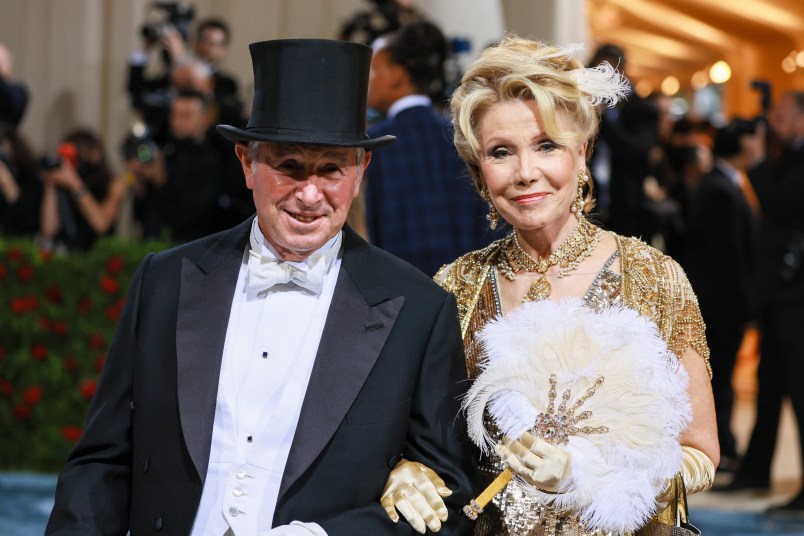
NEW YORK, NEW YORK – MAY 02: Stephen A. Schwarzman and Christine Hearst Schwarzman attend The 2022 Met Gala Celebrating “In America: An Anthology of Fashion” at The Metropolitan Museum of Art on May 02, 2022 in New York City. (Photo by Theo Wargo/WireImage)
Attacking Head-On
The IRS’ announcement of its audit campaign in 2018 meant the agency would stop pushing around the edges and unleash a frontal assault: Its audits would target not just the newer form of partnerships but also LPs.
This time, after years of audits and appeals within the IRS, the agency finally got its splashy court case. Many taxpayers chose to settle, but Cohen’s partnership and at least five others took their cases to tax court, the first in 2022. All argued they were following the law.
Soroban Capital, a hedge fund, was audited after converting to an LP from an LLC. Demonstrating the gulf between owners and employees, Soroban’s three partners collected $142 million in income over the two years of the audit, while paying a total of $74 million in salaries and wages (subject to Medicare tax) to the fund’s staff.
Soroban’s founder, Eric Mandelblatt, was once an employee. His compensation from Goldman Sachs cost him $128,000 in Medicare tax one year, according to ProPublica’s IRS database. After he started his own hedge fund and began earning tens of millions more, his Medicare tax bill never exceeded a third of that, the records show. Soroban did not respond to requests for comment.
In 2023, the IRS won a major tax court decision against Soroban. The “limited partner exception of I.R.C. § 1402(a)(13) does not apply to a partner who is limited in name only,” the court said, because Congress had only intended to “exclude earnings from a mere investment.” A “functional analysis,” the court said, was needed to determine whether a partner was really “limited.”
With the Soroban decision, the loophole entered a new stage in its history. It’s the most serious challenge since 1997 when, protected by Congress, the loophole emerged not only unscathed but stronger. This time, it’s up to the federal judges who will be reviewing appeals of the tax court’s rulings in the IRS’ cases.
One of the audit targets, Sirius Solutions, a consultancy, has already sought a more sympathetic venue than the U.S. Tax Court. Last summer, it turned to the 5th U.S. Circuit Court of Appeals, known for its conservative bent. Industry groups representing the hedge fund and real estate industry have filed amicus briefs. Tax law experts told ProPublica they are skeptical the IRS’ position will ultimately prevail.
Still, amid this uncertainty, the Treasury Department and IRS last year announced plans to start work on a regulation for Section 1402(a)(13). It’s a process that could take years if it isn’t halted by the incoming administration. If a new rule is finally released, it might again face a hostile Congress. It would also be subject to challenge in the courts.
As has always been the case, the simplest solution is for Congress to change the law. Democrats will keep trying, said a former senior congressional aide, especially when they propose some new expensive initiative and need ways to pay for it.
Including a fix for the Medicare tax loopholes is “a beautiful pay-for,” he said. “It’s real money, and there are not a lot of options sitting around that are this obvious and relatively straightforward technically.”
The last attempt came a couple years ago, when Democrats needed to cover the cost of their $2.4 trillion climate bill. Build Back Better, as it was initially called, passed the House with a provision similar to Furman’s gap-plugging tax. The proposal was estimated to raise $252 billion over 10 years.
But the bill stalled in the Senate, where Democrats needed every vote. In the summer of 2022, negotiations suddenly approached consensus on a new, slimmer bill, soon dubbed the Inflation Reduction Act. The gap-plugging tax was part of the mix.
As they had 25 years before, business groups quickly rallied. Several dozen trade groups co-signed a letter to congressional leaders. The National Federation of Independent Business launched radio ads. “Now Congress is considering a brand-new tax on West Virginia small businesses, an additional tax wrongly characterized as the closing of a loophole,” ran one ad targeting Sen. Joe Manchin, one of the two key swing votes.
When a deal was finally announced on the bill, the proposal was gone. There had been other, less politically dangerous options to raise revenue.