The Supreme Court Thinks You Are Stupid

This article is part of TPM Cafe, TPM’s home for opinion and news analysis. It was originally published at Balls and Strikes.

A key component of President Donald Trump’s plan for preserving the Republican Party’s power and influence is making it as difficult as possible for Democrats to vote. As the 2026 midterms approach, he is still pushing the unhinged lie that widespread fraud both cost him the 2020 presidential election and also explains every Republican loss in every election since. 

This delusion is partially responsible for his obsession with mail-in voting. In March, Trump told Republican lawmakers that passing legal restrictions on mail-in voting would “guarantee the midterms.” Their failure to do so, he continued, would mean “big trouble.”

That same month, Trump did his part, issuing an executive order that would impose onerous requirements on states that allow their residents to vote by mail. And in an unsigned opinion on Monday, the Supreme Court did him yet another favor, turning away a legal challenge that had temporarily blocked the order from taking effect.

The result in Trump v. California does not give Trump everything he wants. But it shows just how far this six-justice conservative supermajority is willing to go to help its favorite president’s political movement—all while reserving for itself the right to decide how much of the Constitution remains in place for the midterms, and how much Trump gets to rewrite as he sees fit.
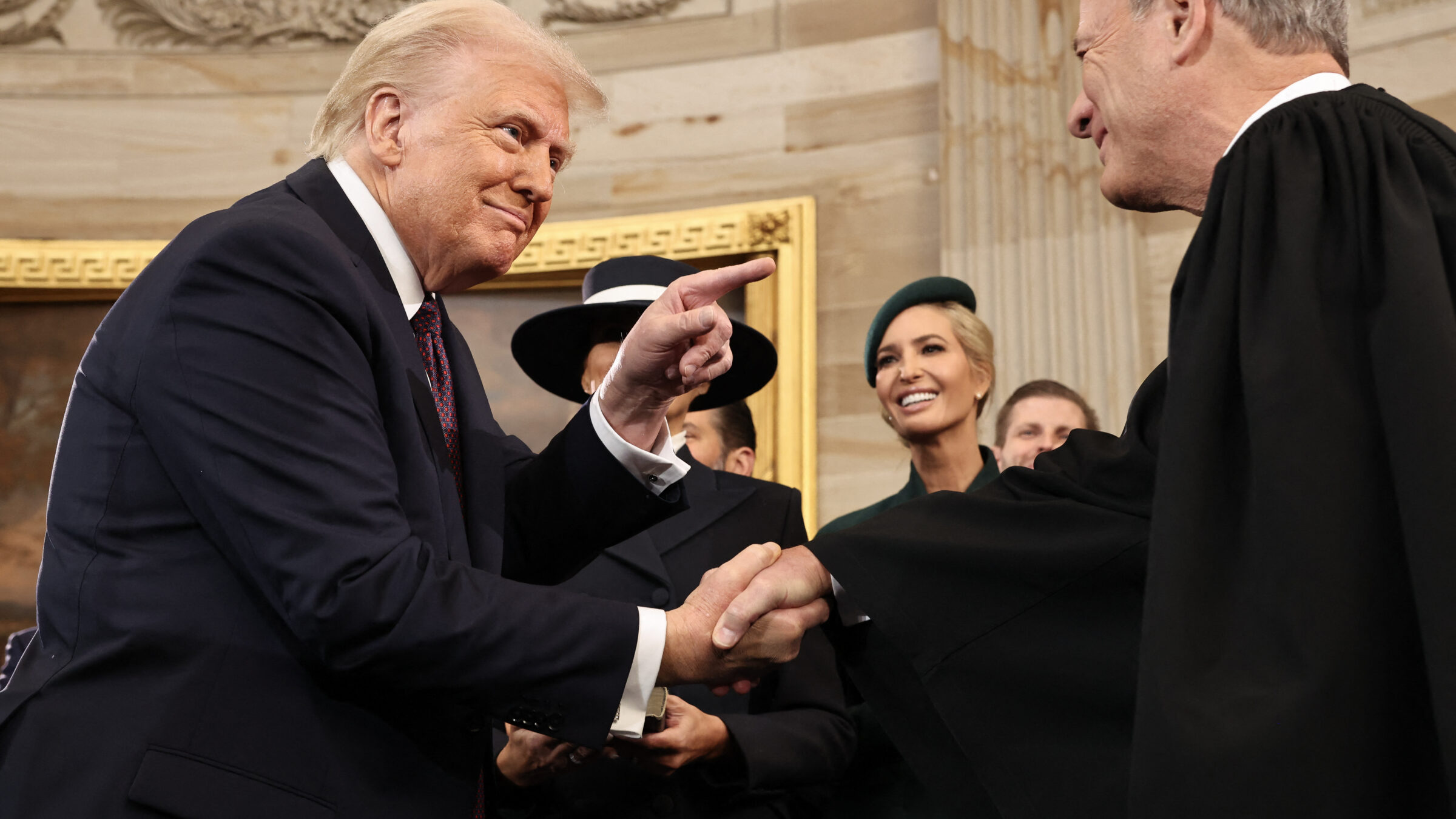
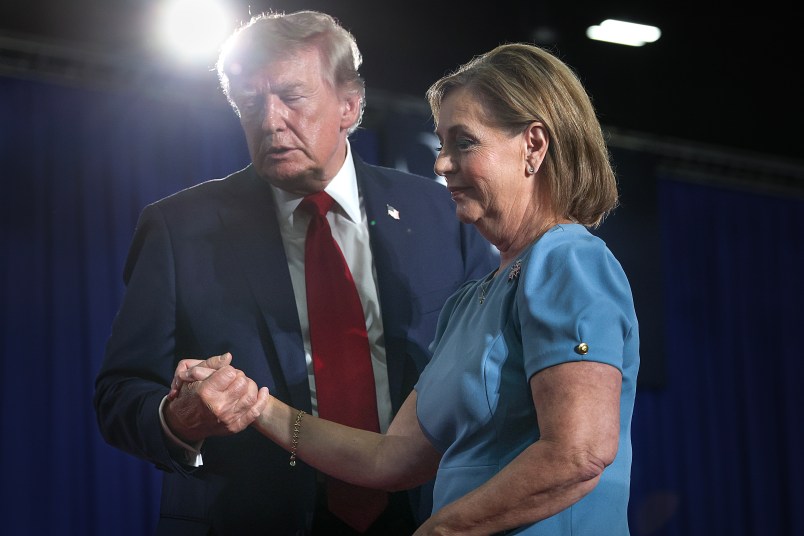
(Photo by CHIP SOMODEVILLA/POOL/AFP via Getty Images)

Trump’s order seeks to do three main things. First, it requires the Department of Homeland Security to provide states with lists of voters whom the federal government has “confirmed” as eligible to vote. Second, it directs Attorney General Todd Blanche and the Justice Department to “prioritize” investigations of state officials who provide ballots to anyone who is not eligible to vote. Finally, it orders the U.S. Postal Service to propose a rule that would require states to send mail ballots in a particular type of envelope and with a special barcode, ostensibly for the purposes of “tracking” the ballot. Trump’s order specifically requires that the Postal Service’s rule prevent the agency from processing a ballot—as in, submitting it for counting—unless a voter has been “enrolled” by the Postal Service first. 

This is admittedly confusing, because the order is kind of an executive power matryoshka doll: Instead of directly requiring the Postal Service to refuse to deliver certain mail ballots, it adds a step, requiring the Postal Service to come up with an administrative rule for when it will refuse to deliver those ballots. Perhaps even the Trump brain trust understood that a president ordering an agency with a statutory obligation to provide “prompt, reliable, and efficient services” to “all communities” to simply ignore votes in blue states would be, legally speaking, not a good look.

That said, given that Trump’s order prescribes the content of the Postal Service’s “proposal” in exacting detail, the real-world impact is the same. Under the Constitution, states have the power to administer elections. If Trump gets his way, his federal government would be deciding who does and does not get to vote. 

I am not speculating here: In June, Postmaster General David Steiner confirmed to Congress that under the rule, which was still being drafted at the time, the Postal Service would not deliver ballots in states that refuse to hand over their voter rolls to the Trump administration—a move that, if the rule were to take effect, would effectively disenfranchise tens of millions of people for the crime of living in a state Trump does not like. Sure enough, last Friday, the Postal Service released a proposal that does exactly as Steiner promised.

Earlier this year, a coalition of voting rights groups and a coalition Democratic-led states filed separate legal challenges to the executive order in federal court. In the states’ case, in July, Massachusetts District Court Judge Indira Talwani blocked the order from taking effect before the 2026 midterms, basically preserving the status quo while legal challenges continue to wind their way through the federal court system.

In its ruling on Monday, the Court decided that Talwani went too far. The thrust of the majority opinion is that because Trump’s order doesn’t impose obligations on states, states are not “harmed” in any meaningful sense. For example, the opinion casts the Department of Homeland Security’s creation of Trump-approved voter eligibility lists as a mere “internal directive from the President to a subordinate” that does not affect states one way or the other. The requirement that the Justice Department focus its attention on certain state officials, the Court says, is within Trump’s Article II power to set “prosecutorial priorities.” The provision that requires the Postal Service to draft a restrictive mail-in balloting rule merely “initiates” a “process” that “might bind the States in the future,” but “imposes no legal requirements” on them now.

The Court allows that the Postal Service’s rule—again, a rule the Postal Service issued at Trump’s direction and according to his specifications—will not “necessarily” be lawful, and that states are free to challenge it. But at this stage of litigation, the majority concluded, blocking the executive order would cause Trump “irreparable harm,” because it improperly “interferes with the internal operations of the Executive Branch.”

This framing only tracks if you possess the critical thinking skills of a goldfish. As Justice Sonia Sotomayor pointed out in a dissent joined by Justice Elena Kagan, the order must be read as a “unified whole.” By simultaneously mandating the creation of Trump-approved eligibility lists and targeting state officials who allegedly issue ballots to ineligible voters, the White House is sending a clear message to its political enemies: Use its list, or else. The Court’s treatment of these provisions as independently innocuous is roughly analogous to arguing that because a bank robber hasn’t actually opened fire, the teller staring down the barrel of his gun should not understand “empty the safe” as a threat.
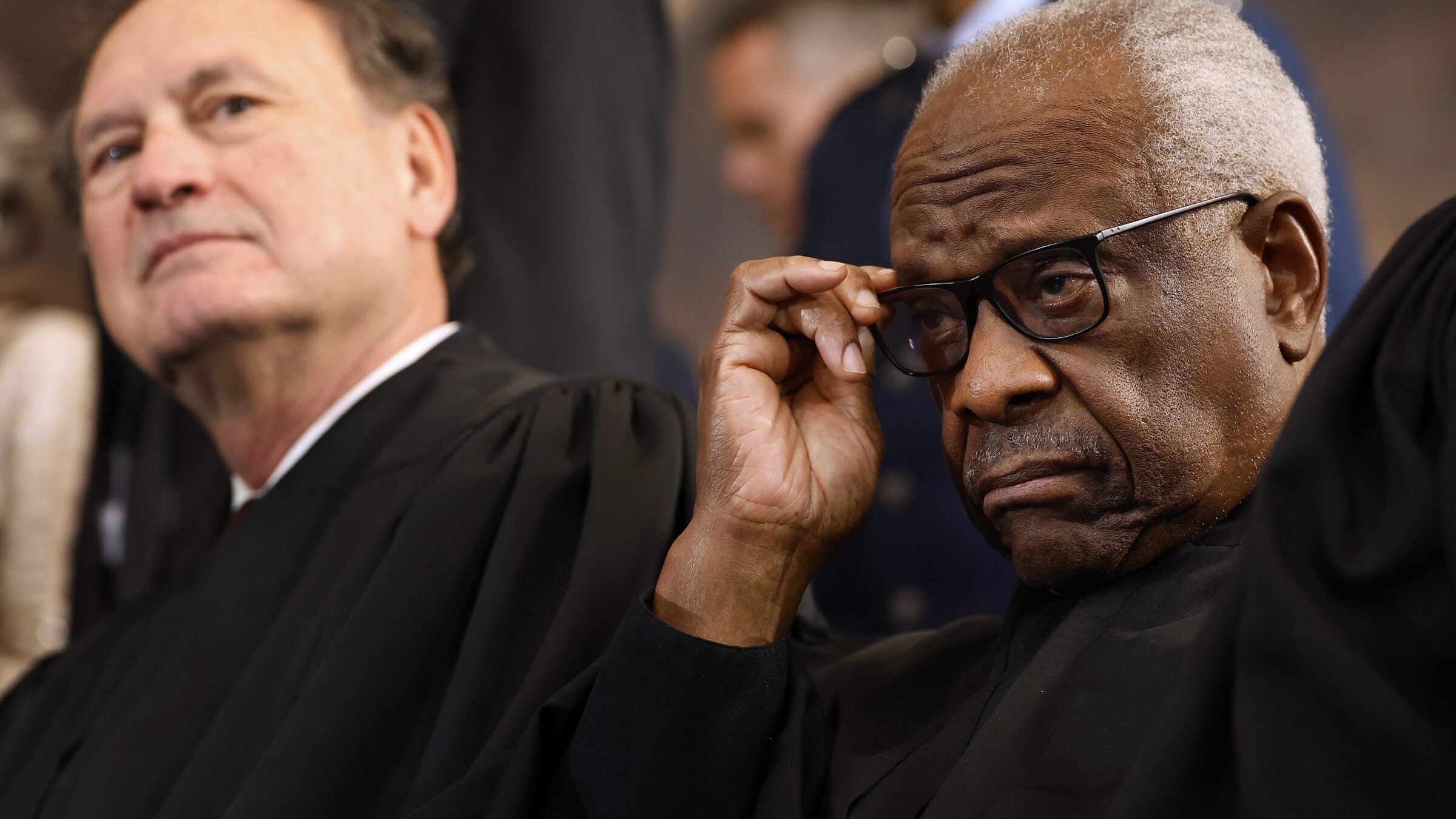
(Photo by Chip Somodevilla/Getty Images)

In a separate dissent, Justice Ketanji Brown Jackson highlighted a different, equally silly aspect of the majority’s argument: that Trump will be “irreparably harmed” if a court prevents him from infringing on states’ power to administer elections. “The President is only conceivably harmed by an injunction barring executive action if that court order is preventing him from doing something the law permits him to do,” she wrote. Given that nothing in the Constitution empowers him to prescribe the form of mail-in ballots in California or anywhere, Jackson concluded, the holding in Trump v. California is tantamount to asserting that “the President must be injured whenever he is prevented from doing something as he wishes.”

In her opinion’s most important section, Jackson took aim at what she (graciously) called the Court’s lack of “situational awareness.” State officials have been preparing for the 2026 general election since the 2024 general election ended. They have spent time and money buying equipment, printing ballots, checking voter rolls, and training staff to work at polling places. Eight months before Election Day, Trump issued an illegal executive order that would disrupt all that careful preparation, and only on Friday did the Postal Service unveil its plan for implementing that order. Now, with just ten weeks to go until Election Day, the Court is essentially telling states, so sorry, you actually sued too early, better luck next time.

The government’s strategy—slow-rolling a rule while fast-tracking a demand for the Supreme Court’s preemptive blessing—is “tailor-made to weaponize this case as a means of destabilizing the nation’s vote-by-mail systems through court-assisted procedural maneuvers,” Jackson wrote. Trump’s actual objective, she continued, is to “foment chaos.”

Trump v. California does not guarantee that the Postal Service’s rule will take effect before November. Thanks to a separate injunction in the case brought by the voting rights groups, Trump’s executive order is still on ice. And now that, as of four days ago, the parties have an actual, concrete Postal Service rule to deal with, it would not be especially complicated for Talwani to block it, too, on the grounds that the proposal is as cartoonishly unconstitutional as the half-baked executive order that gave rise to it.

The basic problem, though, is that by kicking the can down the road, the Court is reserving for itself the option to overrule lower court rulings that are not as deferential to Trump as the justices would like. In recent years, the Court has urged judges not to allow officials to make last-minute changes to election rules, ostensibly in order to prevent “voter confusion.” In practice, the conservative supermajority has selectively invoked this concept, known as the “Purcell principle,” to uphold election rules that Republican politicians want. To give you a sense of just how flexible Purcell is, the opinion in Trump v. California, a case about whether the Trump administration can take over mail-in voting nationwide, does not even mention it.

In the context of the shrinking timeline, Purcell remains a dire threat to the integrity of the 2026 midterms. No matter how quickly lower courts move on the Postal Service’s proposal, as the calendar changes over to September and then to October, it is not hard to imagine this Court suddenly rediscovering the virtues of Purcell and declaring that with Election Day so near, it is too late for judges like Talwani to intervene.

The cool thing about being on the Supreme Court is that as long as you have five votes, you can do anything you want. If the conservative justices wanted to put an end to Trump’s mendacious, embarrassing efforts to hijack the democratic process, I promise you they could cobble together a legal justification for that result. By declining to do so, they are once again demonstrating that they do not give a shit about the “integrity” of the election. They just want to give their fellow Republicans a better shot at winning it.
Ex-NBA Troll Who Got in Mid-Game Altercation Laments That His Anti-Trans Crusade Distracts From WNBA Play

Former NBA player Enes Kanter Freedom is just distraught that his antics — sitting courtside in an anti-trans shirt after proclaiming himself a woman to declare for the 2027 WNBA draft — are distracting from the play of the league’s athletes.

Continue reading “Ex-NBA Troll Who Got in Mid-Game Altercation Laments That His Anti-Trans Crusade Distracts From WNBA Play”

Trump DOJ Colludes With Texas to Harbor Fugitive ICE Agent

First at TPM …

In important development overnight, the Trump administration is now openly colluding with Texas Gov. Greg Abbott (R) to keep an indicted ICE agent from facing justice in Minnesota.

In a new court filing, the Trump DOJ leaped in on Abbott’s side only a few hours after Abbott in his own filing outlined for the first time his legal argument for not yet having complied with Minnesota’s extradition request for ICE agent Christian Castro. Castro, who is jailed in Brownsville, is charged with allegedly shooting Julio Cesar Sosa-Celis through the front door of a home in Minneapolis in January during Operation Metro Surge then lying about it.

While the Constitution, federal law, and legal precedent don’t give a governor discretion to deny a valid extradition request from another state, Abbott claims he is “investigating” whether Castro is truly a fugitive under extradition law. His argument — which legal experts dismiss as insubstantial — is that Castro may not be a fugitive because he didn’t flee Minnesota after the incident but was ordered by ICE to return to his home base in Texas. As a legal matter, that’s irrelevant to the analysis.

“While the Governor has serious doubts that Mr. Castro qualifies as a fugitive, the Governor has not yet received a report from the Secretary and so has not made a decision concerning Minnesota’s request,” Abbott’s filing said.

Last night, the Trump DOJ jumped into the case to which it is not a party. It filed a statement of interest that attempts to buttress Abbott’s legal position by supplying a declaration from an ICE official that Castro was indeed directed to return home to Texas after the incident, which the official says was common practice after such incidents for public safety or the safety of federal agents. “Castro had no discretion in the matter,” according to Patrick Divver, an ICE official above Castro in the chain of command during Operation Metro Surge.

In his declaration, Divver describes getting Castro and his partner — a witness to the shooting — out of Minnesota two days after the shooting. He claims it was to protect them from protesters “using aggressive and sometimes violent tactics, including doxxing” against federal agents. Immediately removing them from Minnesota also had the effect of putting the agent involved in the shooting and an agent who witnessed the shooting out of reach of Minnesota law enforcement.

While the DOJ filing doesn’t explicitly take Abbott’s side, it provides the factual underpinning for Abbott’s legal argument. The dove-tailed filings by Abbott and the Trump DOJ on the same day are just the latest effort by the Trump administration to foil Minnesota’s effort to criminally charge federal agents for abuses during Operation Metro Surge:

  • The Trump DOJ blocked Minnesota from participating in the ultimately aborted federal investigations into the fatal shootings of Renee Good and Alex Pretti and for months withheld from state investigators and prosecutors the evidence it had initially collected after those shootings.
  • More recently, the Trump DOJ has threatened criminal prosecution of the victims of a road-rage-style incident in which ICE agent Gregory Morgan, Jr. allegedly brandished his service weapon at a random driver while passing him on the right shoulder. As a result, the victims have taken the Fifth rather that testify, forcing Minnesota prosecutors to seek immunity for their testimony — immunity that the Trump DOJ has refused to give.

Notably, even as Abbott has stonewalled for months Minnesota’s extradition request for Castro, he has routinely processed other extradition requests from Minnesota.

After the new filings, Minnesota late yesterday asked the court to allow it to file a reply to Abbott’s new arguments, which it says he had not previously raised during the month’s long stonewalling of its request.

It also sought to supplement the record with declarations from Minnesota investigators to reinforce its argument that Castro is a flight risk because he is in a “close, personal relationship” with a woman in Mexico. A state investigator reviewed 16 of the 394 jailhouse phone calls between Castro and the woman in which he expressed his intention to marry her after his release and “buy a big house in Mexico so he can retire there.” Another investigator talked to Castro’s wife, who said he had left their home and marriage in November to pursue the relationship with the Mexican woman and claimed he bought the property in Mexico where the woman lives, along with a Jeep for her use.

The tone of Abbott’s filing is telling. If he loses the extradition fight, he can blame the courts for making him do it. If he wins, it’s icing. In the meantime, he can use it as a performative tip of the hat to President Trump and to make political hay, like this gratuitous swipe at Minnesota Gov. Tom Walz (D) in his latest filing: “Given this odd rush to judgment, it is difficult to ignore the possibility that Governor Tim Walz is content to look the other way when the context is sexual violence against children by illegal aliens, but not when the context is immigration enforcement by federal officers.”

It’s all of a piece with the larger Cold Civil War that Trump is fighting by sending armed federal agents into blue states, targeting elected Democrats with spurious accusations of fraud and pursuing them with a new DOJ fraud section run out of the White House, refusing to provide blue states with disaster funds, and targeting specific states like Colorado for retribution for alleged misdeeds like prosecuting a Trump ally and having mail-in voting.

Aiding and abetting a red state in refusing to abide by the Constitution and honor a blue state’s extradition request is in the same bucket of sledge-hammering the federal system as deploying red state national guards to blue states over the objections of their governors.

While accountability for the abuses of federal agents in Minnesota during Operation Metro Surge is a historically important endeavor in preserving the rule of law, the larger issue is the assault on the federal structure by, of all things, a president absurdly butt-hurt by the fact that not every state voted for him.

Unpacking What SCOTUS Just Did

Over the dissents of the three liberal justices, the Roberts Court lifted an injunction on a Trump executive order to create citizenship lists and gives the Postal Service control over who receives a mail-in ballot — although, importantly, another injunction blocking the same executive order remains in place:

  • Chris Geidner: What Monday’s Supreme Court election order ruling is and is not
  • Rick Hasen: KBJ Warns of “Kafkaesque Nightmare” After Pro-Trump Supreme Court Ruling on Mail Voting. We’ll Know Soon Enough.
  • Steve Vladeck: Making Sense of the Mail-in Ballots Ruling
  • TPM’s Kate Riga: Trump Gets Significant Early Win in Mail-In Ballot Case from Supreme Court

Trump Can’t Say He Wasn’t Warned

The WSJ reports on a February meeting with President Trump in the Oval Office :

Then-Director of National Intelligence Tulsi Gabbard outlined assessments from America’s intelligence apparatus. According to people familiar with the meeting, she told Trump that killing Iran’s supreme leader would likely usher in a more hard-line regime open to acquiring nuclear weapons. Tehran would rush to close the Strait of Hormuz, destabilizing the global energy market. And it would strike U.S. forces and partners in the Middle East, prompting questions about American resolve and reliability with allies.

Today’s Absurdity: 🙃🙃🙃

News? Tips? Feedback? Please let me know. For sensitive information, use the encrypted methods here.

SCOTUS Sets Up Ongoing Fight Over Trump’s Executive Order on Elections

Trump’s Elections Order Will Be Back Before the Supreme Court Before Long

A ruling yesterday evening by the Supreme Court suggests we’re going to be spending the next few months watching litigation around Donald Trump’s March 2026 executive order on elections unfold. The order is one of Trump’s most sweeping efforts to mess with elections, and one that still poses a live risk to the midterms. It directs the federal government to create lists of eligible voters, and requires the United States Postal Service to implement new measures around mail ballots and refuse to mail ballots for states that don’t cooperate with the administration.

Yesterday evening, the Supreme Court’s conservative majority found that a district court order blocking the executive action was issued too early, finding that the states who had challenged it brought their case when the harms were still hypothetical, before the administration had written rules putting the order into effect.

Importantly, Monday’s Supreme Court ruling did not engage with the merits of what the administration is trying to do — it only took a position on whether the time was right for states to sue. Its possible the conservative justices don’t have consensus among themselves on the merits.

Another district court injunction against the order remains in place, so it will not go into effect for now.

Meanwhile, events have already moved past the Supreme Court’s ruling, which appears to have been written last week. As I noted yesterday, the U.S. Postal Service released a rule Friday that will be formally published this week outlining how it will implement the executive order.

Voting rights groups in one case challenging the order asked Massachusetts U.S. District Court Judge Indira Talwani to enforce an earlier preliminary injunction that they say should block the USPS from promulgating this rule. Talwani told DOJ to respond to the voting rights groups’ request by today.

The issue will be back before the justices soon. It’s possible none of this gets decided before the midterms. It’s also possible it does. The worst-case scenario I’ve seen was outlined by law professor and Supreme Court expert Steve Vladeck yesterday, who envisioned a situation in which the Court allows the order to move forward, and then, at a later date, decides it is now too close to the election to block it.

Seventh, the shadow looming over all of this is the “Purcell principle,” the idea that, as election day draws nigh, federal courts should stay their hand rather than issue coercive orders changing the rules for when and how people vote. Purcell is the source of significant controversy and criticism, almost all of it deserved. Among the charges are that (some of) the justices are ruthlessly inconsistent in when they do and don’t apply Purcell—leading to the worry that an injunction against the USPS Final Rule might be deemed “too close to the election,” and stayed under Purcell. That’s a genuine concern, and given the Court’s own repeated transgressions of the Purcell principle earlier this term in Texas, Louisiana, and Alabama, to hide behind it to allow the USPS Final Rule to go into effect would be as indefensible and anti-democratic a ruling as the Court has handed down in a very long time. 

Darline Graham Faces a Single Challenger

MYRTLE BEACH, SOUTH CAROLINA – AUGUST 21: U.S. President Donald Trump and U.S. Sen. Darline Graham (R-SC) attend a campaign rally on August 21, 2026 in Myrtle Beach, South Carolina. President Trump traveled to South Carolina to join Republican Senate candidate Darline Graham for a campaign rally ahead of Tuesday’s runoff election against Ralph Norman. (Photo by Win McNamee/Getty Images)

An odd spectacle is unfolding in South Carolina, where, as sometimes happens, Donald Trump is going all in to back one loyal ally over another.

  • The state will hold a runoff today to replace Lindsey Graham, who died earlier this year, as its Republican Senate nominee. The candidates are his sister, who is also currently in the role in an interim capacity, and Ralph Norman, a far-right congressman and member of the House Freedom Caucus who came in second place during a very crowded primary earlier this month.
  • Norman holds a special place for TPM. In our 2022 series on a trove of text messages former White House chief of staff Mark Meadows had handed over to Jan. 6 investigators, Norman played a notable role, going as far as anyone to press the chief of staff to overturn the election, even after Jan. 6. “Our LAST HOPE is invoking Marshall Law!! PLEASE URGE TO PRESIDENT TO DO SO!!” a Meadows correspondent identified as Norman wrote on Jan. 17. Later asked about the message, he expressed regret over his spelling error.
  • Despite his extremism in 2021, Norman endorsed Nikki Haley ahead of the 2024 election, a sin that has continued to loom over him in the MAGA universe. Darline Graham has Trump’s backing in today’s contest, in part, it seems, because she has never defied him: she is a blank slate who can serve as a rubber stamp for the president. She has suggested as much, including when she professed that she was “not that informed on national security.” Norman’s allies piled on. National security knowledge is “not something you inherit,” Haley, who is backing Norman in this race, wrote.
  • Looking both to support Graham and to avoid seeing one of his endorsees lose, Trump’s been campaigning hard for her. An aligned super PAC is spending nearly a million dollars to do get-out-the-vote, the Wall Street Journal reports.

Tabs

  • The Trump administration is preparing to revoke up to 200,000 visas of people in the U.S. who have applied for refugee status, perhaps the largest such action in history.
  • The White House has become deeply involved with the process of selecting the next secretary general of the United Nations, the Washington Post reports.

Man of the Hour

Premier Doug Ford during question period at Queens Park in Toronto. May 26, 2026. Steve Russell/Toronto Star (Steve Russell/Toronto Star via Getty Images)

It’s Doug Ford, the premier of Ontario and, as Donald Trump put it, the “overall unimpressive brother of the late, great, Rob Ford.” Trump and Doug Ford spent yesterday trading attacks on one another amid Trump’s new trade war with Canada. Josh Marshall took the occasion to review some TPM history relating to both Rob and Doug Ford.

Are We at War?

Yes, both shooting and economic wars — and both bad news for those who want low oil prices.

Dems Prepare for Trump Corruption Investigation Blitz Should They Take House

First Up: Qatari Jets and Crypto Schemes

I received an email from Stand Up America last week about Sen. Elissa Slotkin (D-MI), a potential Dem 2028 hopeful, joining the Kick Out Corruption Tour in St. Louis last week, “where over 100 Missourians gathered for a conversation about how corruption in Washington is contributing to higher costs for working families and what can be done to fight back.”

The subject line only caught my eye because it appeared to solidify a series of headlines I’ve been seeing from Axios and others over the past week about Democrats’ coalescing around a midterms message point that, it seems, they think they can continue to capitalize on should the party take back the House in November, and with it, investigative and oversight authority.

Trump’s profits irk Americans as Dems test anti-corruption message,” read the headline on a Wednesday Axios piece that unpacked Americans’ growing aversion to Trump and his family profiting off the presidency. It cites a handful of recent polls that have found that the majority of Americans are not happy with everything from Trump’s private business interests influencing his decisions as president to his cryptocurrency ventures to his family doing business with foreign countries.

Democrats appear to be banking on this messaging resonating with midterms voters, especially against the backdrop of the nation’s ongoing affordability crisis that Republicans and Trump have done nothing to address. (This midterms strategy is particularly stark when compared to the GOP’s, which is mostly just Islamophobia and calling all Dems communists; I get into that more below).

But it’s also more than an empty message. Should Democrats retake the House, top Democrats in lower chamber are also already preparing for aggressive oversight, looking specifically at Trump and his family’s corruption. Politico reported late last week on the investigative priorities of Reps. Jamie Raskin (D-MD) and Robert Garcia (D-CA) should Dems win the House and put both men back at the helm of powerful oversight committees. Garcia is poised to lead the House Oversight Committee and Raskin the Judiciary Committee. Both said they plan to look into Trump’s acceptance of a Qatari jet as his new Air Force One and his family’s ludicrously profitable crypto schemes, for starters. Per Politico:

“Ideally, it’s the president’s sons and the president and the family,” Garcia said, adding a litany of other members of the Trump inner sanctum he wants to hear from. They include chief of staff Susie Wiles, deputy chief of staff Stephen Miller and son-in-law and foreign envoy Jared Kushner, as well as former Homeland Security Secretary Kristi Noem and Cory Lewandowski, who served as her chief of staff.

In addition to the crypto profits and the much-criticized Qatari 747, Garcia said he planned to probe federal contracts awarded to members of Trump’s family and the series of pardons Trump has granted early in his second term.

Raskin, a veteran of the investigative onslaught that took place in the second half of Trump’s first term, said he planned to focus on allegations of self-enrichment by Trump and his family — as well as illicit foreign influence on American institutions and rising authoritarianism in government.

Republican Islamophobia Watch

I’ve been writing a bit about the Republican Party’s resurrected bloodlust for spreading a new Muslim panic ahead of the midterms because it has nothing else to campaign on (and it pairs well with its red scare campaign because many of the left-leaning progressive candidates it’s trying to demonize as communists also tend to support a free Palestine). Folks like Texas Gov. Greg Abbott are gambling on Islamophobia as an effective campaign strategy. Others, like Rep. Nancy Mace (R-SC) are just piling on out of love for the hateful discourse.

We’ve got another entry in the love-of-the-game bucket this week.

Indiana’s Lt. Gov. Micah Beckwith is a Christian pastor who won the 2024 election alongside Gov. Mike Braun — whom TPM covered most recently for his role in helping the Trump administration bully Republican members of his own state legislature to cave to pressure to gerrymander its maps mid-cycle for Trump. Beckwith and Braun are not up for reelection until 2028. But Beckwith is paying it forward, helping the Republican Party spread its anti-Islam message far and wide ahead of elections this fall. Beckwith has previously said, “I hate Islam” and has described the religion as “a demonic death cult.” During an appearance on the right-wing podcast “Palumbo-Booker Justified” Beckwith doubled down on this sentiment, while also bragging that “Marxists don’t like me and I wear that with a badge of honor.”

“What I said was, not that Muslims are demonic, but Islam is demonic ideology,” he clarified. “And I said, ‘Hey I love Muslims.’ I would give a Muslim in my community the shirt off my back if they needed it. And I would help them, I would serve them and care for them. But their ideology is, I believe, a wicked, evil ideology that is totally incompatible with the American way of life and we should not put up with that ideology.”

Indiana was recently devastated by floods and thousands are still without power, but at least Lt. Gov. Micah Beckwith was able to find the time to go on a podcast to talk about his hatred for Islam: "We should all learn to hate what is evil."

Right Wing Watch (@rightwingwatch.bsky.social) 2026-08-24T17:50:55.152Z

‘All the Administration’s Shit’

Some Republicans in Congress are putting the Trump administration on notice against trying to pull any last minute pocket rescissions if it wants to avert a government shutdown ahead of the midterms. GOP lawmakers largely kept their mouths shut about the first round of lawless actions by the Trump administration as it, throughout the first year of Trump’s second term, repeatedly nixed and blocked funding that had already been appropriated by Congress without Congress’ permission. But now some are speaking out about the administration denying federal grants that Congress has authorized. It’s been a theme of TPM’s legislative coverage since January 2025 as it became clear that Republicans in both chambers were willfully ceding their authority over government spending to the executive branch’s political whims.

Now, Republican senators are attempting to block the Trump administration from picking and choosing how to spend money Congress has appropriated by including a provision in a must-pass spending bill that’ll keep the government open through the election. Per Politico:

Earlier this month, GOP senators overwhelmingly agreed to a bipartisan government funding bill that would temporarily block the Trump administration from finalizing a federal rule to let political appointees steer money toward grants “aligned with the president’s agenda.” The House could clear that bill next month, and Trump is expected to sign it to avert a shutdown before the midterms.

As TPM’s Emine Yücel has reported, Office of Management and Budget Director Russell Vought claimed earlier this summer that the White House would not try to force Congress to pass more rescissions this year. But it appears some Republicans are not buying into Vought’s spin, given the administration’s ongoing attempts to change rules for grant funds and then retroactively freeze funds because of it.

“Pocket rescissions would be a very interesting way to curry favor with the legislative branch — especially the one part of the legislative branch which has delivered on all of the administration’s shit,” Rep. Mark Amodei (R-NV) told Politico.

One Thing You Should Read From TPM Today

Kate Riga has been covering the right-wing media’s obsession with the WNBA amid Indiana Fever guard Sophie Cunningham’s willingness to serve as the right’s new poster child for the anti-trans agenda. Now it appears a MAGA organization — which counts current Trump administration officials among its founding members — is getting involved in at least one of the recent anti-trans culture war stunts keeping the saga alive and well on Fox News: Trump-Aligned America First Policy Institute Backing Ex-NBA Player Tossed from WNBA Game

Yesterday’s Top Story

The US-Canada Trainwreck and the Limits of American Power

What I’m Reading

Farmers Struggle to Get Basic Services From Depleted Agriculture Dept.

Bessent unveils sweeping campaign of sanctions and pressure against Iran 

Trump’s Fury Over Natalie Harp Mess Worsens as Leaks Grow More Damning 

Trump Gets Significant Early Win in Mail-In Ballot Case from Supreme Court

The Supreme Court on Monday lifted an injunction on an executive order that would create citizenship lists to control who can vote and give the federal government control over who receives a ballot. But another injunction keeps the order blocked, for now.

Continue reading “Trump Gets Significant Early Win in Mail-In Ballot Case from Supreme Court”

Trash Talking Doug Ford and a Bit of TPM Lore

The U.S.-Canada trade situation is so bleak (as I’ve been discussing in these three posts: 1, 2 and 3) that I guess it could use a bit of comic relief-cum-TPM lore. The current Premier of Ontario (their analog to the governor of state) is Doug Ford. He’s the brother of the late Rob Ford, who you’ll remember was the rotund, buffoonish, crack-smoking mayor of Toronto from 2010 to 2014. In December 2013, Rob Ford won a Golden Duke award and we sent Hunter Walker, then in his first stint at TPM, to personally bestow the Golden Duke statuette to Mayor Ford. Hunter and then-TPM intern Yumi Araki hunted around Toronto to find Ford but finally had to settle on giving it to Ford’s brother Doug. (We’ll come back to their quest in a moment. You can read Nicole LaFond’s recollection of the story for our 20th Anniversary celebration here.)

Continue reading “Trash Talking Doug Ford and a Bit of TPM Lore”

Trump-Aligned America First Policy Institute Backing Ex-NBA Player Tossed from WNBA Game

An organization closely tied to the Trump administration seems to be collaborating with Enes Kanter Freedom, an ex-NBA player who has joined the right-wing, anti-trans crusade against the WNBA and was ejected from a Chicago Sky game Sunday.

Continue reading “Trump-Aligned America First Policy Institute Backing Ex-NBA Player Tossed from WNBA Game”

Not Good

Jewish Insider, the source of this passage, often has what I’d consider tendentious coverage of this issue. But these words from Hasan Piker really speak for themselves …

In his commentary, Piker added that Jews who tie their “entire identity” to Israel, which he referred to as “Jewish ISIS,” are “making antisemitism worse.” 

“People don’t f*** with Israel any longer,” Piker said two hours into his nearly seven-hour stream on Thursday. “If Jews in America keep putting this idea out there that they are singularly invested in Israel, eventually someone’s going to come around and take action, not against the State of Israel, mind you, but against American Jews.”

Continue reading “Not Good”