Even Republicans on House Oversight Panel Insist on Testimony from Fired AG Bondi

Not So Fast

It appears as though members of the House Oversight Committee, including some Republicans, are not going to let ousted Attorney General Pam Bondi get away with skipping her deposition now that she is no longer attorney general.

House Oversight Committee Chair James Comer (R-KY) subpoenaed Bondi for an April 14 deposition before the committee to answer questions about the Justice Department’s handling of the Jeffrey Epstein case and the relase of the department’s investigative files on the wealthy financier who was charged with sex trafficking before he died in prison. Bondi had not yet officially confirmed the date of her testimony when she was unceremoniously fired by Trump last week, reportedly due to her apparent failure to secure timely indictments and investigations into Trump’s perceived political enemies. The panel said in a statement today that they plan to continue seeking a date for her to testify.

The DOJ reportedly sent Comer a letter this week requesting that Bondi be relinquished from her deposition duties since she was fired from the DOJ. Per Politico, which obtained a copy of the letter to Comer:

“We kindly ask that you confirm that the subpoena is withdrawn,” wrote assistant attorney general Patrick Davis, adding that DOJ “continues to believe that additional compulsory process is unnecessary in light of our demonstrated willingness to voluntarily assist your oversight efforts.”

Democrats on the panel have already indicated that they believe Bondi must still answer the committee’s questions, despite her ouster.

“Now that Pam Bondi has been fired, she’s trying to get out of her legal obligation to testify before the Oversight Committee about the Epstein files and the White House cover-up,” the panel’s ranking member Rep. Robert Garcia (D-CA) said in a statement Wednesday. “Our bipartisan subpoena is to Pam Bondi, whether she is the Attorney General or not. She must come in to testify immediately, and if she defies the subpoena, we will begin contempt charges in the Congress. The survivors deserve justice.”

It appears panel Republicans are on the same page:

“The Department of Justice has stated Pam Bondi will not appear on April 14 for a deposition since she is no longer Attorney General and was subpoenaed in her capacity as Attorney General,” a House Oversight Committee Republicans spokesperson said in a statement to Politico Wednesday. “The Committee will contact Pam Bondi’s personal counsel to discuss next steps regarding scheduling her deposition.”

It’s been an open question whether Republican Oversight Committee members might still enforce the subpoena after Bondi’s departure. But Comer broke with other Republican panel members, alongside four other Republicans on the committee, to join Democrats in voting to subpoena Bondi in March, indicating he may still be interested in hearing from her despite her ousting from the DOJ.

Iran War Powers Vote Incoming

Democratic leadership in Congress is planning a handful of actions to at least make some noise about President Trump’s ongoing, unauthorized and increasingly hysterical war in Iran, which may or may not be ongoing. While leadership did not join the chorus of calls from Democratic members of Congress yesterday to invoke the 25th Amendment and/or impeach Trump, Senate Minority Leader Chuck Schumer (D-NY) is planning to force a vote on a war powers resolution in the upper chamber next week.

“Congress must reassert its authority, especially at this dangerous moment. No president, Democrat or Republican, should take this country to war alone. Not now. Not ever,” Schumer said at a press conference Wednesday. “Republicans will once again have the opportunity to join Democrats and end this reckless war of choice. The public must demand that Republicans join with us to approve the War Powers Act.”

While similar measures have already failed repeatedly in the Senate, it appears that Republicans may try to bake authorization for Trump’s military operation in Iran into an impending budget reconciliation package that they’re expected to use to give Trump billions more in funding for his war.

Meanwhile, in the House:

Americans Against Data Centers

A small city in Wisconsin, just outside of Milwaukee — currently home to a Trump-backed data center AI project — has voted to block the development of future data centers in the city. Advocates say their efforts could serve as a blueprint for residents seeking to fight the development of AI data centers in communities around the nation.

More details, from the Milwaukee Journal Sentinel:

The referendum won with 66% of voters answering ‘yes’ on the ballot question, asking whether to approve an ordinance that would add a public checkpoint to the approval process for TIF districts over $10 million. The ordinance was proposed by residents part of a grassroots, local anti-data center group, called Great Lakes Neighbors United, that opposed the $15 billion AI data center for Oracle, OpenAI and Vantage on the city’s north side.

Relatedly, a new piece in TPM Cafe today: Trump Wants to Build Massive New Detention Centers. States Are Blocking Their Construction.

In Case You Missed It

New piece just out from Layla A. Jones: New Labor Department Rule is Trump’s Latest Favor to the Crypto Industry

Morning Memo: Declaring Victory and Walking Away Can’t Conceal the Scale of Trump’s Folly

John Light: ‘Open’ Is in the Eye of the Beholder

In case you missed it last night: Dem-Backed Judge Wins Wisconsin Supreme Court Seat, Expanding Its Liberal Majority

Yesterday’s Most Read Story

Trump: ‘A Whole Civilization Will Die Tonight’ … Maybe

What We Are Reading

Trump administration personnel agency is asking for federal workers’ medical records

How Trump Took the U.S. to War With Iran

RFK Jr is launching a podcast to expose ‘lies’ that have made Americans sick
A Few Thoughts on Trump’s Pre-Deal With Iran

First, just because Donald Trump is an inveterate liar, don’t assume that Iran is a reliable narrator about anything that was agreed to in this deal. (Was there a deal? We’ll get to that.) One thing both sides explicitly agree on, coming right from President Trump himself, is that the 10 point Iranian plan will serve as the basis for discussions over the next two weeks. The early accounts of what that document included focused on a lot things Iran wants, even including things it wanted before the war broke out. It doesn’t really focus on the things the U.S. notionally got into this war for. (We’ll get in a moment to what’s included in the document Iran released today.) For the U.S., this ceasefire is at best a ceasefire on the basis of a stalemate, where the fight is about a draw and both sides want to see if they can bring the fight to an end.

That’s the optimistic view. The U.S. has clearly been more eager to get to the negotiating table. It’s the U.S. that wants out most. The items on that list tilt heavily toward Iran. The Iranians appear to be exercising continued control of the Strait of Hormuz even if they may allow ships to go through — “allow” being the key word.

Continue reading “A Few Thoughts on Trump’s Pre-Deal With Iran”

New Labor Department Rule is Trump’s Latest Favor to the Crypto Industry

The U.S. Department of Labor has proposed a rule designed to make it harder to sue retirement plan fiduciaries that invest in risky, more volatile assets. The rule is also President Donald Trump’s administration’s latest giveaway to the Trump family’s favorite industry: Cryptocurrency.

Drawing on Trump’s August 2025 executive order titled, in part, “Democratizing Access to Alternative Assets,” the Labor Department rule highlights a non-exhaustive list of six such investments, including private credit, real estate, and cryptocurrency. To protect retirement plan agents and managers who choose to include these riskier products in their 401(k) offerings, the proposed rule outlines six factors over 164 pages designed to define a legally required “prudent process” fiduciaries should take to vet an asset. It lists several hypothetical situations and thoroughly explains how to do the right thing in each as defined by this administration. The rule signals to fiduciaries: If you follow these step-by-step processes, our rule offers you safe harbor from litigation. 

“When a plan fiduciary [follows] the described process…,” the rule reads, “its judgment regarding the factor or factors is presumed to be reasonable and is entitled to significant deference.” The DOL’s proposal “gives fiduciaries (not opportunistic trial lawyers) the discretion and flexibility.”

Trump’s DOL rule is the latest element of the president’s oft-stated goal to grow the crypto industry, signaling the administration’s desire to allow huge sums of money to flow from retirement accounts into the largely unregulated, new financial realm, experts told TPM. Looming over all crypto policy decisions, these experts warned, was the fact that they could stand to further enrich a president with unprecedented conflicts of interest related to his family’s own business ventures.

“The White House is now directly meddling in every policy, especially with regard to financial regulation like this,” Corey Frayer, director of investor protection at the Consumer Federation of America, told TPM. “And rather than making a fact-based analysis of the facts and coming to some neutral conclusion, the policies are all bent towards either serving industry or, worse, benefiting companies that Trump and his family have enormous financial interest in.” 

In the first several months of his second term, Trump’s family enterprise World Liberty Financial netted more than $800 million crypto sales, according to a Reuters tally — largely through sales made to foreign countries and entities. But as with many of the administration’s pro-crypto policies, the impact is not purely personal — crypto’s administration-supported expansion throughout the U.S. economy could come at a cost to average Americans at a time when the Trump administration is dismantling consumer protection agencies and departments like the Consumer Financial Protection Bureau.

Trump’s August executive order frames more volatile alternative investments as aspirational. His pitch hinges on the idea that wealthy individuals are already reaping the rewards of the sophisticated investments ordinary retail investors have been locked out of, a sentiment that has been echoed by big wigs on Wall Street whose firms are invested in private credit and digital asset industries. The rule change also garnered support from professional advocacy groups like the American Retirement Association. 

“Put simply: this rule is not about expanding access to any particular investment,” ARA CEO Brian Graff wrote in a letter explaining the group’s support of the rule. “Rather, it reinforces the protective standards that govern how plan fiduciaries make decisions by providing a roadmap for investment selection, not a mandate.”

Experts who spoke to TPM, though, said the rule removes legal protections from retirees in the event employer-sponsored retirement plan managers don’t live up to their fiduciary duties. The rule risks protecting fiduciaries who operate in their own interests rather than that of their clients, and gives a green light to investments that offer less stability, less transparency, and less protection from adverse investment results.

“The reason fiduciaries were not taking these risks with employees’ retirement savings is because the potential rewards aren’t commensurate with those risks and under the current standard they are incentivized by the threat of litigation not to make investments that aren’t in the employee’s interest,” said Frayer, who served as a senior advisor on crypto markets at the Securities and Exchange Commission during the Biden administration. “The ability of the investor to hold that fiduciary accountable has been made harder.”

To make money there’s gotta be this kind of perpetual motion machine where you’re constantly finding new people to bring into the ecosystem to offload the investments onto.

Graham Steele, academic fellow at Stanford University’s Rock Center for Corporate Governance and former Assistant Secretary for Financial Institutions at the U.S. Treasury Department

Just before the Labor Department’s announcement, the health of the private credit industry, which has historically offered higher yields in exchange for higher fees and less immediate liquidity, was beginning to come under scrutiny. Investors who were already tapped into the market initiated, over the last few months, record high withdrawals and hit withdrawal caps, prompting concerns about access to investments and limited investor pools. Cryptocurrency has long been considered a volatile, less regulated instrument susceptible to financial crimes, though some digital assets try to offer more stability and are pegged to traditional assets. 

In response to questions from TPM, a Labor Department spokesperson said the department’s rule affirms a process outlined in retirement investment law and affords “maximum discretion” to fiduciaries who follow the department’s outlined process.

Trump’s August executive order used almost the exact same language employed by BlackRock CEO Larry Fink last year in his influential annual letter to investors. With one section titled “The democratization of investing,” Fink spends much of the letter arguing that capitalistic wealth creation can reach more people by diversifying retirement plan investments to include private credit and digital assets.

“The beauty of investing in private markets isn’t about owning a particular bridge, tunnel, or mid-sized company,” Fink wrote. “It’s how these assets complement your stocks and bonds — diversification.”

But Trump and Wall Street don’t actually care about expanding access to wealth, Graham Steele, former Assistant Secretary for Financial Institutions at the U.S. Treasury Department, told TPM. Instead, it’s about broadening the investor pool to inject more wealth into the pockets of sophisticated investors.

“To make money there’s gotta be this kind of perpetual motion machine where you’re constantly finding new people to bring into the ecosystem to offload the investments onto,” said Steele, who is now an academic fellow at Stanford University’s Rock Center for Corporate Governance. “The administration uses language about quote unquote democratization, but it’s really a way to prop up asset prices to benefit crypto, venture capital, and private equity in particular.”

A DOL spokesperson told TPM the rule is to provide “regulatory clarity and guidance,” not to show support for a specific industry or asset class.

“The proposed rule is asset neutral,” the spokesperson wrote in an email. “DOL provided regulatory clarity and guidance so that plan fiduciaries can evaluate all potential assets (sic) classes that may or may not be appropriate for a 401(k) plan, and provided additional factors like liquidity and valuation guidance for the diligent evaluation of more complex or potentially volatile investments.”

Steele and Frayer said the language in the DOL rule could, in fact, result in propping up certain asset classes by sending a wink and a nod from the administration to fiduciaries. Another result of that signaling, said Steele, could be to connect more exclusive assets to the mainstream market and to help protect those more volatile products from a possible future, industry-wide downturn.

“People are less sympathetic to the idea of bailing out crypto if it’s just going to make a bunch of crypto companies whole,” Steele said. “But if there’s actually working people standing behind that, there’s a more compelling case there.”

A study from JPMorganChase found fewer new investors are entering the crypto market. Retail investors who participate in the market are confident in it, a 2025 study from PriceWaterhouseCooper showed. As of 2021, only about 14% of adults in the U.S. had traded crypto as of 2021, according to the Federal Reserve Bank of San Francisco, but the incorporation of crypto assets into 401(k)s presented growth opportunities for the volatile asset class. The rate of U.S. crypto ownership remained virtually unchanged through 2024, the Pew Research Center found.

Democrats in Congress have initiated several investigations and inquiries into the president’s ties to the crypto industry and his other business interests, which they have said present exceptional conflicts of interest.

“Changing the rules to allow such risky investments into retirement accounts is deeply alarming, but it is hardly surprising,” said Sen. Richard Blumenthal (D-CT), who on March 30 sent a letter to the SEC about the Trump family’s crypto ties, said in a statement to TPM. “Americans’ savings will be in danger, but President Trump will be making millions from this risk.”

World Liberty Financial in January applied with the U.S. Office of the Comptroller of the Currency for a national bank charter under the name World Liberty Trust Company. In the application, the firm said it had attached a request “to have full fiduciary powers” in a “Confidential Business Plan” exhibit, though it’s unclear exactly what the request contained or what the implication of those powers would be. The Office of the Comptroller of the Currency did not respond to multiple requests for comment from TPM.

World Liberty Financial spokesperson David Wachsman told TPM the company’s banking charter application “is not for” the purpose of being a retirement plan fiduciary and that the charter is “unrelated” to becoming a 401(k) management or advisory company. 

Still, Steele and Frayer envisioned a future where companies seeking to curry favor with the president could pump up their retirement offerings with crypto offered by World Liberty Financial.

“We already see foreign countries doing this,” said Frayer.

Declaring Victory and Walking Away Can’t Conceal the Scale of Trump’s Folly

A Ceasefire … or a Fig Leaf?

Despite some initial reports that a tenuous two-week ceasefire is holding in the Middle East, Kuwait, the UAE, and Qatar all claimed to have subsequently received incoming missile fire. For its part, Iran claimed that one of its oil refinery on a island in the Persian Gulf had come under attack since the ceasefire by unnamed “enemies.”

The ceasefire did not include Israel’s ongoing offensive in southern Lebanon, where it carried out the largest wave of strikes since the war began.

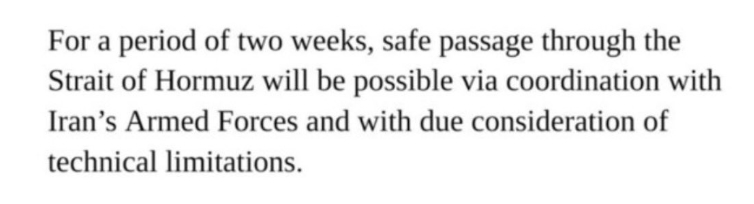
The real focus of the highly contingent ceasefire agreement was the Strait of Hormuz, which was free and open before President Trump’s elective war and is now throttled by Iran. Trump is declaring the strait open for his own political purposes, but the terms of the ceasefire give Iran more control over the vital waterway than it had before the war started:

  • Iran and Oman will jointly charge newly imposed fees for passage through the strait. “The strait is in the territorial waters of both Oman and Iran,” the AP reports. “The world had considered the passage an international waterway and never paid tolls before.”
  • The new fee is “roughly $2 million per ship,” the NYT reports.
  • The White House and Trump reposted a statement from the Iranian foreign minister that showed the highly contingent nature of the agreement on the strait:

On the water, there were few signs that the ceasefire had created sufficient conditions for safe passage through the strait. While it was still early, Lloyd’s of London issued a statement that cautioned about the continuing peril: “Moving before new protocols are clarified could expose crews, ships and cargoes to heightened risk.”

The strategic catastrophe for the United States appears to extend beyond the narrow confines of the strait. Trump called Iran’s 10-point peace plan “a workable basis on which to negotiate.” Any long-term agreement along those lines would be a remarkable coup for the Iranians to have pulled off in the face of withering American firepower:

Iran's 10 point plan seems to put them in a better position than they were in before the war www.theguardian.com/world/2026/a…

Eliot Higgins (@eliothiggins.bsky.social) 2026-04-08T06:59:19.596Z

Yep

The New York Times’ Charlie Savage: Trump’s Iran Threats Look Like Self-Incrimination for Potential War Crimes

Quote of the Day

“Better TACO Tuesday than World War III.”—an unnamed European official told Politico

Abrego Garcia Case Goes Off the Rails Yet Again

Another bizarre development in the Trump administration’s never-ending brutalization of Kilmar Abrego Garcia.

In what should have been a placid conference call to set a briefing schedule for the administration’s renewed effort to deport him to Liberia, a career DOJ attorney took the puzzling position that Abrego Garcia could self-deport to Costa Rica on his own at any time. That ignores entirely the pending criminal prosecution of him in Tennessee by the same Justice Department.

U.S. District Judge Paula Xinis of Maryland was confounded by the DOJ attorney’s position, and after scolding him at length that Abrego Garcia was legally barred in the criminal case from voluntarily leaving the country, he mostly retreated. “This is chimerical,” Xinis spit out at one point with such vigor that it sounded like a curse word. My full write up is here.

Mass Deportation Watch

  • New ICE shooting: A man is in critical condition after being shot by ICE officers during a targeted traffic stop in California. Video of the incident shows a chaotic scene with agents surrounding the man’s car as he attempts to flee.
  • Kseniia Petrova, the Russian-born Harvard researcher who allegedly smuggled frog embryos through Boston’s Logan Airport won a victory in court when U.S. District Court Judge Christina Reiss of Vermont ruled that her visa had been unlawfully cancelled.
  • Annie Ramos, the undocumented wife of an Army sergeant who was detained by ICE at Ft. Polk as they were moving into base housing has been released from detention after five days.

The Retribution: Cassidy Hutchinson

In double whammy of abuse of power and corrupt retributive prosecutions, the Trump II DOJ is targeting Trump I White House aide Cassidy Hutchinson and bizarrely using its Civil Rights Division to do so, the NYT reports:

The move was a highly unusual one by Justice Department leadership, directing a criminal case that appears to involve accusations of lying to Congress to a specialized unit that normally focuses on systemic civil rights abuses like police misconduct and racial discrimination.

The new focus on Hutchinson, a star witness before the House Jan. 6 committee, appears to have been a last-gasp effort by then-Attorney General Pam Bondi to produce results in targeting President Trump’s political foes. Instead of being run by D.C. U.S. Attorney Jeanine Pirro, as would be normal, the case was assigned to Harmeet Dhillon, who oversees the Civil Rights Division. It’s another way for Dhillon, who is reportedly in line for a promotion to the No. 3 slot at DOJ, to burnish her reputation as a Trump loyalist.

The Retribution: Todd Blanche Edition

In his first press conference since Bondi was fired, acting Attorney General Todd Blanche defended President Trump’s retributive prosecutions against his political foes: “That is his right, and indeed it is his duty to do that.”

The Corruption: Mile High Edition

The White House has purchased — without congressional authorization — and taken control of the controversial $70 million luxury jet that then-DHS Secretary Kristi Noem was leasing for her own use, the WSJ reports. First lady Melania Trump and select cabinet secretaries will have access to the jet.

Hot tips? Juicy scuttlebutt? Keen insights? Let me know. For sensitive information, use the encrypted methods here.

Trump Wants to Build Massive New Detention Centers. States Are Blocking Their Construction.

This article is part of TPM Cafe, TPM’s home for opinion and news analysis.

Last week, ICE released its own inspection report on Camp East Montana, the detention facility in Texas that has become a symbol of the administration’s overfunded, overcrowded, underregulated mass detention project — where prior reporting revealed that staff bet on which detainee might be next to die by suicide. The new findings were not leaked by advocates or surfaced by investigative reporters. They came from the agency itself: 49 failures in medical care, disease control, and oversight; undocumented uses of force; inadequate sexual assault response. The federal government’s own auditors documented the suffering, and the federal government will do nothing about it.

But while Washington absorbs the daily torrent of executive orders, social media provocations, and congressional paralysis, something significant is happening at a different level of American government. States are moving — aggressively, creatively, and increasingly together — to impose accountability on a detention system explicitly designed to avoid it.

Continue reading “Trump Wants to Build Massive New Detention Centers. States Are Blocking Their Construction.”

Dem-Backed Judge Wins Wisconsin Supreme Court Seat, Expanding Its Liberal Majority

Chris Taylor, the Democratic-backed candidate for Wisconsin’s state Supreme Court, easily defeated Maria Lazar, the Republican-backed candidate, expanding the Court’s liberal majority, per the Associated Press. Taylor was leading 60.1% to Lazar’s 39.8% with 95% of the votes in on Wednesday morning, according to the New York Times‘ tracker.

Her win represents the fourth straight victory for Democratic-backed candidates in the state’s high court elections.

Continue reading “Dem-Backed Judge Wins Wisconsin Supreme Court Seat, Expanding Its Liberal Majority”

Trump Punts Disaster for ‘Two Weeks’

Trump on Truth Social, 6:32 p.m. ET, with the climb-down, describing what he claims will amount to a “double sided CEASEFIRE!”:

Based on conversations with Prime Minister Shehbaz Sharif and Field Marshal Asim Munir, of Pakistan, and wherein they requested that I hold off the destructive force being sent tonight to Iran, and subject to the Islamic Republic of Iran agreeing to the COMPLETE, IMMEDIATE, and SAFE OPENING of the Strait of Hormuz, I agree to suspend the bombing and attack of Iran for a period of two weeks.

Continue reading “Trump Punts Disaster for ‘Two Weeks’”

This Is What We Were Talking About, Say Dems Who Trump Threatened to Hang

*Post-publishing update: He changed his mind.

Invoking the 25th?

Some Democratic members of Congress are doing what they can to sound the alarm about an unhinged president threatening to make good on his social media promise that “a whole civilization will die tonight,” including urging Trump’s Cabinet to invoke the 25th Amendment and calling for impeachment.

Continue reading “This Is What We Were Talking About, Say Dems Who Trump Threatened to Hang”