

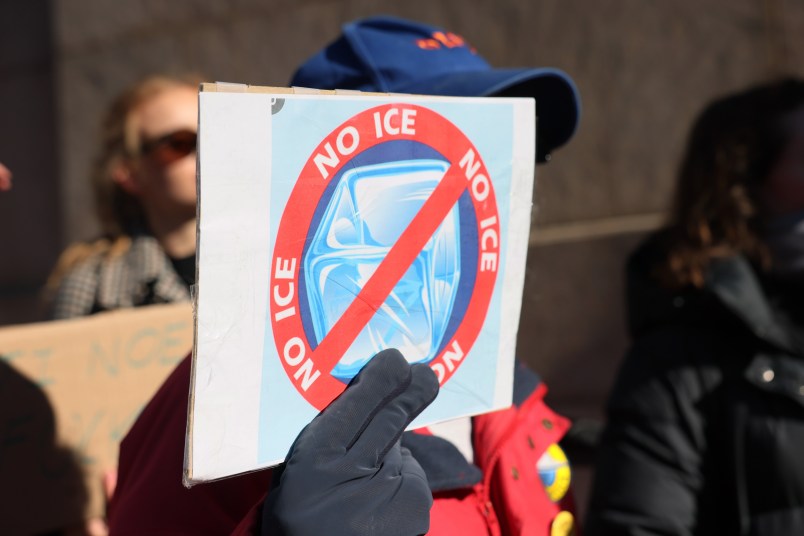
This article is part of TPM Cafe, TPM’s home for opinion and news analysis.
Last week, ICE released its own inspection report on Camp East Montana, the detention facility in Texas that has become a symbol of the administration’s overfunded, overcrowded, underregulated mass detention project — where prior reporting revealed that staff bet on which detainee might be next to die by suicide. The new findings were not leaked by advocates or surfaced by investigative reporters. They came from the agency itself: 49 failures in medical care, disease control, and oversight; undocumented uses of force; inadequate sexual assault response. The federal government’s own auditors documented the suffering, and the federal government will do nothing about it.
But while Washington absorbs the daily torrent of executive orders, social media provocations, and congressional paralysis, something significant is happening at a different level of American government. States are moving — aggressively, creatively, and increasingly together — to impose accountability on a detention system explicitly designed to avoid it.
The scale of what’s been built is staggering. Nearly 70,000 people are detained, an increase of over 70% from the end of the Biden administration. Children allegedly denied medical treatment, access to drinkable water and hygiene supplies, subjected to sleep deprivation. Rampant allegations of overcrowding and sexual assaults across facilities. Deaths in ICE custody hit a two-decade high in 2025 — even as ICE detention facility inspections dropped by more than 36% — and are on pace this year to surpass that record. More people, fewer inspectors, and a private detention industry gleefully profiting from every literal body behind bars.
States are not going to stand by.
For generations, liberals have been ambivalent about state-level power – wary of the other “f word,” federalism, and its ugly history as a shield for oppression. That wariness was, for a time, understandable. But it was costly. Conservatives figured out decades ago that states are critical venues of power, and that acting in concert, they can shift narratives, move markets, and generate pressure that no single state can produce alone. ALEC has spent 50 years moving model bills from capitol to capitol through trusted networks of like-minded legislators. The left ceded that ground for far too long. But state legislators who share a vision for the public good are finally reclaiming it.
State leaders across the country know that the old aversion to state power is no longer a plausible posture. As New Mexico State Representative Eleanor Chavez, co-chair of the State Futures Federal Response Coalition, said on a press call last week: “New Mexico is not going to participate in the business of human misery.” New Mexico just enacted HB9, prohibiting public bodies from entering into agreements with ICE to hold immigrants for civil detention purposes. The consequence is concrete and immediate: New Mexico’s largest detention center will have to close this year. That is what it looks like when a state exercises its power for the public good.
New Mexico is far from alone. State Futures, the organization I founded in 2025, is currently tracking over 200 state-level immigration and rule of law bills moving in 31 states. The range of tools being deployed is striking and very encouraging.
Cutting off cooperation. Twelve states — including California, Colorado, Delaware, Illinois, Maryland, Oregon, and Washington — have limited or banned state and local law enforcement from cooperating with federal immigration detention activities, including 287(g) agreements that delegate federal enforcement authority to local police. Many more states have proposed similar bills.
Regulating and taxing private detention. New Jersey lawmakers have proposed a 50% tax on the gross receipts of private immigrant detention facilities, with proceeds directed to an immigrant protection fund. This is a direct strike at the financial model that makes mass detention profitable.
Establishing rights for detained individuals. Washington gives detained people a private right of action — the ability to sue for monetary and injunctive relief when their rights under state law are violated. GEO Group, a federal contractor that operates ICE facilities, unsuccessfully tried to block the law, which remains in effect for now. Massachusetts is considering a bill that would guarantee detained individuals meaningful access to information in their primary language, access to counsel, and phone access.
Zoning and health standards. Maryland restricts the conditions under which zoning variances and permits can be issued for private detention facilities, and is considering a bill to further restrict zoning and another requiring facilities to meet minimum water and sewer standards. Illinois is weighing a bill that would prohibit detention facilities within 1,500 feet of schools, daycare centers, parks, and places of worship. Colorado is considering authorizing its Department of Public Health to require facilities to meet health and safety standards.
Transparency. Maine requires law enforcement agencies to retain records whenever federal immigration authorities request that someone be held. Illinois requires annual reporting to the state attorney general on immigration enforcement requests. Minnesota is considering requiring that vehicles used to detain and transport people be marked as law enforcement. Washington lawmakers have proposed both a statewide registry of all detention facilities and mandatory reporting of serious incidents to the Department of Health.
Inspection authority. Colorado requires annual health inspections of detention facilities. Washington has established routine inspections by its Department of Health. New York is considering creating a dedicated legislative committee for detention facility oversight.
These efforts aren’t confined to deep blue trifecta states. Bills are moving in Wisconsin, Arizona and Pennsylvania to limit or ban state and local law enforcement cooperation with federal immigration detention activities, among others. Even where passage is unlikely, they serve a purpose: they tell constituents that their representatives are paying attention, are outraged, and intend to keep fighting.
Beyond legislation, state leaders are litigating, demanding physical access to facilities, and making the fight visible. They’re responding to a groundswell of opposition from residents and activists who are concerned about everything from transparency to tax revenue loss to community impact. And they’re doing it together. A new State Futures Federal Response Coalition now connects 113 legislators from 36 states, which together are home to 80% of the U.S. population. This broad and powerful coalition of state leaders is sharing strategy, aligning on model bills, and ensuring that a breakthrough or idea in one capitol travels quickly to the next — at last, a counterweight to the state-level organization and collaboration on the right.
Almost 70,000 people are held in immigration detention right now, roughly the population of Scranton, Pennsylvania — in facilities that are invisible by design, with an administration that intends that number to grow. But this is also a story about something quietly gathering force: state lawmakers discovering they have more authority than they thought, more allies than they knew, and more obligation than they can ignore. The federal government documented the suffering at Camp East Montana and walked away. States are walking in.




States fighting back. Great post.
Of course, this all has nothing to do with detention for legitimate reasons. Anyone over the age of 12 knows that the facility is leased way over fair mkt prices, then the landlord gives large kickbacks to the trumpians.
Yes they are. Lots of people are fighting back. At every level. Day in and day out.
Unfortunately, that doesn’t sell nearly as well as panic. Or doom-posting. Or cynical hip.
There’s plenty of encouraging pushback – but that’s not what social media or journalism sell.
(And we’re all less for it.)