


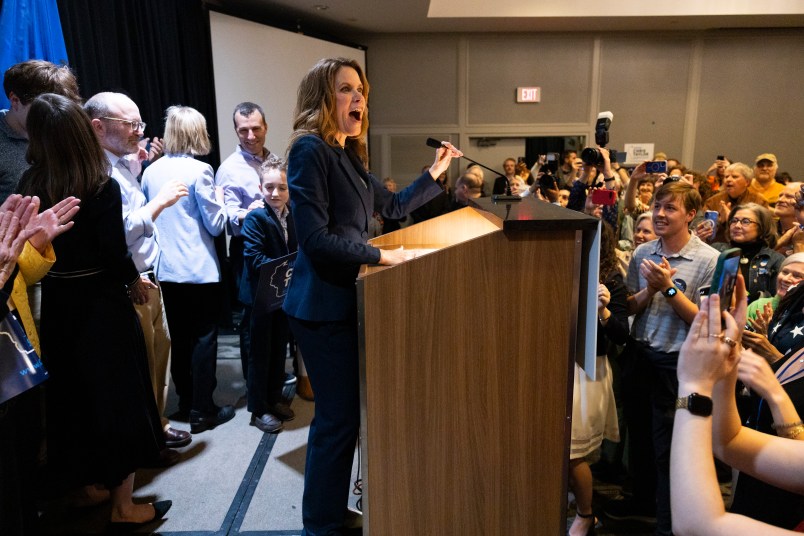
Chris Taylor, the Democratic-backed candidate for Wisconsin’s state Supreme Court, easily defeated Maria Lazar, the Republican-backed candidate, expanding the Court’s liberal majority, per the Associated Press. Taylor was leading 60.1% to Lazar’s 39.8% with 95% of the votes in on Wednesday morning, according to the New York Times‘ tracker.
Her win represents the fourth straight victory for Democratic-backed candidates in the state’s high court elections.
The outcome is in keeping with polls over the last few months, which consistently showed Taylor running ahead of Lazar, as well as Taylor’s fundraising and ad spending advantage over Lazar throughout the campaign cycle. That, coupled with liberal candidates’ double-digit victories in the last three state Supreme Court races, had Wisconsin Democrats feeling hopeful ahead of Tuesday night’s election.
“Once again, Wisconsin showed the entire nation that we believe that the people should be at the center of government and the priority of our judiciary, not the billionaires, not the most powerful and privileged, but the people,” Taylor said in her victory speech.
Taylor spent the last week of the campaign barnstorming around the state and secured an endorsement from former President Barack Obama. Former Attorney General Eric Holder also stumped for the liberal candidate this last week. Taylor — an appeals court judge and former state legislator who previously worked for Planned Parenthood — campaigned on her support for reproductive rights and her opposition to recent cuts to safety net programs. Lazar, also an appeals court judge who worked for former Wisconsin Gov. Scott Walker’s (R) administration, campaigned on an anti-abortion position and tried to criticize Taylor’s political career, despite having one herself.
Wisconsin’s state Supreme Court races regularly attract huge sums of money and national attention, in part because the purple state’s high court has a say in a number of high-stakes issues, including state-level redistricting and other matters related to election administration. The court may also hear cases related to any sort of election disputes, including those that may come with the certain-to-be-fraught 2028 presidential contest.
Unlike similar Wisconsin court elections in 2023 and 2025, this month’s race did not have the power to determine the court’s majority, as the outcome of those previous races cemented a liberal majority until 2028.
In 2023, after voters elected Democratic-backed Justice Janet Protasiewicz, the Wisconsin Supreme Court flipped from a conservative to a liberal majority. Then, in 2025, Democratic-backed Susan Crawford defeated her Republican-backed opponent and affirmed a liberal stronghold on the court for an additional three years.
As it stands now, with Taylor’s win, the court now holds a 5-2 liberal majority.
Among the issues the new state Supreme Court may hear are cases stemming from the state’s near-constant fights over gerrymandering.
Last summer, the state Supreme Court declined to take up a case challenging the state’s Republican-favoring congressional maps. Instead, enforcing a 2011 law, it appointed a three-judge panel to hear two of the cases against the state’s gerrymandered maps. One case was filed on behalf of Democratic voters and argues that the maps discriminate against Democrats. The other lawsuit was filed by Wisconsin Business Leaders for Democracy and argues that the maps are an anti-competitive gerrymander.
Final rulings on these cases from the panel can and likely will be appealed to the state Supreme Court.
Although we do not yet know when the panel will make a decision on the maps, Howard Schweber, political science professor at UW-Madison, told TPM that it is likely to rule that the maps are unconstitutional.
“I think it is pretty much certain that each of the panels will rule the current districts to be an unconstitutional gerrymander,” he said. “The judicial panels are empowered to adopt new maps, which can then be appealed to the state Supreme Court — but they do not have to take the case. So one very plausible outcome is that the panels produce a set of maps and the Supreme Court simply lets them stand.”
The court will also rule on a number of issues related to election administration and voting in the state.
In the past, the court has ruled on whether or not to ban ballot drop boxes, as well as a challenge to a bill that sought to expand who can bring forward election-related lawsuits. And in the future, per reporting from Votebeat, we can expect the court may also hear cases on whether or not people with disabilities can cast electronic ballots, and whether or not the Wisconsin Election commission can demand an audit of the citizenship status of registered voters.



Amos 5:24: “Let justice roll down like waters, and righteousness like an ever-flowing stream.”
Shit, there goes Western civilization. I really mean it this time. – Elon “Cheesehead” Musk
On Wisconsin!
And Good Night!
Huzzah!!
I was a poll watcher in Racine yesterday, and it seemed like hardly any MAGA party voters showed up.
it’s a shame they did in November 2024, since Orange Caligula™️ won the state.