

Manhattan’s St. Mark’s Church in-the-Bowery was packed with a standing-room only crowd of well over a hundred people. It was Jan. 12, a cold Monday evening and not a typical night for services, but the crowd was gathered for a special vigil announced on short notice. They were there to honor a woman the White House has branded a “deranged lunatic” and a domestic terrorist.
“Welcome again friends to this time of prayer, reflection, lament, and singing in response to the death of Renée Nicole Good and all those whose lives have been broken or harmed by the cruel and violent immigration system in the U.S. and the increasing militarization around our country,” Reverend Anne-Marie Witchger, the church’s priest declared as the service began.
Good, who was 37, died after being shot at least three times by an Immigration and Customs Enforcement officer on Jan. 7. She and her wife were among a group of Minneapolis residents who showed up at the scene of ICE activity with whistles to alert their neighbors as the city has been the focus of a wave of immigration raids. On Saturday, another person, Alex Pretti, was killed by federal agents after being shot at least ten times while he was filming immigration enforcement operations.
As TPM has chronicled in our series on the “Undocumented Underground,” those grassroots rapid response efforts are one part of a growing movement resisting President Donald Trump’s mass deportation push. The recent shootings by federal agents show how these activists are putting their lives on the line. And the services for Good are just one small example of how much churches have become a central hub and a flashpoint in the fight.
Faith leaders have played a prominent role in rapid response efforts and other protests. Hundreds of clergy members from a wide range of faiths have flocked to Minneapolis to stand alongside organized groups resisting ICE. When federal agents swarmed Chicago last fall, faith leaders became a regular presence in protest actions outside the detention facility that served as an ICE headquarters. And, in New York and around the country, churches have become the setting for legal clinics and other services for the undocumented immigrant population. Those programs have operated in a climate of fear since, shortly after taking office last year, the Trump administration issued a new directive allowing ICE raids inside houses of worship, reversing a longstanding policy against the practice.
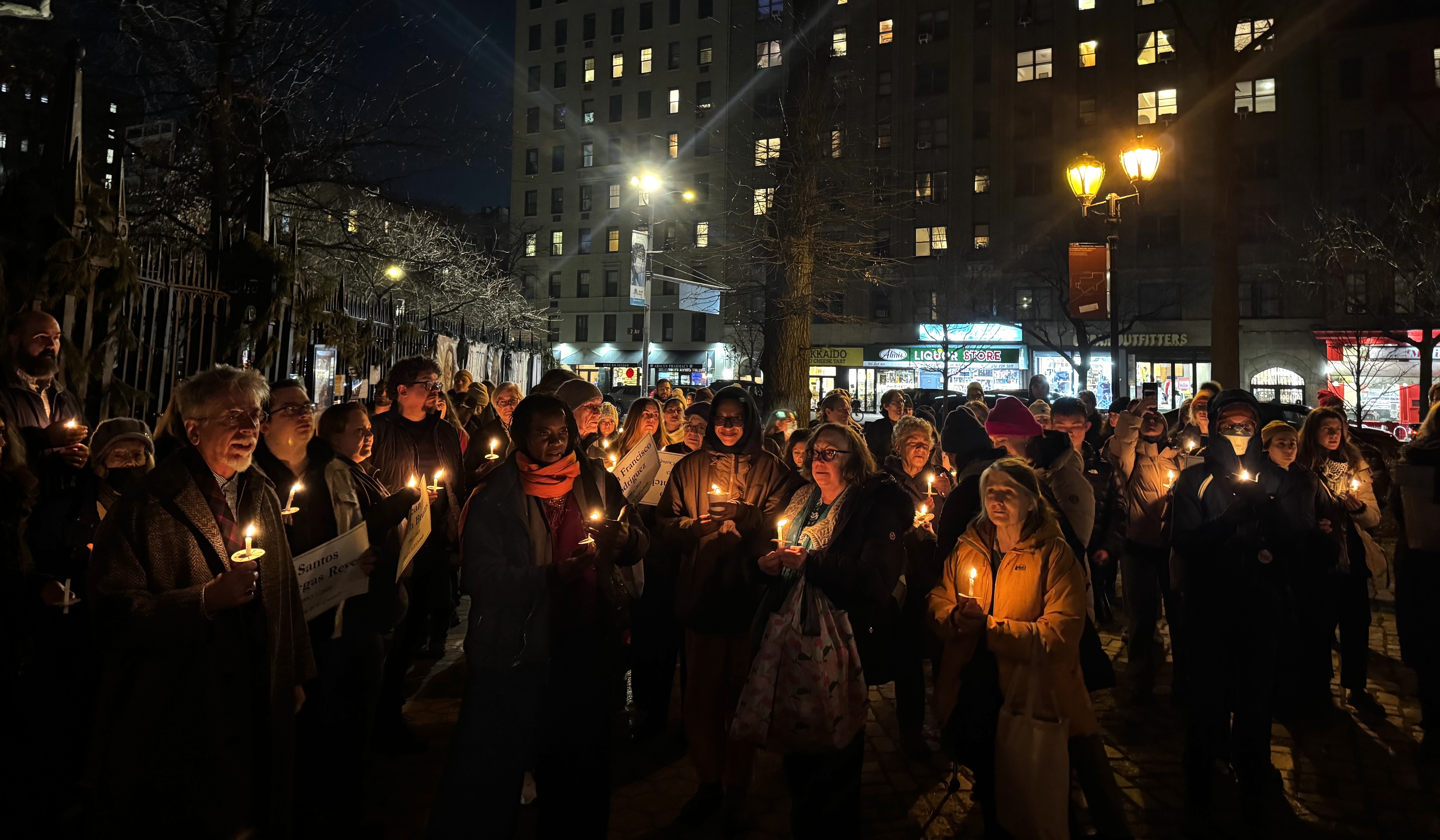
In Manhattan, the vigil for Good was sponsored by four churches; St. Mark’s, which hosted the event, Judson Memorial Church, Trinity Lower East Side, and Middle Collegiate Church. In his remarks at the event, Rev. William Kroeze, the pastor at Trinity, laid out his view of the stakes. Kroeze noted that his Lutheran denomination has German roots. He pointed out that, “as the drumbeat of fascism began to rise” in that country “so many of our own joined their ranks” while others fought back.
“I’ve often wondered what it would have been like to have made the choice to stand with the light or to stand with darkness,” Koeze said. “It’s always been so hypothetical: what was that like, what would it have been like to be a person of faith? … Well, that’s not hypothetical anymore. We are in those very same days ourselves.”
Speaking with TPM ahead of the event, Witchger explained that the situation in Minnesota had, for many people, served as “a wake up call.”
“The way that the Trump administration is handling immigration, the tactics that ICE officers are being empowered to use, it’s violent and it’s cruel,” she said, “ and it impacts all of us, and it has to stop.”
Those concerns have similarly led church leaders to establish programs to provide immigrants in New York with food and housing. Witchger, for example, has worked in “collaboration with other downtown churches” to establish a transitional housing program in New York City. She said the effort is rooted in religious conviction.
“Faith leaders started talking and emailing each other and saying, ‘How do we respond to this huge need that we’re seeing in the community?’” Witchger recounted. “People started saying, you know, one of the main things that we have is space. We can open space and we can gather people. … As faith communities, that’s sort of what we do. We create space. We gather people. We feed people. That’s at the heart of what Jesus did.”
For Witchger, there’s a special resonance in helping migrants, many of whom have fled violence in their own countries. She pointed to The Gospels, which detail a time when the infant Christ and his parents “became refugees in Egypt” as they fled a campaign led by King Herod to kill young children as he feared the birth of a prophesied leader. The story, which is a major part of the narrative of Christ’s birth, has become known as the Slaughter of the Innocents.
“We’re well acquainted in our faith tradition with the violence that comes from fear at the center of power,” Witchger said.
The housing program Witchger is involved with is located inside of a church property somewhere in the five boroughs. (Throughout this series, TPM has refrained from identifying precise locations where services are being provided to undocumented immigrants and often agreed not to use peoples’ real names.)
The men inside the home do not open the door for strangers. When I visited late last year, no one answered my initial knock on the door. After a few minutes, the volunteers who work with the program showed up and placed a call to the migrants inside, who let us in. Apart from the initial security procedures, the home is an inviting one. The men had prepared a spread with juice and tea. There were floral rugs and couches and a television playing Premier League soccer.
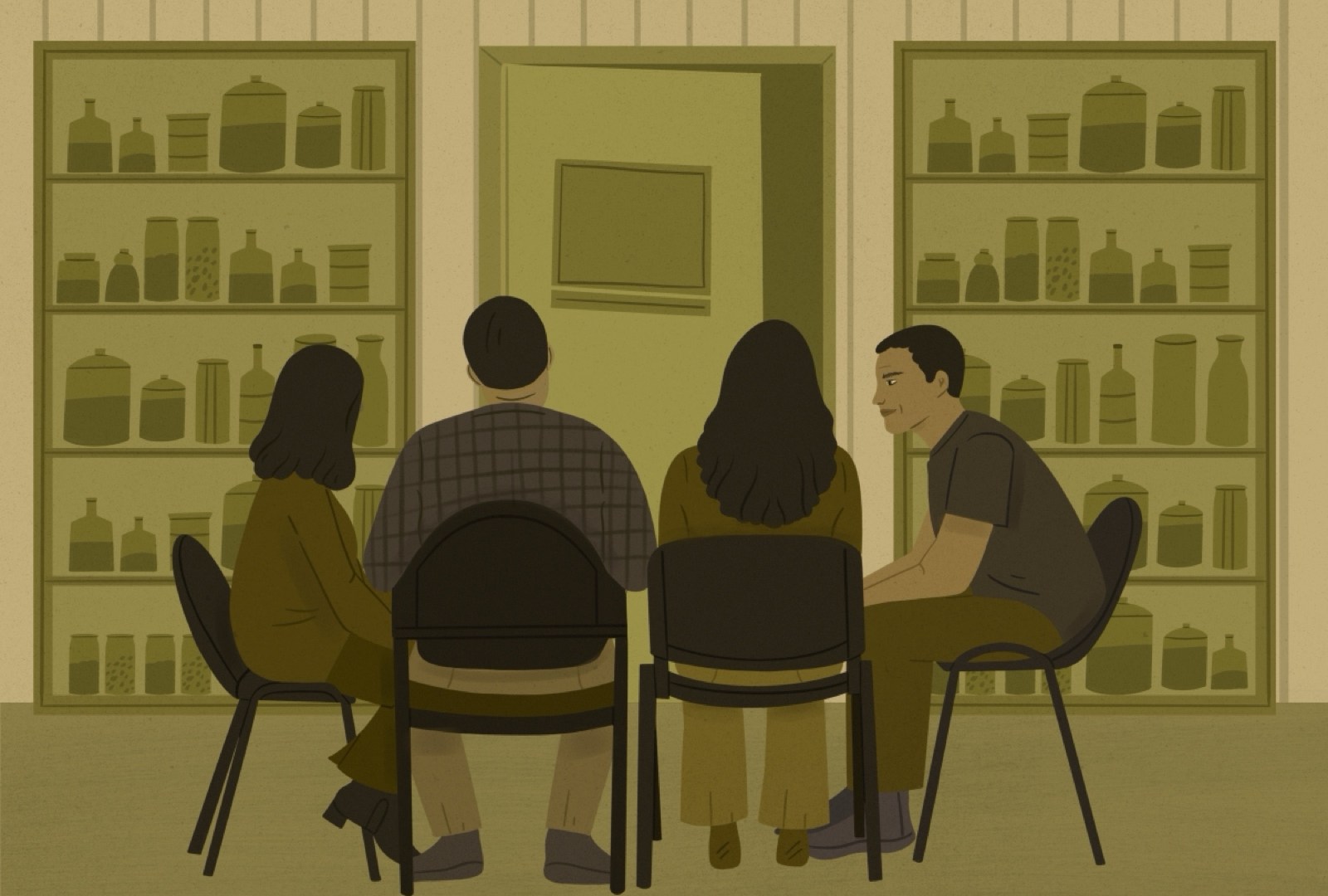
On my visit, I was accompanied by three volunteers who were there to lead a monthly house meeting: a social worker named David, and two women who work with the program. They sat around the cozy living room with the five current residents of the house, who are all from Senegal and Guinea.
“Good morning my brothers and my sisters, community of the house,” David said in halting French.
David has been studying the language, but his knowledge is limited. One of the women who accompanied him was a Senegalese congregant from a church involved in the effort. She has volunteered as a primary translator for these meetings. As he began, David pointed at me, informed the group they had a “guest,” and asked me to introduce myself. In my own broken French, I told the five men about this series and stressed that I would not be identifying them in this story. David then asked the men if it was alright for me to stay and record. One turned to me and asked for assurance his name would be kept on “the private side.”
“Welcome,” he said when I confirmed he would remain anonymous. “It’s a pleasure and that works for me.”
The others nodded agreement.
In my conversation with Witchger, she explained that the goal of the program is to provide residents with “free housing” and “an opportunity to save money.” They are also paired with a mentor. In exchange, they must be working or in school.
“We have sort of agreements and basic rules, but there aren’t a whole lot. I mean, it’s not meant to be particularly prescriptive in that way,” she explained. “It really is meant to put trust in human possibility and the capacity for humans to flourish if given the space and the tools.”
Those guidelines include participation in the monthly meetings and a prohibition on alcohol and drug use. The substance abuse ban hasn’t proved controversial since the program caters to migrants from West Africa, a small but growing portion of the undocumented population that is particularly prevalent in New York, most of whom are practicing Muslims. David, the volunteer social worker, said the church is eager to work with those in need who are outside of their own religious community and noted that local mosques have also pitched in on the effort.
“We not for a minute ever wanted to convert anybody,” he said. “Actually, we’ve had some wonderful relationships with mosques.” .
At the house meeting, after initial introductions, security and safety were top priorities.
“The first thing is, we are really glad to see you, and we care so much about you. You are, in a way, our family,” David said, adding, “And for us, it’s a big responsibility. … It’s very important. … You are dear to us … our first priority above all is to keep you safe.”
He then went around the room and asked everyone “how it’s going.” One of the men discussed his work as a home attendant and talked about how he had recently received his professional license.
“We’re so proud of you,” David said.
Another talked about being “a little tired” after working nights delivering food. Then, the conversation turned back to security. One of the men described an incident that took place during the month where he said the police stopped the residents as they were locking their gate.
“I heard them asking the guys for ID,” the man recounted. “I said, ‘Close the door. Tell them you can’t open the door.’ They kept pushing, saying, ‘we have to go in.’”
That incident was resolved when the men put the officers on the phone with someone from the church who verified that they had permission to be in the home. However, they said there is now a constant police presence on the corner that has amplified their concerns about being turned over to ICE. A group of officers was present outside when I visited the home.
“They’re watching,” one of the female volunteers told the men. “The police are out there and people all around are watching. And that’s the point, you have to be very careful.”
Another one of the men said they did their best to avoid unwanted attention from law enforcement. Their situation is an example of how migrants around the country are concerned about local police potentially working with federal immigration enforcement. In New York, the new mayor, Zohran Mamdani, told TPM he plans to maintain the city’s “sanctuary” status, which includes the police force only cooperating with ICE and federal law enforcement in cases that involve specific, serious offenses including murder and rape. Yet, those assurances haven’t eased the fear of police felt by migrants living in the shadows.
“You know they stand here all night,” he said. “We have a regimen. We have a route before getting in here. … We know what to do and what not to do.”
I turned to David and said I was struck by how excited the men were by the whistles and how moved they seemed to be that American citizens were organizing to watch out for ICE. He agreed. “It means the world to them,” he said.
The female volunteer tried to acknowledge how tense the experience is for the home’s residents.
“When we’re talking about stress, it’s the stress of living here and being a migrant, and living in this society, and being watched all of the time, correct?” she asked. “I mean you’re being watched all of the time.”
“Every corner,” one man said, nodding.
The churches opened this housing program in 2024, but the situation has become far more fraught for the residents since Trump took office last year and stepped up immigration enforcement. During the meeting, one man said his life was “going well” apart from his concerns related to the recent wave of raids and detentions.
“I’m just worried a bit because the things we see happening with ICE and, whenever people in the house go out, I am worried about them coming back safely,” he said. “When we’re back here together I feel good.”
Witchger noted that, for the churches involved in the program, giving the men some measure of calm is important.
“The fear is so, so present,” she said. “We are really working hard to create spaces that feel safe and comfortable. We see that as a core part of our faith too.”
To that end, the volunteers used the meeting to discuss fire drills and smoke detectors with the men. One of the men, who was a designated “safety captain” reviewed his work on this front. They also talked about pooling resources to get toiletries and supplies. The volunteers shared a few places that could help provide basics like rice and cooking oil. They also made plans to get flu shots.
As the meeting drew to a close, David asked me to talk to the men about what I had seen outside and in court. They were particularly interested in the rapid response efforts and the whistles used to alert people to ICE.
“We want to get whistles!” one of the men said.
After a little over an hour, I left with the volunteers. As we walked away, I turned to David and said I was struck by how excited the men were by the whistles and how moved they seemed to be that American citizens were organizing to watch out for ICE. He agreed.
“It means the world to them,” he said.
At one church in the city, the priest opens the doors every afternoon to the largely Latin American community of undocumented migrants in the neighborhood. He runs a small food pantry for them and also helps advise on court cases. The priest invited me to visit one day late last year and, even though we got there over an hour before the program technically began, there were already several people waiting outside.
As we came in from the cold, an Ecuadoran man, Jaime, sat outside the priest’s office waiting to discuss his case.
“I have an order of removal and I have 28 days to try and change it. I’m hoping with guidance from the priest everything will go well and they will accept my appeal,” Jaime said in Spanish, adding, “Those of us who come here, we feel in some way protected … because the priest guides us, tells us the things we have to do. … Being alert to the things that could happen day by day, I think that’s how to get more peace of mind.”
Jaime said he is 40 years old, drives an ice cream truck, and came to the United States from Guayaquil, one of Ecuador’s largest cities. He is seeking asylum due to the rampant gang violence that has plagued his country in recent years.
“Sadly, in Ecuador, everything changed in an instant. It was a very safe country. … The country is so out of control with crime right now that a lot of people like me have left,” he said.
Here in the U.S, Jaime said his main goal is to have his case reopened so he can obtain a work permit, help his family, and make an “honest contribution.” All of that has become more complicated under the Trump administration, which has placed a hold on new asylum applications, dismissed many pending cases, and removed deportation protections from people with ongoing appeals. Jaime is committed to pressing on despite the difficult climate.
“It’s not like you’re going to come here and have everything. You have to build it … even at times when the laws aren’t favorable to everyone,” he said. “That’s where we are.”
Yet even amid his resolve, Jaime also admitted he is afraid.
“It’s something totally uncertain in that you don’t know if they will take you or if they won’t take you,” he said. “There’s a lot of worry. There’s a lot of uncertainty. There’s a lot of fear, but you have to fight against it and keep going.”
Further inside the church, two Honduran women were unloading boxes of food in a small kitchen. One of them, Cristal, explained that they were trying to give back after receiving help at the church.
“We help the priest distribute food to the people who come here because, for the time being, we don’t have work,” she said. “They offer us a lot of help here so assisting is a way of thanking the priest for the help he gives us.”
Cristal said it is “difficult” to find work because she does not have a permit. She is currently seeking asylum after coming to the U.S. with her 13-year-old child.
“I have a case. … I crossed the border over the river like all of the migrants … to make it here. I had to sleep on the streets with my son,” Cristal said.
Cristal also said she emigrated to escape crime in her country.
“It’s very difficult there because of the gangs. They take territory to sell drugs. They killed my ex-partner’s entire family,” she said. “They tried many times to kill my son or to take him from me.”
According to Cristal, the situation was particularly bad because the boy’s father had been involved in crime. That left some of the gangs with a vendetta. Cristal said she tried to move on and start a family with another man, but he left her “alone and pregnant.” And the gangs did not leave her alone.
“They came to my house, they beat me, and I lost the child. They put me into a coma,” Cristal said. “When I began to recover, I made the decision to leave my country and come here. I didn’t tell anyone. I didn’t even tell my family.”
Here in the U.S., Cristal and her child have found a new fear: ICE.
“It feels horrible. It’s a terror that we live every day,” she said. “My son lives it every day at his school. He asks me, ‘Mom, if they show up there, what should I do?’ … My son didn’t even want to go to school because of it. We stopped for two months. … It’s not just my son: all the kids in school live in that terror.”
The church has been a welcome refuge.
“The priest has been a great support for everyone who has come here knocking on the door,” she said. “He has never denied anyone food or information.”
Karen, the other woman working in the kitchen, was initially reluctant to talk. However, Cristal encouraged her to sit with me. Karen said the violence in Honduras was particularly dangerous for her because she is trans.
“Everything was very tragic with how I left my country because the main reason I came to the U.S. looking for opportunity is that, in Honduras, there is a lot of discrimination against trans people,” she said. “There were many times they tried to kill me because I am a different kind of person.”
Karen is currently living in a shelter while requesting asylum. For her, the church has been a vital resource.
“Here in the church, I have had many opportunities with the priest. He advises me. He’s given me advice on the steps I should take while waiting for my asylum and trying to secure a work permit,” she said.
Organized religion has not always been friendly to the LGBTQ community, but Karen said everyone has been welcome at the food pantry.
“There are no problems here for that, for this priest, the pastor of this church. For him, there are no distinctions of any type of person, neither sex nor color. For him, everyone is equal,” she said. “Here at the church, there’s always, always food, even for people from the streets. They come in all dirty, they are given clothes, they are given food.. … Here we feel safe, we feel a great peace and tranquility.”
Outside, the situation is different. Karen said she lives “with the fear.”
“We all run the risk of being caught and being deported,” she said. “They don’t bother to understand a person’s situation or why they’re here. They’re not interested. Even if your life is at risk in your home country, they just take you, and their only concern is sending you back to your country.”
Both Karen and Cristal said the main thing they want is a legal work permit and, effectively, a full chance to participate in American society. Karen said she would love to work as a cleaner in a home, office, or kitchen.
“We ask that they get to know us a little better and that they give us the opportunity to work, and to obtain a permit, and a job,” she said. “We are determined to work however we can.”
Cristal offered a similar perspective.
“We came here only to work to move our families forward and move our children forward,” she said. “We came to this country with the hope that our children wouldn’t face the same challenges we did. … That’s all we ask for, an opportunity to work.”
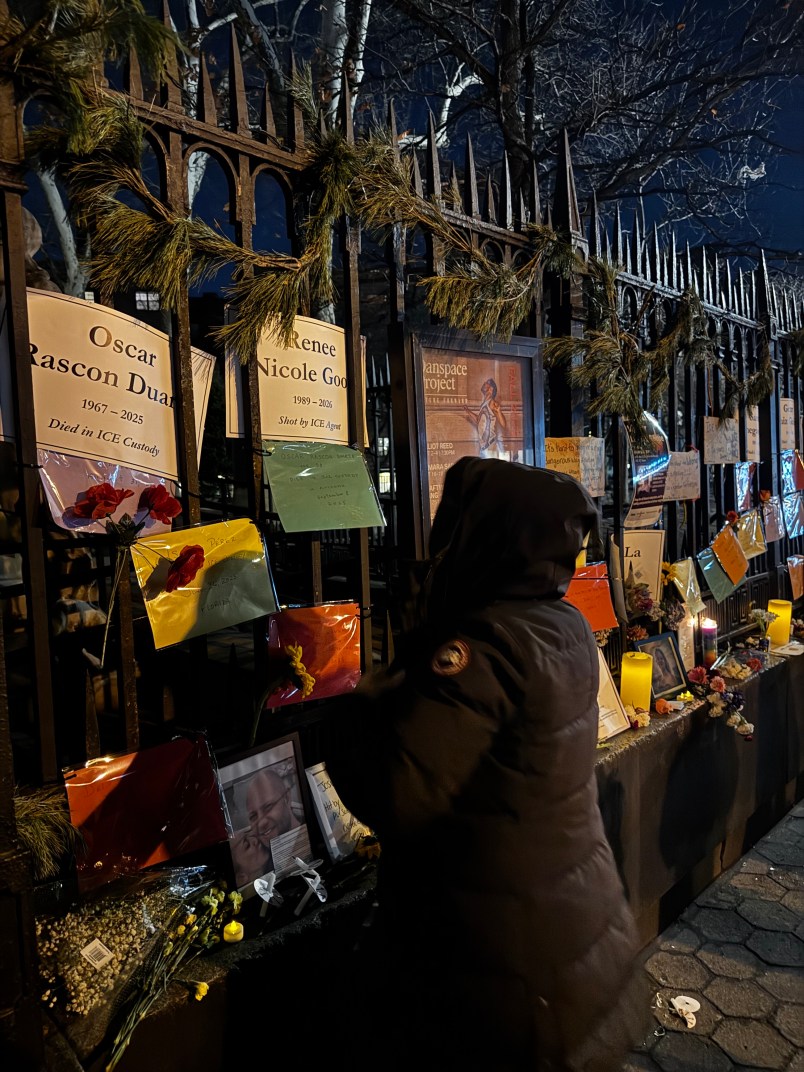
Earlier this month, as the vigil at St. Mark’s Church in-the-Bowery came to a close, the crowd spilled into the surrounding streets carrying candles and cards bearing the names of Renée Good and dozens of others who had been killed by ICE last year. The gates outside the church have been turned into a makeshift memorial with art and photos of the dead.
As the group stood with their candles and sang, a six-year-old girl named Ida scampered through the flickering lights accompanied by her aunt. She wore a pink sequined skirt and carried a bag of whistles.
“Does anybody want a whistle? Anybody over here need a whistle?” Ida said.
I asked what she was doing and why.
“We’re giving people whistles,” Ida said. “They alert your neighbors … about being safe.”
As I said good night, Ida turned the focus back to her rapid response efforts. She had a question for me:
“Do you want a whistle?”




Good to see. I recognize some folks on these sites have nothing positive to say, think, or feel regarding religion for, in their case, probably understandable reasons. Since media representing the administration’s alternate reality will not carry this story, thanks TPM for carrying it. There are many good folk acting concretely out of their religious faith to benefit our neighbors. A BIG THANKS to them!
“Silence in the face of evil is itself evil; God will not hold us guiltless. Not to speak is to speak. Not to act is to act.” – Dietrich Bonhoeffer
Beautiful, stirring, and humbling, all at the same time. This represents the very best of organized religion in our troubled, conflicted society.
I have only one question: Where are the white evangelical churches?
The position of anti-immigrant doesn’t seem very disciple-like, does it? Perhaps their Jesus is only powerful enough to assist their favorite football team or their favorite NASCAR driver.
Perhaps that Jesus that they pray to is nowhere near powerful enough to assist to with societal issues related to providing refuge to the oppressed. A weakling slacker Jesus. A lazy sandbagger Jesus. I don’t think that I would pray to that Jesus, nor read the book about him.
Or their favorite president, the new King Cyrus?