


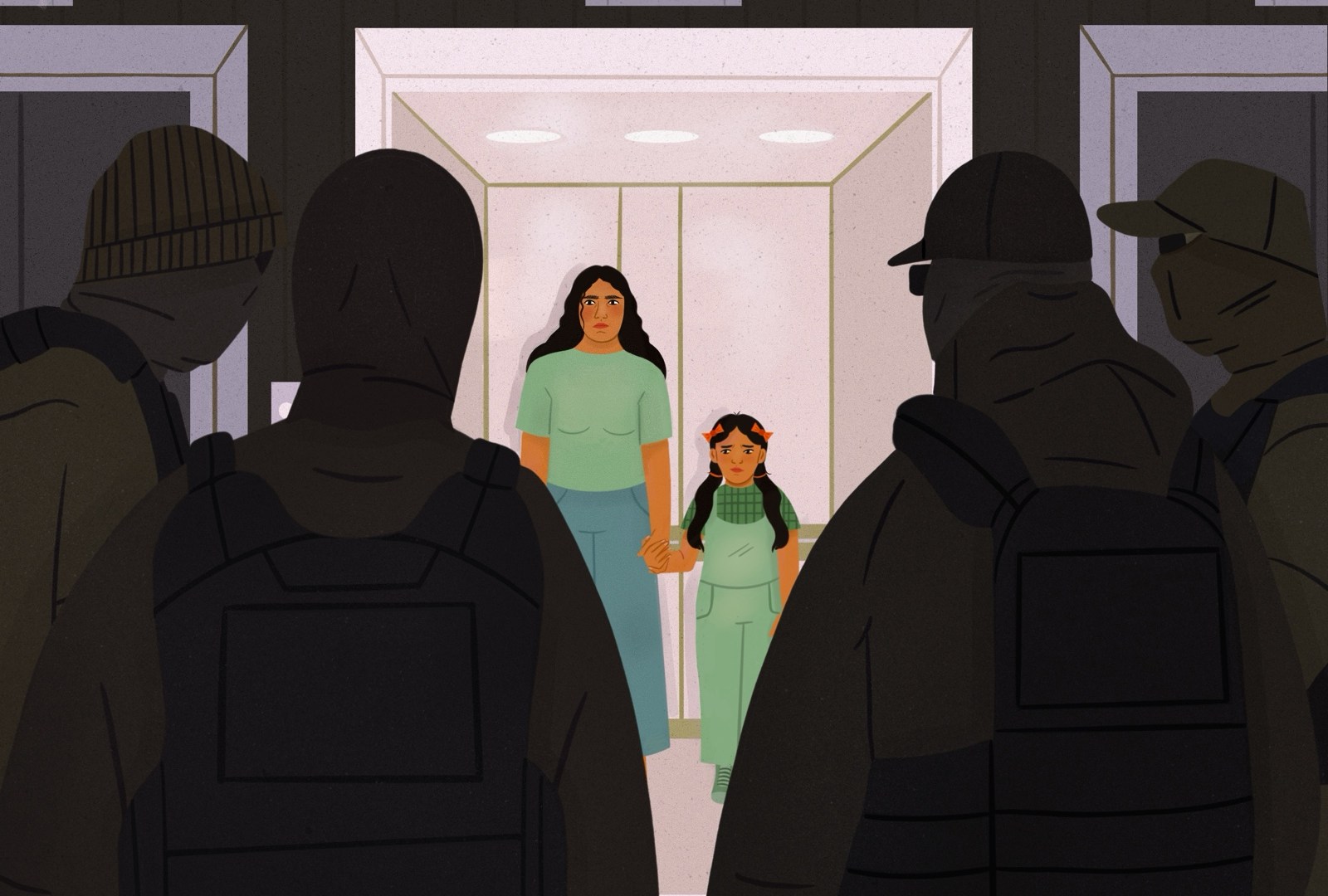
One day last month, a Peruvian mother and her daughter went into Manhattan. They were both dressed in their best. The girl, who could not have been more than 10 years old, had a pink backpack shaped like a cat and matching bows in her hair. It was an important day: they were due at the immigration court at 26 Federal Plaza for a hearing related to their effort to obtain lawful residency.
But while these courthouses are theoretically the gateway to American justice and citizenship, in recent months they have played host to horrifying scenes where many of those who hope to experience the best of this nation are instead forcefully rounded up in the halls by federal agents.
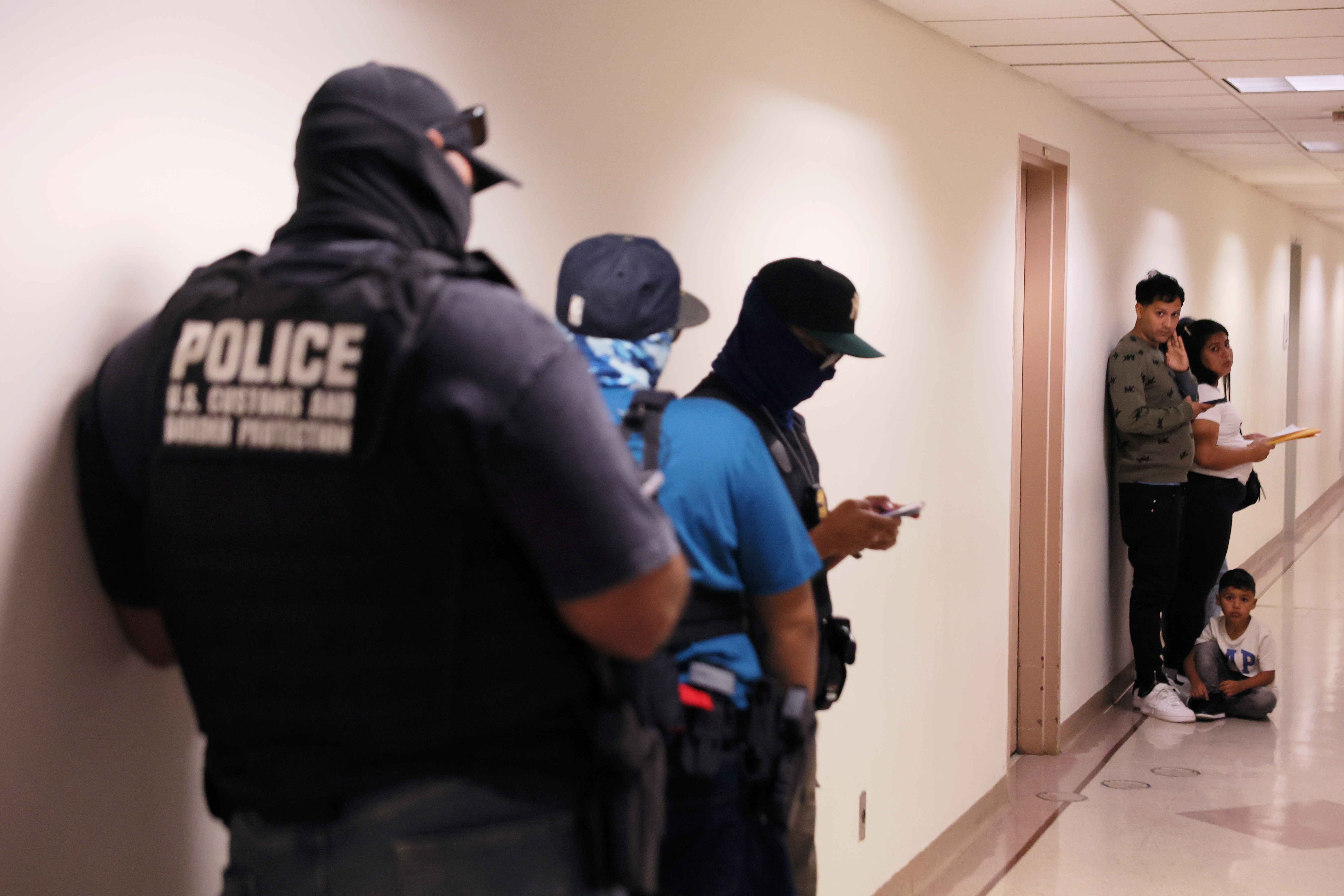
Since President Donald Trump retook the White House in January, he has sought to bring his vision for “mass deportation” to life by expanding the budget for the Immigration and Customs Enforcement agency, instituting drastic removal quotas, expanding detention facilities with little concern for alleged human rights abuses, and staging dramatic raids with heavily armed officers from multiple federal agencies. In New York City, the masked footsoldiers of Trump’s deportation machine have set up shop in three immigration courts where they regularly detain people who show up for hearings and mandatory check-ins.
When these agents pull immigrants from the halls of these Manhattan courthouses, they are also ripping them from their shot at citizenship. Often those who are being dragged away have further court dates and appeals. Traditional due process is being snatched from them. Even for those who are not taken, the daily spectacle has left them with a profound fear. Each person who comes to these courts knows they could be next.
For the Peruvian family, walking into this world meant passing under the glare of a handful of agents who flanked one of the halls. Their black masks and tactical gear made them dark shadows in the fluorescence of the cramped corridor.
The mother and daughter made it through their court appearance. Their next hearing was scheduled for some time in 2029. In theory, the justice system had granted them time to make their case and stay in the country. But leaving the building would not be so simple.
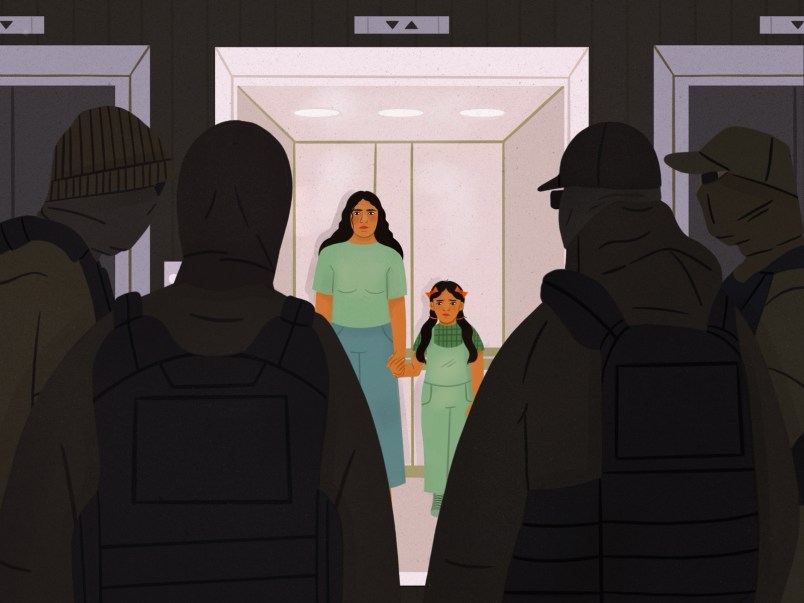
Agents surrounded the elevator bank in the center of the hall, encircling the Peruvian family as they waited for the ride down to the exits that would allow them to experience another day of American life outside. As the doors slid shut after they got on board, one of the masked men pressed a button to hold it up. He stepped into the cramped car and towered over the mother, who was just over five feet tall. The man stood, silently facing the woman and child. Black sunglasses made his face a reflection of the family’s fear.
Their ride was an agonizing wait as the threat of detention literally loomed over them. Their two hands squeezed. About halfway down the tall, grey tower, the elevator stopped and the agent exited.
I explained in Spanish that I was a reporter and that the other man left on board the elevator was a volunteer court observer named Peter Melck Kuttel.
“We’re not agents. There’s no ICE here now.”
The woman let out an audible sound, something between a gasp and a cry.
“I was very scared,” the woman replied, in Spanish. “Very nervous.”
The observer handed her the business card of Father Fabian Arias, one of the many religious leaders around the city who have been organizing legal clinics and other resources for immigrants. When the elevator reached the first floor, he walked her towards the exit and encouraged her to move quickly.
At 26 Federal Plaza, getting out of the building means freedom. And many do not get out.

Since October, TPM has made multiple visits to the immigration courts in Lower Manhattan. Along with the masked agents and the deep panic they have instilled in the immigrants who are required to report to the building, we encountered elements of the Undocumented Underground.
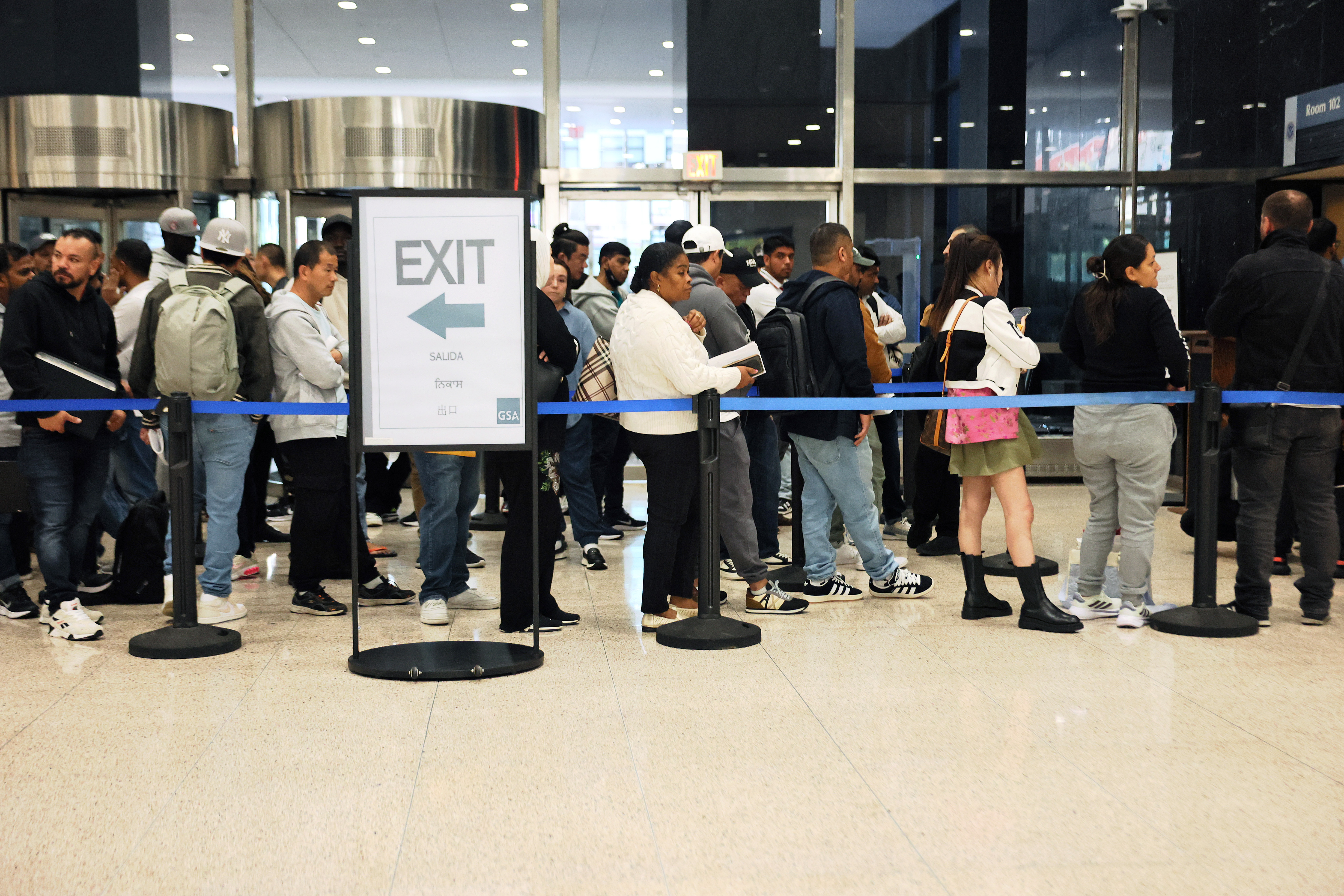
Data compiled by local news outlets shows that courthouse detentions are uniquely prevalent in New York. In the city, there are several organized efforts to offer immigrants at the courthouses legal assistance or simply accompaniment as they face the threat stalking the halls. Some of the groups volunteering in the courts decline to speak to the press or identify themselves for fear of retaliation. Other court observers allowed us to spend time with them and explained how they have come up with a rapid response system for addressing detentions. And this somewhat ad hoc network of advocates and activists has managed to find a key ally in Congress. They’ve also won court victories that have seen multiple immigrants released and reunited with their families.
Kuttel, a 30 year old with slicked-back, long hair, a closely cropped beard, and a penchant for sharp plaid dress pants, is a fixture in this scene. He’s at the courts pretty much every day. Currently, Kuttel is working as a full-time volunteer with Arias’ church. He previously worked with New Sanctuary Coalition, an immigrant advocacy group. In one of our conversations, Kuttel explained that the court observers have discovered each of the federal agents in the halls has their own “persona” and “unique flavors.”
“Some of them are very sadistic. Some of them are just in it for the love of the game because they think that they are doing the Lord’s work and that every single person they detain … is some violent criminal that they’re removing from the streets and from the country,” Kuttel said. “That couldn’t be farther from the truth.”
Analyses have shown that there is an unprecedented number of people in ICE detention and about two thirds of them have no criminal convictions. Trump and his administration have said their beefed up immigration enforcement complex is aimed at the “worst of the worst” violent criminals, but the majority of the people caught in the teeth of his detention machinery are not criminals at all.
“You don’t really kind of grasp the scale of what’s going on until you see it in person,” he said.
Volunteer court observer Peter Melck Kuttel
On board the elevator that day last month, we apparently saw an agent who has become one of the most infamous figures at 26 Federal Plaza. Kuttel explained that the regular observers have nicknamed him “The Big Guy.” The reasons are obvious: The Big Guy is well over six feet tall with a wide, thick chest, which makes him easy to spot among the other masked men in the hall. Yet sheer size isn’t the only reason he stands out.
“He likes to intimidate. He likes to get in an elevator with you,” Kuttel explained. “He likes to follow people around. He likes to stare at you.”

Earlier that morning, I drew The Big Guy’s attention when I approached a group of six masked guards and asked for directions to the bathroom. The Big Guy stepped in front of me and looked over the notebook in my hands.
“Why’d you write down IRS?” he asked.
I explained that I was a reporter and pointed towards one of the agents, who was wearing a vest emblazoned with “IRS-CI,” which is the abbreviation for the tax agency’s criminal investigations unit. He was the only agent whose affiliation was identifiable. The Big Guy demanded to see my press pass.
“You have to identify yourself,” he said from behind his mask. It was unclear which agency he works for.
In fact, both press and members of the public are allowed in 26 Federal Plaza and the courts downtown. The proceedings there are theoretically public. However, under Trump, the immigration judges he has chosen to keep amid a wave of firings, and the rule of The Big Guy and his colleagues in the halls, the reality is quickly changing. Individual courtrooms and even waiting rooms are regularly blocked to outside observers and even credentialed reporters. On the day of the elevator ride, as Kuttel stood outside the doorway of a hearing listening to the cases inside, The Big Guy ordered him to leave.
“Come on man,” The Big Guy said. “You know the rules.”
Afterwards, I asked Kuttel what regulation he had violated.
“No rule whatsoever,” he said, adding, “Rules change when ICE is around.””
A news photographer who is also a daily presence at the courts was standing nearby in the hall. The photographer agreed with Kuttel’s assessment of The Big Guy.
“He just goes out of his way to fuck with people,” the photographer said.
Just as the courthouse regulars have gotten to know the individual enforcement officers, the agents apparently have their eyes on the volunteers. After we left court that day, Kuttel and I were standing outside of 290 Broadway. It is another one of the downtown courthouses that’s located directly across the street from 26 Federal Plaza. Kuttel was involved in a furious series of back and forth calls to see if an immigrant whose case he was working on would be able to meet with him and other advocates. Suddenly, Kuttel gestured for me to turn around.
A small woman walking next to a much larger man had wheeled around in the street, charged up to us, and was angrily staring at Kuttel.
“Can I help you?” she asked incredulously
“You just look familiar,” he said laughing.
The woman huffed and turned back to go inside 26 Federal Plaza. As they walked away Kuttel explained why she had homed in on us.
“That’s Sam,” he said, adding that she was an ICE agent who had become a notorious figure for the regular court observers.
I was later able to identify the woman as Samantha Camlica. Badges displaying her name and ICE affiliation are visible in a newspaper photo showing her holding a detainee. At 26 Federal Plaza, Camlica has distinguished herself among the ICE agents for her small stature and the fact she is typically the only one who goes unmasked. She’s also become known for angrily lashing out volunteers, reporters, and detainees. In one incident described to TPM she allegedly threatened to handcuff a minister who was accompanying immigrants at the courthouse.
“She’s particularly aggressive and it’s like she takes pleasure in being particularly aggressive,” said one court observer.
Camlica — and her insults and “volatile” behavior in the halls — featured prominently in an October New York Magazine article that documented the stream of people being violently dragged from the courts and detained. The magazine included a picture of Camlica sucking on a lollipop. On later rotations, one court observer handed out lollipops of their own in an effort to poke fun at the ICE agent.
I called Camlica on Wednesday evening. She was in no mood to comment.
“Hold on. Hold on. Hold on. How did you get this number?” she asked, before abruptly hanging up. “I’m not talking to you.”
After running into Camlica, Kuttel and I went to a nearby park where he broke down the “several roles” volunteers play at the immigration courts. As he discussed accompaniment, Kuttel used the language favored by New Sanctuary Coalition, which refers to the immigrants they work with as “friends.”
For court accompaniment, volunteers meet a friend — the legal term is respondent — and “accompany them in and out of the building,” Kuttel said. “They become your friend for the entire day and you go in, you sit in the hearing, you help take notes, you gather documents and such, and then you help walk them out of the building, and make sure that they leave.”
Kuttel distinguished this from court “observation,” which he said entails watching multiple cases and “ensuring that proper rights and proper courtroom procedure is granted.” These days, Kuttel is mostly focused on what he calls “post-detention work,” which involves “trying to get the legal ball rolling immediately once family separation or detention happens.” The urgency involved in connecting immigrants to legal services stems from the fact the Trump administration has a tendency to rapidly move detainees out of New York. They are whisked away to other facilities in other states where judges order deportations at a much higher rate and are less likely to grant asylum. Those ICE flights also pull the immigrants away from their families and attorneys.
“It’s a clock that starts ticking,” Kuttel explained. “They will be here for less than 24 hours. They’ll end up in another state and it makes it very difficult to provide legal work or assistance. So, we try to connect them immediately with lawyers that can try and fill out habeas motions that can try to help stall or release the detained friend.”
Kuttel, who is a defense contractor in the space industry, said he became “engrossed” in the courts after visiting Federal Plaza for work one day during the summer and seeing the masked agents. He grew more involved with various advocacy groups until he found it was “what I wanted to do every day.”
“You don’t really kind of grasp the scale of what’s going on until you see it in person,” he said.
For Kuttel, there is a fundamental issue as people are rounded up amid their court proceedings. Justice is being denied by the agents in the halls.
“With the agents in the hallways, there is no sanctity of court. There is no rule of law. There is simply just the iron will of the administration being imposed,” Kuttel said. “No matter what the ruling of this judge is, it has no bearing on if you can walk out of there because you are already predetermined for detention. And that is wrong. That is wrong. That is not what this country is about.”
For the regular court accompaniers and observers, the movements of the masked agents have become familiar. They break them down like weather patterns.
During the summer and fall, there were often multiple violent detentions happening per day, the court regulars said. In more recent weeks, particularly during the government shutdown, the pace of detentions slowed. Lately, on the handful of floors in the court buildings where hearings are held, there have been days with just one or two people taken. The agents tend to clear out around lunchtime. On some days, no one is grabbed at all.
“It’s been abnormally quiet for weeks,” one immigration attorney who asked to speak on background said early last month. “We’re trying to figure out what that means, but the absence of the craziness has a tension all its own. There’ll be agents waiting all day, and they take just one person, and it’s about being on top of that.”
The advocates believe most of the recent detentions at 26 Federal Plaza have occurred on the building’s fifth floor where immigrants are required to show up for ICE check-ins. Observers and reporters have been barred from this part of the building. They also suspect at least one other floor contains a detention facility.
According to the volunteers, another recent trend at 26 Federal Plaza is entire families being detained at once. The brutal detentions that made headlines during the summer and fall largely involved men. More recently, the advocates say they have witnessed ICE agents quietly surrounding families and pulling them all out of the halls together.
“You can just feel the tension in the hallway, people screaming, and it’s all over in a matter of like three or four minutes. I hear those things in my dreams.”
John Sirabella, volunteer with the New Sanctuary Coalition
This trend is particularly disturbing to the advocates for multiple reasons. It’s unclear whether there are any detention facilities in the building that are set up to accommodate children. Both the Department of Homeland Security, which oversees ICE, and the General Services Administration, which operates federal buildings, did not respond to questions about this issue.
Kuttel also said that rounding up a whole family essentially means “their immediate legal counsel is completely rendered null and void.” In other words, if they did not share their information with one of the advocates in the halls prior to the detention, it leaves no one able to quickly follow up on their case or contact a lawyer.
“It’s a dangerous tactic and unfortunately you just see it more and more now. It’s policy. We’re trying to react,” Kuttel said.
John Sirabella, a volunteer with the New Sanctuary Coalition who leads a team of volunteer court accompaniers once a week, said he has also seen this phenomenon.
“I had only witnessed them taking men but just last week I witnessed them taking whole families,” Sirabella said early last month. “That was a first.”

TPM reached out to the Department of Homeland Security, which oversees ICE, for comment. In an email, DHS Assistant Secretary Tricia McLaughlin provided a statement she has previously issued denying there is a “detention center” at the most prominent immigration court in Manhattan.
“26 Federal Plaza is not a detention center. It is processing center where illegal aliens are briefly processed to be transferred to an ICE detention facility,” McLaughlin said. “Any claim that there is overcrowding or subprime conditions at ICE facilities are categorically false.”
There is ample evidence of immigrants being detained at 26 Federal Plaza. In September, a federal judge Lewis Kaplan issued an order limiting the number of people that could be held at the building. In his opinion, Kaplan cited brutal conditions that were described in over a dozen affidavits and captured in videos showing people packed in cramped rooms and laying on thin blankets placed on the floor.
“ICE has forced these detainees into facilities that are too small to accommodate the numbers, that never were intended to hold people overnight, that are unequipped to feed them properly, and that, more broadly, are not capable of housing the detainees in a humane manner,” Kaplan wrote.
Late last month, a class of detainees filed a court motion claiming the harsh detention conditions have continued and calling for DHS to be found in contempt.
McLaughlin’s statement to TPM did not address questions about entire families being taken, the conduct of individual ICE agents, or the broader concerns about due process being denied by the courthouse detentions. Overall, she characterized the Trump administration’s immigration policy under DHS Secretary Kristi Noem as an improvement over the policies of former President Joe Biden.
“Secretary Noem is reversing Biden’s catch and release policy that allowed millions of unvetted illegal aliens to be let loose on American streets. This Administration is once again implementing the rule of law,” McLaughlin said.
Like the ICE agents, the court watchers have come up with their own processes and rhythms. Sirabella is a Brooklynite and retired marketing executive who volunteered with Kamala Harris’ unsuccessful presidential campaign in 2024. After Trump’s victory, he was searching for another way to take action.
“I looked for some way of — not serving meals or something — but really helping people where rubber meets the road,” Sirabella said.
Sirabella typically begins his weekly shifts at the court early in the morning at a nearby diner where he links up with the other volunteers who have come that day. Over coffee, Sirabella gives a quick briefing for any newcomers about what to expect inside. He warns them that the detentions can be intense.
“It’s a lot of waiting … then it’s a very explosive deal,” Sirabella said.
Sirabella assigns groups to each of the three courthouses. The NSC volunteers maintain an encrypted chat where they alert each other which of the buildings and floors have the most agents.
“We all sort of communicate … any time there is an ICE presence,” Sirabella explained.
Once inside, the volunteers introduce themselves to immigrants in the halls. They offer flyers with information about legal clinics and other resources. NSC accompaniers also encourage immigrants to provide their “alien numbers” and sign forms allowing the volunteers to follow up on the case in the event of a detention. Working in conjunction with Kuttel, other advocates, and Rep. Dan Goldman (D-NY), who has a district office inside of 290 Broadway, the group has come up with what Sirabella describes as a “standard operating procedure” in the event someone is taken from the courts.
“If anyone gets detained, I have steps of what you can do, including going to Dan Goldman’s office,” Sirabella said. “It’s really a matter of timing getting them to Dan Goldman’s office, because the sooner that you get there, the sooner that he can make a difference.”
Kuttel said that Goldman has been a “phenomenal” ally. The congressman has opened his office to immigrants as a space where they can decompress after a family member is detained. Goldman’s office has also served as a de facto headquarters for advocates as they work on these cases. Kuttel describes this partnership between the activists and Goldman as a “habeas machine” that has filed multiple rapid-fire court motions which have resulted in immigrants being freed from detention.
Inside the courts, Sirabella’s teams are a motley crew of clergy, retirees, and young activists. On one day in late October, he was accompanied by a Presbyterian minister and a Catholic priest.
“It’s really important that some of our friends see their faith leaders,” Sirabella said. “We are also mindful of our non verbal presence so they see we are there to support them.”
They try to bring volunteers with language expertise in each court, but often, the wordless presence is all they can provide.
“Sometimes, all it takes is just putting your hand on their shoulder,” Sirabella said.
In one of the waiting rooms, the minister sat with a Haitian couple who was nervously awaiting a hearing. The woman was an American citizen and she had met her boyfriend at the church they both attend. They were desperate to stay together. As the man sat, taut, the minister put an arm around him and they prayed together.
“You know the word mercy in our Christian tradition?” the minister asked. “Sometimes we ask for mercy.”
Last month, NSC sent a pair of older women into 26 Federal Plaza. One of them was a retired philosophy professor who described the routine of walking people out of the building and returning upstairs as “rinse and repeat.”
The other volunteer, who said her name was Hutton, had commuted to Manhattan from Connecticut on board a 6 a.m. train. Hutton said that she was motivated to get involved at the courts when she witnessed the firsthand impacts of Trump rolling back Temporary Protected Status to migrants from unstable countries.
“I taught an ESL class, and I had, like, 20 Haitians, and they all went underground. I wondered if I could do something,” Hutton explained, adding, “I hope they’re in hiding. I hope they’re safe.”
There are periodic scenes of humanity amid the tension and aggression in the halls. Many children come to the courts with their parents. As I sat in one of the waiting rooms in late October, I saw a little boy climbing on a chair and playing with a toy car. He seemed to have no sense of the potential danger that awaited his family in the halls outside.
Despite putting on a brave face for his son, the boy’s father was clearly conscious of the threat. He whispered just two words when I asked how he was feeling.
“Very scared,” he said in Spanish.
The man told me they were from Venezuela and had spent 20 hours traveling on a bus from another state to make this court date. When they went before the judge, he moved their next court date to their new home state. They were free to go and ostensibly allowed to continue with their asylum application. Of course, at 26 Federal Plaza, that judge’s order may have been meaningless. The family still had to make it past ICE and out of the building. I walked with them down the hall.
It felt interminably long. The father stared straight ahead. As we passed the masked shadows along the wall, the boy showed me pages from a coloring book where he had drawn pictures of animals and trucks. I smiled at him and then looked up at the agents searching for some reaction or insight into how they felt looming over a child whose day would otherwise be filled with cars and crayons. They offered none.
This time, when the family boarded the elevator, no one joined us. The father let loose a deep sigh and his shoulders dropped. It would be another 20-hour bus ride home, but the worst part of their journey was over.
Back upstairs, another pair of boys were playing with toys and drawing in the back of a courtroom as their father sat before Judge John J. Siemietkowski. Through a Spanish interpreter, Siemietkowski shared some of his “experiences” with the man and the other immigrants in the room.
“I want to mention a program that has been around for a while but has become more popular in recent months. There’s a program called voluntary departure. As the name implies, it means you voluntarily leave the United States as opposed to being put on an ICE plane and taken somewhere,” Siemietkowski said.
The judge went on to explain who might benefit from this program, which he noted generally provided three to four months for a participant to get their affairs in order before leaving the country. As he walked through the theoretical legal options, Siemietkowski acknowledged they do not necessarily work as advertised in the current environment.
“I mention this for people who think they have a weak asylum claim,” the judge said. “It’s also being used for people who are afraid of being arrested by ICE, although it doesn’t necessarily stop ICE from arresting anyone.”
Siemietkowski acknowledged arrests and detentions are, as he put it, “a cold topic to discuss.” They’re also a serious possibility, given the large backlog of asylum cases and fact that pending applicants for this legal status have been targeted by Trump’s deportation machine.
“We can’t avoid it,” Siemietkowski said, addressing the potential for detention. “Realistically, you’re not going to have a full asylum case, at least not here in New York, probably until the year 2030. … Our court as a whole has about 265,000 cases. I’ve got about 6,000 of those.”
As the translator parroted his words, the judge went on to outline elements of a successful asylum case. He stressed that applicants must show they are living in danger of persecution for “a protected reason.” Siemietkowski explained that this typically couldn’t be fear of high crime rates or domestic abuse. He also stressed that it would help if the applicant is able to show they sought help from local law enforcement. The judge then explained that applicants should prove they were being targeted for “political opinion” or their “ethnic background.” He gave a hypothetical example of someone being beaten as their antagonists shouted, “you stupid indigenous, go back to the mountains where you belong.”
“Do you understand the difference between the specific examples and crime?” Siemietkowski asked the boys’ father.
The man quietly nodded in assent.
“Good, good,” Siemietkowski said before telling the man his next hearing was set for August 2026.
The judge directed the man to get his paperwork from the court officer. Then, he sent the family back out of the room to face the agents in the halls.
As the judge dismissed them, one of the boys lifted up a Spiderman figure for the room to see. His gesture caught Siemietkowski’s eye.
“I almost forgot something important,” the judge said. “Have the two young men made me any pictures?”
He called the boys up to the bench and displayed their work. The drawings showed their hero, Spiderman, leaping through the air.
“Wow, look at this young man’s drawing,” Siemietkowski said. “How about some appreciation for our young Picasso?”
The crowd seated before the judge clapped. Then the sweet gestures came to an end. The man and his boys were sent out to the mercy of ICE. Afterwards, I talked about what we had just seen with Kuttel, who pointed out the judge’s kindness has a concrete limit.
“Siemietkowski has been really sweet. He’s really nice,” Kuttel said. “I just wish he had a better approval rating for asylum cases.”
Data compiled by Syracuse University’s Transactional Records Access Clearinghouse shows Siemietkowski has denied 63.3% of the asylum cases that have come before him. That’s a slightly higher than average denial rate.
Around the country, the Trump administration has been firing dozens of immigration judges, who are overseen by the Justice Department. At 26 Federal Plaza, eight judges were dismissed at the start of this month. Data indicates those who have been dismissed grant asylum at higher rates. Some of the fired judges believe the administration is systematically removing jurists it believes are too lenient as part of efforts to step up deportations.
With the changes behind the bench and the violent scenes in the halls, Kuttel, based on what he has witnessed, believes many immigrants are simply staying away and missing their required court dates.
“We’re seeing more and more absences, and it’s just because of this,” he said.
Lawyers and some of the volunteers in the Undocumented Underground have tried to help immigrants file motions to attend hearings remotely via online video. But some of the judges who have survived the firing purge do not allow this option.
Kuttel said he and other advocates have had to “beg” and “plead” with families to show up for court. Missing appearances will cause their case to be removed, which eliminates legal avenues for residency. Kuttel suspects this is exactly what the administration is hoping for.
“They don’t want them to come back because the case gets removed,” he explained, adding, “They’re trying to scare people.”
For Kuttel, along with the people he has freed from detention, each time he and his colleagues are able to successfully bring someone in and out of court to keep their case going, it’s a victory.
“There’s still ways to fight back without physically fighting, ways to fight back in the most American way possible,” Kuttel said.
Yet he’s haunted by the times he’s witnessed people being dragged away who did not provide any of their information to the court observers. In those moments, there is nothing they can do to help or follow up.
“I have to, like, emotionally forget because it will eat you alive,” Kuttel said.
Sirabella, similarly, finds the work of court accompaniment to be a mixture of emotions.
“We’ve been able to get people out quickly even though they were marked to be taken,” Sirabella said, describing incidents where he believes the group was able to move out immigrants that ICE intended to grab. “So, that’s when you really feel like you’ve made a difference for that person on that particular day.”
At the same time, Sirabella said many of the NSC volunteers have been “rattled” by the heavy atmosphere and the violence that are ever-present in the courts. He tries to remind his colleagues that, however they’re feeling, the situation is hardest for the immigrants caught in the crosshairs.
“I always emphasize to the people that I work with that it’s not about your feelings,” said Sirabella. “We’re here to serve the friends.”
He conceded, however, that he is drained after the weekly shifts in court.
“When I go home, I have to lie down for half an hour and let the whole stress just leave my body,” he said.
“I’ve seen it where 10 football player-sized men with masks literally lift up a person physically and swarm them,” Sirabella recounted. “You can just feel the tension in the hallway, people screaming, and it’s all over in a matter of like three or four minutes. I hear those things in my dreams.”








With the US, and JD Vance specifically, trying actively to topple governments in Europe, it is no wonder that Europe’s leaders are starting to poke holes in Trump’s Machiavellian Illusion of Power.
However, making money off Russia at the expense of everybody else is not a great foreign policy. Europe now understands that the US is no longer a reliable partner as it has been gutted by a Machiavellian tech-extractionist host within the US government. Oddly, the US, which invented Madison Avenue, broadcast tv, and advertising algorithms. is not adjusting to the crumbling of the power illusion. The Kremlin certainly gets this, especially with Trump’s “I’m walking away, hey, I’m walking away, hey look, I’m serious. I’m walking away, really” schtick failing. Europe is spending more on defense and preparing to use $280 billion in frozen Russian central bank assets to collateralize loans to Ukraine, Because the illusion of power is a mere illusion, its evaporation or dispersal will be crushing for Trump and a loss for Putin. Anyway I expect we’ll be hearing a lot about “walking away” this weekend. It just means Ukraine has got Putin on the back foot.
Thank you for all your hard work reporting this story! Sometimes I feel like I’m powerless to affect the way the world is going, but supporting actual journalism is one thing I can do.
A good man. Vote Democratic.
At what point can these ICE-holes be prevented from any space in a courthouse? They don’t represent any judicial entity and they refuse to identify themselves. If I tried to do any of that, no identification and my appearance obscured by hats and masks, I would be refused entry.
Why are we letting these idiots do this? Does anyone have a legitimate answer, other than ‘because they can’? They can’t and it’s way past time to stop this crap where people are legitimately pursuing their citizenship.
We have an obligation, as a small l liberal nation, to rise up and squash ICE in its tracks. Using the rule of law and not violent means, we must prevail at all costs to preserve and promote our multicultural society.