



After I wrote this “status interview” piece on Tuesday, I heard from TPM Reader AP who said, amidst general agreement, that he would either add to the list or replace DC/PR statehood with expanding the House of Representatives. I’m just seeing now that I hadn’t had a chance to respond yet to AP (I thought I had). But my response was going to be that I basically agree. And as I suggested in the original piece, despite presenting it as a checklist of five questions/agenda items, everything after the first two (filibuster and Supreme Court reform) might have been reclassified as ‘super important things that really need to be done.’ And to that list many more could be added. To go back to the original concept, the thinking behind that list wasn’t that it would be exhaustive but that it was a good list for determining who was serious and who was not, who is worth supporting and who needs to go.
But this potential addition gives me an opportunity to expand what a future era of reformism would need to accomplish because the House of Representatives is a good case study of a number of key trends that got us to this moment. The number of representatives was capped at 435 members in 1929 when the U.S. population stood at roughly 122 million people. That’s about a third of the current population. House districts now average a population of just over 750,000 of a million people. That’s a lot of people. The number was fixed when House districts had a bit over over 250,000 of a million people. Now it’s 750,000. That’s a huge difference and it matters since the House is meant to be the body closest to the people.
Read More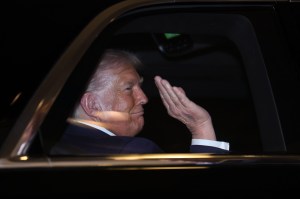
One of my instrument panel watchwords for understanding politics is that all power is unitary. In the case of presidents, you don’t have one bundle of power in one area and a siloed, distinct and unaffected bundle in another. A president’s power is a uniform commodity wherever he reaches. What boosts it or drags it down in one area affects it everywhere else. That’s the best way to understand President Trump’s position 10 months into his second term. It’s hard to know whether it was the five-week government shutdown which focused public attention on draconian cuts to health care, the election night shellacking, the first signs of MAGA diehards defecting from the president, the grotesque and absurd Epstein cat-and-mouse game or a dozen other comparable examples. What makes it both hard to pick apart the different drivers of a president’s decline and perilous for the president himself is that the different drivers feed on themselves. They become both cause and effect in a mounting spiral.
Read More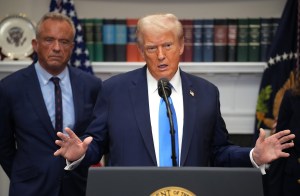
A few TPM readers responded to yesterday’s post about Trump as the “weak horse” arguing that Trump’s waning power makes him more dangerous, not less. I agree. Mostly. What’s “more dangerous” is a subjective question, with different kinds of dangers, different time horizons. Overall it’s clearly a good thing since Trump’s loss of power and the eventual defeat of his movement are good things. Though that’s far from a certainty, it is getting more likely. But Trump won’t go quietly. We know that from Jan. 6. No president wants to see their popularity wane or the loss of power that goes with it. But Trump’s binary mental world puts a sharper, more draconian focus on everything. In his world, you are punishing or the punished, dominating or the dominated. Loss of power means personal political peril. That’s how it works in his own head, and to a significant degree Trump’s own actions have made that all-or-nothing world a reality around him.
Read More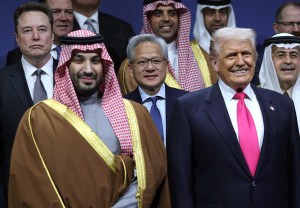
Yesterday President Trump met in the Oval Office with Saudi Arabia’s de facto ruler Mohammed bin Salman (MBS) and, in the midst of defending him over the murder of Saudi journalist Jamal Khashoggi, said that MBS “knew nothing about it.” Last night Rep. Eugene Vindman (D-VA) went to the well of the House and gave a brief speech in which he said that the two most troubling presidential calls he had reviewed while serving on the National Security Council staff were the infamous one with President Zelenskyy and another heretofore unknown call with MBS. Vindman then goes on to imply that the call showed Trump not knew MBS ordered the murder but likely supported it. Vindman first posted the video on Twitter last night. This morning he posted the same video on Bluesky. But in the caption he writes in the post — as opposed to the video — he zeroes in specifically on Trump’s claim that MBS “knew nothing about it.”
Read More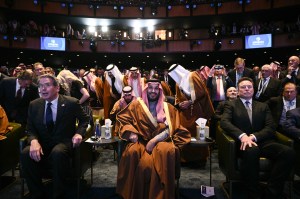
Just before I began writing this post, I saw this article from The Washington Post about the rise of billionaires in American politics. Given Bezos’s ownership and the recent shift in its editorial policies I’m mildly surprised they published it. The key points aren’t terribly surprising. But it brings them together in one place — the vast growth in billionaire giving over the first quarter of this century, the rapid trend from a relatively even partisan split to overwhelming giving to Republicans. It is among other things the story of billionaires becoming increasingly class conscious. It’s always been true that money buys influence in American politics. In some ways, it was even greater and more brazen in the past since there wasn’t even the pretense of limits on giving or disclosure.
But the role of billionaire ownership of the political process has not only grown rapidly in recent years. Public recognition of that fact has, too, which has — perhaps paradoxically or perhaps not — spurred the drive for even tighter ownership. It’s no exaggeration to say that the deca-billionaire or even centi-billionaire class — setting aside those who might command a mere few billion dollars — act now as a kind of post-modern nobility, a class which does not rule exclusively but interacts with politics in a fundamentally different way from the rest of society.
Read More
I mentioned earlier this month that we had this panel at our 25th anniversary event that I simply loved, an oral history of TPM. We published the audio of the panel as last week’s installment of the podcast. I have my own reasons for enjoying it, but I think you will too. In any case, one thing I was reminded of in listening to the discussion is that in recent years I’ve shifted toward analysis and away from my own reporting. Not as an absolute, of course. And in the spring I was reporting on a lot of stuff at once. But certainly over this year, I’ve written a lot of big-picture looks at what I think is happening in the country, what the Trump administration is trying to do, what people can and are doing to resist those efforts, what the big global story is. Listening to the panel discussion made me a bit hungry to do more of the thread-collecting and yanking of nitty gritty reporting, the grabbing on to a story and getting everything of out it, finding and introducing the key characters, finding the arc of their story.
Read More
TPM Reader EB emailed today to tell me something that hadn’t come across my radar: the cost of computer memory is going absolutely through the roof. Just do a Google search for something like rising cost of computer memory and you’ll see a ton of articles. To give you a sense of scale the cost increases are approaching 200% year over year and as much as 30% for certain kinds of gaming RAM recently in one week. The cause is what you’d expect: the insatiable demand for memory created by the AI server farm buildout. I buy computer memory too but I don’t think I’ve tried to buy recently enough to be aware of the surge.
I told EB that I continue to find all of this surreal.
Read More
Recently, Tom Nichols — the dissident or lapsed conservative who is a key Never Trump figure — wrote a Bluesky thread on the importance of federalism. He focused on the longstanding Democratic demand (albeit a futile one) that the president be elected by a national popular vote. I’ve made the same argument, though I’ve never treated it as a big focus since abolishing the Electoral College is all but impossible. You’re never going to get small states to disempower themselves by agreeing to such a constitutional amendment. But Nichols made the argument that some form of the Electoral College is an essential component of American federalism and that federalism is one sheet anchor of our liberties, as we’re finding out today.
Read More
We seem to be in another Epstein hiatus before the story and obsession again explodes into the center of the political news ecosystem. Presumably the next episode will come when the White House releases the heavily redacted and/or cooked version of the “Epstein files” that Congress ordered the administration to release. But I wanted to note this very weird oddity right smack in the center of the story that continues to be almost entirely ignored. I was reminded of it last night by this story in The Bulwark by Mona Charen. I first heard about in those interviews Sid Blumenthal and Sean Wilentz did with Michael Wolff about Jeff Epstein, which I wrote about back in September. Wolff discussed something that I had never heard before: that Steve Bannon, basically right up to the time Epstein died, was working with him on a combo rebrand/crisis comms effort to rehabilitate Epstein’s reputation. Yes! Bannon was working as Epstein’s image rehab specialist. The man at the center of all the anti-“elite”, anti-“globalist” pedophiles was tight with Epstein and trying to help him come in from the sex offender cold. He’d actually done hours of video interviews with Epstein as prep for either a 60 Minutes or 60 Minutes-style interview to revive his reputation.
Read More
Rep. Elise Stefanik, last seen lighting her political career on fire in a run for New York governor, has declared war on House Speaker Mike Johnson (R-LA). Why exactly I’m not entirely sure, other than she simply doesn’t like him. It sparked this deliciously petty but not inapt reply from what appears to have been one of Johnson’s top deputies.
Read MoreMr. Johnson declined to comment, as well. But a senior Republican congressional aide, who spoke on the condition of anonymity for fear of prolonging an intraparty feud, said that after Mr. Johnson had provided Ms. Stefanik with office space and a budget for what the aide described as “a fake job and a fake title,” he would have expected her to be more gracious.