

I wanted to take a moment today to highlight something that to me, at least, is behind a certain uncanny quality to the summer of 2025. Two things, which point in two entirely different directions, are happening at the same time. Every day you can find in the news a new example of the president cutting funding (either by legal or extra-legal means) or asserting direct control over funding in order to entrench his direct personal power. This might be defunding universities, ending funding of public broadcasting, or anything in between. He’s now opened criminal probes into numerous public officials. Immigrations and Customs Enforcement (ICE) continues to expand its war not only against the undocumented and legal residents but also against self-government in major American (blue) cities. I could mention dozens of other examples but the simplest overview is that the president continues to expand and entrench his authoritarian vision of rule, in which the whole machinery of government exists to impose his will and battle his enemies, with courts that are mostly but not always compliant.
Continue reading “Trump and the American People — Two Ships Crossing in the Night”Let’s Keep Up This Momentum
I’m happy and relieved to report that early yesterday we hit the halfway point to our goal of raising $500,000 in this year’s annual TPM Journalism Fund drive. We’re currently at $252,305. The second 50% is way harder. That’s just the logic of drives. But getting to this point in less than one week is very encouraging. As we’ve been explaining, the TPM Journalism Fund is a key part of how we keep this site alive and thriving. So if you’ve been considering making a contribution this year, please take a moment to do so now. It’s quick and easy, and every dollar helps. Just click right here.
Your Government on Trump
Here’s a story a TPM Reader just flagged to me which seems somehow unremarkable in the Trump II Era but would be comical and unreal in a non-degenerate era. “A top State Department official who oversaw recent mass layoffs is now taking over as the acting head of the General Services Administration, according to an email sent to staff.” The article, which Federal News Network ran as a breaking news item with details to follow, explains that Michael Rigas, Deputy Secretary of State for Management and Resources, has personally been ordered by Donald Trump to take over as acting head of GSA, while the just-relieved acting head will remain as Rigas’ deputy acting GSA head.
What’s Next Now That the CECOT Detainees Were Freed?
A lot of things happened. Here are some of the things. This is TPM’s Morning Memo. Sign up for the email version.
Three Cases to Watch
Friday’s repatriation of the Venezuelan nationals that the Trump administration had consigned to the hellishness of El Salvador’s CECOT isn’t the end of the story.
While a host of political, legal, and humanitarian issues remain unresolved, I want to flag three cases to watch:
The ‘Cristian’ Case
In the case of “Cristian,” the pseudonymous Venezuelan man deported to El Salvador under the Alien Enemies Act (AEA) in violation of an earlier court-approved settlement agreement, his lawyers went to court Friday once they heard that the detainees were being transferred to Venezuela and asked the judge to intervene. U.S. District Judge Stephanie Gallagher ordered an immediate status update from the Trump administration. Later in the day, the administration filed an affidavit from a Department of Homeland Security (DHS) official claiming the decision to release the detainees was entirely El Salvador’s “in the exercise of its sovereign authority” — clearly an effort to burnish the administration’s position that the detainees were under El Salvador’s control the entire time. The DHS official also stated:
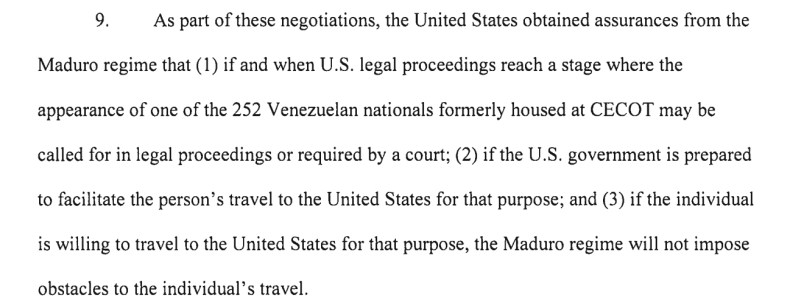
A lot going on there, but what stands out is the stated ability of the Venezuelans to return to the U.S., at least for further court proceedings. In Cristian’s case, the administration was ordered weeks ago to “facilitate” his return to the United States, but it had stonewalled those efforts. In another filing in the case after Cristian was released from CECOT, the Trump administration said the State Department has pledged to help DHS in facilitating his return.
The original Alien Enemies Act Case
In the original Alien Enemies Act case, the Trump administration and plaintiffs agreed to postpone a key deadline in the appeal of the case to the D.C. Circuit in light of the repatriations to Venezuela.
The plaintiffs also asked U.S. District Judge James Boasberg to order the administration to provide an “immediate status update” on “whether it is prepared to bring the members of the class back to the United States for habeas proceedings.” Boasberg hasn’t issued such an order yet, and the administration hasn’t responded.
It’s not clear how the release of the detainees under the AEA will impact their habeas claims, what the process will look like, and what position the administration will take. A lot still to be worked out here.
The Case of Jordin Alexander Melgar-Salmeron
This is the least uncertain of the three cases I’ve highlighted. Melgar-Salmeron was removed to El Salvador in May in violation of an order by the Second Circuit Court of Appeals, which has ordered the government to facilitate his return. There’s no reason to think that Melgar-Salmeron, a Salvadoran national, would have been involved in the detainee transfer to Venezuela, but their release has implications for his case. The administration was already under order from the appeals court to provide weekly status updates beginning today. Stay tuned.
MUST READ
TPM’s Josh Kovensky spoke with the wife of Jesús Alberto Ríos Andrade, one of the Venezuelan nationals removed to El Salvador under the Alien Enemies Act who was reportedly freed Friday. Angie, a Trump supporter, recounts what the last few months have been like and her reaction to the news that the detainees were being released.
State Dept. Official Makes Stunning Admission
At the end of a two-week trial over whether the Trump administration targeted pro-Palestinian international students for their political views, a State Department officials confirmed that criticism of Israel was one of the considerations in revoking student visas. Taking the stand was John Armstrong, the senior bureau official in the Bureau of Consular Affairs.
“Pushed for examples of things he might consider in weighing whether to deny or revoke a student’s visa, Mr. Armstrong testified that calls for limiting military aid to Israel or ‘denouncing Zionism’ could all factor in his agency’s decisions,” the NYT reports.
Closing arguments in the trial are expected to begin today.
Trump Turns U.S. Into International Pariah
- Secretary of State Marco Rubio is yanking the visa of Brazilian Supreme Court Justice Alexandre de Moraes, his allies on the court, and their close family members in retaliation for the prosecution of ex-President Jair Bolsonaro for his attempted coup. Moraes is presiding over the trial of Bolsonaro.
- Rubio ordered the State Department to “stop commenting on the fairness, integrity and legitimacy of foreign elections, a major shift away from a decadeslong practice of promoting democratic elections abroad,” the WSJ reports.
- A federal judge in Maine ruled that President Trump’s executive order punishing people who work with the International Criminal Court likely violates the First Amendment.
Rule of Law Under Siege
- WaPo: “President Donald Trump and his appointees have been accused of flouting courts in a third of the more than 160 lawsuits against the administration in which a judge has issued a substantive ruling, a Washington Post analysis has found, suggesting widespread noncompliance with America’s legal system.”
- NYT: “Mr. Trump has fired or demoted more than 20 inspectors general or acting inspectors general since he took office six months ago, hobbling offices that for years have served as a check on waste, fraud and abuse.”
- Politico: “Director of National Intelligence Tulsi Gabbard called for several Obama administration officials to face criminal prosecution for participating in a ‘treasonous conspiracy’ surrounding the 2016 election … the latest example of the Trump administration targeting critics of the president.”
The Purges
- NYT: After months of denying it would do so, the Trump administration announced Friday it will eliminate the EPA’s scientific research arm and began firing hundreds of chemists, biologists, toxicologists and other scientists.
- WaPo: The Trump administration’s purge of the Justice Department has involved the firing of at least 200 career employees in violation of civil service rules protecting federal workers from political retaliation, according to an advocacy group for former DOJ employees.
- Government Executive: The Trump administration is arguing in the case of fired U.S. pardon attorney Liz Oyer that a subset of federal workers are at-will employees who can be fired at any time for any reason.
Judge Orders RFE/RL Funding Restored
U.S. District Judge Royce Lamberth of DC on Friday ordered the Trump administration to restore funding for Radio Free Europe/Radio Liberty, lambasting it for its “unprecedented” freezing of the congressionally appropriated funds and its “nonsensical” legal arguments.
Not Normal
NYT: “President Trump held a ceremonial swearing-in on Friday in the Oval Office for Billy Long, the new commissioner of the Internal Revenue Service, in a sign of the unusually close relationship Mr. Trump has sought with the typically apolitical tax agency.”
Trump Sues WSJ for Defamation Over Epstein Connex
President Trump filed a federal defamation lawsuit in the Southern District of Florida against the WSJ, News Corp., Rupert Murdoch, Robert Thomson, and two WSJ reporters for its story from Thursday on the letter Trump allegedly penned to Jeffrey Epstein for his 50th birthday.
Meanwhile, in a bit of showmanship, the Trump DOJ asked the federal court in Manhattan to unseal the grand jury transcripts of the investigations into Epstein and his associate Ghislaine Maxwell. As multiple legal experts have opined, the courts may not have a proper basis to make the secret grand jury proceedings public, and even if they do, the contents may be a relatively innocuous compared to the FBI investigative files.
Good Sleuthing
For the past several months, the small but persistent reporting team at Court Watch has been tracking a peculiar federal criminal case in Rhode Island that now turns out to be related to the earlier prosecution of two right-wing accelerationists for allegedly plotting to target the power grid in Baltimore in 2023. It’s a great bit of reporting that uncovers how the feds were able to to use participation in neo-Nazi group chats on Telegram to bring felon-in-possession charges against the defendant.
Do you like Morning Memo? Let us know!
How Florida’s Plan for Immigration Judges at ‘Alligator Alcatraz’ May Violate Constitutional Rights
This article is part of TPM Cafe, TPM’s home for opinion and news analysis. It was originally published at The Conversation.
Seeking to expand Florida’s role in federal immigration enforcement, Florida Gov. Ron DeSantis in May 2025 submitted the state’s Immigration Enforcement Operations Plan to the Trump administration.
The plan, endorsed by President Donald Trump, says all of Florida’s roughly 47,000 law enforcement officers have received, or soon will receive, training to act as immigration officers. It’s part of an effort to, as the plan notes, “maintain state-led border security operations in the absence of federal support.”
The DeSantis plan includes a proposal to deputize Florida’s nine National Guard Judge Advocate General’s Corps officers to serve as immigration judges. JAG officers are attorneys who serve as legal advisers, prosecutors, defense counsel and military judges in a wide range of matters specific to the armed forces. That includes courts-martial and civil matters involving the military.
DeSantis has said the move is necessary to create a fast-track deportation system at Florida’s new immigration detention facility in the Everglades, Alligator Alcatraz.
He has dismissed due process concerns — such as a lack of training and independence — from legal experts, pointing to the backlog in immigration courts. Immigration judges in Florida’s immigration courts have one of the largest backlogs in the country, with over half a million cases.
Congress establishes immigration policy
The Constitution grants Congress, not the president or state governments, the power to establish immigration laws.
Under the Immigration and Nationality Act of 1952, also known as the McCarran-Walter Act, Congress created a clear process for immigration removal cases.
In general, a U.S. noncitizen may face removal from the country based on violations to the immigration laws. Those range from unauthorized entry to committing or being convicted of certain crimes.
Congress designated the Executive Office for Immigration Review, an agency within the Department of Justice that houses the immigration courts and the Board of Immigration Appeals, as the body exclusively responsible for deciding immigration removal cases. The office also details the authority and standards for how immigration judges conduct deportation hearings.
Immigration judges undergo rigorous vetting and training. And their decisions are subject to appeal to the Board of Immigration Appeals, the administrative appellate body for decisions made by immigration judges.
The McCarran-Walter Act also contains several provisions that subject most immigration court decisions such as removal or asylum to judicial review in federal courts. That can happen on direct appeal or as part of habeas corpus petitions that challenge the legality of detention or removal.
The system is far from perfect. But Congress designed it to ensure legal expertise and due process guarantees.
As an immigration scholar, I believe that allowing Florida JAG officers to serve as immigration judges bypasses this framework that is set in law, and violates the constitutionally mandated separation of powers.
JAG officers, including those in Florida’s National Guard, are not governed by the McCarran-Walter Act. They are military lawyers in an entirely separate system, overseen by the Uniform Code of Military Justice, which defines the role of military judges. The code retains a unique military character that is substantially different from the judicial appellate system that governs immigration administrative rulings.
Simply put, neither Trump nor DeSantis can create an entirely new system of immigration judges outside of the one already established by Congress.
Federal agencies cannot deputize JAGs
A current immigration provision, known as the 287(g) program, authorizes U.S. Immigration and Customs Enforcement to collaborate with local law enforcement to enforce federal immigration laws.
But this provision only authorizes deputizing local law enforcement to assist “in relation to the investigation, apprehension, or detention” of immigrants — not the arbitration of deportation cases.
In the nearly three decades since 287(g) was enacted, no state or local officials — let alone military officers — have been permitted to act as immigration judges.
DeSantis’ plan seeks to convert Florida’s JAG officers from state to federal officials to function as immigration judges. Trump’s approval of this plan would also exceed the scope of his statutory authority.
Federal statutes allow the president to federalize the National Guard in limited instances: during times of war or national emergency.
But neither DeSantis’ rhetoric nor Trump’s framing of undocumented immigration as an “invasion” meet these legal thresholds.

JAGs cannot engage in domestic law enforcement
Even if Florida’s National Guard were federalized, JAG officers still could not legally serve as immigration judges.
The Posse Comitatus Act, enacted in 1878, restricts the use of federal military personal in civilian law enforcement. It reflects a longstanding American principle: The military should not police civilians.
Immigration enforcement — including deciding whether someone is deported — is fundamentally a civilian enforcement function.
The only narrow exceptions to the Posse Comitatus Act’s restrictions require a clear statutory basis, such as Trump invoking the Insurrection Act of 1807, a law that would allow the president to rely on the military for domestic enforcement to quell a rebellion or widespread violence.
Due process concerns
The DeSantis plan also compromises constitutionally guaranteed rights to a fair process for immigrants facing removal.
Immigration law is notoriously complex. Even experienced immigration lawyers struggle to keep up with its constant changes.
JAG officers, trained primarily in military law, would face immense challenges interpreting and applying immigration statutes. That’s especially true with only weeks of preparation, as DeSantis proposes.
But due process isn’t only about knowledge of legal technicalities. The Fifth Amendment guarantees due process rights to all persons on U.S. soil, regardless of immigration status.
For decades, courts have interpreted these protections to include fair hearings before qualified immigration judges — and, in most instances, judicial review.
By circumventing established procedures, DeSantis’ plan risks creating a system where expedited deportations come at the expense of accuracy and constitutional rights.
This article is republished from The Conversation under a Creative Commons license. Read the original article.

The Mysterious Roads of ‘Alligator Alcatraz’
Hello it’s the weekend. This is The Weekender ☕️
There may or may not be a stretch of pavement in the Everglades that exposes an alleged lie about Florida Governor Ron DeSantis’ so-called “Alligator Alcatraz” detention camp.
Continue reading “The Mysterious Roads of ‘Alligator Alcatraz’ “CECOT Family Members Rejoice and Worry as Relatives Finally Leave El Salvador
Once Angie Gonzalez started to hear rumors that her husband might finally leave CECOT this week, she stopped being able to sleep. She got out of bed at 4 a.m. on Friday morning and has spent the day glued to a computer screen, watching online plane trackers, following the news on social media, and waiting for the chance to speak to him again.
Continue reading “CECOT Family Members Rejoice and Worry as Relatives Finally Leave El Salvador”Morning Memo: A Special Reader Questions Edition
This is special extra edition of TPM’s Morning Memo. Sign up for the email version.
A Friday afternoon in the summer seemed like a good time to step back and field reader questions, but as I sat down to begin writing this news reports started coming of a three-country prisoner exchange involving the detainees the Trump administration removed to CECOT. Under the reported arrangement, most or all of the deported Venezuelans in CECOT will be transferred to Venezuela, and the Venezuelan government will return some American political prisoners. The pace of news in the Trump era never slows.
But for now, let’s get to your questions:
QUESTION: What is the history of deportations to other countries than country of origin? What about to jails in other countries run by US or run by the other country?
I was in court last week across three different days covering the Kilmar Abrego Garcia case, and I’ve learned quite a bit more about third country removals than I knew before. U.S. law does provide for third country removals, but the key point is that up to now they’ve been relatively rare. The number that came out in court last week and that I’ve seen confirmed elsewhere is that about 1.6% of deportations historically have been to third countries. That’s obviously a small proportion, but it’s also not nothing.
Where things get more nuanced are the circumstances in which third countries were used. My understanding is that prior to the second Trump administration, deportations to third countries where the deportee had no connection of any kind were much more rare. To your second question, deporting people to prisons in third countries (or to countries that are war zones) was unheard of until this year.
Another big issue here is what due process deportees are entitled to before they’re removed to a third country. The Supreme Court’s decision last month to stay a Massachusetts federal judge’s injunction blocking third country removals without notice and hearing cleared the way for the stalled removals to South Sudan. But it also muddied the waters considerably on what due process is required. We learned this week that a new Immigrations and Customs Enforcement (ICE) policy would allow removal to some third countries with as little as six hours notice and no further due process. We’ll probably get a clearer answer when and if the Massachusetts case makes it back to the high court on the merits, but it’s not looking good.
For those looking for more context, The New Yorker talked to Yale law professor Cristina Rodríguez this week about these issues.
QUESTION: Any procedural options for Senate Dems to grind the Bove nomination to a halt?
Not really. Because Senate rules are so byzantine, I feel like I should add a caveat that Democrats might in theory be able to add a few hours to the process, but I’m not aware of anything in the rules that would allow Democrats to stop the Bove confirmation process in its tracks.
QUESTION: Why hasn’t a senator put a hold on Bove’s nomination? Do holds no longer exist?
I suspect you’re remembering the old days, before the end of the filibuster for judicial nominations. Holds still exist, and they can slow down the process for judicial nominees, but they can’t stop them outright.
If you detect me being hedged in my answers, it’s because the parliamentary specifics are complicated and I don’t want to be imprecise. But I also don’t want to leave the impression that there’s some trickery or clever maneuver that is available to stop this. The battles over Senate rules and the nuclear option were fought a decade or so ago. We’re in a new era.
QUESTION: Why hasn’t anyone gone after Bondi et al. through complaints with the bar associations for violating legal ethics and bar codes?
I know there was a bar complaint against then-acting U.S. Attorney Ed Martin in DC that was declined earlier this year, and I see that two Democratic House members this week sent a letter requesting a D.C. bar investigation of Martin. Beyond that, I’m not sure we would necessarily yet know about every pending bar complaint against Trump administration lawyers.
As for Bondi, some of the most egregious and corrupt things Bondi has done — like eroding the Justice Department’s independence from the White House — are not strictly illegal or necessarily violations of legal ethics standards. I mention only to note how limited of a tool bar complaints are.
Ethics rules should be enforced, like they were against some of the lawyers complicit in the 2020 Big Lie. But I think we also saw real limitations there that made them less than a magic bullet; namely, they’re slow. Doesn’t mean they should be ignored! Just wouldn’t pin my hopes to them.
QUESTION: Are there any more whispers in D.C. about Stephen Miller running the show in the White House? Will Congress clutch pearls or do something?
By all accounts, Stephen Miller is an exceptionally influential and powerful White House aide who has succeeded in channeling Donald Trump’s id into key policy areas like mass deportation. Morning Memo, I believe, was among the first to note that the Trump executive order on DOJ weaponization made Miller the White House point person. Miller also embodies Trump’s vindictive tendencies and seems to relish serving in an enforcer role. As for Congress, as long as both chambers are in GOP hands, I don’t see it targeting Miller for investigation.
QUESTION: I have two adult children with severe intellectual disabilities in a group home. Any idea how BBB Medicaid cuts will affect them?
I’m sorry you’re having to grapple with these kinds of questions. I was initially inclined not to try to answer this question because the issue is so important for you and for families like yours that it deserves an expert response. But I wanted other readers to see it, and what I can offer might help orient them.
My sense is that fight here now moves to the states, where the massive reduction in federal funding for Medicaid is blowing holes in their budgets. Each state is going to have to figure out how much of those holes they can fill with their own funding, and then make tough decisions about which benefits they prioritize. That makes it almost impossible to answer your question with any specificity now.
Medicaid recipients in blue states will probably, on balance, fare better than those in red states. But I don’t think there’s any doubt that benefits will be cut across the board, even in blue states. The funding cuts are just too big. But how it looks state to state will probably vary considerably.
QUESTION: My question is about whether Democrats taking over Congress in 2026 is really the best hope. Yes, they could block things, but they couldn’t repeal things or get new things done because of the veto power. At this rate, most of the damage will have been done before they are seated.
I would flip the question around and ask what’s the alternative? Is it not contesting the 2026 midterms? Is it giving up all hope? I agree that there’s no magic bullet. Democrats winning the House won’t solve every problem or stop every Trump transgression or instantly restore the rule of law. I subscribe to an “all of the above” approach. You do everything you can wherever you can to preserve democratic institutions and civil society capacity and then do the long, hard, often slow work of rebuilding what has been lost. Winning elections isn’t the only thing, but it’s an indispensable thing.
Do you like Morning Memo? Let us know!
Trump Is Failing and Flailing—No One’s Ever Seen Anything Like It!
You’ve no doubt seen the Wall Street Journal story on Trump’s lewd and innuendo-rich 2003 birthday card to Jeff Epstein. That speaks for itself. To me what speaks more loudly is what appears to have been an all-out war from the White House to get the Journal to kill the story. Just after 8:30 p.m. ET the President posted a jangling rant attacking Rupert Murdoch and Journal editor Emma Tucker, insisting he’ll sue, blaming Hillary and Obama. An hour and a half later, he posted a more succinct version of the same post, again claiming the letter was “FAKE”, threatening to sue, yada. In between those two posts he did yet another post clearly intended to appear to be Trump finally losing his patience and insisting that all information be made public. Only it wasn’t that at all. Trump said he was asking Attorney General Pam Bondi to “produce any and all pertinent Grand Jury testimony, subject to Court approval. This SCAM, perpetrated by the Democrats, should end, right now!”
There are three problems with this.
Continue reading “Trump Is Failing and Flailing—No One’s Ever Seen Anything Like It!”Feel the Momentum!
We’re on our fourth day of this year’s TPM Journalism Fund drive and we have half a chance to getting to 50% of the way toward our goal today. We’re at $231,827. So just $18,000 short of the $250,000 mark. Needless to say, the second 50% always takes longer than the first. But this is a great start. And we really appreciate it. If you’ve been planning on making a contribution but haven’t gotten around to it, why not make today the day? Help us close out the week strong? Just click right here.
I try to keep these updates light. But don’t let the lightness fool you. These drives are critical to the livelihood of the whole organization. We’re able to keep it light because TPM readers have always been there for us. And for that we’re endlessly appreciative.