

One of Trump’s Truthed conditions for a ceasefire was the “SAFE OPENING of the Strait of Hormuz.” The White House appeared ready to declare that condition met. But even this morning, before reports emerged that Iran was once again closing the strait, there was some fine print.
Continue reading “‘Open’ Is in the Eye of the Beholder”Declaring Victory and Walking Away Can’t Conceal the Scale of Trump’s Folly
A Ceasefire … or a Fig Leaf?
Despite some initial reports that a tenuous two-week ceasefire is holding in the Middle East, Kuwait, the UAE, and Qatar all claimed to have subsequently received incoming missile fire. For its part, Iran claimed that one of its oil refinery on a island in the Persian Gulf had come under attack since the ceasefire by unnamed “enemies.”
The ceasefire did not include Israel’s ongoing offensive in southern Lebanon, where it carried out the largest wave of strikes since the war began.
The real focus of the highly contingent ceasefire agreement was the Strait of Hormuz, which was free and open before President Trump’s elective war and is now throttled by Iran. Trump is declaring the strait open for his own political purposes, but the terms of the ceasefire give Iran more control over the vital waterway than it had before the war started:
- Iran and Oman will jointly charge newly imposed fees for passage through the strait. “The strait is in the territorial waters of both Oman and Iran,” the AP reports. “The world had considered the passage an international waterway and never paid tolls before.”
- The new fee is “roughly $2 million per ship,” the NYT reports.
- The White House and Trump reposted a statement from the Iranian foreign minister that showed the highly contingent nature of the agreement on the strait:
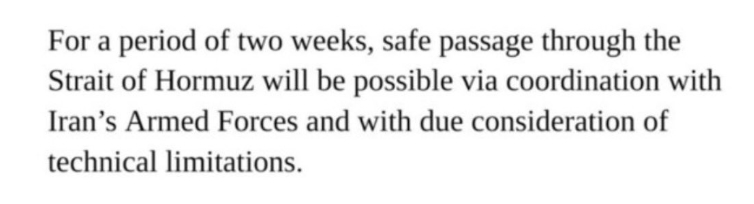
On the water, there were few signs that the ceasefire had created sufficient conditions for safe passage through the strait. While it was still early, Lloyd’s of London issued a statement that cautioned about the continuing peril: “Moving before new protocols are clarified could expose crews, ships and cargoes to heightened risk.”
The strategic catastrophe for the United States appears to extend beyond the narrow confines of the strait. Trump called Iran’s 10-point peace plan “a workable basis on which to negotiate.” Any long-term agreement along those lines would be a remarkable coup for the Iranians to have pulled off in the face of withering American firepower:
Yep
The New York Times’ Charlie Savage: Trump’s Iran Threats Look Like Self-Incrimination for Potential War Crimes
Quote of the Day
“Better TACO Tuesday than World War III.”—an unnamed European official told Politico
Abrego Garcia Case Goes Off the Rails Yet Again
Another bizarre development in the Trump administration’s never-ending brutalization of Kilmar Abrego Garcia.
In what should have been a placid conference call to set a briefing schedule for the administration’s renewed effort to deport him to Liberia, a career DOJ attorney took the puzzling position that Abrego Garcia could self-deport to Costa Rica on his own at any time. That ignores entirely the pending criminal prosecution of him in Tennessee by the same Justice Department.
U.S. District Judge Paula Xinis of Maryland was confounded by the DOJ attorney’s position, and after scolding him at length that Abrego Garcia was legally barred in the criminal case from voluntarily leaving the country, he mostly retreated. “This is chimerical,” Xinis spit out at one point with such vigor that it sounded like a curse word. My full write up is here.
Mass Deportation Watch
- New ICE shooting: A man is in critical condition after being shot by ICE officers during a targeted traffic stop in California. Video of the incident shows a chaotic scene with agents surrounding the man’s car as he attempts to flee.
- Kseniia Petrova, the Russian-born Harvard researcher who allegedly smuggled frog embryos through Boston’s Logan Airport won a victory in court when U.S. District Court Judge Christina Reiss of Vermont ruled that her visa had been unlawfully cancelled.
- Annie Ramos, the undocumented wife of an Army sergeant who was detained by ICE at Ft. Polk as they were moving into base housing has been released from detention after five days.
The Retribution: Cassidy Hutchinson
In double whammy of abuse of power and corrupt retributive prosecutions, the Trump II DOJ is targeting Trump I White House aide Cassidy Hutchinson and bizarrely using its Civil Rights Division to do so, the NYT reports:
The move was a highly unusual one by Justice Department leadership, directing a criminal case that appears to involve accusations of lying to Congress to a specialized unit that normally focuses on systemic civil rights abuses like police misconduct and racial discrimination.
The new focus on Hutchinson, a star witness before the House Jan. 6 committee, appears to have been a last-gasp effort by then-Attorney General Pam Bondi to produce results in targeting President Trump’s political foes. Instead of being run by D.C. U.S. Attorney Jeanine Pirro, as would be normal, the case was assigned to Harmeet Dhillon, who oversees the Civil Rights Division. It’s another way for Dhillon, who is reportedly in line for a promotion to the No. 3 slot at DOJ, to burnish her reputation as a Trump loyalist.
The Retribution: Todd Blanche Edition
In his first press conference since Bondi was fired, acting Attorney General Todd Blanche defended President Trump’s retributive prosecutions against his political foes: “That is his right, and indeed it is his duty to do that.”
The Corruption: Mile High Edition
The White House has purchased — without congressional authorization — and taken control of the controversial $70 million luxury jet that then-DHS Secretary Kristi Noem was leasing for her own use, the WSJ reports. First lady Melania Trump and select cabinet secretaries will have access to the jet.
Hot tips? Juicy scuttlebutt? Keen insights? Let me know. For sensitive information, use the encrypted methods here.
Trump Wants to Build Massive New Detention Centers. States Are Blocking Their Construction.
This article is part of TPM Cafe, TPM’s home for opinion and news analysis.
Last week, ICE released its own inspection report on Camp East Montana, the detention facility in Texas that has become a symbol of the administration’s overfunded, overcrowded, underregulated mass detention project — where prior reporting revealed that staff bet on which detainee might be next to die by suicide. The new findings were not leaked by advocates or surfaced by investigative reporters. They came from the agency itself: 49 failures in medical care, disease control, and oversight; undocumented uses of force; inadequate sexual assault response. The federal government’s own auditors documented the suffering, and the federal government will do nothing about it.
But while Washington absorbs the daily torrent of executive orders, social media provocations, and congressional paralysis, something significant is happening at a different level of American government. States are moving — aggressively, creatively, and increasingly together — to impose accountability on a detention system explicitly designed to avoid it.
Continue reading “Trump Wants to Build Massive New Detention Centers. States Are Blocking Their Construction.”Democrats Expand Their Majority on Wisconsin’s Critical State Supreme Court
Khaya Himmelman has the story here.
Dem-Backed Judge Wins Wisconsin Supreme Court Seat, Expanding Its Liberal Majority
Chris Taylor, the Democratic-backed candidate for Wisconsin’s state Supreme Court, easily defeated Maria Lazar, the Republican-backed candidate, expanding the Court’s liberal majority, per the Associated Press. Taylor was leading 60.1% to Lazar’s 39.8% with 95% of the votes in on Wednesday morning, according to the New York Times‘ tracker.
Her win represents the fourth straight victory for Democratic-backed candidates in the state’s high court elections.
Continue reading “Dem-Backed Judge Wins Wisconsin Supreme Court Seat, Expanding Its Liberal Majority”Trump Punts Disaster for ‘Two Weeks’
Trump on Truth Social, 6:32 p.m. ET, with the climb-down, describing what he claims will amount to a “double sided CEASEFIRE!”:
Continue reading “Trump Punts Disaster for ‘Two Weeks’”Based on conversations with Prime Minister Shehbaz Sharif and Field Marshal Asim Munir, of Pakistan, and wherein they requested that I hold off the destructive force being sent tonight to Iran, and subject to the Islamic Republic of Iran agreeing to the COMPLETE, IMMEDIATE, and SAFE OPENING of the Strait of Hormuz, I agree to suspend the bombing and attack of Iran for a period of two weeks.
This Is What We Were Talking About, Say Dems Who Trump Threatened to Hang
*Post-publishing update: He changed his mind.
Invoking the 25th?
Some Democratic members of Congress are doing what they can to sound the alarm about an unhinged president threatening to make good on his social media promise that “a whole civilization will die tonight,” including urging Trump’s Cabinet to invoke the 25th Amendment and calling for impeachment.
Continue reading “This Is What We Were Talking About, Say Dems Who Trump Threatened to Hang”Abrego Garcia Case Goes Off the Rails Yet Again
I try not to burden you with procedural minutiae in the key Trump II cases, but an unexpectedly strange 30-minute status conference ended a short time ago in the Abrego Garcia II civil case. What would normally be a snoozy housekeeping matter — in this instance, to set a briefing schedule on the Trump administration’s renewed bid to deport Kilmar Abrego Garcia to Liberia – went off the rails a bit.
Continue reading “Abrego Garcia Case Goes Off the Rails Yet Again”‘WAR CRIME ALERT!!’ MAGAworld Is Split Over Trump’s Threat To Destroy Iran’s ‘Whole Civilization’
President Donald Trump’s latest escalation of threats against Iran has further exposed growing rifts on the far-right. On Tuesday morning, Trump used his Truth Social platform to suggest he will launch a devastating attack against Iran this evening unless the country makes a deal with him.
Continue reading “‘WAR CRIME ALERT!!’ MAGAworld Is Split Over Trump’s Threat To Destroy Iran’s ‘Whole Civilization’”Tactical Victories, Strategic Calamities—Another Day in Trump’s Iran War
Here are a few additional thoughts about the state of the war between the U.S. (and Israel) and Iran.
First, we had news from Reuters over the weekend that the U.S. and Iran might be on the brink of a ceasefire agreement, maybe as soon as Monday. It now seems like that was yet another example of a mix of over-optimism from broker countries trying to bring the sides together and, even more, the White House trying yet again to force a quick-to-fade market bounce. Yesterday afternoon I saw this piece in Haaretz which says that Pakistan (a lead country trying to broker a deal between the two sides) believes that Iran is now under the effective control of the commander of the Islamic Revolutionary Guard Corps, that this commander thinks Iran is winning and that he’s not willing to compromise on Iran’s key demands or accede to the United States’. It also notes that Pakistan thinks the U.S. is more eager for a deal than Iran.
I don’t think you need to be Pakistan to see that last point. Everything President Trump does sends that message. Now, in the wake of the Trump’s threat to “end” Iranian civilization tonight, Iran has reportedly cut off participation in ceasefire talks with the U.S..
A few moments ago I saw this snippet in the Times:
Continue reading “Tactical Victories, Strategic Calamities—Another Day in Trump’s Iran War”