Let me take an initial crack at assessing what the United States has done in Venezuela with the proviso that time can easily prove such analyses mistaken. Donald Trump’s claimed takeover of Venezuela has been compared to what the American invasion aimed to do in Iraq in 2003, but I’d go back instead to the American intervention in the Spanish-American War in 1898 and its conquest and takeover of Cuba and the Philippines, about which I wrote in Folly of Empire.
In those cases, the United States was entering into global wars of redivision (Lenin’s term in Imperialism), but as a latecomer and marginal world power. Such wars have not vanished. That’s what Russia’s invasion of Ukraine is about. But by taking over Venezuela, the United States has upped the ante and may have ushered in a new global era of imperial combat.
The earlier era, which began in 1871, led to two world wars, the breakdown of the international economy, and, after World War Two, decades of anti-colonial struggles. Trump’s attempt to take over Venezuela, coupled with his threats against Canada and Greenland (which must now be taken much more seriously) and his punitive and often irrational trade policy is creating the condition for a new era of global strife that could lead to disastrous wars.
I don’t pretend to understand why Trump did this. He seems to want Venezuela’s oil. There may be money in it for him and his family, or he may simply believe that America’s prosperity depends on controlling hemispheric energy production. Trump’s Secretary of State Marco Rubio, a Cuban-American, seems to have wanted to break up the axis of Cuba and Venezuela. By taking over Venezuela’s oil, the thinking may go, the United States will be able to deprive Cuba of oil and strangle its economy. Some State Department strategists may have wanted to damage China’s economy by cutting off an important source of its oil. (In 2025, China purchased over 75 percent of Venezuela’s oil.)
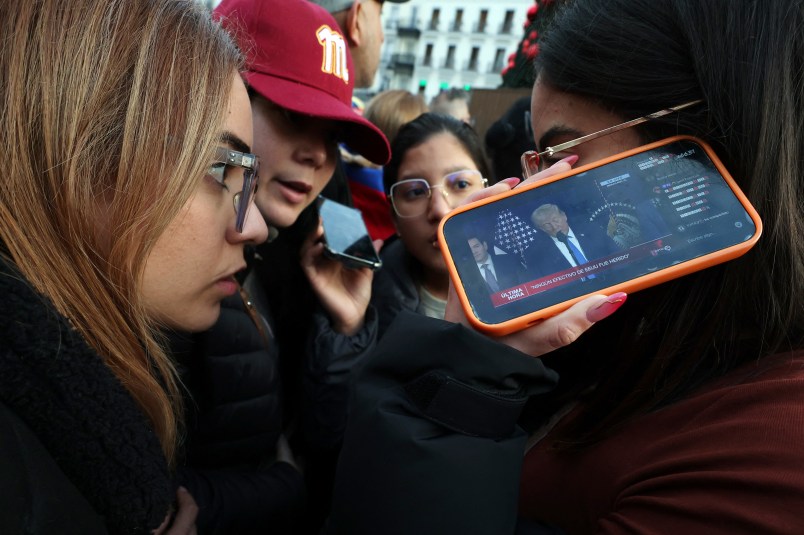
But judging from the tenor of Trump’s speech Saturday, I would have to add a personal and political dimension. Trump may have wanted to cement his legacy and his immortality in the way that the kings and tyrants of old did it — through military conquest. I wouldn’t discount this explanation. I’ve always thought that the best comparison for Trump’s behavior was not Hitler or Mussolini, but the early English monarchs whose fame rested on their success in war and whose thirst for riches and for vengeance over their enemies foreign and domestic could not be slaked. Whatever the reason, Trump’s takeover of Venezuela spells trouble for the United States and the world.