The Legal System Should Not Give Trump the Benefit of the Doubt

This article is part of TPM Cafe, TPM’s home for opinion and news analysis. It was originally published by Balls and Strikes

On Monday, the Department of Justice filed a misconduct complaint against U.S. District Court Chief Judge James Boasberg for the offense of telling colleagues that some judges worried the Trump administration would violate court orders. According to the DOJ, his private comments “eroded public confidence in the judiciary.”

The complaint comes on the heels of The Federalist reporting on a memorandum recapping the March 2025 meeting of the Judicial Conference, the national policymaking body for federal courts. According to The Federalist, the memo states that at this judges-only event, Boasberg “raised his colleagues’ concerns that the Administration would disregard rulings of federal courts leading to a constitutional crisis.” The Federalist contended that these comments revealed an inexcusable “anti-Trump bias” and “clear disregard for the presumption of regularity—a presumption that requires a court to presume public officials properly discharged their official duties.” 

The DOJ then said the same. “Federal courts must begin from a presumption of regularity—the settled doctrine that executive officials have properly discharged their official duties absent clear evidence otherwise,” reads the complaint, signed by Chad Mizelle, who is the chief of staff to Attorney General Pam Bondi. “By predicting non-compliance, Judge Boasberg turned that presumption on its head, contradicting both the evidence of past compliance and the governing law.” 

A recent Washington Post analysis shows that the Trump administration has defied roughly one-third of rulings against it. Among the disobeyed directives is an order Boasberg issued a couple days after the Judicial Conference, instructing the administration to stop secretly renditioning American residents to El Salvador’s Terrorism Confinement Center.

Mizelle and The Federalist got one thing right: The “presumption of regularity” does refer to the notion that courts should assume public officials are lawfully discharging their duties. But as the Supreme Court put it twenty-odd years ago, “the presumption perhaps is less a rule of evidence than a general working principle.” It is also nigh impossible to reconcile with an executive branch that is openly contemptuous of the law and brimming with people who find it easier to lie than to breathe. To the extent that Trump was ever entitled to a presumption of regularity, he has forfeited it. Courts should regard both the president and the administration’s invocations of the presumption with skepticism. 

The exact contours of the doctrine are nebulous, and it may not apply here to begin with. Historically, it has been used to fill small gaps in evidentiary records in a given case—for example, in a 2001 case that involved disciplinary action against a Postal Service employee, the court presumed that the agency’s underlying process for reviewing alleged misconduct was fair. The presumption does not, in other words, require judges to assume that the government will always behave perfectly. Nor does it prevent judges from discussing interbranch constitutional challenges with their colleagues behind closed doors. 

To justify this novel application of the principle to out-of-court conversations, the DOJ’s complaint points to United States v. Chemical Foundation, a 1926 case in which the federal government sued to set aside its sale of various patents to a private company. In that case, the government argued in part that the sales were “procured through the fraudulent deception” of the president and other government officials. But the Court figured it was safe to presume the officials knew what they were doing and “acted upon knowledge of the material facts,” and declined to invalidate the sales. 

Basically, in Chemical Foundation, the Court decided that if it heard hoofbeats, it would assume horses and not zebras unless given reason to do otherwise. The DOJ’s complaint is thus attempting to transform a principle about rebuttable inferences in court cases into insulation from even private critique. 

The Trump administration has tried to use Chemical Foundation to avoid scrutiny before. On appeal in Trump v. Hawaii, the 2018 case about Trump’s Muslim ban, the Justice Department complained that it was inappropriate for the lower court to take note of Trump’s comments at the signing ceremony, at which Trump had read the formal title aloud—“Protecting the Nation From Foreign Terrorist Entry into the United States”—and then said, “We all know what that means.”

Challengers to the Muslim ban suggested this showed the policy was not actually motivated by national security, and the government objected strenuously. “At a bare minimum, the presumption of regularity that attaches to all federal officials’ actions, as well as the respect due the head of a coordinate branch, should have foreclosed the Fourth Circuit from invalidating a presidential proclamation based on an uncharitable interpretation of an offhand, six-word comment made in connection with a prior directive,” said the DOJ’s brief. 

Then and now, the Trump administration treated the presumption of regularity as an all-encompassing permission slip. With slip in hand, Trump argues, no one can look at his actions too closely, speak about him too harshly, or judge him at all. Such an expansion of the presumption is especially dangerous in a time that is far from “regular”—when the government is summarily sending people to be tortured abroad and suing anyone, up to and including judges, who get in its way. The DOJ’s complaint pays lip service to the idea of accountability for Boasberg, but its actual goal is plainly to bully the judiciary into submitting to Trump’s authoritarian rule.
Trump and Allies Flounder on Epstein Files While Senate Dems Forge Ahead

A lot of things happened. Here are some of the things. This is TPM’s Morning Memo. Sign up for the email version.

Dems Push for Release of Epstein Files

Under pressure to quell the firestorm over his relationship with Jeffrey Epstein, last week President Donald Trump told the Justice Department to ask the courts to unseal grand jury testimony from criminal investigations of the child sex trafficker. A Florida court has already denied one DOJ request. In a filing ordered by a judge in New York, the DOJ revealed this week that the two grand juries that indicted Epstein and his accomplice Ghislaine Maxwell heard from just two witnesses in total — neither of them victims. The New York Epstein grand jury only heard testimony from an FBI agent who summarized his interviews with Epstein’s victims. The Maxwell grand jury heard from that same FBI agent and a New York City police detective.

All of that means that even if the DOJ were to convince the New York judge to override grand jury secrecy rules and release the transcripts, they would not be particularly informative. Although Trump has used his request to release them as evidence of his supposed transparency, now it is clear his DOJ knows they would be of limited revelatory value.

Amid this gaslighting, Trump’s allies are also attempting to create an atmosphere of conspiratorial panic about other issues to divert the public’s attention from the administration’s refusal to release the files Trump’s own supporters have long sought. Yesterday. Fox News Digital published an anonymously sourced article claiming that FBI Director Kash Patel has just “found a trove of sensitive documents related to the origins of the Trump–Russia probe buried in multiple ‘burn bags’ in a secret room inside the bureau.” Asked about it later by reporters, Trump appeared to not understand the question and meandered about his desire to release the Epstein files. 

Some simple questions: If he really wants them released, why hasn’t he done so? Trump then digressed to “it’s gotta be stuff that really doesn’t hurt people unfairly” — however that’s defined, and certainly “people” here means him. He then veered to “the whole thing is a scam — it’s a scam set up by Democrats.” If that is true, why wouldn’t it benefit Trump to release all the files and prove his case? Finally, Trump offered, “it’s getting to be very old news.” If it’s actually dull and boring, what’s the harm in letting it all out in the open? When a reporter asked a substantive question about Epstein — what he thought his friend “stole” women from him for — Trump left the room

While House Republicans beholden to Trump shut down the chamber early rather than holding a vote on releasing the Epstein files, the Senate is still in town, and Democratic lawmakers are getting creative. They are relying on a little-known 1928 law that authorizes the minority party to compel a federal agency to provide information if five members of a committee request it and it is relevant to the committee’s jurisdiction. Here, five Democratic members of the Homeland Security and Governmental Affairs Committee are invoking the law to force the Justice Department to release the Epstein files. The New Republic’s Greg Sargent has all the details.

‘Fuck the Justice Manual’: A New Trump DOJ Assault on the Rule of Law

The Justice Manual is the DOJ’s internal handbook of rules on prosecutorial conduct. According to a damning Bloomberg Law piece, Bill Essayli, Trump’s interim US Attorney in Los Angeles, said “fuck the Justice Manual” in response to questions from line attorneys about his pursuit of indictments against anti-ICE protesters. (Morning Memo has previously discussed reports of LA-based grand juries not returning indictments against protesters and prosecutors being forced to drop felony charges because of false evidence presented by arresting officers.) Bloomberg sourced the quote to four current and former prosecutors in the office.

Trump’s Tariffs in Court Again Today, With His Brazil Retribution in the News

The legal challenge to Trump’s tariffs brought by small business owners is in court again today, before the U.S. Court of Appeals for the Federal Circuit in Washington, D.C. Trump has held that by declaring a national emergency, he is able to impose sweeping tariffs under the International Emergency Economic Powers Act (IEEPA). The small businesses won an injunction before the U.S. Court of International Trade this spring, arguing that Trump had exceeded his authority under the law. The appellate court stayed the injunction pending the appeal.

Legal experts tell Reuters that Trump’s imposition of tariffs on Brazil, because he is angry that his friend Jair Bolsonaro is in legal jeopardy for attempting a coup, is likely to come up in oral arguments. Daniel Esty, a professor at Yale Law School, called the Brazil tariffs “so clearly outside the bounds of the law as to be shocking.”

New Reporting Sheds More Light on Suspect Activities of DOGE Staffer ‘Big Balls’

A new report in Wired, based on documents obtained through a Freedom of Information Act request, shows that the 19-year-old DOGE staffer Edward “Big Balls” Coristine rapidly obtained access to sensitive personal payroll, human resources, and government contracting data in the early days of Trump’s second term. Under intense pressure, federal officials made a blitz of decisions to give access to someone who would not have received it under normal channels. Coristine thus got into Small Business Administration data as well as that of the payroll system for federal employees covering about one-fifth of the federal workforce, including the Department of Justice and the FBI. The data included Social Security numbers, banking information, addresses, dates of birth, and more.

Senate Democrats, led by Sheldon Whitehouse (RI), Elizabeth Warren (MA), and Ron Wyden (OR), have introduced the Pick Up After Your DOGE Act, which would require security and performance audits and fixes of federal computer systems and networks accessed by DOGE personnel.

Equal Employment Opportunity Commission Gets Sued…for Discrimination

FreeState Justice, a pro-LGBTQ rights legal services nonprofit, has sued the Equal Employment Opportunity Commission for seeking to dismiss discrimination complaints brought on behalf of transgender workers. “The cases that the EEOC sought to abandon concerned transgender workers who had been subjected to egregious conditions in the workplace: slurs and grossly derogatory statements, graphic sexual comments and unwanted physical touching, misgendering, unfavorable shift changes, and termination after disclosing their gender identity — often in combination,” the lawsuit alleges.

Russell Vought Loses Bid to Cut $15 Billion for Medical Research Grants With a Footnote

Office of Management and Budget Director and foe of the federal government Russell Vought tried to bring down medical research with a footnote in a budget document. The footnote maintained that for the rest of this fiscal year, no funding to outside sources — that is, to scientists studying cures for diseases like cancer and diabetes at universities and other institutions — could be dispersed from the National Institutes of Health. 

There was a big backlash on Capitol Hill, and also, according to the Wall Street Journal, inside the Department of Health and Human Services. “This outrageous decision to prevent NIH from spending the funding that Congress has explicitly provided for medical research must immediately be reversed — life-changing cures and patients’ prognoses hang in the balance,” Sen. Patty Murray (D-WA) said. Very shortly after that, the decision-by-footnote was reversed. If the past is any guide, though, Vought is likely to try to find other ways to accomplish his goals.

No One Is Safe From the Wrath of Laura Loomer

Pressure from the conspiracist right-wing influencer Laura Loomer has forced the resignation of Vinay Prasad, the top vaccine official at the Food and Drug Administration. Prasad, who attacked vaccines and masks during the COVID-19 pandemic, would seem to be acceptable to Trump’s base. But Loomer unearthed old social media posts in which he praised Sen. Bernie Sanders (I-VT), identified as liberal, and mocked Trump  — and her ire could not overcome even the support of Health and Human Services Secretary Robert F. Kennedy, Jr. 

What is to be done about the wreckage that Trump acolytes have made of HHS? The 17 members of the Advisory Committee on Immunization Practices that Kennedy abruptly fired now urge setting up alternative structures outside of government to mitigate the harm to vaccine policy. In the New England Journal of Medicine, they wrote yesterday:  “No viable pathway exists to fully replace the prior trusted and unbiased ACIP structure and process. Instead, the alternatives must focus on limiting the damage to vaccination policy in the United States.”

Southern Baptists Pressure Trump to End Mail-Order Distribution of Mifepristone

Led by the Family Research Council President Tony Perkins, 40 Southern Baptist leaders have sent a letter to President Trump, urging him to impede or stop the sale by mail of the FDA-approved abortion pill mifepristone. They want the FDA to require patients receiving the drug to have an ultrasound first, and to revisit its approval of the drug. Even more ominously, the letter urges Trump to “instruct the Department of Justice to enforce the Comstock Act to protect states’ rights to uphold pro-life laws.” To understand what invoking the Comstock Act actually means, read this.

Bessent Admits Big Beautiful Bill Has “Backdoor to Privatizing Social Security”

At a Breitbart event yesterday, the Treasury Secretary discussed “Trump accounts” included in the so-called Big Beautiful Bill, that will give parents a one-time payment of $1,000 per child born between 2025 and 2028. Parents then can contribute as much as $5,000 per year until the child’s 18th birthday (that is, if they have that money). “I’m not sure when the distribution date should be, whether it’s 30 and you can buy a house, should it be 60,” said Bessent, a billionaire hedge fund manager before Trump tapped him for a Cabinet post. “But in a way, it is a backdoor for privatizing Social Security.”

More Havoc From Trump’s Big Beautiful Bill 

CNN reports that the new law’s draconian cuts to the Supplemental Nutrition Assistance Program (SNAP) could imperil independent grocery stores, given “the program’s role as an economic anchor for grocery stores and communities, particularly in rural areas.” 

Do you like Morning Memo? Let us know!

Sic Transit

I’m not sure I’ve seen in six months a better capturing of the second Trump administration. I write this just as I saw that the White House just produced a fact sheet about the US-European Union trade deal which contradicts and asserts different terms than what the EU says it agreed to. That’s pretty redolent too. But this one is even deeper in it.

A few moments ago I got an email alert from STAT News that reads: Top White House pandemic preparedness official resigns, officials say, in sign of broader disarray. But it’s the summary of the story that really captures it.

Continue reading “Sic Transit”

Warren Demands Dems Refuse to Participate in Budgeting So Long As Trump is Freezing Funds

Sen. Elizabeth Warren (D-MA) took to the Senate floor on Wednesday morning to call out Senate Republicans for helping President Donald Trump and the White House snatch away Congress’ power of the purse.

And, given that the Trump administration has so fully robbed Congress of its authority to make spending decisions, Warren expressed her opposition to participating in the appropriations process — the historically bipartisan, mammoth undertaking Congress attempts every year to compile the federal government’s budget for the next fiscal year — arguing that Democrats can’t trust Republicans and Trump to uphold any bipartisan government funding agreement.

Continue reading “Warren Demands Dems Refuse to Participate in Budgeting So Long As Trump is Freezing Funds”

Trump Says Epstein ‘Stole’ Accuser Virginia Giuffre From Mar-a-Lago

A lot of things happened. Here are some of the things. This is TPM’s Morning Memo. Sign up for the email version.

Trump’s Epstein Story Keeps Changing

Yesterday on Air Force One, returning from his trip to Scotland, President Donald Trump admitted that child sex trafficker Jeffrey Epstein “stole” accuser Virginia Giuffre from his employment at Mar-a-Lago. “People were taken out of the spa, hired by Epstein,” Trump said. “I told him we don’t want you taking our people, whether it’s spa or not spa. He did it again, I said, Out of here.” When asked if one of the people was Giuffre, Trump replied, “I think so. He stole her.”

Whether Trump is purposefully muddying the waters, engaging in misdirection, panicking, or simply unable to keep his own story straight is unclear. But the admission that Epstein “stole” Giuffre from the golf club spa mires Trump even deeper in apparent evidence that he knew what Epstein was doing, and remained friends with him nonetheless.

On Monday, Trump had said that he fell out with Epstein because “he hired help” and “he stole people that worked for me,” without specifying Giuffre. Earlier on Tuesday he had tried to claim reports of his own assertion that Epstein stole employees from him was “fake news,” before later acknowledging Epstein “stole” Giuffre. 

The timeline of Giuffre’s employment at and recruitment from Mar-a-Lago, along with Trump’s continued friendship with Epstein, shows that Trump did not promptly tell Epstein, “out of here.” 

Giuffre, who died by suicide in April, accused Epstein accomplice Ghislaine Maxwell, who was convicted in 2021 of conspiring with Epstein to recruit, groom, and abuse teenaged girls, of recruiting her from Mar-a-Lago in 2000. She described being held in servitude as a teen “sex slave” until 2002. Much of Giuffre’s testimony came in a defamation case she filed against Maxwell, which was settled in 2017. A court unsealed records in the case in August 2019, and Epstein committed suicide the next day. Records produced by Mar-a-Lago in the case confirmed Giuffre was a summer worker there in 2000.

In 2002, two years after Epstein “stole” Giuffre, Trump infamously told New York Magazine “I’ve known Jeff for 15 years. Terrific guy.” He described him as “a lot of fun to be with. It is even said that he likes beautiful women as much as I do, and many of them are on the younger side. No doubt about it — Jeffrey enjoys his social life.” The next year, according to a Wall Street Journal recent report, Trump made Epstein a birthday letter, its text framed by a drawing of a naked woman, which read, in part, “Happy Birthday—and may every day be another wonderful secret.” Trump has sued the newspaper and its owners News Corp and Rupert Murdoch, claiming the story is defamatory, and seeking $10 billion in damages. Trump is now asking the court for an expedited deposition of the 94-year-old media mogul, claiming he would unlikely be available at trial due to his age and health.

All of these developments are certain to keep the Epstein story in the news for the foreseeable future.

The Trump Administration Wants to Burn the Planet, Poison Your Air and Water

Yesterday the Environmental Protection Agency announced a proposed regulation repealing the “Endangerment Finding,” the underpinning of all climate change regulation based on the conclusion that carbon dioxide and other greenhouse gases imperil human health and the environment. Environmental groups plan to challenge the action in court, as climate scientists consider the move a “kill shot” that would invalidate all government efforts to address climate change. 

The kill shot is on top of other administration actions, including the exemption of 15 coal-burning power plants from regulations restricting emissions of mercury and other pollutants, and of  chemical plants from regulations of other hazardous chemicals. This was part of a wider wave of exemptions for companies that obtained them merely by emailing the EPA, the New York Times reported yesterday.

And as part of Trump’s “sweeping AI policy recommendations to ‘usher in a new golden age of human flourishing,’” Wired reports, the administration plans to loosen Clean Water Act permitting requirements for tech giants running the energy-hogging data centers for AI.

Pam Bondi Tries to Undermine a Federal Judge, Again, and Gets Her Own

Attorney General Pam Bondi has filed a misconduct complaint against James Boasberg, the chief judge of the U.S. District Court for the District of Columbia, who is presiding over a legal challenge to the Trump administration’s disappearing of detainees to the CECOT prison in El Salvador. Bondi claims that Boasberg made unspecified “improper public comments about President Trump and his Administration.” Legal scholar Steve Vladeck calls the complaint “ridiculous,” and, at the end of a lengthy post explaining why, offers some advice to Supreme Court Chief Justice John Roberts about protecting the judiciary.

Meanwhile, Senate Republicans confirmed Emil Bove to the Third Circuit, 50-49, last night, waving away his role in dropping the corruption case against New York City Mayor Eric Adams, firing January 6 prosecutors, and whistleblower complaints that he told DOJ lawyers to flout the federal court orders.

The Big Beautiful Deception

House Republicans were sent home for summer recess with marching orders from the National Republican Congressional Committee: sell the highly unpopular Medicaid cuts in the “Big Beautiful Bill” as “an overhaul that will strengthen the program” in order to “push back on Democrat fearmongering,” Politico reports. The Republicans’ campaign committee also instructed members to tell constituents that the law, which gives massive tax breaks to billionaires, is “holding elites accountable.”

Taxpayers Are Footing the Bill for Trump’s Profits and Luxuries 

Trump spent $10 million of taxpayer money on his recent trip to Scotland, where he met with European leaders about trade and Gaza, but also hosted a ribbon-cutting ceremony for his new Trump International Golf Links Aberdeen and played a lot of golf. “The president was accompanied by his sons, Eric and Don Jr., who have taken the helm of their fathers real estate, licensing, and growing cryptocurrency empire while he occupies the White House,” Rolling Stone reports

Meanwhile the costs of retrofitting two Boeing 747s and the gift plane from the Qatari government to use as Air Force One (and, in the case of the Qatari gift, after he leaves office) have together ballooned to billions of dollars.

Inside a Christian Nationalist Compound in Tennessee

Phil Williams of Nashville’s News Channel 5 digs deep into the Christian nationalist utopia that far right activists are building 90 miles from the city’s downtown. New Founding, LLC boasts investment from tech billionaire Marc Andreesen and connections to Vice President JD Vance, the Claremont Institute, and far-right podcaster Tucker Carlson. The group rejects democracy, wants a “national divorce,” and anticipates a “system collapse” so it can restore “order” with a “Protestant Franco.” Its backers also are members of the Society for American Civic Renewal, the secretive, men-only, Christian nationalist organization that TPM’s Josh Kovensky reported on last year.

The Making of a DOGE Destroyer

Bloomberg Businessweek is out with a comprehensively reported and horrifying profile of DOGE’s Luke Farritor, who was on the ground floor of the destruction of the U.S. Agency for International Development in the early days of Trump’s second term. Career government officials considered Farritor, 23, who dropped out of college to become a Peter Thiel fellow, to be unqualified for his job. DOGE hired him nonetheless, and he “helped assess, slash or dismantle at least nine departments and agencies after USAID— the Offices of Personnel Management and of Management and Budget; the Departments of Education, Energy, Labor, and Health and Human Services; the National Science Foundation; the Federal Bureau of Investigation; and the Consumer Financial Protection Bureau,” the magazine reports.

The Trump Administration Is Destroying Our Health Care System

Public Citizen has published an alarming report, “Trump’s Dangerous Health Cabal Threatens Patients, Providers, and the Programs They Rely On.”

U.S. Support for Israel’s War on Gaza Falls

Just 32%  of Americans support Israel’s military campaign against Gaza, Gallup found in a new poll. Among Americans 18-34 years old, that number is just 9%. The poll was conducted before images of Gazans suffering from malnutrition and dying from starvation became more widespread in the media. 

In an act of civil disobedience, more than two dozen rabbis were arrested outside of Senate Majority Leader John Thune’s office yesterday as they prayed for food assistance for Gazans.

Do you like Morning Memo? Let us know!

Tonight?

Thanks to everyone who contributed to the TPM Journalism Fund over the last 24 hours. We’re now at over $350,000 — $357,221 to be precise. We’re trying to get to $365,000 tonight and $375,000 tomorrow. That’s 75% of the way toward our goal at two weeks into our annual drive. I know these posts can be a bit annoying. Tedious? Repetitive. But we’re doing it because it’s really important. If you’ve been mulling contributing this year just take a quick moment to make tonight the night. If we can get to our goal, it will be a big big deal. Just click right here.

How Trump’s ‘Least Bad Outcome’ Trade Agreements Could Hurt Everyone

A prevailing narrative has emerged about recent U.S. trade agreements: other countries are bending under the heavy hand of an all-powerful Trump. 

Axios framed an agreement reached with Japan as evidence of U.S. omnipotence in global trade. Reuters reported a 660% bump month to month in Chinese exports of rare earth minerals to the U.S. (The bump came only because the Chinese all but stopped exports in retaliation against Trump’s initial tariff announcement.) And a Wall Street Journal article described the trade deal the U.S. struck with the European Union on Sunday as “the Least Bad Outcome” for business leaders.

But economists TPM spoke to suggest these agreements will end up harming everyone involved: foreign governments, the U.S. government, and American businesses and consumers. 

“What I’m seeing so far, which is really interesting, is the fact that a lot of folks are talking about these trade deals as the other countries are losing and the U.S. is winning. I think that narrative is actually incorrect,” Ina Manak, a trade policy fellow at the Council on Foreign Relation, told TPM. “The U.S. is putting up all these barriers.”

“If anyone is losing, it’s us. It’s us, here in the U.S., that are gonna pay for it long-term.” 

The Trump administration has tossed out generations of trade policy practices dating back to WWII — protocols which involved Congress, small businesses, corporations, academics and other stakeholders. Instead of fighting for favorable trade agreements, countries are negotiating directly with President Donald Trump and his handful of trade officials for hazy promises — seeking, merely, anything that is not worse than what has been offered to other countries.  

Given this chaotic state of affairs, it’s understandable that governments seem relieved just to put an end to the volatility  and accept lower — though still significant — tariff rates. But the lack of details released around the individual deals makes it difficult to judge their merits. 

Trump’s deal with the 27 of countries that comprise the EU includes a 15% baseline tariff for most European goods. The EU also agreed not to tax a yet unknown category of U.S. imports, to purchase $750 billion of energy products from the U.S., and invest another $600 billion in the country, Trump said. Notably, the White House and the European Commission have since put out several contradictory claims about the agreement, with the EU saying it cannot guarantee the sizes of either aforementioned investments, according to Euronews

Still, Eurochambers, a European association of chambers of commerce and industry, told the Journal the deal was “the least painful solution” for the EU. In another article, the newspaper called the EU deal “the most consequential agreement Trump has so far announced.” The president, in his typical hyperbolic fashion, suggested it was “the biggest deal ever made.” 

But economists have said those kinds of assertions are hard to make because so little is known about the actual parameters of the deal.

The trade deals in question aren’t actually deals at all. Instead, Manak said, they’re proposals or announcements — “sort of a framework for future discussions.” 

“Until we see a full text of things it’s going to be hard to know what exactly was agreed to,” she said of the EU deal. 

The trade negotiation process typically takes years, Joshua Mask, an economist and professor at Temple University, points out. “Things could be changed along the way” as the details of the agreements are hammered out, Mask said. And Trump is facing a lawsuit challenging his authority to issue sweeping tariffs in the first place. 

Trump and his small team, which includes Treasury Secretary Scott Bessent and Commerce Secretary Howard Lutnick, have been making a flurry of agreements with the biggest U.S. trading partners ahead of Trump’s arbitrarily-set, looming tariff deadline of August 1. Trump had initially issued an executive order instituting sweeping global tariffs on April 2, a date he called “Liberation Day,” before pausing them amid market panic. The deadline for them to go into effect was then pushed back twice. 

Bessent is now downplaying the August deadline, too, instead saying negotiations with the country’s most prolific trading partners could go until Labor Day.

An agreement with the United Kingdom agreed to in May set a 10% tariff rate on most goods and and on a maximum of 100,000 imported cars, but maintained a 25% tariff on steel, which Trump has said will be reduced “pretty soon.” Japan negotiated a 15% tariff on imported goods. The administration has come to nebulous agreements with Indonesia and the Philippines as well, and claimed to make a deal with Vietnam. In that case, according to Politico, the announced details apparently differed so greatly from what Vietnamese officials understood, some questioned whether a deal was made at all.

“The administration has sort of bitten off more than it can chew,” said Manak. “They’re trying to negotiate deals with everybody.”

From Scotland on Monday, Trump claimed he’ll probably apply a 15% to 20% blanket import tariff on countries that have not made dedicated agreements with the U.S., because, he said, “you can’t sit down and make 200 deals.”

With so much still up in the air, the experts TPM spoke to were wary of making predictions about the impact of future tariffs. They cautioned that any hikes will be felt by American consumers and potentially by U.S. businesses that import foreign goods.

“Trump Administration officials insist that foreign producers will pay the entire tab,” said Stephen Stanley, chief U.S. economist at Santander Bank, in an emailed analysis on the EU agreement.  “While this is possible, and may be accurate in a few specific cases, it is doubtful that U.S. consumers will escape unscathed.”

Tariffed countries will also be less inclined to continue to trade with the U.S. at the same volume, Mask said. 

“That’s not something that’s just going to unwind overnight,” he continued. “But the longer this goes, countries will start looking for other options.”

Don’t Be Surprised When Trump Pardons Ghislaine Maxwell, and Other Epstein News

I mentioned yesterday the importance of keeping up with stories that are absurd in their substance but real in their consequence. Along those lines I wanted to give you a brief update on the Jeffrey Epstein story. If you’ve been following it closely this may not be news. But I know not everyone is doing so. And while I said that it’s important for political journalists to keep track of these stories, that doesn’t mean that you (a non-journalist) have to.

So a few points.

The first is that Donald Trump really does appear to be seriously considering issuing a pardon to Epstein confederate, procurer and one-time girlfriend Ghislaine Maxwell. I’m not saying he will. But I think it’s a real possibility. All the standard signs are there. He’s going into full “finding the real killers” mode, and getting “the truth” from Maxwell is central to that. The question has all the standard will he or won’t he drama. But this isn’t our first rodeo. We’ve been at this long enough to know the signs when Trump is warming to an idea and when he’s laying the public groundwork for it. We have the standard lines like, I haven’t decided to but I totally have the power to pardon her if I want. We’ll see. Everybody agrees I’m “allowed.” We’re seeing all the standard lines in the progression.

Continue reading “Don’t Be Surprised When Trump Pardons Ghislaine Maxwell, and Other Epstein News”

The Campaign Against Mamdani Has Echoes of the Panic Around Another Socialist Democrat

This article is part of TPM Cafe, TPM’s home for opinion and news analysis. It was originally published at The Conversation.

It has happened before: an upset victory by a Democratic Socialist in an important primary election after an extraordinary grassroots campaign.

In the summer of 1934, Upton Sinclair earned the kind of headlines that greeted Zohran Mamdani’s primary victory on June 24, 2025, in the New York City mayoral election.

Mamdani’s win surprised nearly everyone. Not just because he beat the heavily favored former governor Andrew Cuomo, but because he did so by a large margin. Because he did so with a unique coalition, and because his Muslim identity and membership in the Democratic Socialists of America should have, in conventional political thinking, made victory impossible.

This sounds familiar, at least to historians like me. Upton Sinclair, the famous author and a socialist for most of his life, ran for governor in California in 1934 and won the Democratic primary election with a radical plan that he called End Poverty in California, or EPIC.

The news traveled the globe and set off intense speculation about the future of California, where Sinclair was then expected to win the general election. His primary victory also generated theories about the future of the Democratic Party, where this turn toward radicalism might complicate the policies of the Democratic administration of Franklin D. Roosevelt.

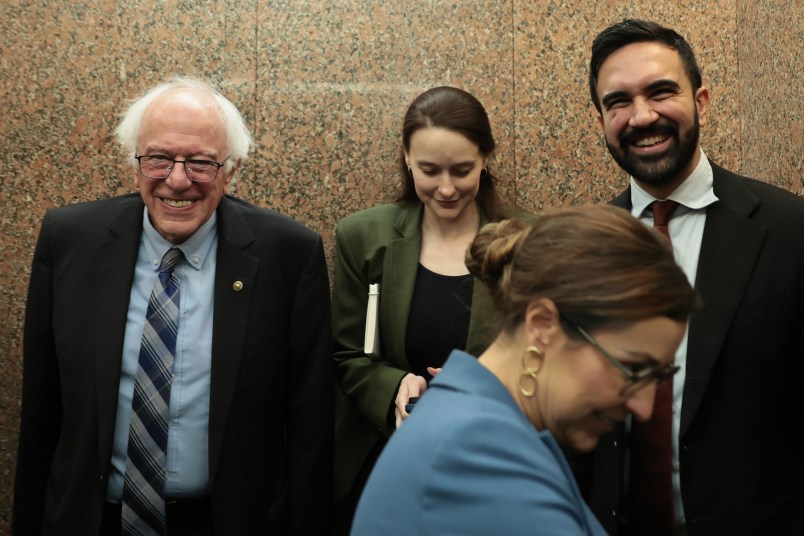
WASHINGTON, DC – JULY 16: Sen. Bernie Sanders (I-VT) and NYC Mayoral Candidate Zohran Mamdani enter an elevator after a meeting in the Dirksen Senate Office Building on July 16, 2025 in Washington, DC. Zohran met privately with Sanders after attending a breakfast event hosted by Rep. Alexandria Ocasio-Cortez (D-N.Y.) He is expected to meet House Minority Leader Rep. Hakeem Jeffries (D-NY), who has yet to endorse later this week. (Photo by Michael M. Santiago/Getty Images)

What happened next may concern Mamdani supporters. Business and media elites mounted a campaign of fear that put Sinclair on the defensive. Meanwhile, conservative Democrats defected, and a third candidate split progressive votes.

In the November election, Sinclair lost decisively to incumbent Gov. Frank Merriam, who would have stood less chance against a conventional Democrat.

As a historian of American radicalism, I have written extensively about Sinclair’s EPIC movement, and I direct an online project that includes detailed accounts of the campaign and copies of campaign materials.

Upton’s 1934 campaign initiated the on-again, off-again influence of radicals in the Democratic Party and illustrates some of the potential dynamics of that relationship, which, almost 100 years later, may be relevant to Mamdani in the coming months.

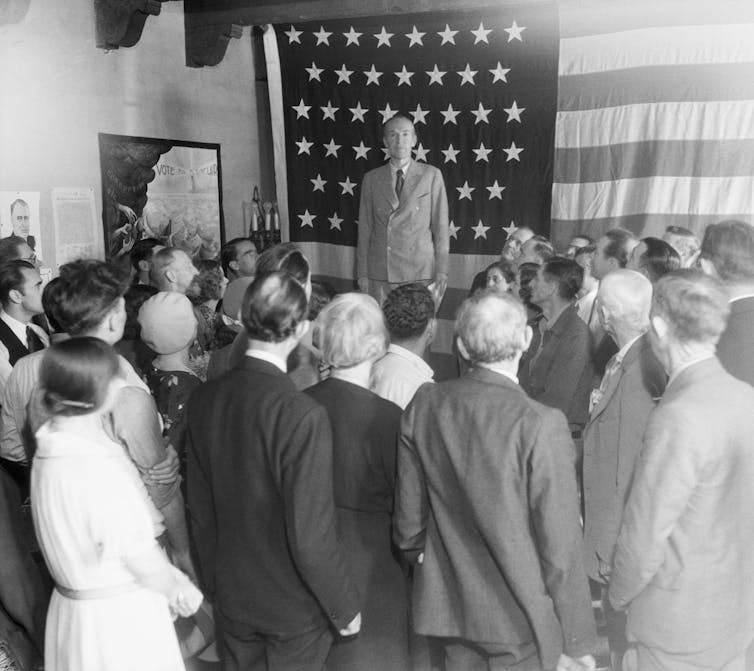
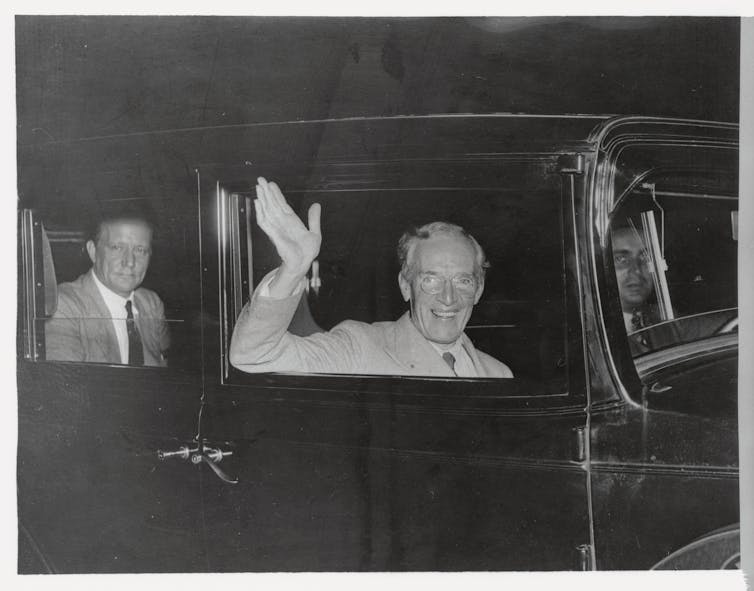
Upton Sinclair is seen in September 1934 in Poughkeepsie, N.Y., following a conference with President Franklin D. Roosevelt. Bettmann/Contributor/Getty Images

California, 1934

Sinclair launched his gubernatorial campaign in late 1933, hoping to make a difference but not expecting to win. California remained mired in the Great Depression. The unemployment rate had been estimated at 29% when Roosevelt took office in March and had improved only slightly since then.

Sinclair’s Socialist Party had failed badly in the 1932 presidential election as Democrat Roosevelt swept to victory. Those poor results included California, where the Democratic Party had been an afterthought for more than three decades.

Sinclair decided that it was time to see what could be accomplished by radicals working within that party.

Reregistering as a Democrat, he dashed off a 64-page pamphlet with the futuristic title I, Governor of California and How I Ended Poverty. It detailed his plan to solve California’s massive unemployment crisis by having the state take over idle farms and factories and turn them into cooperatives dedicated to “production for use” instead of “production for profit.”

Sinclair speaks to a group in his campaign headquarters in Los Angeles, Calif., in September 1934. Bettmann/ Contributor/Getty Images

Sinclair soon found himself presiding over an explosively popular campaign, as thousands of volunteers across the state set up EPIC clubs — numbering more than 800 by election time — and sold the weekly EPIC News to raise campaign funds.

Mainstream Democrats waited too long to worry about Sinclair and then failed to unite behind an alternative candidate. But it would not have mattered. Sinclair celebrated a massive primary victory, gaining more votes than all of his opponents combined.

Newspapers around the world told the story.

“What is the matter with California?” The Boston Globe asked, according to author Greg Mitchell. “That is the farthest shift to the left ever made by voters of a major party in this country.”

Building fear

Primaries are one thing. But in 1934, the November general election turned in a different direction.

Terrified by Sinclair’s plan, business leaders mobilized to defeat EPIC, forming the kind of cross-party coalition that is rare in America except when radicals pose an electoral threat. Sinclair described the effort in a book he wrote shortly after the November election: “I, Candidate for Governor: And How I Got Licked.”

Nearly every major newspaper in the state, including the five Democratic-leaning Hearst papers, joined the effort to stop Sinclair. Meanwhile, a high-priced advertising agency set up bipartisan groups with names like California League Against Sinclairism and Democrats for Merriam, trumpeting the names of prominent Democrats who refused to support Sinclair.

Few people of any party were enthusiastic about Merriam, who had recently angered many Californians by sending the National Guard to break a Longshore strike in San Francisco, only to trigger a general strike that shut down the city.

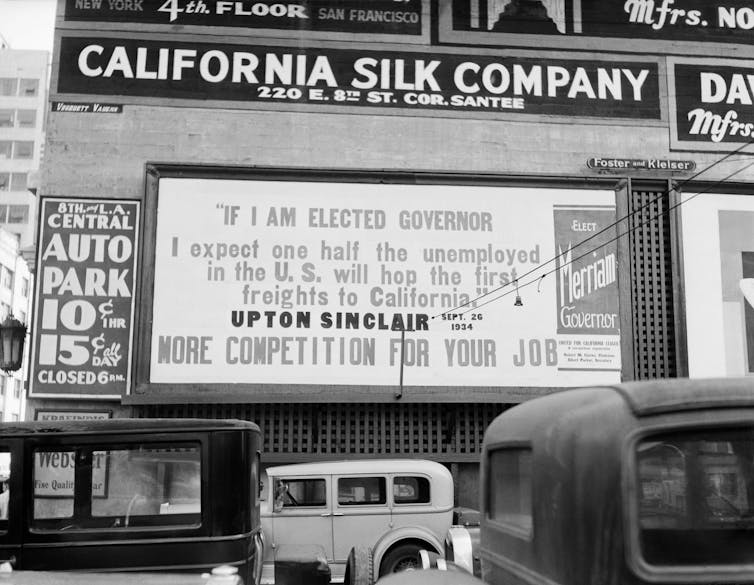
A billboard supports Republican Frank Merriam and opposes Democrat Upton Sinclair for governor of California in January 1934. Bettmann /Contributor/Getty Images

The campaign against Sinclair attacked him with billboards, radio and newsreel programming, and relentless newspaper stories about his radical past and supposedly dangerous plans for California.

EPIC faced another challenge, candidate Raymond Haight, running on the Progressive Party label. Haight threatened to divide left-leaning voters.

Sinclair tried to defend himself, energetically denouncing what he called the “Lie Factory” and offering revised, more moderate versions of some elements of the EPIC plan. But the Red Scare campaign worked. Merriam easily outdistanced Sinclair, winning by a plurality in the three-way race.

New York, 2025

Will a Democratic Socialist running for mayor in New York face anything similar in the months ahead?

A movement to stop Mamdani is coming together, and some of what they are saying resonates with the 1934 campaign to stop Sinclair.

The Guardian newspaper has quoted “loquacious billionaire hedge funder Bill Ackman, who said he and others in the finance industry are ready to commit ‘hundreds of millions of dollars’ into an opposing campaign.”

In 1934, newspapers publicized threats by major companies, most famously Hollywood studios, to leave California in the event of a Sinclair victory. The Wall Street Journal, Fortune magazine and other media outlets have recently warned of similar threats.

And there may be something similar about the political dynamics.

Sinclair’s opponents could offer only a weak alternative candidate. Merriam had few friends and many critics.

In 2025, New York City Mayor Eric Adams, who abandoned the primary when he was running as a Democrat and is now running as an independent, is arguably weaker still, having been rescued by President Donald Trump from a corruption indictment that might have sent him to prison. If he is the best hope to stop Mamdani, the campaign strategy will likely parallel 1934. All attack ads — little effort to promote Adams.

But there is an important difference in the way the New York contest is setting up. Andrew Cuomo remains on the ballot as an independent, and his name could draw votes that might otherwise go to Adams.

Curtis Sliwa, the Republican candidate, will also be on the ballot. Whereas in 1934 two candidates divided progressive votes, in 2025 three candidates are going to divide the stop-Mamdani votes.

Religion also looms large in the campaign ahead. The New York City metro area’s U.S. Muslim population is said to be at least 600,000, compared to an estimated 1.6 million Jewish residents. Adams has announced that the threat of antisemitism will be the major theme of his campaign.

The stop-Sinclair campaign also relied on religion, focusing on his professed atheism and pulling quotations from books he had written denouncing organized religion. However, a statistical analysis of voting demographics suggests that this effort proved unimportant.

This article is republished from The Conversation under a Creative Commons license. Read the original article.

The Conversation

A Third Whistleblower Challenges Bove, and a Criminal Defendant Challenges Habba

A lot of things happened. Here are some of the things. This is TPM’s Morning Memo. Sign up for the email version.

More Bad News for Bove

A third whistleblower has come forward to the Senate Judiciary Committee, charging that Emil Bove, Trump’s nominee for a lifetime appointment to the Court of Appeals for the Third Circuit, misled senators during his confirmation hearing, the Washington Post reports

This latest whistleblower follows two others who accused Bove of telling Justice Department attorneys to ignore court orders blocking Trump’s deportations. Specifically, former DOJ attorney Erez Reuveni said that Bove had told department lawyers to say “fuck you” to judges blocking Trump’s scheme to render Venezuelan detainees to an El Salvador prison. Bove claimed in his confirmation hearing he did not recall saying this.

“We have substantial information relevant to the truthfulness of the nominee,” Sen. Cory Booker (D-NJ) said in a floor speech yesterday. But Senate Republicans have shown no interest in even finding out what the new whistleblower has to say. 

The opposition of Lisa Murkowski (R-AK) and Susan Collins (R-ME) is insufficient to deprive the Republicans of the 50-vote majority necessary to confirm someone who allegedly told DOJ attorneys to flout court orders to be a judge for the rest of his life. Bove is 44.

Meanwhile, a New Jersey defense attorney is seeking to have drug and gun charges dismissed against his client on the grounds that Alina Habba’s second appointment as interim U.S. Attorney was “under questionable legal authority,” Politico reports. Even if the motion is ultimately unsuccessful, it points to potential turmoil and disruptions as a result of the supposedly tough-on-crime Trump administration’s extreme measures to keep his close ally in power as the state’s top federal prosecutor.

As Morning Memo reported last week, Attorney General Pam Bondi thumbed her nose at an order issued by federal judges in New Jersey, who had blocked Habba’s continued appointment following the expiration of her 120-day interim term. (Bondi said that DOJ “does not tolerate rogue judges — especially when they threaten the President’s core Article II powers.”) Trump then withdrew Habba’s nomination to serve in the role permanently (subject to Senate confirmation). That cleared the way for Bondi to make Habba her “chief deputy” — a maneuver that in turn allowed her to reappoint Habba for an additional 210-day interim term.  

If Bove is confirmed to the Third Circuit, he potentially could be on a panel of judges to hear appeals of challenges to Habba’s or any other DOJ-installed U.S. Attorney’s appointment in New Jersey.

Trump Administration Greenlights Proselytizing in the Federal Workplace

Under a memo issued by the Office of Personnel Management yesterday, federal workers are permitted to talk to their co-workers about their religion, including engaging a colleague “in polite discussion of why his faith is correct and why the non-adherent should re-think his religious beliefs.” They are also allowed to engage in religious displays, conversations, or prayer in public spaces and with members of the public.

All of the examples of protected conduct cited in the memo involve Christianity or Judaism, but not other religions. The memo cites the acceptability of displaying a cross, crucifix, rosary beads, mezuzah, tefillin, or Star of David, or of citing or keeping a Bible at one’s desk. It does not cite any examples of permissible workplace religious expression from Islam, Buddhism, Hinduism, Sikhism, or other religions.

Christian nationalists have long portrayed a secular workplace as one that discriminates against conservative Christians, who claim that their religious freedom demands they be allowed to share the gospel with co-workers or refuse service to prospective clients or the public on the grounds their conscience forbids same-sex marriage, for example. While the movement has long focused on private workplaces, the new OPM guidance exemplifies how the Trump administration’s plans to completely remake the federal workplace include Christianizing it. Project 2025 envisioned a broad Christianization of the federal government and American workplaces, calling on the new administration to “enact policies with robust respect for religious exercise in the workplace, including under the First Amendment, the Religious Freedom Restoration Act of 1993 (RFRA), Title VII, and federal conscience protection laws,” and to “provide robust accommodations for religious employees.”

Speaking of Project 2025

Project 2025 author and former Heritage Foundation official Paul Dans has announced a primary challenge to Sen. Lindsey Graham (R-SC) next year. During the height of the 2024 presidential campaign, Dans had stepped down from his Heritage post amid rising public opposition to Project 2025, and the Trump campaign’s duplicitous effort to “distance” him from the controversial policy tome. Now Dans is accusing Graham of “betraying” the state’s conservatives, and is taking credit for helping Trump “implement the America First agenda that’s reshaping America into the country we have always dreamed of.” Former Trump campaign advisor Chris LaCivita, now advising Graham, accused Dans of having attempted to “torpedo” Trump’s 2024 prospects, and ominously predicted his Senate primary campaign would “end prematurely.” 

That’s right: Dans left Heritage because he was supposedly talking too much about the blueprint document that the Trump administration has since largely implemented, and Graham’s campaign is accusing him of having tried to torpedo Trump’s campaign by being too public about it.

Speaking of Religious Freedom

Several non-MAGA religious denominations have filed a fourth lawsuit challenging the Trump administration’s rescission of a 2011 policy restricting Immigration and Customs Enforcement (ICE) raids at “sensitive locations,” including houses of worship. The plaintiffs, which include several synods of Evangelical Lutheran Church in America, three Quaker groups, American Baptist Churches USA, Alliance of Baptists, and Metropolitan Community Churches, allege that ICE raids and the prospect of ICE raids at houses of worship infringe on congregants’ ability to participate in religious services and fulfill religious obligations. The raids are not hypothetical: the complaint cites several arrests outside of California churches since the Trump administration ended the sensitive location policy.

Christian Right Activists Suddenly Concerned Some of Their Own Might Be Deported

Although Trump’s anti-immigrant policies are widely supported by white evangelicals, some leaders are now worrying that deportations might sweep up some of their fellow travelers, including parishioners and pastors. At Right Wing Watch, Kyle Mantyla reports on an episode of Christian right activist Jim Garlow’s podcast “sound[ing] the alarm over the prospect that tens of thousands of Latino Christians could be forcibly deported from the United States because of the Trump administration’s policies.”

Feds Forced to Drop Charges Against Anti-ICE Protesters in L.A.

Federal immigration officers in Los Angeles made false or misleading statements about the arrests of protesters against Trump administration crackdowns earlier this month, the Guardian reports. As a result, in addition to the previously reported refusal of grand juries to indict protesters, federal prosecutors have also been forced to drop felony charges against some protesters who had been charged with assaulting or impeding officers. 

The Making of Trump’s “Border Attack Dog”

The Phoenix New Times’ Stephen Lemons is out with a deep dive into Trump’s vicious “border czar,” Tom Homan, a veteran of Arizona immigration enforcement under Republican and Democratic presidents whose former colleagues remember as a “reasonable” person who “abhorred Donald Trump.” But now:

In the second Trump administration, Homan seems to be enjoying all the attention that helming a cruel and chaotic mass deportation scheme has afforded him. The 63-year-old — that’s a year younger than George Clooney, though Homan appears a million city miles older — has become a mainstay of conservative media. He threatens to arrest Democratic lawmakers who oppose the actions of the Immigration and Customs Enforcement agents whom he’s let off the leash. He gloats over the abduction and removal of non-criminal migrants to foreign gulags. He peddles bullshit about the doxing of ICE agents to justify hiding their identities. Ironically, considering how much his agents conceal their faces, Homan’s love of the MAGA spotlight has made his craggy visage one of the most recognizable among Trump’s cronies.

In Epstein Scramble, Mike Johnson Blames Democrats for His Early House Summer Recess 

In an interview with the Family Research Council’s radio program This Week on Capitol HIll, the House Speaker claimed that Democrats are to blame for the House calling an early recess to avoid a possible vote to force the Trump administration to release the Epstein files. 

Although MAGA influencers have spent years clamoring for the release of the Epstein files, it has not been a huge issue for the Christian right. That’s why Johnson could mislead that audience into believing the whole transparency debate is the Democrats’ fault, accusing them of an underhanded attempt to derail Trump’s agenda. Displaying some serious chutzpah, Johnson claimed the Democrats are “suddenly trying to manufacture something … with the so-called Epstein files.”

Elon Musk Still the DOGE Villain

Unidentified creative activists have been displaying a 12-foot high replica of Elon Musk’s head at national parks this summer, seeking to link longer wait times with DOGE cuts of National Park Service staff. They have wheeled the head on a flatbed bearing signage reading “Make America Wait Again” and “Now With Longer Lines Thanks To Doge Cuts!” 

Important Read

Princeton University authoritarianism expert Kim Lane Scheppele lays out the stakes in Trump’s assaults on universities, and how to combat them.

Do you like Morning Memo? Let us know!