


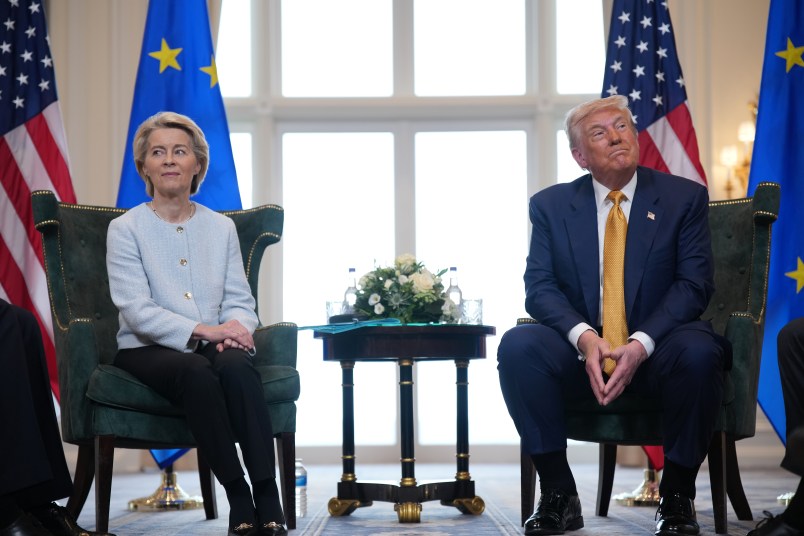
A prevailing narrative has emerged about recent U.S. trade agreements: other countries are bending under the heavy hand of an all-powerful Trump.
Axios framed an agreement reached with Japan as evidence of U.S. omnipotence in global trade. Reuters reported a 660% bump month to month in Chinese exports of rare earth minerals to the U.S. (The bump came only because the Chinese all but stopped exports in retaliation against Trump’s initial tariff announcement.) And a Wall Street Journal article described the trade deal the U.S. struck with the European Union on Sunday as “the Least Bad Outcome” for business leaders.
But economists TPM spoke to suggest these agreements will end up harming everyone involved: foreign governments, the U.S. government, and American businesses and consumers.
“What I’m seeing so far, which is really interesting, is the fact that a lot of folks are talking about these trade deals as the other countries are losing and the U.S. is winning. I think that narrative is actually incorrect,” Ina Manak, a trade policy fellow at the Council on Foreign Relation, told TPM. “The U.S. is putting up all these barriers.”
“If anyone is losing, it’s us. It’s us, here in the U.S., that are gonna pay for it long-term.”
The Trump administration has tossed out generations of trade policy practices dating back to WWII — protocols which involved Congress, small businesses, corporations, academics and other stakeholders. Instead of fighting for favorable trade agreements, countries are negotiating directly with President Donald Trump and his handful of trade officials for hazy promises — seeking, merely, anything that is not worse than what has been offered to other countries.
Given this chaotic state of affairs, it’s understandable that governments seem relieved just to put an end to the volatility and accept lower — though still significant — tariff rates. But the lack of details released around the individual deals makes it difficult to judge their merits.
Trump’s deal with the 27 of countries that comprise the EU includes a 15% baseline tariff for most European goods. The EU also agreed not to tax a yet unknown category of U.S. imports, to purchase $750 billion of energy products from the U.S., and invest another $600 billion in the country, Trump said. Notably, the White House and the European Commission have since put out several contradictory claims about the agreement, with the EU saying it cannot guarantee the sizes of either aforementioned investments, according to Euronews.
Still, Eurochambers, a European association of chambers of commerce and industry, told the Journal the deal was “the least painful solution” for the EU. In another article, the newspaper called the EU deal “the most consequential agreement Trump has so far announced.” The president, in his typical hyperbolic fashion, suggested it was “the biggest deal ever made.”
But economists have said those kinds of assertions are hard to make because so little is known about the actual parameters of the deal.
The trade deals in question aren’t actually deals at all. Instead, Manak said, they’re proposals or announcements — “sort of a framework for future discussions.”
“Until we see a full text of things it’s going to be hard to know what exactly was agreed to,” she said of the EU deal.
The trade negotiation process typically takes years, Joshua Mask, an economist and professor at Temple University, points out. “Things could be changed along the way” as the details of the agreements are hammered out, Mask said. And Trump is facing a lawsuit challenging his authority to issue sweeping tariffs in the first place.
Trump and his small team, which includes Treasury Secretary Scott Bessent and Commerce Secretary Howard Lutnick, have been making a flurry of agreements with the biggest U.S. trading partners ahead of Trump’s arbitrarily-set, looming tariff deadline of August 1. Trump had initially issued an executive order instituting sweeping global tariffs on April 2, a date he called “Liberation Day,” before pausing them amid market panic. The deadline for them to go into effect was then pushed back twice.
Bessent is now downplaying the August deadline, too, instead saying negotiations with the country’s most prolific trading partners could go until Labor Day.
An agreement with the United Kingdom agreed to in May set a 10% tariff rate on most goods and and on a maximum of 100,000 imported cars, but maintained a 25% tariff on steel, which Trump has said will be reduced “pretty soon.” Japan negotiated a 15% tariff on imported goods. The administration has come to nebulous agreements with Indonesia and the Philippines as well, and claimed to make a deal with Vietnam. In that case, according to Politico, the announced details apparently differed so greatly from what Vietnamese officials understood, some questioned whether a deal was made at all.
“The administration has sort of bitten off more than it can chew,” said Manak. “They’re trying to negotiate deals with everybody.”
From Scotland on Monday, Trump claimed he’ll probably apply a 15% to 20% blanket import tariff on countries that have not made dedicated agreements with the U.S., because, he said, “you can’t sit down and make 200 deals.”
With so much still up in the air, the experts TPM spoke to were wary of making predictions about the impact of future tariffs. They cautioned that any hikes will be felt by American consumers and potentially by U.S. businesses that import foreign goods.
“Trump Administration officials insist that foreign producers will pay the entire tab,” said Stephen Stanley, chief U.S. economist at Santander Bank, in an emailed analysis on the EU agreement. “While this is possible, and may be accurate in a few specific cases, it is doubtful that U.S. consumers will escape unscathed.”
Tariffed countries will also be less inclined to continue to trade with the U.S. at the same volume, Mask said.
“That’s not something that’s just going to unwind overnight,” he continued. “But the longer this goes, countries will start looking for other options.”



Why do Donald Trump and the billionaires who fund him, hate America.
I ask this because it is evident that they are working hard to end the American hegemony. We were the world’s last superpower but Trump is doing all he can to end our superpower status.
Trump acts like he is carrying out the obsolete strategic game plan of Vlad Putin. Trump is a Putin fan so that might explain Trump but how does it explain the tech bros who seem to want the same shit.
““Until we see a full text of things it’s going to be hard to know what exactly was agreed to,” she said of the EU deal.”
There is no text. There are no details. There is no solid agreement with any of these countries.
It’s all smoke and mirrors.
Trump doesn’t understand economics, so any of the recent tariff “deals” should only be regarded as political theater. Trump is praised for a radical reordering of the global economy, but the psychology of the moment is more like the final erratic behavior of individuals and firms just before going bankrupt.
I wonder if there will be at least one, maybe more, multinational corporations that will have to hire more accountants? I mean they might have an American company in their portfolio, that gets parts from another of the corporation’s companies that manufactures in another country, which the American company assembles. Or even assembles in a third country at that.
And for the love of God can someone please explain to me why anyone in manufacturing would listen to a guy whose only experiences are in real estate and hotels?
The American people will soon tire of these deals if they lead to higher prices or fewer consumer options as foreign suppliers seek different markets.