Since December, Southern California has been dealing with flooding caused by storms churning up the Pacific Ocean and periods of extreme rainfall. Residents of this region are not typically subject to such conditions but, with global warming affecting weather patterns, it is becoming a more common occurrence. From Ventura County to San Diego, coastal cities are getting hit hard this winter.
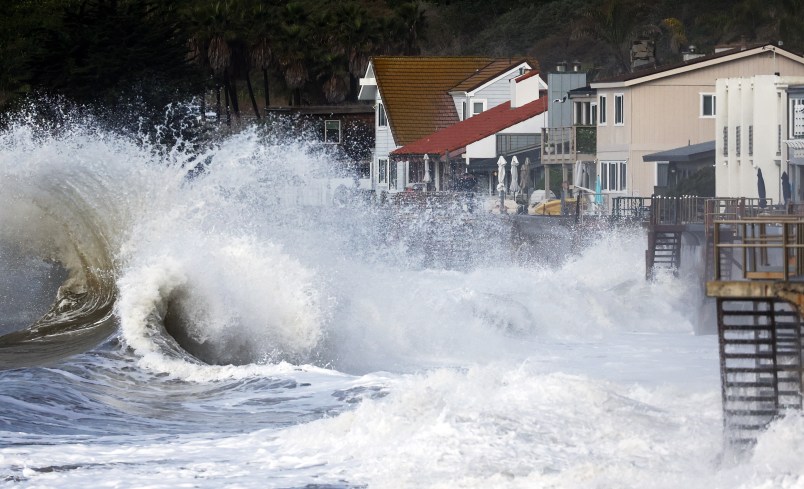
Waves crashing next to homes in Ventura, California
VENTURA, CALIFORNIA – DECEMBER 30: Powerful waves crash next to homes along the coastline on December 30, 2023 in Ventura, California. Dangerous surf churned up by storms in the Pacific is impacting much of California’s coastline with coastal flooding possible in some low-lying areas. A 2023 study from UC San Diego Scripps Institution of Oceanography showed that California’s winter waves have increased in size since 1970, a rise the study associates with global warming. (Photo by Mario Tama/Getty Images)
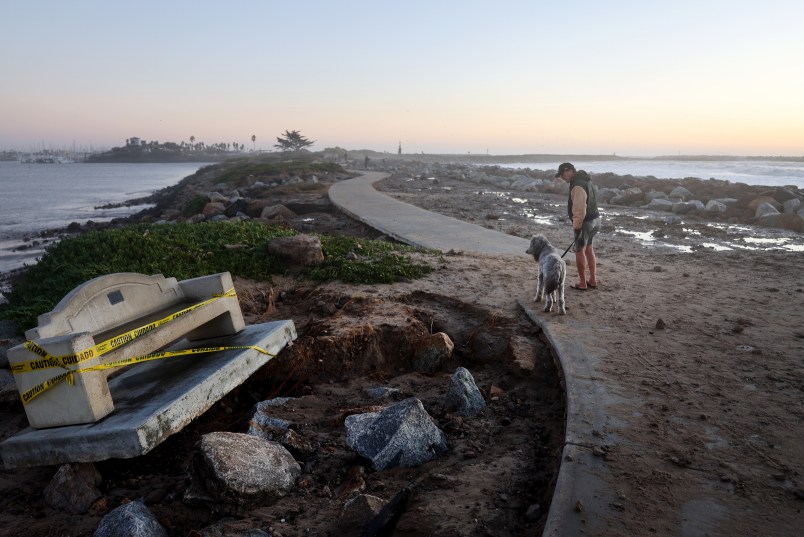
A bench displaced by strong waves in Ventura, California
VENTURA, CALIFORNIA – DECEMBER 30: A person walks with a dog past a bench which was displaced by strong Pacific Ocean waves on December 30, 2023 in Ventura, California. Dangerous surf churned up by storms in the Pacific is impacting much of California’s coastline with coastal flooding possible in some low-lying areas. A 2023 study from UC San Diego Scripps Institution of Oceanography showed that California’s winter waves have increased in size since 1970 as climate change has warmed the planet. (Photo by Mario Tama/Getty Images)
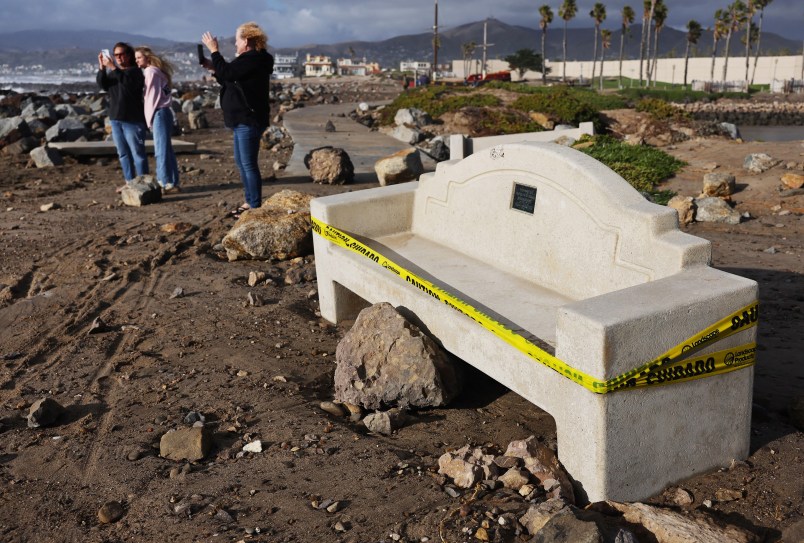
Another bench displaced along a stretch of beach in Ventura, California
VENTURA, CALIFORNIA – DECEMBER 30: People take photos near a bench which was displaced by strong Pacific Ocean waves on December 30, 2023 in Ventura, California. Dangerous surf churned up by storms in the Pacific is impacting much of California’s coastline with coastal flooding possible in some low-lying areas. A 2023 study from UC San Diego Scripps Institution of Oceanography showed that California’s winter waves have increased in size since 1970 as climate change has warmed the planet. (Photo by Mario Tama/Getty Images)
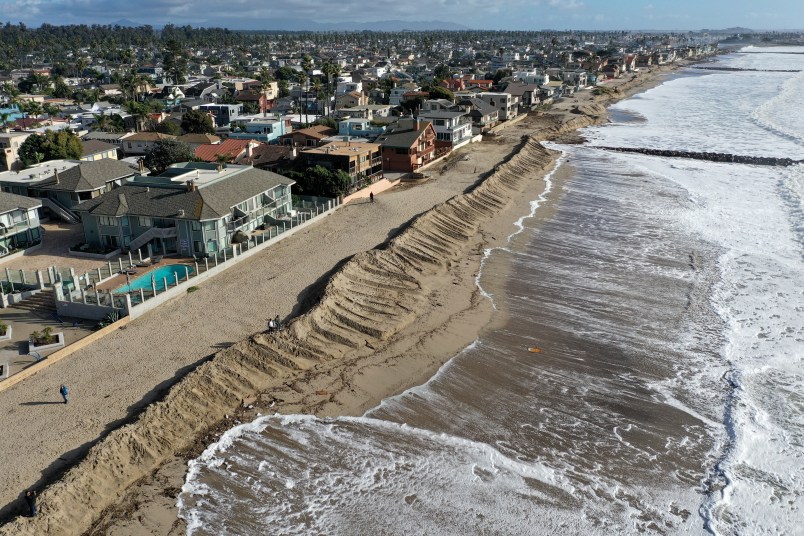
A protective berm constructed in Ventura, California
VENTURA, CALIFORNIA – DECEMBER 30: In an aerial view, a newly constructed sand berm protects against strong Pacific Ocean surf, two days after a rogue wave inundated the area and injured eight people, on December 30, 2023 in Ventura, California. Dangerous surf churned up by storms in the Pacific is impacting much of California’s coastline with coastal flooding possible in some low-lying areas. A 2023 study from UC San Diego Scripps Institution of Oceanography showed that California’s winter waves have increased in size since 1970 as climate change has warmed the planet. (Photo by Mario Tama/Getty Images)
A powerful wave breaking in Ventura, California
VENTURA, CALIFORNIA – DECEMBER 30: Pelicans fly above a powerful Pacific Ocean wave breaking on December 30, 2023 in Ventura, California. Dangerous surf churned up by storms in the Pacific is impacting much of California’s coastline with coastal flooding possible in some low-lying areas. A 2023 study from UC San Diego Scripps Institution of Oceanography showed that California’s winter waves have increased in size since 1970 as climate change has warmed the planet. (Photo by Mario Tama/Getty Images)
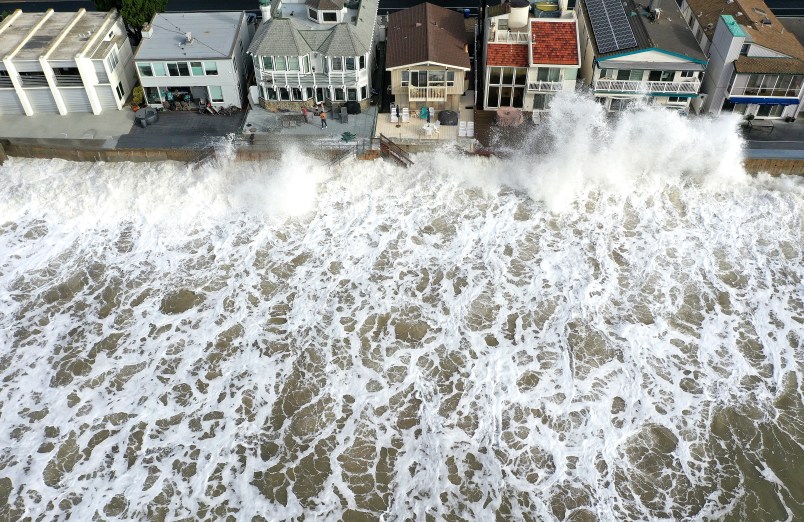
Waves crashing into homes in Ventura, California
VENTURA, CALIFORNIA – DECEMBER 30: An aerial view of Pacific Ocean waves crashing against a seawall protecting homes on December 30, 2023 near Ventura, California. Dangerous surf churned up by storms in the Pacific is impacting much of California’s coastline with coastal flooding possible in some low-lying areas. A 2023 study from UC San Diego Scripps Institution of Oceanography showed that California’s winter waves have increased in size since 1970 as climate change has warmed the planet. (Photo by Mario Tama/Getty Images)
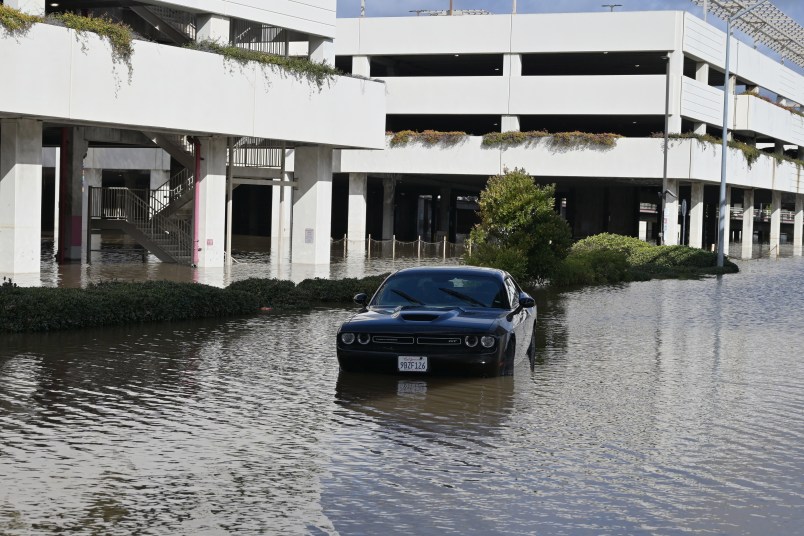
An abandoned car in a flooded area of San Diego, California
SAN DIEGO, CALIFORNIA, US – JANUARY 23:An abandoned car in a flooded area is seen below the Fashion Valley Trolley Station during the aftermath of the storm in San Diego, California. on January 23, 2024. San Diego Mayor Todd Gloria declared a state of emergency on Monday ‘due to extreme rainfall and flash flooding” as heavy rain fell across parts of California. (Photo by Carlos Moreno/Anadolu via Getty Images)
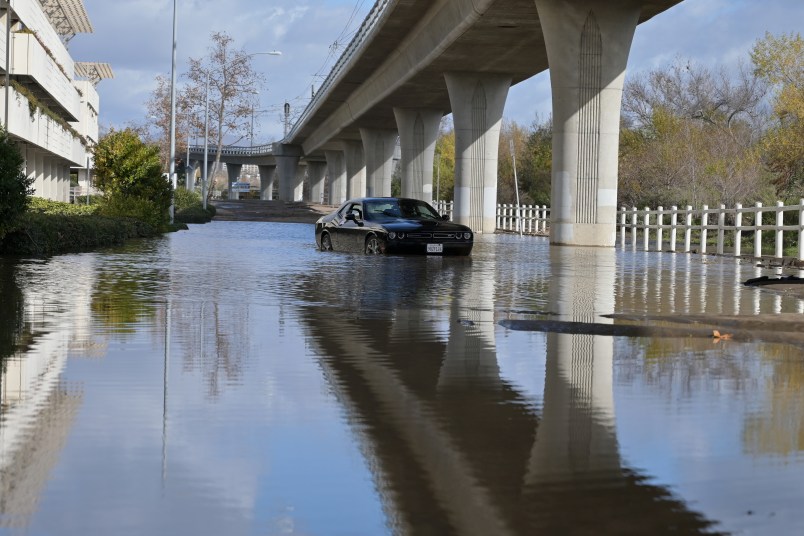
Flooding near a trolley station in San Diego, California
SAN DIEGO, CALIFORNIA, US – JANUARY 23:An abandoned car in a flooded area is seen below the Fashion Valley Trolley Station during the aftermath of the storm in San Diego, California. on January 23, 2024. San Diego Mayor Todd Gloria declared a state of emergency on Monday ‘due to extreme rainfall and flash flooding” as heavy rain fell across parts of California. (Photo by Carlos Moreno/Anadolu via Getty Images)
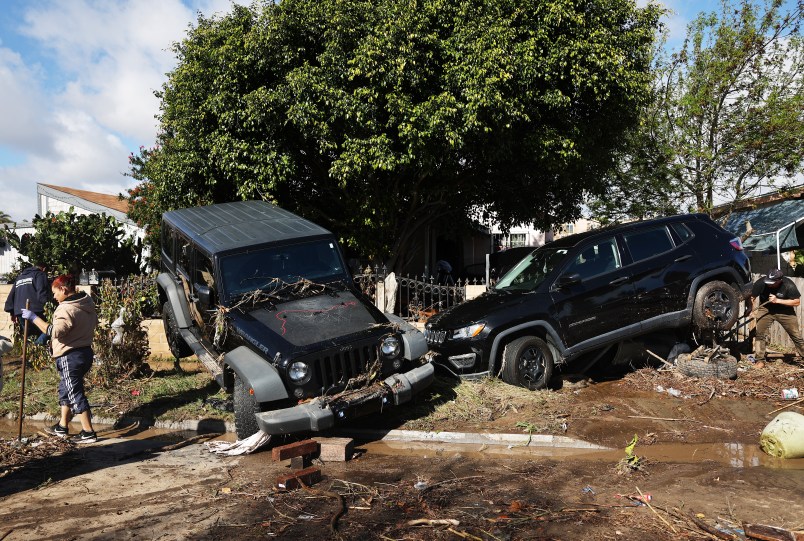
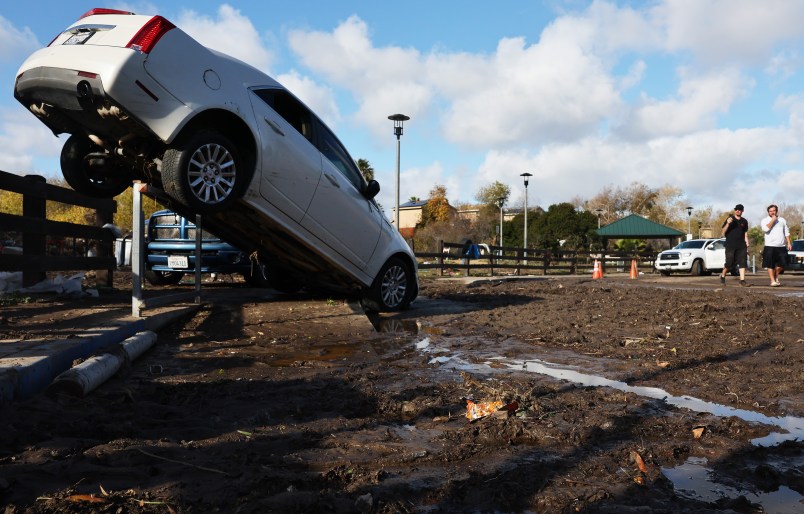
A vehicle lodged on a fence in the aftermath of flooding in San Diego, California
SAN DIEGO, CALIFORNIA – JANUARY 23: A vehicle moved by flooding remains lodged on a fence the day after an explosive rainstorm deluged areas of San Diego County on January 23, 2024 in San Diego, California. The intense rains forced dozens of rescues while flooding roadways and homes and knocking out electricity for thousands of residents. (Photo by Mario Tama/Getty Images)
Attempts made to dislodge stuck cars in the aftermath of flooding in San Diego, California
SAN DIEGO, CALIFORNIA – JANUARY 23: A person (R) works to help tow away a vehicle dislodged by flooding the day after an explosive rainstorm caused flooding in areas of San Diego County on January 23, 2024 in San Diego, California. The intense rains forced dozens of rescues while flooding roadways and homes and knocking out electricity for thousands of residents. (Photo by Mario Tama/Getty Images)
A car moved by flood waters after a rain storm in San Diego, California
SAN DIEGO, CALIFORNIA – JANUARY 23: People walk past a vehicle moved by flooding that remains lodged on a fence the day after an explosive rainstorm deluged areas of San Diego County on January 23, 2024 in San Diego, California. The intense rains forced dozens of rescues while flooding roadways and homes and knocking out electricity for thousands of residents. (Photo by Mario Tama/Getty Images)
Residents cleaning mud from a home damaged by flooding in San Diego, California
SAN DIEGO, CALIFORNIA – JANUARY 23: Family members clean mud from a home damaged by flooding, with the floodwater line visible on the house, the day after an explosive rainstorm deluged areas of San Diego County on January 23, 2024 in San Diego, California. The intense rains forced dozens of rescues while flooding roadways and homes and knocking out electricity for thousands of residents. (Photo by Mario Tama/Getty Images)
For almost a year now, I’ve been struggling with how to cover Texas Gov. Greg Abbott’s performative border clash in a way that reflects that it’s fundamentally a political stunt while also warning of how extreme the premise of the stunt is. It’s a tricky balance that is a hallmark of the Trump era we find ourselves in.
No one really believes that individual states have or should have authority to police the international borders of the United States. No one really believes that the U.S. is under invasion by unarmed migrants crossing the southern border for desperate economic reasons. No one really believes that Abbott is acting in good faith to address an intractable policy problem with a well-designed, carefully calibrated, workable solution.
In the old days, the fact that no one really believes this is anything other than a political stunt would probably have been enough either not to cover it or to cover it solely as a stunt. And there’s plenty to cover as a political stunt, including: It aligns with Trump’s campaign efforts to demonize and vilify migrants; it syncs up with the House GOP’s effort to make the border central to the 2024 election; it gives Republicans a vehicle to highlight the so-called border crisis and attack President Biden for it; and it inoculates elected Republicans in Texas from criticism for the border crisis.
The tell that the right wing doesn’t really care about the border except as a political cudgel is how there is virtually no criticism of Texas elected officials for the border crisis they insist exists or blowback for the small-bore, penny-ante solutions they’ve come up with, like stringing barbed wire across sections of the Rio Grande. It’s the same dynamic that insulated President Trump from criticism for failing to build the wall let alone shut down the border entirely – and lets him campaign for Trump II while unironically continuing to promise to build the fabled wall.
But this isn’t the old days. Abbott has a legislature going along with his plans. The 5th Circuit Court of Appeals, which includes Texas, is the most conservative in the country and gives Abbott not just cover but vindication, and there’s a conservative supermajority on the Supreme Court that just might be willing to rewrite federal immigration law, dramatically alter the balance of power between the states and the federal government, or engage in some other mischief.
And so the challenge of covering it is how to treat it like a stunt, while noting the substantive risks, even if remote, and at the same time not unduly alarm the public in the exact same way that the stunt is intended to do. I’m not complaining. There are much harder jobs than this one. But it’s these kinds of performative threats – and their symbolic and real power – that mark the Trump era and generate often subpar coverage of what’s really happening.
A sampling of Josh Kovensky’s early coverage shows how we balanced it before it became a national story:
"There are remedies for those who think the federal government is not doing enough at the border… Those remedies do not include every state for themselves."@steve_vladeck on why we could see a confrontation between state and federal officials along the U.S.-Mexico border: pic.twitter.com/PvOULTiJl8
The House Homeland Security Committee is expected to approve baseless and evidence-free articles of impeachment today against DHS Secretary Alejandro Mayorkas on the bogus grounds that he hasn’t sufficiently secured the southern border.
Lankford Gets The MAGA Treatment
The Oklahoma GOP is very upset that Sen. James Lankford (R-OK) is negotiating a border bill.
Fascism Spares No One
Aaron Blake: Republicans now say it might be okay to ignore the Supreme Court
In the wake of the 2020 election, the president of the far-right network One America News sent a potentially explosive email to former Trump campaign lawyer Sidney Powell, with a spreadsheet claiming to contain passwords of employees from the voting technology company Smartmatic, according to court filings.
The existence of the spreadsheet was recently disclosed by Smartmatic, which is suing OAN for defamation. CNN pieced together who was involved in the email exchanges by examining court records from three separate cases stemming from the 2020 election.
Lawyers from Smartmatic told a federal judge that the email, and the attached spreadsheet, suggest OAN executives “may have engaged in criminal activities” because they “appear to have violated state and federal laws regarding data privacy.”
Victory Tour
E. Jean Carroll made the rounds on TV yesterday, basking in her $83 million judgment against Donald Trump:
"He's nothing. He is like a walrus snorting." E.Jean Carroll describes her surprise at how insubstantial Donald Trump's presence was in court, despite his image and hype. pic.twitter.com/PLAr1Jc9nJ
In emerging plans that involve everything from the EPA to the Federal Trade Commission to the Postal Service, nearly 100 anti-abortion and conservative groups are mapping out ways the next president can use the sprawling federal bureaucracy to curb abortion access.
Many of the policies they advocate are ones Trump implemented in his first term and President Joe Biden rescinded — rules that would have a far greater impact in a post-Roe landscape. Other items on the wish list are new, ranging from efforts to undo state and federal programs promoting access to abortion to a de facto national ban. But all have one thing in common: They don’t require congressional approval.
This announcement on the House floor yesterday spawned a lot of speculation:
“This is to notify you formally pursuant to rule 8 of the rules of the House of Representatives that the office of the sergeant at arms for the House of Representatives has been served with a grand jury subpoena for documents issued by the U.S. Department of Justice” pic.twitter.com/Qct7SsGuRi
Later in the day, reportsemerged that the Justice Department is investigating a not-yet-named-publicly House Democrat for alleged misuse of government funds for personal security.
Illinois Considers Trump DQ Clause Case
The Illinois Board of Elections is scheduled this morning to consider a Disqualification Clause case against Donald Trump.
2024 Ephemera
Biden super PAC claims its $250 million ad blitz will be the largest single purchase of political advertising ever by a super PAC.
WSJ: Haley Taps Wall Street and Main Street to Keep Anti-Trump Bid Funded
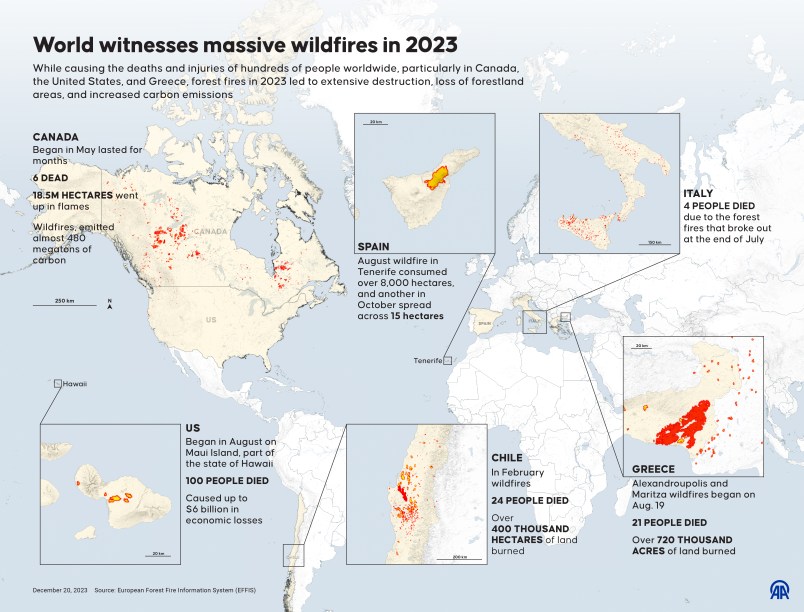
The New Yorker’s Elizabeth Kolbert reviews three new books on climate-change-driven wildfires.
ANKARA, TURKIYE – DECEMBER 20: An infographic titled “World witnesses massive wildfires in 2023” created in Ankara, Turkiye on December 20, 2023. While causing the deaths and injuries of hundreds of people worldwide, particularly in Canada, the United States, and Greece, forest fires in 2023 led to extensive destruction, loss of forestland areas, and increased carbon emissions. (Photo by Yasin Demirci/Anadolu via Getty Images)
The Department of Defense has identified the three soldiers killed in the drone attack on the undisclosed U.S. base in Jordan. They are Spc. Breonna Alexsondria Moffett, 23, of Savannah, GA; Sgt. William Jerome Rivers, 46, of Carrollton, GA; and Spc. Kennedy Ladon Sanders, 24, of Waycross, GA. The three were assigned Fort Moore, Georgia and deployed near the Syrian border as part of the U.S.’s on-going fight against the Islamic State.
Politico’s “West Wing Playbook” is out tonight with a report about the pro-Palestine “Ceasefire Now’ protestors which are showing up at basically every Biden event.
Here’s the lede of the newsletter which gives a taste of it …
Amid apparent infighting in the Oklahoma Republican Party, a resolution was passed over the weekend to formally condemn Sen. James Lankford (R-OK), who has caught the ire of Donald Trump supporters for working on the bipartisan immigration bill that Trump had asked congressional Republicans to spike.
You’ve probably seen the stories about the UN Agency which allegedly had amongst its employees Hamas operatives who directly participated in the October 7th massacres in southern Israel. The story is both more and less than it seems. The background helps illuminate this as well as much of what we’ve seen over the last three months.
United Nations Relief and Works Agency for Palestine Refugees in the Near East (UNRWA) was founded in 1949 to administer refugee camps for the hundreds of thousands of Palestinians who had either fled the fighting or were driven out by the Israeli military during both phases of the Israeli War of Independence, what Palestinians call The Nakba. (Most of this happened during the first phase of the war.) There were camps in Gaza, the West Bank, Lebanon, Syria and Jordan. Those camps are still there 75 years later. “Camps” is a misnomer. Over time permanent buildings replaced temporary structures and tents. Schools, hospitals, civic buildings and businesses grew up. They are more like towns, or districts of towns. The vast majority of residents of the camps are third and fourth generation descendants of the original refugees of 1947-48. Under UNRWA’s framework they are also refugees. UNRWA still plays a central role administering these communities — running schools, hospitals, various civil services.
A former president accused of rape and of defaming his victim by denying it.
The victim (though her strength, resilience, and aplomb defy use of that term) has now won two federal jury verdicts in NYC in the matter worth tens of millions of dollars.
Carroll v. Trump in both its iterations reaffirmed that no one is above the law, demonstrated that an experienced jurist can bring Trump to heel, and confirmed that the legal system can sternly punish those who discredit it and act with impunity to violate the law.
The nearly $90 million in judgments against Trump and in favor of Carroll put a nice, big, fat number on top of the underlying principles that were defended and ultimately vindicated.
I registered disappointment in some quarters that Carroll’s $83.3 million verdict Friday wasn’t as big in dollar terms as last month’s $148 million judgment in DC that bankrupted Rudy Giuliani. But the two verdicts compare favorably with each other and are arguably quite consistent.
First off, the Giuliani verdict involved two plaintiffs – Georgia election workers Ruby Freeman and Shaye Moss – so simply dividing their verdict in half (in truth, Moss won slightly more than Freeman) leaves each with $74 million. So in that rough sense Carroll won more than Freeman and Moss on a per capita basis.
Breaking it down a bit, Carroll won $18.3 million in compensatory damages compared to about $36 million apiece for Freeman and Moss. But she more than made up that difference with her punitive damages award of $65 million, quite a bit more than the $37.5 million apiece for Freeman and Moss.
Jury awards are notoriously difficult to compare, and these were in two different courts in two different parts of the country, with different defendants and claims. But I was struck less by how different the verdicts were than how similar.
While the gargantuan dollar figures enhance the schadenfreude, the real satisfaction is in seeing Carroll, Freeman and Moss individually striking blows for justice against a far more powerful figure and the forces arrayed behind him. It doesn’t always work that way, but it did here, and it is to their eternal credit that they bit the bullet and pursued their cases through to the end.
The Rule Of Law Applies To Everyone
E. Jean Carroll's attorney, Roberta Kaplan:
"Today was a good day for our system of justice. Today was a day that shows that the rule of law applies to everyone, even if you don't think the rule of law applies to you, it applies to you, and applied today to Donald Trump." pic.twitter.com/JyCr68ZdIf
You know the story by now. E. Jean Carroll met conservative lawyer and Trump foe George Conway at a party at the home of Molly Jong-Fast back in 2019. That chance meeting prompted Conway to introduce Carroll to attorney Roberta Kaplan, which eventually led to Carroll winning two defamation judgments against Trump for denying he raped her. Here’s Conway relishing in the $83 million damages verdict:
Joah Walsh: “If Attorney General Letitia James gets the $300 million she is seeking, suddenly, between that and the two Carroll awards, Trump is dangerously close to the $400 million he has testified he has in cash on hand.”
NYT: $83 Million Verdict Renews Spotlight on Trump’s Finances
NYT: Carroll Promises to Do ‘Something Good’ With a Fortune Won From Trump
Quote Of The Day
My advice to you is that you never disclose that you were on this jury and I won’t say anything more about it.
U.S. District Judge Lewis A. Kaplan, to the jurors in the E. Jean Carroll defamation trial
[F]ormer federal judge Barbara Jones, the court-appointed special monitor in Donald Trump’s New York business fraud case, just planted a financial bombshell that legal experts say suggests Trump lied knowingly and repeatedly on his federal financial disclosures about a major loan that never existed—and may have evaded taxes on $48 million in income.
So, ask yourself, is that enough to make you do more than you have done? Is that enough to commit for the next 10 months to do more than you have ever done during an election year? To give more? To canvas more? To spread the word more? To help get voters to the polls? To ensure every member of your family, your friends, your co-workers do the same? The stakes are too high to do less than everything you can. The stakes are too high to allow this man to continue to play any role in American public life.
Our Political Religion
Heather Cox Richardson marked the 186th anniversary of Abraham Lincoln’s Lyceum Address, where he said:
Let every American, every lover of liberty, every well wisher to his posterity, swear by the blood of the Revolution, never to violate in the least particular, the laws of the country; and never to tolerate their violation by others. As the patriots of seventy-six did to the support of the Declaration of Independence, so to the support of the Constitution and Laws, let every American pledge his life, his property, and his sacred honor;–let every man remember that to violate the law, is to trample on the blood of his father, and to tear the character of his own, and his children’s liberty. Let reverence for the laws, be breathed by every American mother, to the lisping babe, that prattles on her lap–let it be taught in schools, in seminaries, and in colleges; let it be written in Primers, spelling books, and in Almanacs;–let it be preached from the pulpit, proclaimed in legislative halls, and enforced in courts of justice. And, in short, let it become the political religion of the nation; and let the old and the young, the rich and the poor, the grave and the gay, of all sexes and tongues, and colors and conditions, sacrifice unceasingly upon its altars.
Keeping A Watchful Eye On Greg Abbott
University of Texas Law professor Steve Vladeck: What Texas is (and is not) doing to defy a Supreme Court setback
[Sponsored] An Inside Story Of The Democratic Party At A Moment Of Great Peril
The Truce, from journalists Hunter Walker (of Talking Points Memo) and Luppe B. Luppen, explores the major fault lines that define Democratic politics today and asks big questions about the future of the party. An engrossing page-turner, The Truce grapples with the dangers that threaten American democracy and the complicated cast of characters who are trying to save it.
NYT: Why Nikki Haley Has So Few Friends Left in South Carolina Politics
Koch-aligned group tells donors that it’s still backing Haley but that she faces a steep climb.
Benjy Sarlin: In the aftermath of the E. Jean Carroll verdict, Haley takes her Trump critique farther than before by saying “I absolutely trust the jury.”
Biden: You are the reason I'm president. You are the reason Kamala Harris is a historic vice president. You are the reason Donald Trump is a loser. And you are the reason we are going to win and beat him again. pic.twitter.com/HOYRn9W1pA
Biden: Donald Trump when he was commander-in-chief refused to visit a U.S. Cemetery outside of Paris for fallen American soldiers. He referred to those heroes as suckers and losers. How dare he say that! I called them patriots and heroes. The only loser I see is Donald Trump. pic.twitter.com/SiFBh0DWs7
However, wars do come to an end, often with one side making concessions in exchange for peace. And over the course of the Ukraine war, influential voices in the West – be it those of the late Henry Kissinger, former President Donald Trump or high-ranking NATO official Stian Jenssen, to name a few – have raised the prospect of Ukraine having to cede land to Russia in exchange for peace.
As an expert on Western military interventions in transnational ethnic conflicts, I have seen how well-intentioned peace agreements offered to the perceived aggressor can inadvertently plant the seeds for renewed conflict. This is because such agreements can deliver in peace what the aggressor pursues in war: territory.
Rather than resolve the root cause of conflicts, this can reward revanchism – that is, a state’s policy to reclaim territory it once dominated – and embolden an aggressor to use war to achieve its aim. This is especially true when the West rewards aggression with generous peace agreements.
Take the former Yugoslavia.
It has been more than 20 years since the end of the Yugoslav wars, a series of conflicts that followed the breakup of Yugoslavia. During these wars, Serbia sought to unify large swaths of territories populated by Serbs and non-Serbs into a “Greater Serbia.”
Of course, each war is different, and the circumstances surrounding the invasion of Ukraine are unique.
But I believe the examples of Bosnia and Kosovo show that Western-sponsored treaties, when they sacrifice land for peace, can store up trouble for later – especially when it comes to revanchist nations.
A picture shows a shadow of a man running past the Wall of Remembrance of the Memory Wall of Fallen Defenders of Ukraine in the Russian-Ukrainian War, in Kyiv on January 17, 2024, amid Russian invasion in Ukraine. (Photo by Sergei SUPINSKY / AFP) (Photo by SERGEI SUPINSKY/AFP via Getty Images)
Russia and Serbia revanchism
Russian and Serbian revanchism has been evident ever since the countries they once dominated – the Soviet Union and Yugoslavia, respectively – broke up in the early 1990s.
In 1992, Russia seized Transnistria, the Moscow-backed breakaway part of Moldova that borders southwestern Ukraine, under the pretext of securing peace. The same year, Russia intervened in Abkhazia and South Ossetia, autonomous regions within Georgia populated by pro-Russia but non-Georgian peoples, to “end the ethnic fighting.” In 2008, Russia expanded further into Georgia. The same scenario recurred in 2014 when Russia sent forces to Crimea and the Donbas to “protect” ethnic Russians from “Nazi” hordes.
Since the breakup of Yugoslavia, Serbia has similarly sought to reclaim its dominance of that region. It has done this under various pretexts. Serbia’s decadelong wars began in 1991 and included fighting in Slovenia purportedly to “keep Yugoslavia together”; in Croatia, it was to protect ethnic Serbs from the “fascist” regime; in Bosnia, Serbia claimed to be preventing the founding of an “Islamic state”; and in Kosovo, the stated aim was to fight “terrorists.”
Yet, a quarter of a century on – and despite hopes that the fall of former Serbian and Yugoslav President Slobodan Milosevic in 2000 might usher in a more peaceful era – political elites in Serbia continue to pursue the unification of all Serb-populated lands, or at minimum gain the West’s acceptance of a “Serb world” – that is, a sphere of Serbian influence in Bosnia, Kosovo and Montenegro where Serbia dominates.
Walking the Balkan path
The various peace treaties meant to stabilize and bring lasting peace to Bosnia and Kosovo have, to various degrees, failed, due in no small part, I would argue, to the very terms of settlement.
In Bosnia, the U.S.-brokered Dayton Accords of 1995 brought the Bosnian War to an end. But it also reorganized the state into two subnational units: the majority-ethnic Serbian Republic of Srpska and the Federation of Bosnia and Herzegovina.
The accords awarded 49% of the recently independent Bosnia’s territory to the Republic of Srpska despite Serbs constituting 31% of the general population and having committed genocide and ethnic cleansing in pursuit of crafting a Serb state within Bosnia.
In Kosovo, with each European Union-sponsored peace agreement to normalize relations between Serbia and Kosovo, security threats from Serbia escalate, as evidenced by a recent armed attack led by Milan Radoičiċ, an associate of Serbia’s president.
Meanwhile, what critics see as Western appeasement of Serbia’s revanchism has led to further concessions in regard to Kosovo. In contrast to Bosnia, the Kosovo model involves incremental appeasement through various peace agreements – the Ahtisaari Plan, Brussels 1 and 2 Agreement, Ohrid Agreement, and the Draft-Statute proposal. These plans offer political concessions to Serbia in exchange for the recognition of Kosovo’s independence.
The same fate for Ukraine?
To suggest that a similar fate to Bosnia or Kosovo may await Ukraine is not beyond the realms of reality.
Any such solution could be an off-ramp to war, but it would hand Vladimir Putin what he wants: control over Russian-speaking people and key strategic territory in Ukraine.
If the West follows either the Bosnia or Kosovo model for peace for Ukraine, the result would likely be the same: First, it would result in the reorganization of Ukraine into two political-administrative units, one under control of a pro-Western government in Kyiv, the other under the influence or direct control of Moscow. Second, it would see the promotion of complex political arrangements, such as ethnic veto powers, dual sovereignty and international representation, that yield institutional dysfunction and political instability. And third, there would be no robust security deployments or guarantees from the U.S. or NATO to deter future Russian aggression.
KYIV, UKRAINE – 2024/01/17: People walk along a pedestrian bridge in Kyiv. (Photo by Sergei Chuzavkov/SOPA Images/LightRocket via Getty Images)
From Kosovo to Kyiv
The current Western support for Ukraine’s defense will likely lead to its heavy involvement in any peace negotiations.
But ultimately, the implications of a Western-imposed peace in Ukraine may, if the past is any indicator, do little to appease Russian revanchism and may, in fact, encourage Russian elites to pursue a similar policy in Estonia and Latvia – states where Russians make up a quarter of the population.
The West may hope that a plan based on land for peace helps Ukraine by stopping the bloodshed, while at the same time appeases Russia and solves a geopolitical problem for the EU and the U.S.
But if the cases of Bosnia and Kosovo are anything to go by, it could on the contrary only whet Russia’s appetite for more territorial claims, and leave Ukraine feeling betrayed.
This article is part of TPM Cafe, TPM’s home for opinion and news analysis. It was originally published at The Conversation.
How well can ordinary citizens exercise a political function traditionally assigned to elected legislators?
Michigan is finding out. The state has assigned the job of drawing election districts to a group of citizens with no special qualifications. Selecting government officials by lot is a procedure first employed in Athens 2,500 years ago. This experiment has produced dramatic results – as well as a court challenge.
Then as now, the 5th Circuit has had a complicated relationship with a Supreme Court that was ideologically sympathetic with the lower court. At times, the 5th Circuit was willing to go further than the Supreme Court on some issues. But the high court hesitated to rebuke the 5th Circuit.
Understanding the 5th Circuit’s work therefore can provide important insights into broader legal trends in the U.S.
If a 5th Circuit decision on the availability of the abortion drug mifepristone is upheld by the Supreme Court, it could severely curtail the ability to get an abortion. Anna Moneymaker/Getty Images
Undercutting federal agency power
The Supreme Court can handle only a limited number of cases each year, so it tries to establish general principles that lower courts can apply.
Federal appellate courts oversee the work of federal district courts that apply those general principles. Because the devil is in the details, an appellate court can interpret those principles broadly or narrowly, and in so doing can support or undermine Supreme Court rulings on a day-to-day basis.
Several recent 5th Circuit decisions threaten to undercut the power of federal agencies.
One notable example is the case of the abortion-inducing drug mifepristone. The 5th Circuit in August 2023 rejected the Food and Drug Administration’s relaxation of the conditions under which that drug can be used. That decision, if upheld by the Supreme Court, could severely curtail the ability of a woman to get an abortion. It could also portend widespread challenges to FDA decisions about the safety and effectiveness of drugs and medical devices.
The 5th Circuit suggested an alternative basis for restricting access to mifepristone. It expressed some sympathy for the plaintiffs’ broad reading of the 1873 Comstock Act, an anti-vice law, as forbidding the shipment of any “drug, medicine, article, or thing designed, adapted, or intended for producing abortion.” But that interpretation might effectively outlaw all abortions, because not only pills but virtually everything used in surgical abortions gets shipped across state lines.
Other 5th Circuit rulings that went against the federal government are also pending before the Supreme Court this term.
Among those, one notable case could eviscerate the ability of agencies to enforce regulatory laws through traditional in-house hearings. The 5th Circuit ruled that the Securities and Exchange Commission must use jury trials in federal court instead of those in-house hearings, that the statute giving the SEC discretion about using agency hearings was unconstitutional, and that the administrative law judges who preside at agency hearings were unlawfully appointed. That ruling, if it stands, could hamstring numerous agencies that enforce federal regulations via in-house hearings.
In a second case now before the U.S. Supreme Court, the 5th Circuit ruled that the Consumer Financial Protection Bureau’s funding mechanism was unconstitutional, because this agency gets its money from the Federal Reserve rather than from Congress.
These rulings are part of a striking pattern of restricting federal authority that makes the 5th Circuit distinctive among federal appeals courts across the nation.
But this isn’t the first time the 5th Circuit has stood out.
Furthering desegregation
In the wake of the Supreme Court’s landmark 1954 ruling in Brown v. Board of Education, which barred racial segregation in public schools, the old 5th Circuit compiled a courageous record in promoting civil rights.
Those judges invalidated the segregation ordinance that was a key target of the 1955-56 Montgomery bus boycott, which propelled Dr. Martin Luther King Jr. to prominence and helped to galvanize the Civil Rights Movement. The 5th Circuit even held the governor and lieutenant governor of Mississippi in contempt of court for defying desegregation orders in 1962.
The current 5th Circuit, in short, looks very different from its predecessor. That is no small irony, as the 5th Circuit sits in a courthouse named for John Minor Wisdom, one of the heroic judges of the civil rights era.
Limiting federal power
But it’s not only the 5th Circuit that has changed. So has the Supreme Court, which is now dominated by conservative justices.
The Supreme Court that decided Brown v. Board of Education wanted public schools desegregated, but the justices left implementation to federal district judges, whose knowledge of local circumstances could make the process go more smoothly. That approach too often encouraged foot-dragging and massive resistance. Still, the 5th Circuit’s persistence furthered the Supreme Court’s ultimate goal of breaking down segregation.
Today’s Supreme Court has very different priorities. Now, the justices are more interested in limiting federal power than in promoting civil rights.
Through its “major questions” doctrine, which requires clear congressional authorization for agencies to address problems that have a significant economic impact, the court has made it harder for agencies to undertake new initiatives.
The 5th Circuit these days is still promoting larger Supreme Court goals. Sometimes the 5th Circuit has gotten ahead of the justices, which might explain why the Supreme Court has reversed or limited some of the appellate court’s decisions and might do so again this year.
Then, as now, the 5th Circuit has had a symbiotic relationship with the Supreme Court. This term’s rulings will further clarify the workings of that relationship.