A quick update on our weekend site upgrade (see posts below). We’ve got the new system up and running. Thank you so much for your indulgence over the weekend. We really appreciate it. We’re still working to get the comments widget on the story pages back up and running. That should be up soon. Otherwise, on the reader end, everything should be back to the way it was and, under the hood, much better than it was.
Just a reminder that we are currently doing a major site upgrade, specifically tied to our membership system, and no one can currently log in to the site. If you’re a member there’s an email about this in your inbox that you should have received yesterday. And you can see the post two posts down in the Editors’ Blog. This is a weekend long project. As noted below, we apologize for the inconvenience. But I assure you it’s both necessary and worthwhile. You don’t need to change your password. There’s no technical issue with the log in. It’s just not available through most of this weekend.
In politics and in our personal lives we are often spinning ourselves in circles searching for explanations of the inexplicable when a bit of comparative analysis would do us wonders. For Democrats an abiding question of the Biden presidency, especially in 2024, is this: why hasn’t Joe Biden gotten more credit for the roaring 20s economy? Growth is steady, unemployment is at historic lows, inflation has fallen dramatically, wages are rising. Each rosy data point purports to have a context which shows it isn’t all its cracked up to be. And some of those contexts bear consideration. But the G-7 summit in Italy this last week is perhaps the most clarifying context.
IMPORTANT: Comments and The Hive are temporarily unavailable due to scheduled site maintenance of our membership and login system. You can learn more here.
Does Donald Trump actually need any human help?
The once and potentially future president went on Logan Paul’s podcast and mused about AI, including its potential to replace his speechwriters.
“I had a speech rewritten by AI out there, one of the top people,” Trump said, per a writeup in The Guardian. “He said, ‘Oh, you’re gonna make a speech? Yeah?’ He goes, click, click, click, and like, 15 seconds later, he shows me my speech that’s written that’s great, so beautifully. I said, ‘I’m gonna use this.’ I’ve never seen anything like it.”
We don’t know when or if Trump used that speech. But it’s hard to imagine that AI chatbots, known for their riveting “on the one hand,” “on the other hand,” “in conclusion” style of argumentation, could capture Trump’s signature style. No details about sinking boats, sharks, or electrocution, I’d guess. Nonetheless, Trump joked to Paul he is ready to fire his speechwriters.
Would such a move matter? He doesn’t lean too heavily on their speeches anyway. There is a sense in which those around Trump seem to feel, this time around, that it’s not even worth asking the question of whether they should let Trump be Trump. Trump will be Trump. There’s not really a choice, there’s not much those around him can do to intervene, and there’s not many left with the spine to try. Take this New York Times’ report on Trump’s debate prep, which doesn’t actually involve any prepping for debates, just “refreshers” from his staff on the “policies” Trump allegedly supports (as if those are not prone to change based on gut feeling, barometric pressure, or a well-placed donation from an executive).
One can imagine a Trump campaign ideas team staffed entirely by chatbots: chatbots to write speeches, chatbots to give “policy” “refreshers,” chatbots to speculate on new and innovative ways the election may be or may have already been stolen. It might not change much about how the former president moves in the world, given the low level of resistance to his worst ideas currently exhibited by those humans around him, but it might reduce the number of Trump’s codefendants after the fact.
Anyway. Here’s what’s on tap this weekend.
Kate Riga writes on the Supreme Court’s unsurprising abortion decision this week, and the damage it might do in the weeks to come.
Josh Kovensky looks for the now barely seen Proud Boys, and finds them lying in wait.
Emine Yücel was on the Hill Thursday trying to report as hoards of other reporters hounded senators for details of Trump’s visit to the Hill. She recounts the experience.
The danger of electric vehicles, according to Marjorie Taylor Greene.
Let’s dig in.
— John Light
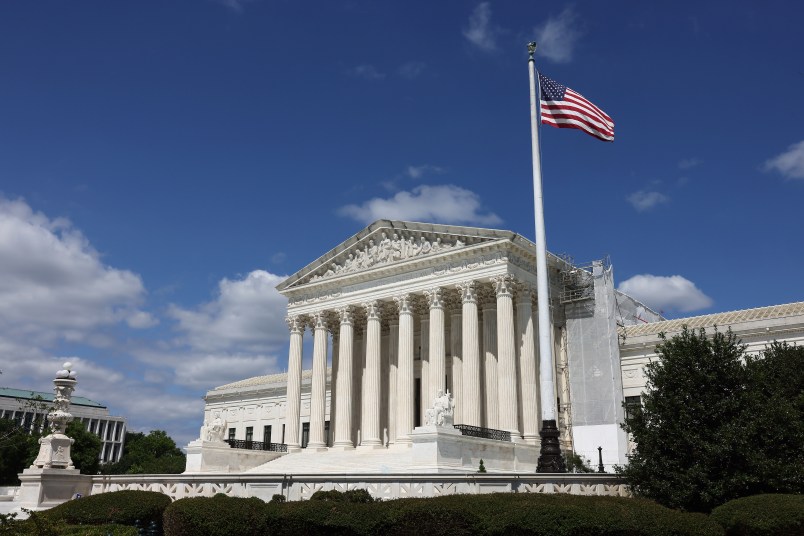
Celebrating That The Supreme Court Meandered Its Way To The Obviously Correct Decision
(Photo by Jemal Countess/Getty Images for Court Accountability)
The Supreme Court did its job this week in FDA v. Alliance for Hippocratic Medicine, the case where anti-abortion doctors attempted to get mifepristone yanked from the market. Cue the ticker-tape parade.
Seriously though — with this Court, often so hellbent on reverse engineering its way into preferred policy outcomes, it was by no means a predetermined conclusion that the justices would find that the anti-abortion plaintiffs obviously lacked standing to bring the suit. The waters were further muddied by the justices’ own actions; they chose to hear the case rather than turning it away on spec; both Justices Samuel Alito and Clarence Thomas would have allowed the 5th Circuit’s decision (which reimposed restrictions on the drug) to stand while the Court considered the case.
But they came out with a unanimous decision, realizing, rightly, that granting standing to doctors who couldn’t prove an injury would throw wide the courthouse doors to lots of other people whose chief complaint is not liking something that someone else is doing.
The Biden campaign scrambled after the decision to remind reporters that the happy outcome of this case does not mean mifepristone is safe. Campaign manager Julie Chavez Rodriguez said on a call that “Trump’s second term agenda threatens women in all 50 states” and that Donald Trump could ban mifepristone without Congress or the courts.
They’re clearly worried that ill-informed complacency could replace the nationwide urgency to beat back abortion restrictions borne from the Dobbs decision (a boon to Democrats). She added that abortion would be a centerpiece of Biden’s debate strategy later this month.
The Biden team may not have to worry; I suspect that the joy over this non-heinous abortion decision will be short-lived. We’re still awaiting the Court’s decision in Moyle v. United States, on whether federal emergency room standards trump state abortion bans. From a legal standard, it’s another easy case: Federal laws preempt state ones. But the right-wing justices sounded determined to decide against the U.S. government at oral argument, getting frustrated as Justice Sonia Sotomayor brought in real-world anecdotes of the suffering letting Idaho’s ban govern emergency care would unleash.
It’s the same Court as ever. They just couldn’t quite stomach an argument so flawed that a 1L would know to decide against it.
— Kate Riga
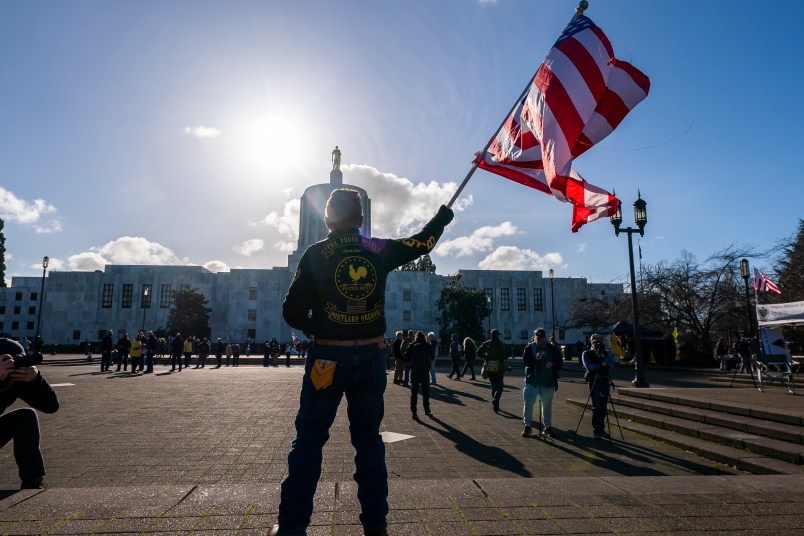
Loud and Proud
(Photo by Nathan Howard/Getty Images)
I wrote this week about the Proud Boys. The group was everywhere during the Trump years, doing battle with his opponents and buttressing his supporters. But at the Trump trial — including on the day of its dramatic end — they were nowhere to be found.
That surprised me. Throughout the trial, Trump had complained that his fans were being blocked from coming to show their support. I was there every day, and saw neither blockage nor a significant number of his supporters. But the Proud Boys struck me as different. During the Trump years they proudly acted as his auxiliaries, claiming to provide “security” for him and his supporters. Why weren’t they there for him at his moment of maximum legal peril?
The answer is that they’re standing back and standing by, avoiding situations that might subject them to further scrutiny from the FBI. In other words, they’re avoiding situations that might cause mass arrests, like the courthouse as Trump’s verdict was announced. It reflects many things: the group’s relative weakness when compared to 2020, for sure, but also a certain canniness. They recognize that they are damaging for Trump; as one chapter put it, the requirement then is not to disband themselves, but to lie low and wait until November to act.
— Josh Kovensky
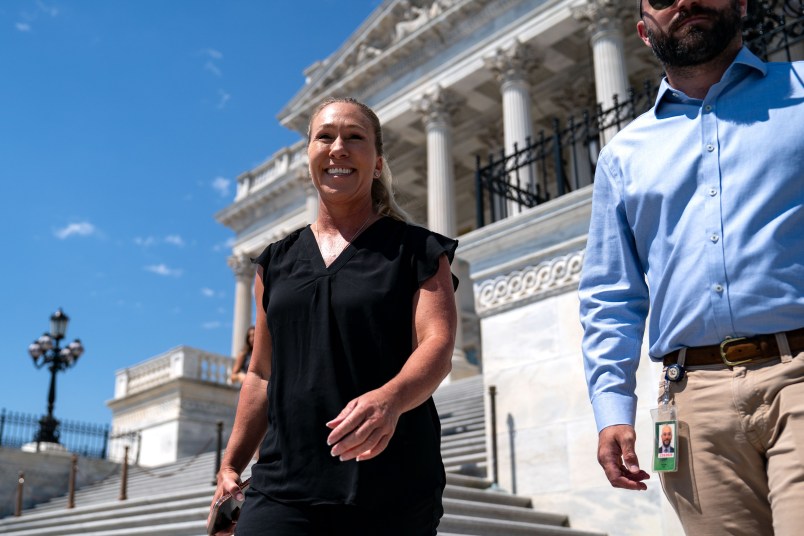
Words Of Wisdom
(Photo by Kent Nishimura/Getty Images)
“If there was an attack on our nation’s capital, Joint Base Andrews would be responding. Are we going to have to sit around and wait for our military members at Joint Base Andrews to charge their electric vehicles to come into the nation’s capital to defend us in case of an attack?”
That’s Rep. Marjorie Taylor Greene (R-GA) speaking on the House floor earlier this week.
The conspiracy theory–loving congresswoman introduced an amendment to the 2025 defense budget Wednesday, trying to withhold funds authorized to the Department of Defense that may be used for electric vehicles or electric vehicle charging infrastructure.
The MAGA hatred for everything electric vehicle is well known but this ridiculous argument is a new one for me…
MTG really seems confused about how electric cars and electronics work in general. Somebody ought to tell her you can charge things ahead of time.
Thankfully House Armed Services Committee Ranking Member Rep. Adam Smith (D-WA) shut it down quickly.
“Let me assure you that as basic readiness they’ll be charged in the same way that the gas tanks are currently full. Okay?” Smith said.
— Emine Yücel
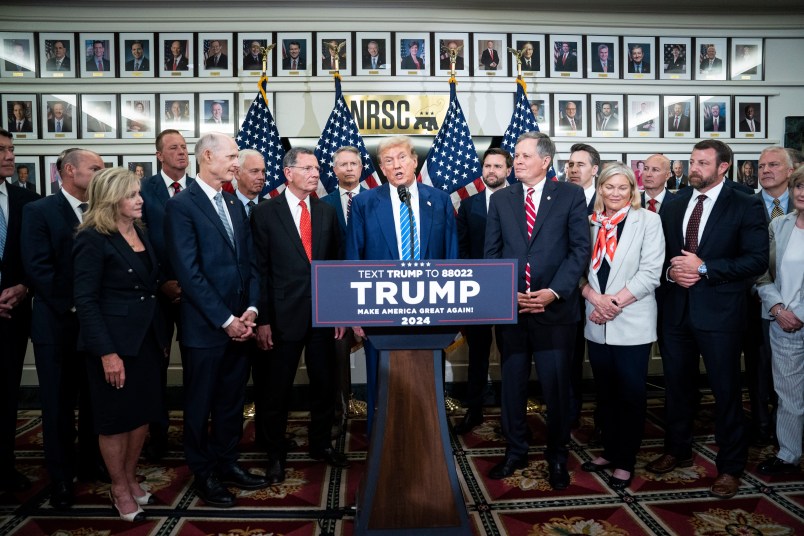
Let Them Eat Cake
(Photo by Jabin Botsford/The Washington Post via Getty Images)
As I exited the metro station this Thursday, I ran straight into a wall of DC’s infamous humidity. That I expected. I did not expect the wall of reporters and cameras that greeted me in front of the Capitol Hill Club.
Former President Donald Trump was on the Hill meeting with Republican lawmakers, but I was not there to cover him: I was tracking Senate Republicans’ efforts to explain why they refused to support the Democrats’ bill to codify in vitro fertilization despite repeatedly claiming they are all for the procedure. I spent most of Thursday debunking one of their go to arguments: that IVF is not under threat at the state level.
After the Trump meeting was over, many of those reporters I had seen earlier swarmed the Senate basement in the hope of getting details on the closed-door meeting.
As I fought my way into the scrums to ask senators about IVF and the bill they were walking up to the Senate floor to vote on, I expected that most of the other reporters would ask instead about the topics of discussion during the Trump meeting. It’s normal, after all, that the press wants to cover what the presumptive GOP nominee said in his first meeting at the Capitol since Jan. 6.
But as senator after senator walked by, reporters were shouting over each other, tripping over the stairs and other members of the press to get their recorders close enough to the conversation to instead ask about mundane details of and how Republican lawmakers kissed the hand.
“Did you sing him happy birthday?”
“Was there cake?”
“What kind of cake did you guys get for the former president?”
Squeezing into the scrums of sometimes more than seven or eight reporters chasing a senator walking down the narrow hallways of the basement connecting the Senate to the senate office buildings, all I heard were those same questions over and over again.
What a scene I thought to myself… Here I was covering a major threat to reproductive rights and I could barely get any question in because everyone else wanted to hear what kind of cake Trump ate.
This weekend we’re going to be doing some very important site maintenance to upgrade our membership system. The site will remain online and our staff will continue to publish, so if there’s any breaking news, you can still count on TPM. However, while this work is going on, you will be unable to log into your account, comment, or access The Hive. Archived member-only content will also be inaccessible.
The work will begin early Saturday morning and may extend into Sunday. We’re sorry for the inconvenience, but this work is critical to the stability and security of the site. Suffice to say it’s extremely important and we thank you for your patience during this process.
A slew of headlines greeted Donald Trump’s return to Capitol Hill yesterday. “Triumphant return” in the words of AP and others, Trump’s “flex” in the words of Axios. Others less generously, including TPM, heralded Trump’s “return to the scene of the crime.” And with Trump, characteristically, there are many crimes to choose from, not just January 6th, his greatest crime, but the fact that this was his first big get together since being convicted of 34 felonies and earning his new first name: “Convicted Felon.” What all seemed to agree on is that it was a “Unity Rally.” But I think there was both more and less to it than that.
First, it was some mix of surprisng and revealing how little of the first round of press coverage noted the very Pyongyang-on-Capitol Hill vibe of these events, right down to the set piece press opportunities with grown men and women from the Senate manically clapping like seals as Trump walks into the room, interviews where they express their hopes that Trump will come and lead them again. Our friend Aaron Rupar really seemed to have his eyes open for this, and he captured it in this video.
Donald Trump’s return to the scene of the Jan. 6 attack that he instigated was a watershed moment in the whitewashing of his failed auto-coup.
Republicans in Congress, many of whom three years ago were running for their lives from the mob Trump unleashed, applauded and celebrated his return in ways that highlighted the party’s cultish, authoritarian turn. It marked a papering over of all the internal divisions and past animosities (which tend to arise when a president of your own party sends over to the Capitol a mob that is intent on hanging his own vice president) in order to rally together to win in November.
All of that is highly newsworthy, of historic significance even.
But the coverage … oh, the coverage.
The AP(!) tweeted this campaign-press-release-quality assessment of the day:
Donald Trump made a triumphant return to Capitol Hill on Thursday, his first with lawmakers since the Jan.6, 2021 attacks, embraced by energized House and Senate Republicans who find themselves reinvigorated by his bid to retake the White House. pic.twitter.com/UqSA7hnz1J
The number of times I've been in scrums today with reporters asking Republicans to recount whether Trump did anything "funny" or "did he tell any jokes" during his meetings with lawmakers. I'm transcribing audio and I've lost count.
Here were are in 2024, and reporters are falling for the same Trump distractions.
Behind closed door, Trump went on a racist rant against Milwaukee, which reporters spent the rest of the day trying to chase down, with lame denials, half-denials, and dodges by various attendees.
Trump randomly floated the idea of replacing income taxes with tariffs, which sent reporters scurrying off in another direction.
It’s not that you can’t cover these things, or shouldn’t cover these things, but how you do it and the self-awareness you bring to it matter … a lot.
How Cultish Was It?
It was so bad that it’s hard to capture.
Rep. Marjorie Taylor Greene (R-GA) gushed like a schoolgirl that Trump was nice to her. Republicans gathered around Trump for photos like the old Soviet Politburo (see the lead photo above).
Aaron Rupar mashed it all together:
here's a supercut of Republicans kissing Trump's ass after meeting with him today. big Dear Leader energy. pic.twitter.com/UjZbeGdCp5
Forced to pick between power and principle, Senate Minority Leader Mitch McConnell stayed true to form.
After the Trump meeting, McConnell touted his handshake with Trump and the multiple standing ovations. “I can’t think of anything to tell you out of it that was negative,” he told reporters.
Former Rep. Liz Cheney (R-WY) was having none of it:
Mitch McConnell knows Trump provoked the violent attack on our Capitol and then “watched television happily” as his mob brutally beat police officers and hunted the Vice President. He knows Trump refused for hours to tell his mob to leave and “even then with police officers… pic.twitter.com/iOiT3E7rbs
>> @julieroginsky: "Ultimately, what Donald Trump is trying to accomplish here is to say 'no big deal.' January 6 was not a big deal…" pic.twitter.com/XhMAsn2WBN
Senate Democrats’ subpoena of billionaire GOP donor Harlan Crow turned up three more previously unreported trips that Supreme Court Justice Clarence Thomas took on Crow’s private jet — in 2017, 2019, and 2021.
Senate Republicans Kill Bill To Protect IVF
Senate Republicans scrambled all week to try to get out from under the gun on IVF, with many of them protesting that they were all for IVF while blocking a Democratic bill that would have protected access to it nationwide.
I know these messaging bills from Democrats can seem like weak tea, but I can’t emphasize enough how effective Republicans are at hoodwinking reporters into buying the latest canard they’re selling, which makes these messaging bills important in providing public clarity. But it requires a press willing to do its job and provide clarity, too. And that’s where things often fall apart.
Republicans want to have it both ways — pro-life! pro-Dobbs! pro-women! pro-fetal-personhood! pro-IVF! But those are inconsistent positions, and it’s up to reporters to sniff that out. It shouldn’t be hard!
Here’s a totally misleading headline from the NYT about the parallel effort by the Southern Baptist Convention to end IVF: How Baptists and the G.O.P. Took Different Paths on I.V.F.
The article buys hook and line and sinker the effort by some Republican elected officials to mollify voters that they’re not opposed to IVF — on the same day that Senate Republicans blocked a bill to protect IVF access.
The crux of the NYT piece on the SBC vote to oppose IVF: “The moment was especially striking given that after the Alabama ruling this year, Republican leaders quickly tried to signal to their base that they supported I.V.F., an extraordinarily popular procedure widely used by Christians and non-Christians alike.”
Yes, the Alabama Supreme Court decision on IVF sent some Republicans scrambling. But fetal personhood has been pushed by Republican legislators across the country for more than a decade. It already is law in some states, and the Alabama decision reinvigorated effort by abortion foes to go after IVF (as well as contraception, as we know).
Republicans are experiencing significant internal strains as the post-Dobbs world imposes real political costs on their long-held anti-abortion views, but it lets them off the hook entirely and takes the pressure off if dancing around the issue is equated with having come to IVF’s defense.
TPM’s Emine Yücel was on the Hill this week and witnessed first-hand GOP senators trying to pretend that IVF wasn’t under threat anywhere and that this was all Democratic fear-mongering. She debunks the notion that IVF isn’t under threat from Republicans across the country.
Even if that were true, the logic is still rather strained: I support IVF but I’m going to block a bill to protect it because all this Democratic fear-mongering needs to come to an end! What?
SCOTUS Lets Abortion Pill Access Continue
The Supreme Court unanimously declined to give abortion foes unprecedented new access to the federal courts and shot down their bid to block access to the abortion pill mifepristone, as TPM’s Kate Riga reports. The court found the anti-abortion plaintiffs lacked standing; finding otherwise would have dramatically rewritten the court’s jurisprudence on standing.
The mifepristone case is one of those that came up through the right-wing-friendly docket of the sole federal judge in Amarillo, Texas: Matthew Kacsmaryk.
Another Right-Wing Judge Doing The Anti-Trans Thing
Another go-to judge for right wing legal advocates has temporarily blocked the Biden administration’s new Title IX rules prohibiting discrimination based on gender identity and sexual orientation.
Terry Doughty, the chief judge of the Western District of Louisiana, ruled that Title IX “was written and intended to protect biological women from discrimination.”
“It is clear in the text of Title IX itself, and in the decades-long impact of Title IX, that its enactment was created to apply to two sexes. There is nothing in the text or history of Title IX indicating that the law was meant to apply to anyone other than biological men and/or women,” Doughty wrote in blocking the rule meant to protect transgender students.
While Conservatives Bemoan Liberal ‘Indoctrination’ …
Louisiana has become the sixth red state to allow controversial videos from “PragerU” into public schools.
Hmmm …
TPM’s Josh Kovensky: Men-Only, Christian-Only Secret Society Gets More Secret
Important
A Texas man has been arrested after threatening to kill a FBI agent working on the Hunter Biden case. To be clear, the threat came this week after Hunter Biden was convicted because the man didn’t think the FBI was doing enough to take down Hunter Biden.
The threats are chilling. Among them: “Did you … really think you were going to disenfranchise 75 million Americans and not die? Lol.”
An Interesting Glimpse Into The House GOP
House GOPers who are less-than-crazy are increasingly frustrated that Speaker Mike Johnson is rewarding the the crazies with plum assignments, like elevating Rep. Scott Perry (R-PA), under investigation for his role in the 2020 election subversion effort, to the intel committee.
Yikes
Sen. John Fetterman (D-PA) is such a bad driver that it has “sparked an informal practice recently instituted in the office that aides should not be in the car when Fetterman is driving, according to one person familiar with the practice,” the WaPo reports.
Insurrectionists Recognize Insurrectionists
192 Republicans just voted to restore a Confederate monument to Arlington National Cemetery, which features a Black 'Mammy' holding a white soldier's baby, and a slave following his master into battle. The effort from Rep. Andrew Clyde R-GA lost 230-192. pic.twitter.com/MwWNOP6WIG
Ed. Note: Nicole Lafond will be back to helming Where Things Stand soon.
Supreme Court Justice Clarence Thomas went up and away into the wild blue yonder aboard billionaire GOP donor Harlan Crow’s private jet three other times that he hasn’t reported on his financial disclosure filings, according to Senate Judiciary Committee Chair Dick Durbin (D-IL).
Durbin’s revelation of the new information about Thomas’ travels came this afternoon, not even 24 hours after Senate Republicans killed a Durbin measure that would have imposed new ethics standards on the Supreme Court.
The demand for greater Supreme Court accountability has ramped up in the months since ProPublica published a Pulitzer Prize-winning series on freebies, gifts, and other financial benefits — including travel — that Crow had bestowed on Thomas but which Thomas had not included in his public financial disclosures.
Just last week, Thomas filed an amended 2019 report that for the first time included the travel that ProPublica had previously reported, a tacit though begrudging acknowledgement by Thomas that he should have included them in the original filing.
The three newly revealed trips announced today by Durbin were not included in Thomas’ amended filing last week.
The three previously unreported trips on Crow’s private jet include:
A May 2017 flight from St. Louis to Kalispell, Montana, with a return flight to Dallas;
A March 2019 round-trip flight between Washington, D.C. and Savannah, Georgia;
A June 2021 round-trip flight between Washington, D.C., and San Jose, California.
Durbin obtained the information about the three flights via a Judiciary Committee subpoena of Crow last November. You can see a portion of the relevant response from Crow’s lawyer here. It’s not clear when the committee obtained Crow’s responses or why Durbin released them today.
In a statement to CBS News, Crow’s office said he had reached an agreement with the committee to provide certain information going back seven years to resolve the matter.
Despite his serious and continued concerns about the legality and necessity of the inquiry, Mr. Crow engaged in good faith negotiations with the Committee from the beginning to resolve the matter. As a condition of this agreement, the Committee agreed to end its probe with respect to Mr. Crow.
Durbin has been a very reluctant warrior on Supreme Court ethics oversight, dismissing as useless the prospect of holding public committee hearings on the court’s ethical lapses and lack of institutional accountability. But Durbin did launch an investigation last fall and has slowly budged in recent days, a result of a combination of outside pressure and a new round of news reports about insurrectionist flags flying outside two of Justice Samuel Alito’s homes.
“The Senate Judiciary Committee’s ongoing investigation into the Supreme Court’s ethical crisis is producing new information — like what we’ve revealed today — and makes it crystal clear that the highest court needs an enforceable code of conduct, because its members continue to choose not to meet the moment,” Durbin said in a press release.
Crow owns a Bombardier Global 5000, ProPublica previously reported. It’s a long-range, twin-engine business jet with a reported range of more than 5,000 nautical miles and cruising speed upwards of 560 m.p.h.
As Senate Republicans sought to explain away why they wouldn’t support the Democrats’ in vitro fertilization bill — an effort to protect and expand nationwide access to fertility treatment, including IVF — they shrugged off the idea that a real threat existed. IVF, they claimed, was certainly not imperiled at the state level.
“I certainly don’t hear that anywhere. I don’t see it anywhere. I’ve never heard anybody ever suggest that,” Sen. Roger Marshall (R-KS), an obstetrician, told TPM on Thursday when asked if he was worried about the possibility of states taking away access to IVF.