Congress’ hemorrhaging of power was stark Saturday morning, as many Americans woke up to the news that President Trump had initiated war with Iran without bothering to preemptively justify the violence, much less seek congressional authorization.
Continue reading “A Congress That Has Made Itself Irrelevant Plays Catch-Up as Trump Unilaterally Pushes US Into War”A Mad King Who Enjoys Watching Things Go Boom
Going … Going … Almost Gone
Take advantage of the special pre-sale offer for Morning Memo readers who aren’t yet TPM members: 40% off an annual TPM membership. The offer lasts until we launch TPM’s annual membership drive this week. Thanks to everyone who is already a member. We can’t do this without you!
Dumb and Illegal
The scale of damage that President Trump could wreak in a second term was always greatest in foreign affairs, where the president’s powers are, generally, most robust and least subject to judicial oversight.
The misadventures on the high seas of the Western Hemisphere, in Venezuela, and now in Iran are just the beginning of what is likely to be more cowboying abroad, as his lame duck status becomes increasingly obvious and his political power at home begins to wane.
The conundrum for Americans opposed to Trump is that while foreign affairs may be the realm in which he sows the most long-term chaos, the best way to rein him in remains in the domestic arena: defending democracy at home in order to preserve the capacity for legitimate regime change here via free and fair elections; defending the rule of the law and the independence of the judiciary; and protecting blue states and marginalized peoples from a weaponized federal government.
With docile GOP majorities controlling both chambers, Congress is willingly surrendering its constitutional and political powers in foreign affairs to a mad king who enjoys pressing buttons and watching things go boom.
Trump’s ever-shifting rationales for the attack neither establish a legal predicate for the U.S.-Israel strike that killed Ayatollah Ali Khamenei nor suggest a coherent strategic vision for relations with Iran, the U.S. role in the region, or the projection of U.S. power in the world. To the extent there was a Trump strategy for regime change, it appears to have overshot its objectives, as it were:
Despite the administration’s effort to construct an ex post facto rationale that a preemptive strike from Iran was imminent, officials told congressional staff that U.S. intelligence did not corroborate that claim and the Pentagon was slow to offer evidence to back up the claim.
The Latest on Iran …
- Kuwait shot down three U.S. fighter jets in a friendly fire incident. All six crew members survived the incident.
- The known death toll among U.S. service members rose to four. While the Pentagon hasn’t confirmed the circumstances, all four deaths appear to have come from an Iranian missile attack on a U.S. facility in Kuwait.
- The death toll in Iran as the U.S. air assault entered its third day reached 555, according to the Iranian Red Crescent Society. The worst single incident appeared to be a strike on a girl’s elementary school in the southern Iran town of Minab that killed at least 175 people.
- The WSJ charts the effect of the decapitation strike on senior figures in the Iranian government.
The Regional Conflagration
The NYT and WaPo have scrambled their respective visual teams to map Iran’s retaliatory strikes in the region.
Pentagon IG Freezes Boat Strikes Review
Faced with a proposed review of military targeting used in the U.S. campaign against suspected drug-smuggling boats on the high seas, Platte B. Moring III, the new Trump-appointed Pentagon inspector general, told staff in a Feb. 11 meeting that he was concerned about the political implications of the review and wanted to consult with Defense Department leadership first, the NYT reports. Since then, Moring hasn’t rejected or approved the proposal, leaving it in limbo.
Pentagon Cuts Ties with Top-Tier Schools
Defense Secretary Pete Hegseth is cutting academic ties between the Pentagon and 13 leading universities in a performative campaign against “wokeness” and alleged anti-Americanism. The disfavored schools, according to a Feb. 27 memo from Hegseth’s office, currently educating are:
- Harvard University
- Saint Louis University
- Massachusetts Institute of Technology
- Tufts University
- Georgetown University
- Carnegie Mellon University
- Brown University
- Columbia University
- Yale University
- Middlebury College
- Princeton University
- The George Washington University
- College of William and Mary
The memo also includes a list of favored schools, which it describes as follows: “These institutions meet the following criteria: intellectual freedom, minimal relationships with adversaries, minimal public expressions in opposition of the Department, and Graduate-level National Security, International Affairs, and/or Public Policy Programs.”
The favored schools include:
- Liberty University
- George Mason University
- Pepperdine University
- The University of Tennessee
- University of Michigan
- University of Nebraska
- Iowa State University
- University of North Carolina
- Clemson University
- Arizona State University
- Baylor University
- University of Florida
- Regent University
- Auburn University
- Hillsdale College
The two-tiered higher-ed system was unveiled the same day Hegseth claimed he’d pressured Scouting America into banning transgender children from participating, a claim the group denied.
Mass Deportation Watch
- Babson College freshman Any Lucia López Belloza — detained en route home to Texas for Thanksgiving and deported to Honduras, where she hadn’t lived since she was a young child — declined to board a government flight to the United States on Friday after ICE threatened in a court filing to deport her again if she returned.
- Four federal judges in the Southern District of West Virginia have suddenly become a firewall against President Donald Trump’s mass deportation agenda, Kyle Cheney reports.
- The Trump DOJ is charging 30 more people in connection with the Jan. 18 protest at a St. Paul church that already led to charges against CNN anchor Don Lemon, who was covering the protest.
The Retribution: ICYMI Edition
The mother of all investigations of the investigators — Miami U.S. Attorney Jason A. Reding Quiñones’ wide-ranging probe of a supposed “grand conspiracy” against Trump — has broadened to include investigating the FBI’s investigation into ties between the 2016 Trump campaign and Russia, the NYT reports.
Elections Are Existential Threat To Trump
Former Obama White House Counsel Bob Bauer, on “the serious possibility that, when the courts are called on—and they will be—to remedy administration actions to interfere with the election, the Trump administration may respond with defiance.”
Judges Under Siege
60 Minutes interviewed 26 federal judges — nine Democratic appointees, 17 Republican, both sitting and retired — about the unprecedented barrage of threats they’ve faced under Trump II:
Hot tips? Juicy scuttlebutt? Keen insights? Let me know. For sensitive information, use the encrypted methods here.
Come Inside the War Room Prepping for SCOTUS to Upend Democracy
For over a decade, no enemy has loomed larger to the Roberts Court than voting protections, especially those for minority groups who have historically been kept away from the polls with laws and violence.
The Court in recent years has raised tests for discrimination to unreachable heights, required voters to employ their own mapmakers, put the responsibility for fixes in the hands of a Congress it knows won’t act, claimed that racism has all but ended anyway.
The groups that fight voter suppression have, under duress, become agile and creative, digging up old statutes under which to challenge voting restrictions when the Court defangs old ones. But that dance became more frantic last June, when the Court ordered that a garden variety case about racial discrimination in Louisiana’s maps be held over to the next term, and posed its own question, one that the litigants were not asking it to decide: Does Section 2 of the Voting Rights Act, one of the only potent remaining parts of the law the Court hasn’t yet hobbled, violate the 14th or 15th Amendments?
The question is almost offensive, that the crown jewel of the Civil Rights movement could violate the Reconstruction Amendments, all bent towards undergirding the embattled rights of Black Americans. But for voting rights advocates, it suggested that the long accumulating storm clouds are set to burst — that the Court is finally ready to fatally weaken or eliminate Section 2, the part of the law used to challenge racially discriminatory gerrymanders. A decision is expected in the coming months.
As they prepare for the blow, groups have mapped out every avenue the Court may go, all knowing that the right-wing majority is unlikely to preserve Section 2 as it is. Section 2, among other things, forbids voting practices which result “in a denial or abridgement of the right of any citizen of the United States to vote on account of race or color.” Advocates have used it routinely when states “crack and pack” minority voters to lessen their vote share by cramming them all into one district or diluting them over many majority-white districts.
The decision could take many forms. A more positive outcome could look like a ruling against the remedies — forbidding judges to order the drawing of additional districts where minority voters compose a majority. Such a decision would leave room for other fixes that could still give minority voters more power in picking the candidate of their choice.
It’d be harder to get around a ruling requiring a new test to prove minority vote dilution. Advocates pointed to Brnovich v. Democratic National Committee, in which Justice Samuel Alito wrote a majority opinion severely narrowing how Section 2 can be used against voter restrictions. One voting rights lawyer told TPM that no one has won a Section 2 vote denial case since Brnovich, and that the Court could hand down a similarly impossible test for racial discrimination in redistricting that makes Section 2 “dead letter.”
Working in the voting rights space means preparing for the worst: that the Court invalidates Section 2 entirely, finding it unconstitutional. Should the Court invalidate Section 2 in full, it would all but end the fight against racial discrimination in redistricting on the federal level.
Litigants have tried in the past to challenge maps under the 14th Amendment’s Equal Protection clause as an alternative to Section 2, but it requires proving that legislators intentionally discriminated when they drew their maps, which is extremely difficult to do. The challenge of proving that a map is contorted on racial grounds, and not merely partisan ones, is due to a) etiquette reasons — judges aren’t fond of labeling legislators racists — b) logistical ones — courts have made it increasingly difficult for plaintiffs to overcome lawmaker immunity to obtain emails and records — and c) American ones — in many parts of the country, race and partisan lean are intertwined, making proving just one without the other very difficult.
In fact, these hurdles are why Congress amended Section 2 in 1982 so that plaintiffs only had to prove that a map had discriminatory effects, not intent. (John Roberts, then working for the Reagan administration, spearheaded the effort to prevent the ‘82 amendments from passing.)
“It’s going to be a challenge to bring federal claims,” Caren Short, director of legal and research for the League of Women Voters, admitted. “Not impossible, but a challenge.”
The Battle Shifts to the States
With federal courts all but shuttered following some of the worse-case-scenario Supreme Court rulings, the fight would shift to the states. Voting rights groups have been a step ahead there, leading the movement to get the states to pass their own Voting Rights Acts. So far, nine states (all blue) have passed them.
These laws are new, and being tested in court for the first time.
They’re not a surefire solution — if the Supreme Court invalidates Section 2 on constitutional grounds, it’s hard to see how the state versions won’t run afoul of the same supposed problem. And the Republican forces that have been attacking the federal Voting Rights Act for decades are likely to come after the state versions with equal verve.
Some states are also attempting other avenues, including using clauses of their constitutions that protect voting to go after gerrymanders. A case challenging a district on those grounds in New York has already reached the Supreme Court.
The Long Game
It’s a sign of how bleak the landscape is for voting rights that every major litigator TPM interviewed pointed to the distant future: 2028, and a possible Democratic trifecta, as the best hope for salvaging the United States’ multiracial democracy.
“We are still working on and moving towards legislation, continuing to perfect and change it based on the realities,” Virginia Kase Solomón, president and CEO of Common Cause, told TPM. “When the time comes, that legislation is ready to go on day one — both the John R. Lewis Voting Rights Advancement Act and For the People Act will be HR1 and HR2,” she added, referring to two pieces of voting rights legislation that did not become law under the last Democratic trifecta due to former Sens. Joe Manchin (D-WV) and Kyrsten Sinema (D-AZ) upholding the Senate filibuster.
Even that legislation may have to be overhauled, depending on where the Court comes down on Callais.
The only lasting solution could push Democrats to a place they’re currently afraid to go: Supreme Court reform itself. Rather than waiting a generation until enough pieces of the right-wing supermajority retire or die, securing voting rights for all Americans might demand Court expansion, enough justices to reverse a maximalist Callais decision, to end the Roberts Court’s crusade.
Prerogative Powers and Presidential Self Care
Another observation on Trump’s attack on Iran. Each of these regime attacks clearly emboldens him. To him, the Venezuelan adventure went great. Where was the blowback — in terms he recognizes? So why not do it again? Sure he hasn’t actually seized Greenland, yet. Beneath the headlines the intensity of European resistance clearly mattered a lot. But this Iran attack almost certainly doesn’t happen without the Venezuela one.
But remember to see this whole escalating series of military adventures in the proper light. Trump is very unpopular and growing more so every day. He now faces what seems close to the certainty of losing at least one House of Congress. As his public support ebbs his power and the power to dominate ebb as well. For Trump that is akin to a psychic death. So, as a matter of psychological balancing and self-care more than strategy, he is leaning heavily into the presidential prerogative powers where his power is most untrammeled, where the loss of political power doesn’t really matter. Almost no presidential power is more clearly in that character as the president’s control over the military. Put simply, he’s leaning into those powers as a matter of psychological compensation.
Trump’s Latest Adventure
Two things occur to me about President Trump’s overnight attack on Iran. The first is one we’ve discussed many times. The issue with this attack or war isn’t just the lack of consultation with Congress or any congressional authorization. The issue is more global: The White House hasn’t given any explanation of why any of this is even happening. This is very much a presidential war in a way we’ve seldom seen before. It’s personal to him. Again, not surprising: I suspect the lack of a public domestic campaign is because it is none of our business. To him, his country, his army. He’s in charge.
The other point is that we’re hearing that the president means to overthrow the Iranian regime. But he’s encouraging the civilian population to rise up and overthrow the government. Those two facts say very different things.
Continue reading “Trump’s Latest Adventure”Trump Officials Attended a Summit of Election Deniers Who Want the President to Take Over the Midterms
This article first appeared at ProPublica.
Several high-ranking federal election officials attended a summit last week at which prominent figures who worked to overturn Donald Trump’s loss in the 2020 election pressed the president to declare a national emergency to take over this year’s midterms.
According to videos, photos and social media posts reviewed by ProPublica, the meeting’s participants included Kurt Olsen, a White House lawyer charged with reinvestigating the 2020 election, and Heather Honey, the Department of Homeland Security official in charge of election integrity. The event was convened by Michael Flynn, Trump’s former national security adviser, and attended by Cleta Mitchell, who directs the Election Integrity Network, a group that has spread false claims about election fraud and noncitizen voting.
Election experts say that the meeting reflects an intensifying push to persuade Trump to take unprecedented actions to affect the vote in November. Courts have largely blocked his efforts to reshape elections through an executive order, and legislation has stalled in Congress that would mandate strict voter ID requirements across the country.
The Washington Post reported Thursday that activists associated with those at the summit have been circulating a draft of an executive order that would ban mail-in ballots and get rid of voting machines as part of a federal takeover. Peter Ticktin, a lawyer who worked on the executive order and had a client at the summit, told ProPublica these actions were “all part of the same effort.”
The summit followed other meetings and discussions between administration officials and activists — many not previously reported — stretching back to at least last fall, according to emails and recordings obtained by ProPublica. The coordination between those inside and outside the government represents a breakdown of crucial guardrails, experts on U.S. elections said.
“The meeting shows that the same people who tried to overturn the 2020 election have only grown better organized and are now embedded in the machinery of government,” said Brendan Fischer, a director at the Campaign Legal Center, a nonpartisan pro-democracy organization. “This creates substantial risk that the administration is laying the groundwork to improperly reshape elections ahead of the midterms or even go against the will of the voters.”
Five of six federal officials who attended the summit didn’t answer questions about the event from ProPublica.
A White House official, speaking on the condition of anonymity, said federal officials’ attendance at the gathering shouldn’t be construed as support for a national emergency declaration and that it was “common practice” for staffers to communicate with outside advocates who want to share policy ideas. The official pointed to comments Trump made to PBS News denying he was considering a national emergency or had read the draft executive order. “Any speculation about policies the administration may or may not undertake is just that — speculation,” the official said.
In the past, Trump has expressed an openness to a federal takeover as a way to stem projected Republican losses in November. This month, he said in an interview with conservative podcaster Dan Bongino that Republicans need “to take over” elections and “to nationalize the voting.”
Mitchell did not respond to questions from ProPublica about the summit. A spokesperson for Flynn responded to detailed questions from ProPublica by disparaging experts who expressed concerns, texting, “LOL ‘EXPERTS.’”
The 30-person roundtable discussion on Feb. 19, at an office building in downtown Washington, D.C., was sponsored by the Gold Institute for International Strategy, a conservative think tank. Afterward, activists and government officials dined together, photos reviewed by ProPublica showed.
Flynn, the institute’s chair, told a social media personality why he’d arranged the event.
“I wanted to bring this group together physically, because most of us have met online” while “fighting battles” in swing states from Arizona to Georgia, Flynn said to Tommy Robinson on the gathering’s sidelines. Robinson posted videos of these interactions online. “The overall theme of this event was to make sure that all of us aren’t operating in our own little bubbles.”
Flynn has repeatedly advocated for Trump to declare a national emergency and posted on social media after the event addressing Trump, “We The People want fair elections and we know there is only one office in the land that can make that happen given the current political environment in the United States.”
In addition to Olsen and Honey, four other federal officials from agencies that will shape the upcoming elections attended the event. At least four of the six attended the dinner.
One is Clay Parikh, a special government employee at the Office of the Director of National Intelligence who’s helping Olsen with the 2020 inquiry. A spokesperson at ODNI said Parikh had attended the summit “in his personal capacity.”
Another, Mac Warner, handled election litigation at the Justice Department. A department spokesperson said that Warner had resigned the day after the event and had not received the required approval from agency ethics officials to participate.
The department “remains committed to upholding the integrity of our electoral system and will continue to prioritize efforts to ensure all elections remain free, fair, and transparent,” the spokesperson said in an email.
A third administration official who attended the summit, Marci McCarthy, directs communications for the nation’s cyber defense agency, which oversees the security of elections infrastructure like voting machines.
Kari Lake, whom Trump appointed as senior adviser to the U.S. Agency for Global Media, was a featured speaker. Lake worked with Olsen and Parikh in her unsuccessful bid to overturn her loss in the 2022 Arizona gubernatorial election.
Lake said in an email that she “showed up to the event, spoke for about 20 minutes about the overall importance of election integrity, a non-partisan issue that matters to all citizens — both in the United States and abroad. I left without listening to any other speeches.”
“Elections should be free from fraud or any other malfeasance that subverts the will of the people,” she added.
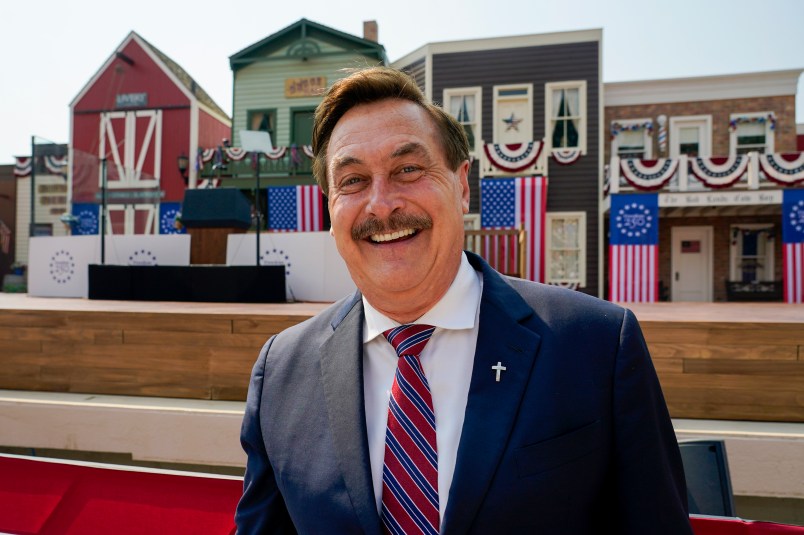
At the meeting, activists presented on ways to transform American elections that would help conservatives, according to social media posts and interviews they gave on conservative media, such as LindellTV, a streaming platform created by the pillow mogul Mike Lindell. They said the group broke down into two camps: those who wanted to pursue a more incremental legal and legislative strategy and those who wanted Trump to declare a national emergency.
Multiple activists left the meeting convinced Trump should do the latter, a step they believe would allow the president to get around the Constitution’s directive that elections should be run by states.
Former Overstock.com CEO Patrick Byrne, a prominent funder of efforts to overturn the 2020 election, told LindellTV that Trump has “played nice” so far in not seizing control of American elections. “But at some point,” Byrne said, “he’s got to do something, the muscular thing: declare a national emergency.”
Byrne responded to questions from ProPublica by sending a screenshot of a poll that he said suggested “2/3 of Americans correctly do not trust” voting machines, which the proposed national emergency declaration aims to do away with.
Will Huff, who has advocated for doing away with voting machines, told a conservative vlogger that Olsen, the White House lawyer, and other administration representatives would take the “consensus” from the gathering back to Trump. “It’s got to be a national emergency,” said Huff, the campaign manager for a Republican candidate for Arkansas secretary of state.
In response to questions from ProPublica, Huff said in an email that Olsen and Trump would use their judgment to decide whether to declare a national emergency.
“The President has been briefed on findings of shortcomings in election infrastructure,” Huff wrote. “I believe there are steady hands around the President wanting to ensure that any action taken is, first, constitutional and legal, but also backed by evidence.”
McCarthy, the cybersecurity official, expressed more general solidarity with fellow attendees in a post on social media about the summit. “Grateful for friendships forged through years of standing shoulder-to-shoulder, united by purpose and conviction,” she wrote. “The mission continues… and so does the fellowship.”
Last week’s gathering was the latest in a string of private interactions between conservative election activists and administration officials, according to emails, documents and recordings obtained by ProPublica. Many have involved Mitchell’s Election Integrity Network. Before taking her government post, Honey was a leader in the Election Integrity Network, ProPublica has reported, as was McCarthy.
Previously unreported emails obtained by ProPublica show that just weeks after Honey started at the Department of Homeland Security, she briefed election activists, a Republican secretary of state and another federal official on a conference call arranged by her former boss, Mitchell.
“We are excited to welcome her on our call this morning to hear about her work for election integrity inside DHS,” Mitchell wrote in an email introducing presenters on the call.
Honey didn’t respond to questions from ProPublica about the call. Experts said Honey’s briefing gave her former employer access that likely would have violated ethics rules in place under previous administrations, including the first Trump administration — though not this one.
The prior “ethics guardrails would have prevented some of the revolving door issues we’re seeing between the election denial movement and the government officials,” said Fischer, the Campaign Legal Center director. Those prior rules “were supposed to prevent former employers and clients from receiving privileged access.”
US Attacks Iran
Immediately giving lie to Vice President JD Vance’s statement earlier this week that there is “no chance” any war with Iran would inspire “a Middle Eastern war for years with no end in sight,” President Trump overnight announced a massive operation in the region and encouraged the Iranian people to overthrow their government amid the attack. Israel and the U.S. have attacked, and Iran has retaliated against Israel and U.S. bases in the region.
Continue reading “US Attacks Iran”Thinking Back to Opportunities Lost While the Supreme Court Menaces the Voting Rights Act
Hello it’s the weekend. This is The Weekender ☕️
As I run by armed National Guard troops gathered at my metro station, look across the river at the potentially soon-to-be-hijacked public golf course on Hains Point, pass the now-lopsided White House, I think about how easily these things could have been avoided.
Continue reading “Thinking Back to Opportunities Lost While the Supreme Court Menaces the Voting Rights Act”Read: The ‘Emergency’ Executive Order Proposal That Trump Activists are Rallying Behind
On Thursday, the Washington Post reported that Trump-aligned activists are pitching the president on a draft executive order that would declare an “emergency,” relying on debunked claims of foreign interference in elections, to order a far-right wish list of changes to how elections are run in America.
That list is far-reaching. It would attempt to revolutionize elections just as President Trump and his allies search for ways to reduce the ease of voting in the run-up to the midterms later this year. Voting by mail would be banned, as would electronic voting machines.
Continue reading “Read: The ‘Emergency’ Executive Order Proposal That Trump Activists are Rallying Behind”Even In Trump Country, State Election Officials Buck DOJ’s Latest Attempt to Seize Voter Rolls
President Trump’s Justice Department is doubling down on its months-long crusade to access sensitive voter information from red and blue states across the country. As it currently stands, the DOJ is suing 30 states — both Republican and Democrat alike — who have refused to succumb to the department’s unprecedented demands for voter roll data.
Continue reading “Even In Trump Country, State Election Officials Buck DOJ’s Latest Attempt to Seize Voter Rolls”